
Reputation Management
Doctors Website SEO That Helps Patients Find Your Clinic Fast

Oct
How Doctors’ Website SEO Helps Patients Find Your Clinic
To help patients find your clinic, start with the searches that lead to appointments. Complete your Google Business Profile, make your site fast on phones, and give each service and location its own useful page. Show who provides care, answer common patient questions with medically reviewed content, and make booking easy. Keep patient details out of marketing trackers and public review replies.
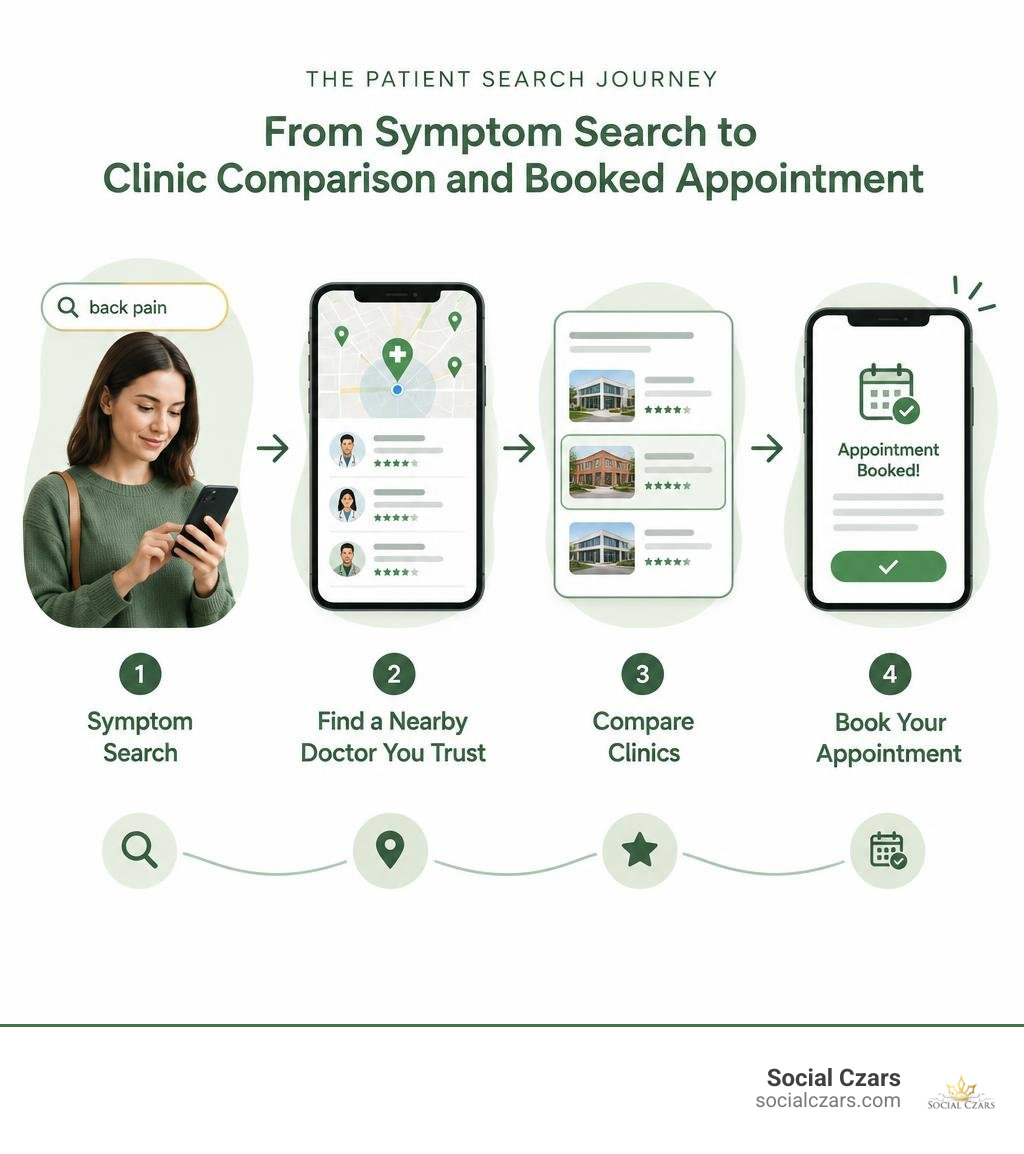
Patients may first search for a symptom, then look for a nearby doctor they trust. Your website needs to help them at both steps. Effective doctors website SEO connects those two moments by making your clinical credentials, local presence, and treatment pages easy for search engines to understand and for patients to act on.
I’m John DeMarchi, founder of Social Czars, where I’ve worked in SEO and online reputation management since 2014. I bring that experience to doctors website SEO, helping practices achieve clear search visibility and build lasting patient trust.
Explore key resources for optimizing your medical practice:
Foundations of Doctors Website SEO: Mastering YMYL and E-E-A-T Architecture
Healthcare searches carry extraordinary stakes. A peer-reviewed analysis of the National Cancer Institute’s Health Information National Trends Survey found that 80% of respondents have used the internet to seek health information for themselves. Because incorrect advice can cause physical harm, Google places healthcare queries under the strictest Your Money or Your Life (YMYL) standards.
To rank reliably, your practice must demonstrate undeniable Experience, Expertise, Authoritativeness, and Trustworthiness (E-E-A-T). Google doesn’t score E-E-A-T as a single metric; instead, its algorithms look for concrete structural signals that verify you are a genuine medical doctor treating real patients.
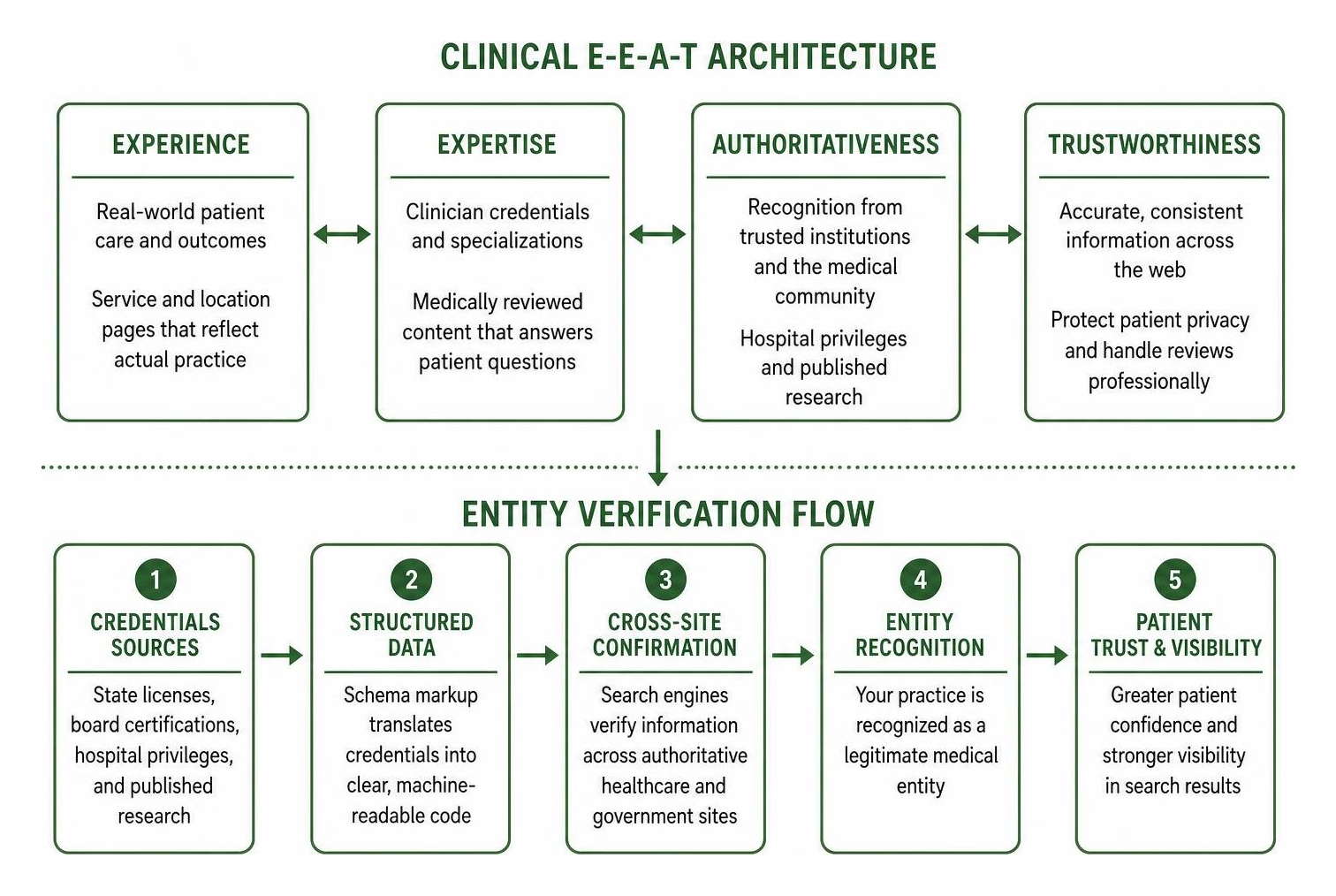
Generic business websites can often get away with anonymous copywriting and lightweight claims. Medical practices cannot. When assessing your digital footprint, search engines cross-examine your clinical credentials, your state licensing profiles, hospital privileges, and published research. Discovering where your site falls short begins with conducting a complete medical SEO audit to pinpoint data discrepancies and missing authority markers.
Connecting Clinical Credentials and Schema Markup for Doctors Website SEO
Structured data (schema markup) translates your human achievements into clean code that search crawlers parse without ambiguity. If you rely solely on standard business schemas, search engines may treat your specialized clinic like a standard retail storefront.
To build an authoritative medical schema stack, we implement:
- Physician Schema: Explicitly identifies each clinician, connecting their full legal name, board certifications, and specialties.
- MedicalBusiness / MedicalClinic Schema: Defines the practice entity, operating hours, accepted insurances, and physical addresses.
- sameAs Properties: Crucial links connecting the provider’s profile to authoritative third-party databases like state licensing boards, NPI registries, and verified health systems.
Connecting these data points ensures search engines know precisely who diagnoses conditions and performs treatments at your facility. Practices looking to resolve technical validation issues can leverage targeted SEO audit services for doctors to fix broken markup hierarchies.
Author Bylines, Medical Review Dates, and Citation Integrity
Thin content written by ghostwriters without clinical oversight no longer survives algorithmic reviews. Every health condition and procedure page must carry a clear clinical byline.
To maintain citation integrity:
- Highlight the Author and Reviewer: State the practitioner’s name, degree (MD, DO, MBBS), and board certification at the top of the article.
- Display Review Timestamps: Include clear “Medically Reviewed On” and “Last Updated” dates to signal clinical freshness.
- Cite Reputable Sources: Ground medical assertions in peer-reviewed literature from PubMed, academic institutions, or established bodies.
- Publish Clear Disclaimers: Clarify that educational material does not replace direct clinical diagnosis.
Local Patient Acquisition: Google Business Profile and Map Pack Dominance
When patients face acute pain or seek a specialist nearby, they rarely scroll past the local map pack. Securing a top-three spot in local map listings is often the single fastest way to drive phone calls and booked appointments.

Your primary Google Business Profile (GBP) category carries immense weight. If you are an orthopedic surgeon specializing in sports medicine, choosing “Orthopedic Surgeon” as your primary category yields far better ranking power than a generic “Medical Clinic” label.
Fill out every available field within your GBP dashboard:
- Use the full 750-character business description to outline clinical specialties.
- List every service and procedure individually.
- Add authentic, high-resolution photography of your clinic, surgical suites, and staff—avoid sterile stock photos that fail to build genuine trust.
- Maintain rigorous Name, Address, and Phone (NAP) consistency across directories.
Practices that post updates, health tips, and clinic news approximately 20 times per month send an unmistakable freshness signal to Google. You can follow our comprehensive playbook for attracting local patients online to turn map impressions into active clinic visits.
Multi-Location Practice Architecture vs. Telehealth Optimization
Operating clinics across multiple cities or offering virtual care requires distinct architectural strategies:
- Physical Clinic Locations: Build unique, standalone landing pages for every physical office. Never duplicate copy across location pages; feature the specific providers who practice at that address, parking directions, local neighborhood cues, and embedded Google Maps alongside dedicated LocalBusiness schema.
- Telehealth Platforms: Telehealth pages do not rely on local neighborhood signals. Instead, build state-specific landing pages tailored to your licensing jurisdictions, using VirtualLocation and medical service schemas to target broad, symptom-based regional queries.
Practices expanding into multiple regions can implement specialized local SEO tactics for dermatologists and clinics to establish clear regional relevance.
Generating HIPAA-Compliant Patient Reviews and Reputation Signals
Online reputation functions as an organic search multiplier. A medical practice with a hundred recent 4.5-star reviews routinely outranks and out-converts a practice with a perfect 5.0 rating based on only six old reviews.
However, gathering reviews requires strict adherence to HIPAA and FTC guidelines:
- Never disclose Protected Health Information (PHI) in review replies. Even confirming that an individual is a patient violates federal privacy standards.
- Use standardized, compliant response templates for negative feedback: “Thank you for your feedback. Due to federal privacy laws, we cannot discuss patient care publicly. Please contact our practice manager directly at our clinic office so we can resolve your concerns.”
- Comply with FTC rules by never gating reviews or incentivizing positive testimonials.
For specialized private clinics, deploying tailored reputation strategies for concierge medical practices helps build steady review velocity safely.
Content Architecture That Converts: Targeting Symptom Queries and Service Pages
Most clinics make the mistake of publishing purely informational health guides that compete directly against giant aggregators like WebMD. A single-physician clinic will rarely outrank massive health portals for broad queries like “what is arthritis.”
Instead, focus your content architecture on symptom-class queries. These searches represent patients transitioning from initial concern to active treatment evaluation. Symptom-class queries convert to booked appointments at 8% to 15% when matched with a dedicated, high-converting landing page.
| Metric / Dimension | Symptom-Class Search Intent | Broad Informational Search Intent |
|---|---|---|
| Example Query | “sharp heel pain when walking in morning” | “causes of foot pain” |
| Searcher Mindset | Actively seeking relief and evaluating care options | High-level research, homework, or general curiosity |
| Conversion to Booking | High (8% – 15%) | Low (< 1%) |
| Primary Competitors | Local clinics, private specialists, regional health systems | WebMD, Healthline, Mayo Clinic, Wikipedia |
| Core Landing Page Goal | Connect symptoms directly to clinic treatments and booking | Provide broad medical definitions and encyclopedic overviews |
To structure your patient acquisition funnel effectively, review the ultimate guide to doctor online marketing strategies.
How High-Converting Service Pages Drive Doctors Website SEO
A high-performing service page is not a 200-word bulleted list of treatments. It is an in-depth clinical guide (typically 800 to 1,500 words) that addresses patient anxieties, outlines procedure steps, explains recovery timelines, and provides clear financial and booking details.
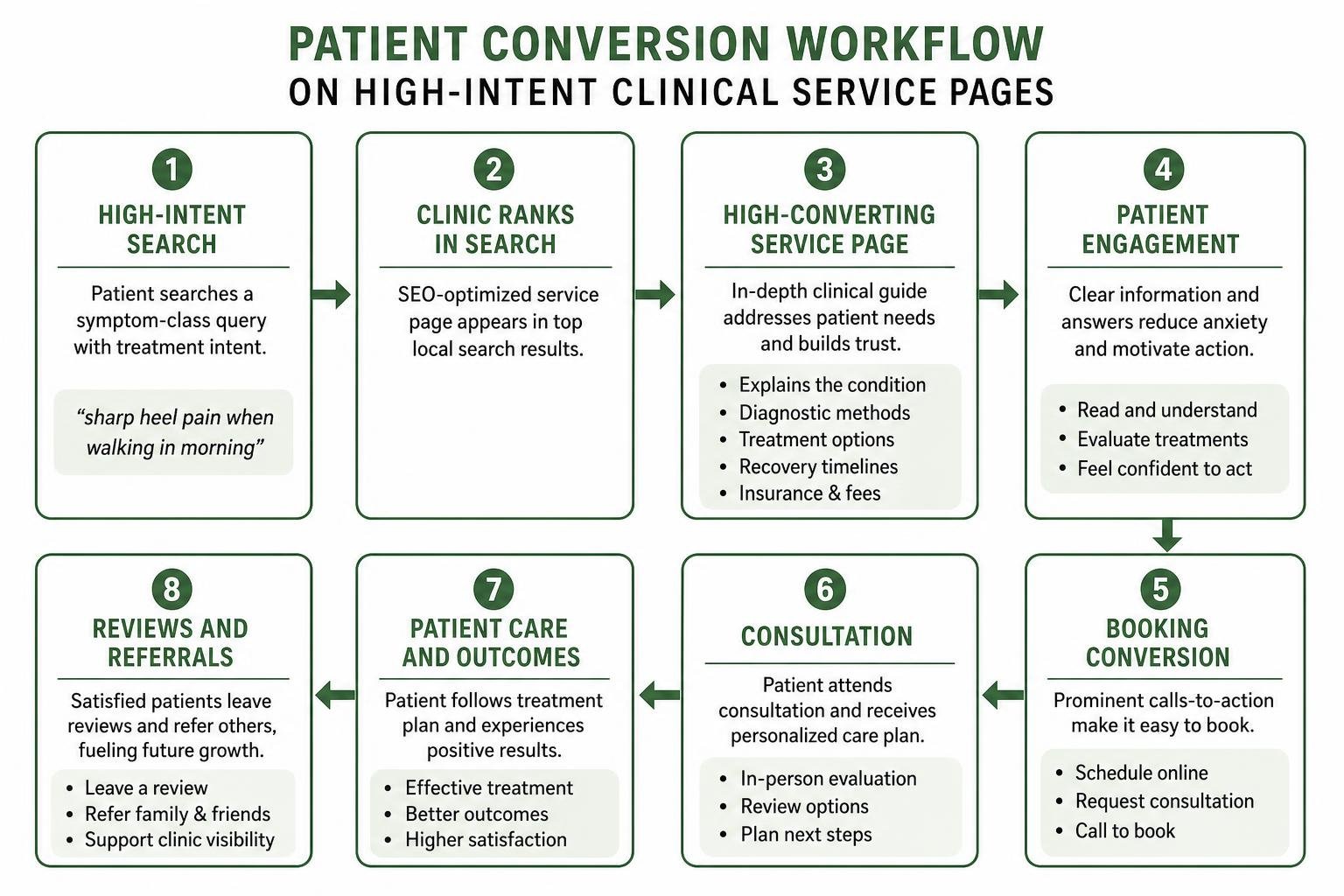
Effective service pages should include:
- A clear explanation of what the condition feels like.
- Diagnostic methods used at your facility.
- Step-by-step walkthroughs of non-surgical and surgical treatment options.
- Transparent insurance and consultation fee information.
- Prominent online scheduling widgets or direct phone click-to-call buttons.
Structuring pages this way ensures patients find your clinic when their search intent is highest, turning search traffic into confirmed calendar bookings.
Optimizing for AI Overviews, Voice Search, and Generative Engines
Search behavior has shifted dramatically with Google AI Overviews and generative tools like ChatGPT. Over 75% of sources cited in ChatGPT health responses stem from established, authoritative institutional databases.
To ensure your clinic is cited and recommended by AI assistants:
- Provide Direct Answers: Place clear, 40-to-60-word conversational summaries directly underneath H2 headings.
- Structure with Clean Headings: Use logical question-and-answer formatting that mirrors how patients speak to voice assistants.
- Note Schema Changes: That FAQ rich results were officially discontinued for standard sites in Google Search as of May 7, 2026. However, structured Q&A content remains vital for generative engines to parse your clinical answers accurately.
To stay ahead of generative algorithms, apply modern GEO strategies for medical practices to earn mentions across conversational AI engines.
Technical Health and HIPAA-Safe Analytics for Medical Sites
A slow or clunky website directly harms patient acquisition. Because the vast majority of local healthcare searches take place on mobile devices, Google indexes the mobile version of your site by default. If your pages take too long to load, potential patients will return to search results and choose a competitor.
Keep your technical foundation solid by addressing Core Web Vitals:
- Largest Contentful Paint (LCP): Keep initial page load under 2.5 seconds by compressing images and eliminating render-blocking scripts.
- Interaction to Next Paint (INP): Ensure interactive elements, such as scheduling menus and forms, respond instantly.
- Cumulative Layout Shift (CLS): Prevent visual jumps as fonts and hero banners load.
Practices seeking end-to-end technical optimization can explore professional SEO services for doctors to maintain peak site health.
Protecting Patient Privacy with Server-Side Tracking and BAA Agreements
Tracking patient conversion funnels requires strict adherence to HHS Office for Civil Rights guidelines. Standard marketing pixels (like third-party social ad trackers or unconfigured Google Analytics) can inadvertently capture IP addresses, URLs containing medical conditions, and appointment selections, transmitting PHI to non-compliant third parties.
To measure conversions safely:
- Remove third-party ad tracking pixels from all clinical, symptom, and appointment booking pages.
- Use server-side tracking environments with privacy filters that strip personal identifiers before data is recorded.
- Partner with HIPAA-compliant analytics providers willing to execute a Business Associate Agreement (BAA).
- Track aggregate metrics—such as total phone calls, appointment clicks, and form submissions—without linking actions to individual medical records.
You can learn more about privacy-first measurement frameworks in our consultant playbook for growing patient volume.
Realistic 90-Day Implementation Timeline and ROI Benchmarks
Medical SEO is an investment that compounds over time. While cold domains starting with no history require 6 to 9 months to establish authority, practices with existing foundation signals typically experience substantial movement within 60 to 90 days.
Practices that execute this structured 90-day plan often see organic appointment bookings double or triple within three months. For clinics generating $1.5M+ in annual revenue, capturing high-intent symptom queries yielding 5 to 50 booked patients per month per page regularly produces a 5x to 12x ROI in year one. You can see how leading institutions structure provider directories on the academic medical center provider search.
Frequently Asked Questions About Medical SEO
How long does it take for a medical practice website to rank and attract patients?
Most established practices begin seeing noticeable ranking improvements and increased patient calls within 2 to 4 months after implementing proper schema, fixing technical errors, and launching dedicated service pages. Highly competitive metropolitan areas or new websites generally take 6 to 9 months for domain authority to compound fully.
What is the difference between practice SEO and individual practitioner SEO?
Practice SEO focuses on the clinic as an organization (the physical facility, operating hours, and overall brand), while individual practitioner SEO highlights the specific medical doctor (their NPI, licensing, board certifications, and specialties). Google guidelines recommend maintaining one GBP for the clinic location and individual practitioner profiles for each doctor seeing patients at that location.
Can medical practices use AI-assisted content for clinical pages?
AI tools can help draft outlines and organize preliminary content, but all clinical claims must be written or reviewed by a qualified healthcare professional. Publishing raw, unverified AI content on YMYL topics risks severe algorithmic penalties and compromises patient trust.
Conclusion
Building a dominant medical website requires a balanced approach: rigorous E-E-A-T credentials, structured schema data, fast mobile performance, and educational symptom pages that guide patients toward care. By executing these fundamentals while safeguarding patient privacy, your clinic can turn search engines into a consistent source of booked appointments.
At Social Czars, we specialize in high-end digital reputation, executive search optimization, and patient acquisition strategies for elite practices. If you operate an aesthetic, surgical, or specialized medical clinic, explore our comprehensive SEO solutions for cosmetic and surgical practices to elevate your practice’s visibility.
