
Reputation Management
How High-Profile Leaders Eliminate Search Engine Defamation for Good

Nov
How to Remove Defamation from Search Engines
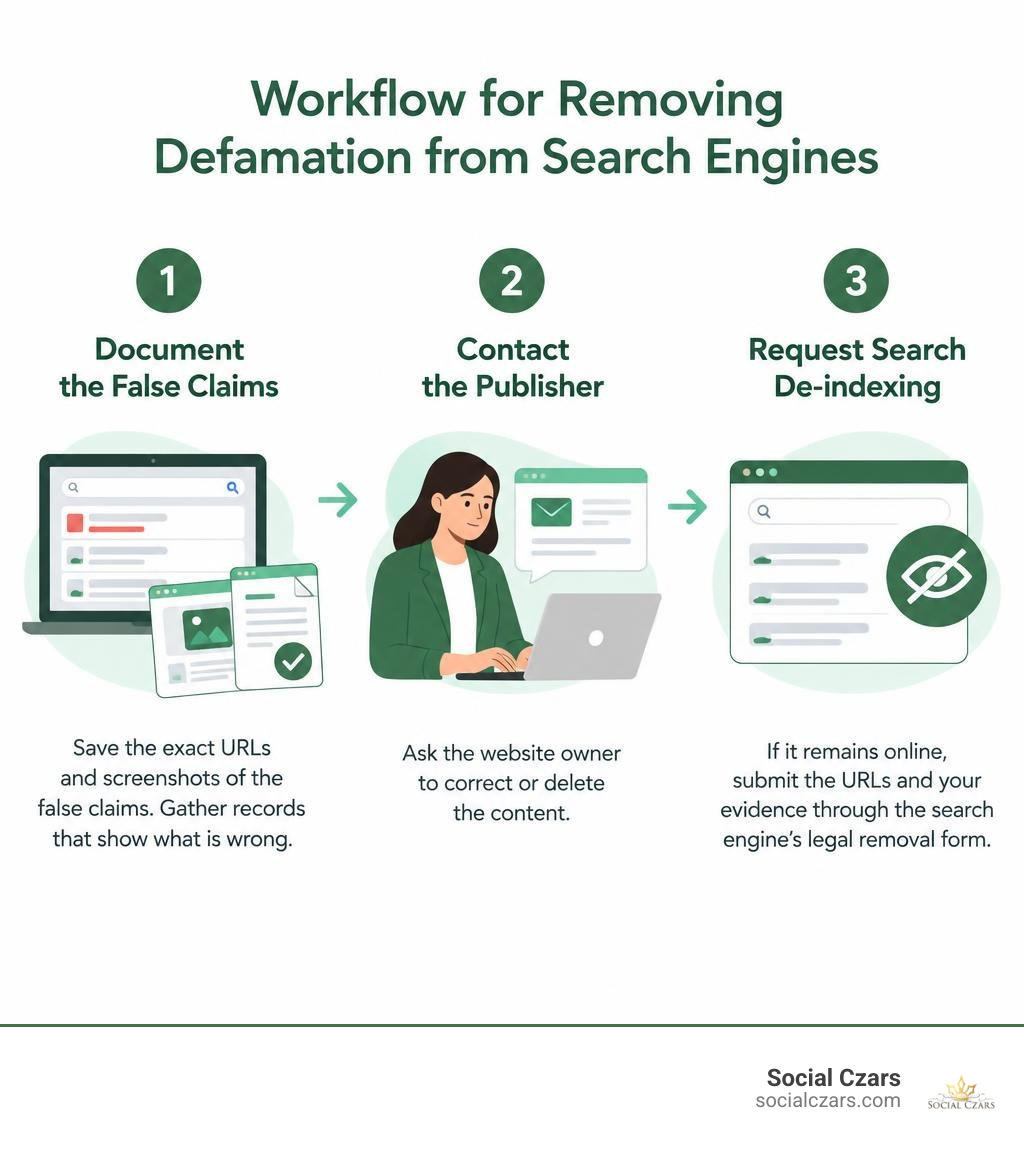
To remove defamation from search engines, first save the exact URLs and screenshots of the false claims. Gather records that show what is wrong, then ask the website owner to correct or delete the content. If it remains online, submit the URLs and your evidence through the search engine’s legal removal form.
De-indexing is not the same as deletion. A removed search result may still exist on the original website. Outcomes also depend on local law and the evidence you can provide, so avoid promises of permanent removal.
I’m John DeMarchi, founder of Social Czars. Since 2014, I’ve helped hundreds of clients with crisis SEO and reputation challenges, including efforts to remove defamation from search engines and limit the reach of harmful results.
Remove defamation from search engines terms at a glance:
- digital marketing executive job description sample
- digital marketing executive work
- required digital marketing executive
Understanding Online Libel and Legal Burdens of Proof
When an executive’s name is smeared online, the fallout is swift. Boardrooms get nervous, stock valuations wobble, and family dinners turn stressful. Navigating the process to clear your name requires understanding what constitutes actionable libel under common law and state statutes across major hubs like New York City, Miami, and Los Angeles.
Defamation is fundamentally a false statement of fact published to a third party that causes reputational harm. If the statement is published in written form online, it is classified as libel. To build an ironclad case for removal, you must substantiate several core legal elements:
- A False Statement of Fact: The statement cannot be a subjective belief or hyperbole; it must be an assertable fact that is demonstrably untrue.
- Publication: The defamatory content was communicated to at least one person other than the subject. Search indexing easily satisfies this condition.
- Fault: The publisher acted with a requisite degree of culpability (either negligence or actual malice).
- Harm / Damages: The publication caused quantifiable financial loss, reputational injury, or emotional distress.
| Plaintiff Category | Required Fault Standard | Burden of Proof | General Threshold for Search Removal |
|---|---|---|---|
| Private Individual | Negligence (failure to exercise reasonable care) | Preponderance of the evidence | Evidentiary proof of falsehood and personal harm |
| Limited-Purpose Public Figure | Actual Malice (regarding specific controversy) | Clear and convincing evidence | High threshold; manifest factual inaccuracy |
| All-Purpose Public Figure / Official | Actual Malice (knowledge of falsity or reckless disregard) | Clear and convincing evidence | Strict scrutiny; judicial order or manifest falsehood |
Distinguishing Actionable Defamation from Protected Opinion
Search engines and courts fiercely protect pure opinion, rhetorical hyperbole, and fair commentary. If an anonymous blogger writes, “I think this CEO is the worst manager in Florida,” that is a protected opinion. However, if that same blogger writes, “This CEO embezzled $2 million from corporate accounts,” that is an assertion of objective fact subject to verification.
When false statements impute criminal conduct, professional incompetence, or loathsome diseases, many jurisdictions treat them as defamation per se. In these cases, harm is presumed by law, eliminating the need to prove specific out-of-pocket financial losses. We dive deep into handling these distinctions in our guide to removing defamatory content from Google, giving leaders a clear path to separate actionable claims from venomous venting.
Public Figure Standards and the Burden of Actual Malice
The landmark Supreme Court precedent in New York Times v. Sullivan altered defamation law by establishing that public officials and figures must meet the “actual malice” standard. Proving actual malice does not mean proving someone was mean-spirited; you must establish that the publisher knew the statement was false or acted with reckless disregard for its truth.
For business leaders, this distinction is critical. If you are thrust into the public eye, publishers gain broader constitutional latitude. However, high-profile status does not grant bad actors blanket immunity to invent lies. High-stakes litigation demonstrates the severe consequences courts impose for manufactured falsehoods. When false accusations attack professional integrity, juries and judges award substantial damages—ranging from economic compensation to millions in punitive and mental anguish awards. Establishing this lack of factual diligence is key to convincing search platform compliance teams that content cannot remain indexed.
Step-by-Step Protocol to Remove Defamation from Search Engines

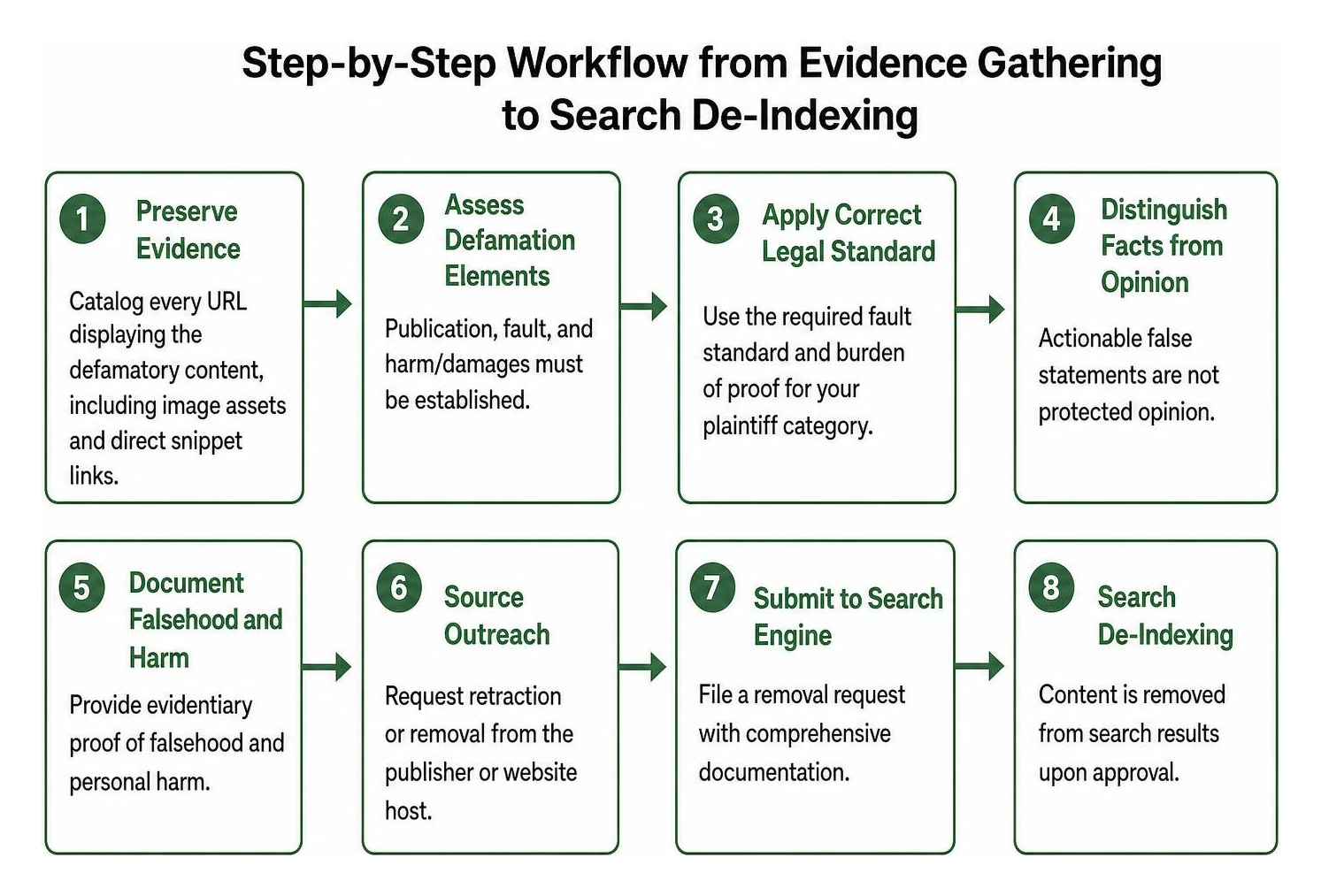
Eliminating defamatory listings demands precision. Rushing into a search engine submission without solid documentation can result in immediate rejection, creating administrative delays that keep harmful search snippets live for months.
Phase 1: Evidence Preservation and Source Outreach
Before alerting the author or web host, preserve a forensic snapshot of the offending webpage:
- Catalog Every URL: Record the exact URLs displaying the defamatory content, including image assets and direct snippet links.
- Capture Timestamped Archives: Take full-page screenshots showing the date, time, and browser URL bar. Utilize third-party digital archive tools to establish an immutable timestamp.
- Identify the Host and Webmaster: Run a WHOIS lookup and DNS check to pinpoint the site owner, domain registrar, and server host.
- Issue a Formal Retraction Demand: Send a concise, legally grounded cease-and-desist or retraction notice to the webmaster. Point out the specific factual inaccuracies and outline potential exposure.
In many instances, professional outreach resolves the issue at the source. If the publisher refuses or remains anonymous, consult our practical guide to negative content removal to evaluate immediate secondary escalation routes.
Phase 2: Submitting Formal Requests to Remove Defamation from Search Engines
When the source publisher is unresponsive or hosting on unmoderated platforms, you must appeal directly to search engine compliance departments. Google, Bing, and other search engines review millions of removal requests daily and rely on structured webforms paired with automated triage systems.
To submit an effective request:
- Navigate to the platform’s official legal removal portal, referencing Google’s official defamation removal criteria.
- Clearly state your jurisdiction and the local statutes governing libel.
- Identify the exact search queries generating the harmful snippet and provide the specific URLs.
- Highlight the precise phrases that constitute manifest factual inaccuracies, explaining why they are false rather than subjective opinion.
- Avoid filing duplicate requests while a review is pending; duplicate submissions reset intake timers and create routing conflicts in automated systems.
Phase 3: How Court Judgments Help Remove Defamation from Search Engines
If administrative notices fail to persuade search compliance teams, securing a judicial order is the definitive way to force de-indexing. Search engines readily comply with signed court orders that declare specific content defamatory.
You can seek injunctive relief, a default judgment (if the anonymous poster fails to appear), or a formal declaratory judgment identifying the text as libelous. Once the judge signs an order mandating the removal of specific URLs, submit the certified document through the search engine’s legal removal gateway. Search engines routinely de-index third-party links named in valid court orders to avoid intermediary liability.
Global Jurisdictions, De-Indexing, and the Right to Be Forgotten

The legal mechanics of de-indexing vary drastically across borders. While United States platforms operate under strong First Amendment protections and Section 230 safe harbors, European and Canadian courts enforce stricter obligations on search engines once put on formal notice.
European and Canadian Precedents: CJEU and Québec Standards
In the European Union, the Right to be Forgotten is codified under Article 17 of the General Data Protection Regulation (GDPR), supported by regional statutes like Spain’s LOPDgdd (Articles 93 and 94). The Court of Justice of the European Union (CJEU) established a vital standard for online reputation: search engine operators must de-reference links when a requester proves the hosted claims are manifestly inaccurate. Crucially, the CJEU held that an individual does not need to obtain a prior court judgment against the original publisher to exercise this right, as detailed in recent analyses of CJEU right-to-be-forgotten rulings on inaccurate information.
Across the Atlantic, Canadian jurisprudence has created significant accountability for intermediaries. Under Québec’s Act to establish the legal framework for information technology (AELFIT), platforms that become aware of unlawful content and fail to act swiftly risk direct civil liability. The legal impact of these duties is explored in depth in analyses of the Québec Superior Court ruling in A.B. v. Google, where substantial damages were awarded after the search engine failed to de-index defamatory materials despite repeated formal notices.
The Limitations of Geoblocking and Technical De-Indexing
A common industry pitfall is assuming that a successful de-indexing order removes content worldwide. In practice, search engines often apply territorial delisting (geoblocking):
- Regional Visibility: Content de-indexed under European GDPR or UK privacy rules may vanish from searches conducted inside those territories but remain visible to users searching from the US.
- VPN Bypass: Anyone routing their connection through an external proxy or foreign IP can view the unedited search results.
- Source Persistence: De-indexing removes the gateway, not the source file. The content remains live on its original server, accessible via direct URL, dark-web scrapers, and alternative search indexes.
Beyond Takedowns: Comprehensive Search Engine Suppression and Defense
Legal removals can take weeks or months. During an active reputation crisis, executive teams must deploy proactive SEO measures to control what stakeholders see on Page One. The most dependable defense is burying hostile listings beneath authoritative, high-ranking digital assets.
Our team at Social Czars engineers high-authority digital ecosystems to displace rogue URLs. By publishing optimized biographical hubs, claimed Google Knowledge Panels, media features, and verified corporate assets, we push damaging content off the first page of search results. Implementing proven negative content suppression strategies ensures your narrative dominates the SERP, creating an impenetrable moat that protects your personal brand against future attacks. When executed alongside targeted efforts to push down negative search results, suppression offers both immediate relief and long-term brand equity.
Frequently Asked Questions About Removing Defamatory Search Results
Can Google be held financially liable for failing to de-index defamatory links?
In the United States, Section 230 of the Communications Decency Act generally shields search engines from publisher liability for third-party content. However, international jurisdictions increasingly reject blanket immunity. Courts operating under frameworks like Québec’s AELFIT have held search engines directly liable for significant financial damages when they refuse to act on clear, substantiated notices of illicit content.
Do I need a court order to de-index manifestly inaccurate content?
Not in every jurisdiction. Under EU law (GDPR Article 17) and CJEU precedents, search engines must process de-referencing requests if you provide sufficient, relevant evidence showing that factual assertions are manifestly inaccurate. In the US, search engines evaluate defamation complaints under voluntary terms of service, but obtaining a formal judicial order remains the most reliable method to compel permanent de-indexing across American search results.
What is the difference between content deletion and search de-referencing?
Content deletion occurs when a webmaster or server host permanently purges the text, images, or database records from the host website, rendering the URL dead (404 Not Found). Search de-referencing (or de-indexing) simply removes the URL from a search engine’s index. The webpage stays live on the host server, but search engines will no longer display it in user search queries.
Conclusion
Protecting your executive reputation from defamatory online attacks requires a coordinated strategy combining strict legal documentation, search compliance fluency, and advanced search engine optimization.
At Social Czars, we specialize in rapid negative content removal and comprehensive brand defense for high-profile leaders, VIPs, and corporate executives across New York City, Miami, Los Angeles, and London. If online falsehoods are impacting your executive presence, contact us today to explore our executive digital marketing solutions and take absolute control of your digital narrative.
