
Reputation Management
What You Should Expect When Partnering with Top Attorney SEO Companies

Nov
How to Compare Attorney SEO Companies
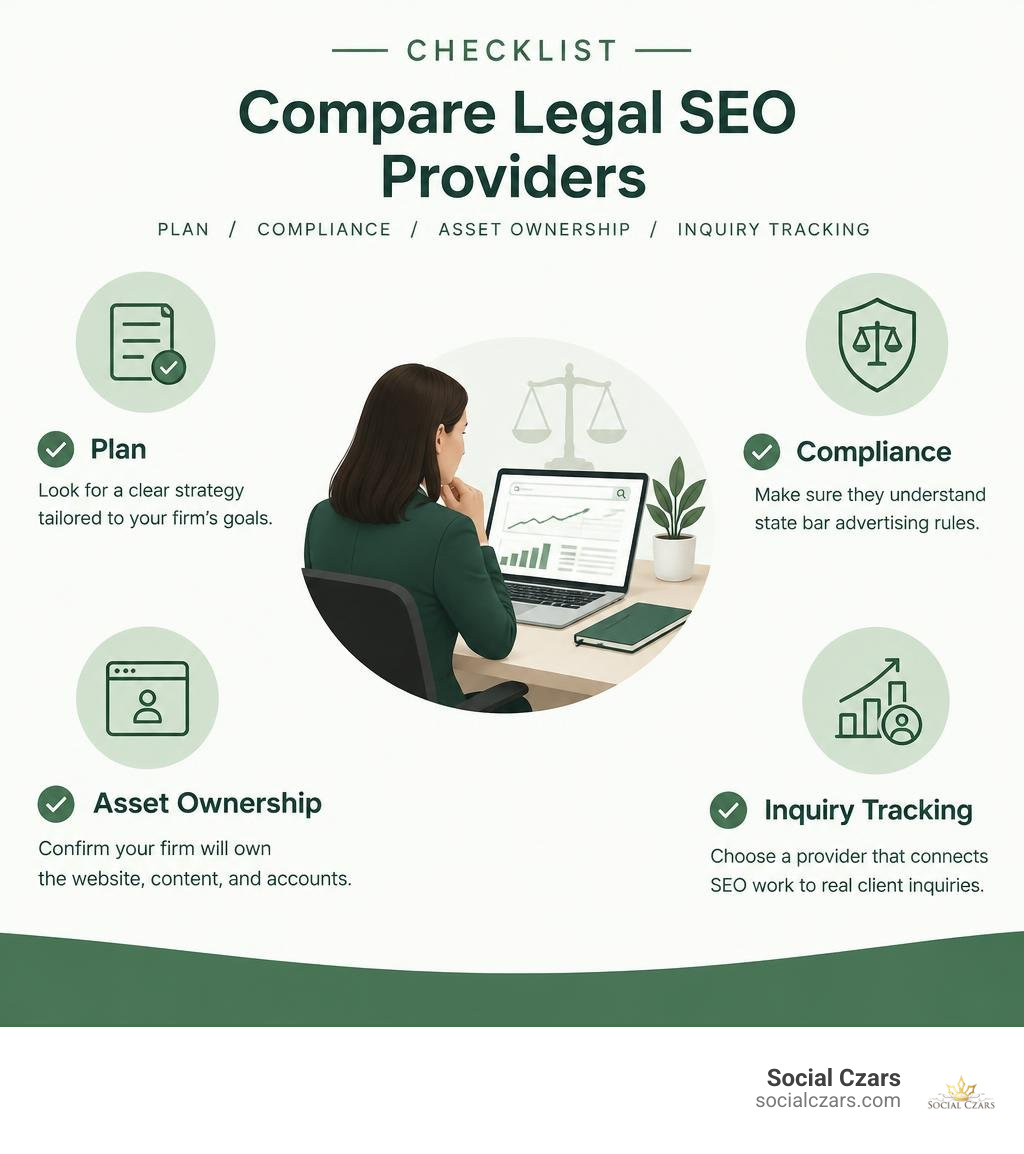
The best way to compare attorney seo companies is to ask for a clear plan, proof of work, and a way to track qualified inquiries. Check that your firm will own its website, content, and accounts. Ask how the provider handles state bar advertising rules, and walk away from guaranteed rankings.
The right partner depends on your problem. A firm that gets traffic but few calls needs a different plan from one that rarely appears in search. Before signing, ask to see a sample report that connects search work to actual client inquiries.
I’m John DeMarchi, founder of Social Czars, where I’ve worked on crisis SEO and search reputation for executives and high-profile clients since 2014. I bring that focus on visibility and accountability to this guide to attorney seo companies.
Attorney seo companies terms simplified:
Introduction
Standing out online has never been more difficult for legal practitioners. With 463,600 law firms operating across the United States and the sector expanding at an average rate of 1.8% each year, market saturation is a daily reality. The days when a basic directory listing or traditional referral network could keep an attorney’s calendar full are behind us.
Today, searching online and exploring a lawyer’s website represent the primary avenues consumers use when shopping for legal representation. Even corporate buyers—who direct roughly 60% of their legal budgets to outside counsel across dozens of external firms—increasingly rely on digital proof points to validate credentials before awarding retainers.

When attorneys look at search marketing, they quickly realize that general agency tactics fall flat. Achieving sustainable organic growth requires an understanding of practice-area nuances, stringent compliance requirements, and technical precision.
What Top Attorney SEO Companies Do Differently for Legal Practices
Legal marketing operates under strict parameters. Unlike an e-commerce brand selling consumer goods, a law firm operates under the watchful eye of state bar regulators and rigorous search engine quality evaluations. Top-tier search partners understand that legal websites fall directly under Google’s “Your Money or Your Life” (YMYL) content classification.

Because a user’s choice of legal counsel impacts their finances, freedom, and well-being, search algorithms demand exceptional Experience, Expertise, Authoritativeness, and Trustworthiness (E-E-A-T). Every page must reflect genuine legal depth, clear authorship, and transparent credentials. Implementing a strategic legal search optimization program means aligning every digital asset with these exacting standards.
Simultaneously, marketing must strictly adhere to state-specific bar ethics standards, such as those informed by the American Bar Association’s Rule 7.2: Communications Concerning a Lawyer’s Services: Specific Rules. Reputable agencies do not make misleading claims, guarantee case outcomes, or publish unauthorized client endorsements. They weave compliance directly into their editorial workflows.
Core Service Models Offered by Attorney SEO Companies
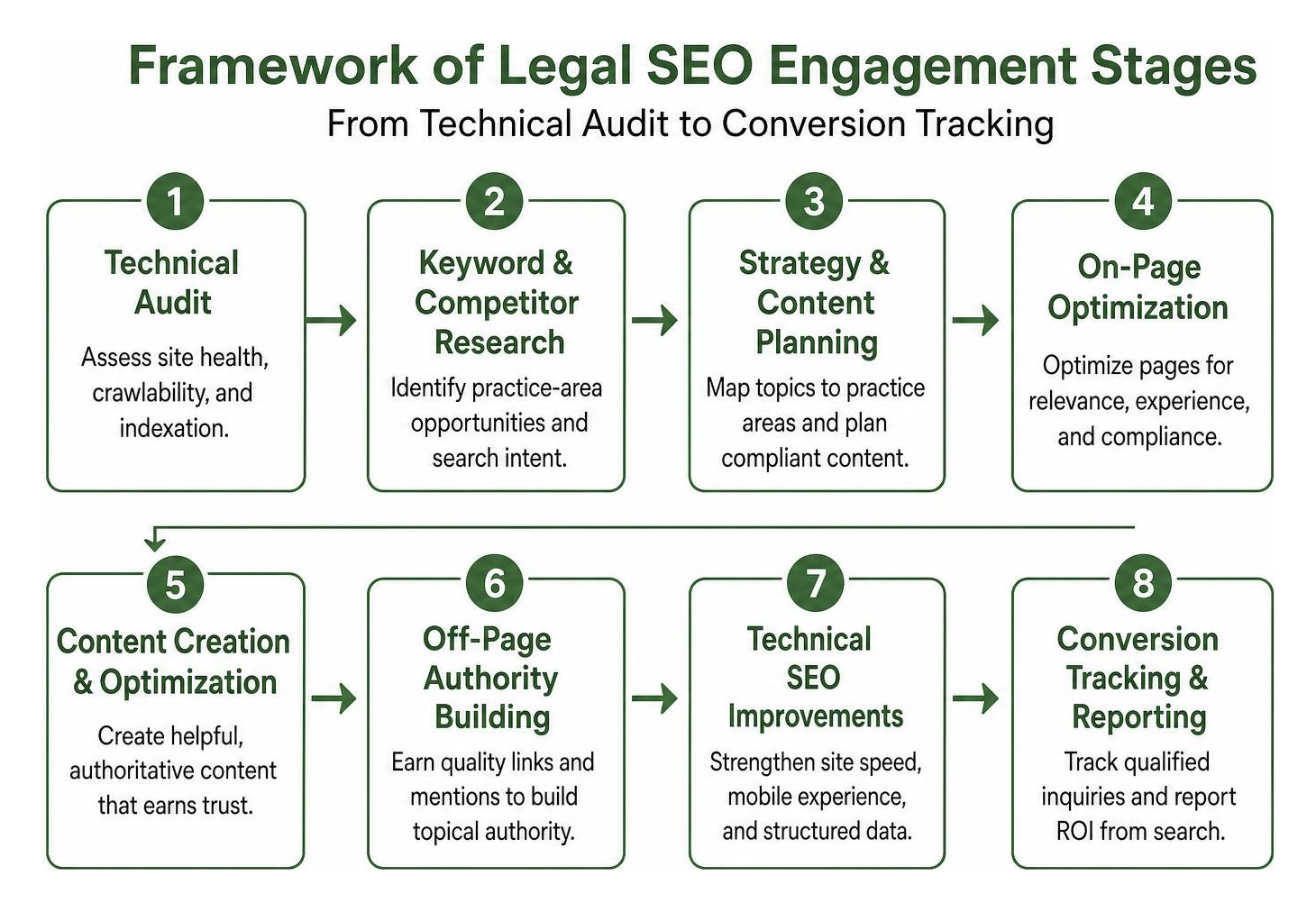
Specialized agencies provide a comprehensive suite of services tailored to how prospective clients search:
- Technical Site Audits: Correcting crawl errors, structuring clean URL hierarchies, implementing schema markup (e.g.,
LegalServiceandAttorneyschemas), and maximizing mobile page speed. - Practice-Area Keyword Research: Identifying high-intent search phrases that indicate immediate legal need rather than generic informational queries.
- Authoritative Practice Content: Crafting thoroughly researched legal pages that inform potential clients while establishing direct E-E-A-T signals.
- Local Map Pack Optimization: Fine-tuning Google Business Profiles, managing local citations, and building localized relevance so your firm dominates high-converting “near me” searches. Solo and boutique practices often thrive by optimizing search presence for small legal practices to capture local neighborhood queries.
- Digital PR and Link Acquisition: Earning high-authority backlinks from reputable legal journals, bar associations, and news publications rather than purchasing toxic spam links.
How Attorney SEO Companies Measure ROI and AI Search Visibility
A vanity metric like raw page impressions means nothing if your phones are not ringing. Modern legal agencies utilize server-side lead tracking to monitor forms directly from your website backend, attributing every call, intake form, and consultation request to its precise organic search origin.
Furthermore, search visibility has expanded into conversational artificial intelligence. Today’s potential clients use tools like ChatGPT and Google Gemini to find counsel. Elite search providers track brand citations across AI answer engines, ensuring your practice is surfaced when prospective clients query large language models for top legal representation.
Real Service Delivery Models: Agencies, Platforms, and In-House Execution
Law firms have distinct options for executing organic search campaigns. Choosing the right path requires understanding the trade-offs between speed, cost, and hands-on effort.
| Service Model | Ideal Law Firm Profile | Primary Strengths | Potential Drawbacks |
|---|---|---|---|
| Full-Service Legal Agency | Growth-oriented firms, competitive practice areas | Turnkey execution, deep technical expertise, dedicated account teams | Higher monthly investment |
| AI SEO Platform / Software | In-house legal marketers, tech-savvy solo attorneys | Automated audits, citation management, lower recurring cost | Requires hands-on execution and strategy |
| Boutique Legal SEO Consultant | Selective boutique practices, custom project scopes | Direct access to senior strategists, bespoke attention | Limited bandwidth for massive content production |
| DIY (In-House Execution) | Brand-new solo practices with minimal starting capital | Complete control over operations, lowest monetary expense | Consumes valuable billable hours, steep learning curve |
Choosing between these paths often comes down to internal capacity. Firms that want dedicated strategic oversight often find success by hiring a dedicated legal SEO consultant to steer high-level strategy while their internal teams manage intake.
Full-Service Legal Marketing Agencies
Full-service agencies deliver end-to-end campaign execution. They handle everything from server optimizations to high-level content governance and PR outreach. For highly competitive niches, such as executing specialized SEO for criminal defense attorneys, a full-service team provides the specialized resources required to outperform aggressive local competitors in major metropolitan markets.
AI-Powered SEO Software and Platform Solutions
Software platforms provide self-directed workflows, automated citation distribution, schema generation, and real-time rank tracking dashboards. While these tools save time on repetitive technical tasks, they do not replace legal content writing or ethical compliance reviews. They serve best as an operational toolkit for firms with an internal marketing manager.
In-House Marketing and Hybrid Agency Support
In a hybrid model, an internal marketing coordinator manages local community outreach and intake, while an outside agency handles technical SEO, strategic link building, and complex search reputation management. This hybrid approach is especially valuable when addressing reputation crises and search suppressions, ensuring that sensitive brand challenges are handled by senior specialists while everyday intake runs uninterrupted.
How to Vet Legal SEO Providers and Avoid Critical Red Flags
Hiring a marketing partner should not feel like an adversarial deposition. Unfortunately, the agency landscape contains providers that rely on opaque reporting and restrictive contracts.
Knowing how to evaluate SEO vendors without getting ripped off protects your firm’s capital and online authority. Watch out for these standard red flags:
- Guaranteed Number-One Rankings: No agency has an exclusive arrangement with Google. Guaranteeing a specific organic position is a major warning sign.
- Account Lock-In & Proprietary Platforms: If an agency insists on building your site on their closed CMS or refuses to give you administrative access to your Google Business Profile and Analytics accounts, walk away. If you leave, they can hold your digital presence hostage.
- Vague Reporting on Vanity Metrics: Monthly reports focused solely on “impressions” without tracking form submissions, phone calls, and case inquiries usually conceal a lack of tangible results.
Crucial Questions to Ask Before Signing an Agreement
Before entering into an engagement, ensure you have clear, written answers to these essential questions:
- Do we retain complete ownership of our domain, website design, content, and Google accounts if we part ways?
- Who is directly responsible for performing the technical work and writing our practice-area content each week?
- Can you provide a redacted, real-client monthly report demonstrating how you tie organic traffic to qualified intake calls?
- How do your retainers align with industry standards? Gaining a clear perspective on understanding retainer rates and law firm SEO pricing ensures you receive fair value for dedicated labor.
Ethical Compliance and Review Management Guardrails
Your digital presence must uphold the integrity of your practice. Unethical vendors sometimes deploy automated review posting or cut corners with synthetic endorsements.
Falsifying reviews violates Federal Trade Commission guidelines and state bar advertising rules. Top agencies establish automated, ethical review solicitation systems that encourage authentic feedback from satisfied clients while remaining fully compliant with all governing standards.
Choosing the Right Partnership Model for Your Law Firm’s Growth Stage
Every law firm has unique commercial objectives. Aligning your marketing model with your practice maturity ensures your budget generates tangible returns:
- Solo Practitioners & New Launches: Focus your budget on local map pack visibility, a clean, fast-loading website, and optimized core practice pages.
- Established Boutique Firms: Invest in authoritative content marketing, technical search auditing, and high-tier digital PR to establish dominance across your primary practice areas.
- Multi-Location & High-Value Litigation Practices: Require dedicated, comprehensive agency partnerships capable of scaling content architectures across multiple jurisdictions while actively monitoring brand authority across conversational AI engines.
If your firm is currently investing in marketing, take time for evaluating if your current law firm SEO is working by assessing your intake numbers rather than relying solely on agency-provided ranking screenshots.
Frequently Asked Questions About Hiring Attorney SEO Providers
How long does it take for legal SEO to generate qualified client inquiries?
Search optimization is an asset-building process rather than an overnight switch. In moderately competitive practice areas, firms generally observe meaningful indexation gains and early inquiries within 3 to 6 months. Highly competitive metropolitan markets—such as personal injury in major cities—often require 6 to 12 months of consistent technical refinement and authority building to achieve top-tier visibility.
Can an agency post reviews or client testimonials on my firm’s behalf?
No. An agency should never author or publish reviews on your firm’s behalf. Doing so violates state bar ethics rules and FTC consumer protection regulations. Instead, a qualified provider will implement compliant, automated software that streamlines how your actual clients submit genuine feedback directly to your public profiles.
How should a law firm decide between DIY search optimization and hiring an agency?
The choice comes down to opportunity cost. If an attorney’s billable rate is $400 per hour, spending 15 hours a month troubleshooting technical site issues, writing blog content, and building citations represents $6,000 in lost billable capacity. If your caseload permits the time investment and funds are tight, DIY is a viable starting point; otherwise, partnering with a dedicated agency is more cost-effective.
Conclusion: Building a High-Performance Organic Client Pipeline
Winning prospective clients through organic search requires strategic clarity, ethical compliance, and verifiable reporting. When evaluating potential partners, focus on accountability: clear asset ownership, transparent monthly deliverables, and lead tracking that connects directly to client consultations.
At Social Czars, we specialize in high-end search optimization and rapid reputation defense for an exclusive clientele. When you are ready to secure enduring search authority, partner with elite SEO specialists for high-impact search performance and build an organic client pipeline that drives consistent growth.
