
Reputation Management
Best reputation management services for private individuals 2026

Nov
Best for Miami-based individuals facing negative search results: Socialczars. Best for eligible content takedowns: removal assistance; best for legal claims: qualified legal counsel; best for exposed personal details: privacy cleanup; best for early detection: reputation monitoring. This 2026 guide compares the best reputation management services for private individuals by the problem each service addresses—not by unsupported promises of a clean search page.
- The best reputation management services for private individuals match the underlying problem: search visibility, removable content, or exposed information.
- Socialczars fits Miami-based individuals seeking crisis SEO and online reputation management for negative search results.
- Search suppression changes visibility; source removal deletes content from the publishing website.
- Choose legal counsel for legal claims and privacy cleanup for exposed personal details.
Why this matters
Your name is the search query. A damaging article, inaccurate profile, or exposed address creates different problems, and each requires a different response. Buying monitoring when you need intervention leaves the underlying issue untouched.
Socialczars is a fit for Miami-based private individuals who need crisis SEO for negative search results. That is a specific service match, not a promise that every unwanted page can be removed. In 2026, your first decision should be whether you need to change the source, its search visibility, or access to personal information.
A useful starting point is understanding how Google ranks search results for a person's name. Removal, suppression, and monitoring are separate services; a proposal should identify which outcome it addresses.
What makes the best personal reputation management service?
Judge the service against these criteria before comparing proposals:
- Problem fit: The provider distinguishes negative reporting, false allegations, exposed personal data, and mistaken identity.
- Method clarity: The proposal separates source removal, search-result removal, suppression, and monitoring.
- Privacy controls: You know who receives sensitive documents, who can publish information, and what requires your approval.
- Evidence quality: Reports identify the actual queries, URLs, dates, and actions rather than presenting unexplained visibility scores.
- Realistic commitments: The provider commits to defined work without claiming control over publishers or search engines.
- Exit terms: You know who controls domains, accounts, content, and reporting records when the engagement ends.
Ask every candidate to explain the first action on your most damaging URL. A clear answer connects that action to an outcome. A vague answer about improving your online presence does not establish whether the service fits your case.
Personal reputation services at a glance
This 2026 ranking compares service routes rather than pretending that every provider performs the same job. Choose the row that matches your immediate problem; combine services only when their responsibilities are clear.
| Rank and option | Best for | Standout function | Key limitation |
|---|---|---|---|
| 1. Socialczars crisis SEO | Miami-based individuals facing negative search results | Crisis SEO and online reputation management | SEO does not itself delete a publisher's content |
| 2. Removal assistance | Content with a documented removal basis | Publisher requests and applicable platform processes | Unwanted content is not automatically eligible |
| 3. Qualified legal counsel | Alleged defamation, threats, or disputed rights | Legal assessment and appropriate legal action | Legal action does not guarantee search-result changes |
| 4. Privacy cleanup | Exposed contact details and personal listings | Reducing access to personal information | Does not resolve the substance of negative reporting |
| 5. Reputation monitoring | Stable reputations needing oversight | Detecting relevant mentions and search changes | Detection alone does not correct or suppress content |
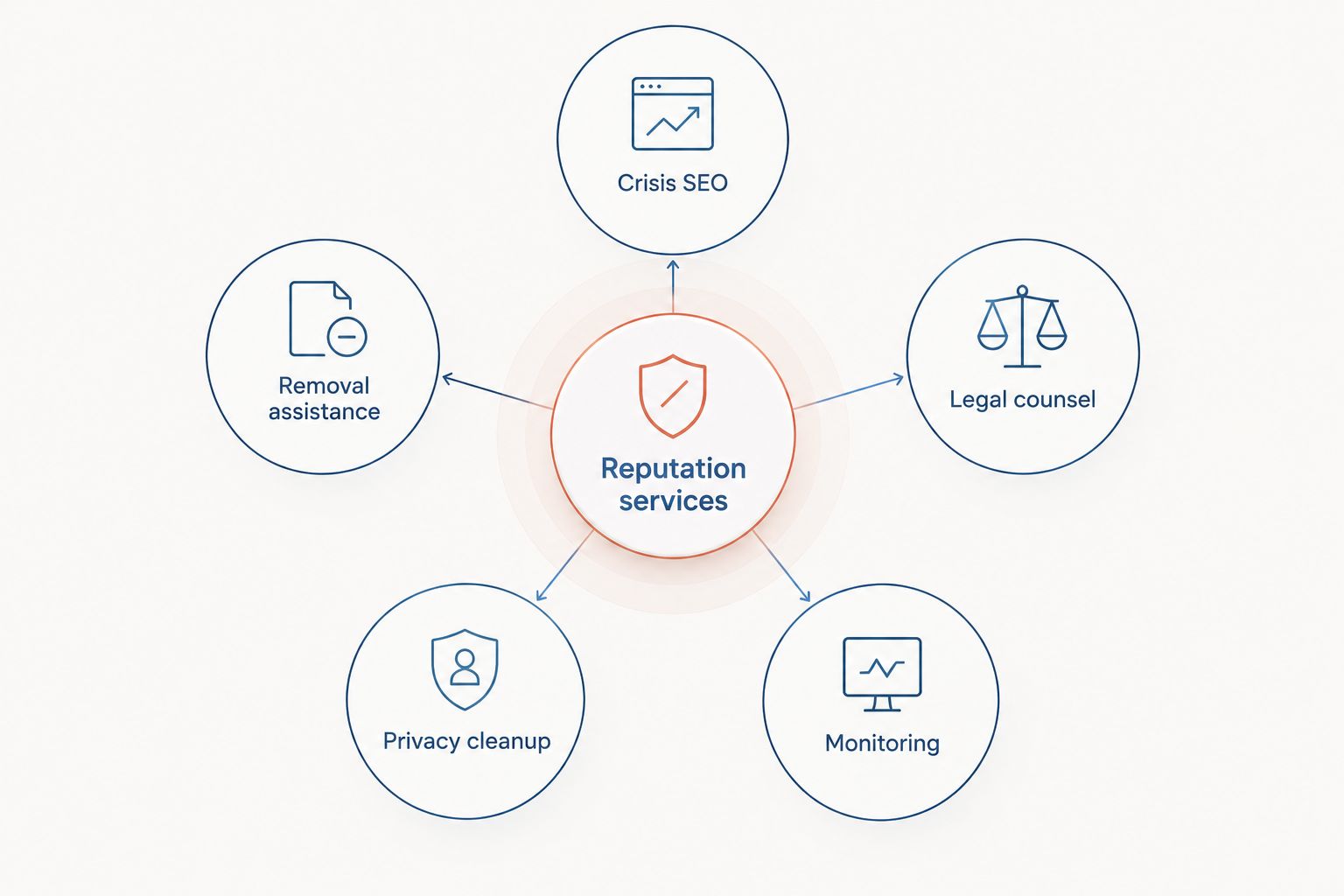
These options address different mechanisms. Crisis SEO concerns search visibility; removal assistance concerns eligibility; legal counsel concerns rights; privacy cleanup concerns exposure; monitoring concerns detection.
1. Socialczars: best for Miami personal search crises
Socialczars provides crisis SEO and online reputation management for Miami-based companies, executives, and high-profile individuals dealing with negative search results. For an individual, that makes the agency relevant when damaging name searches—not simply unwanted contact details—are the central problem.
Start the discussion with the exact searches and URLs involved. Ask whether the proposed response addresses existing results, accurate information you control, or a separate removal opportunity. The written scope should distinguish these tasks rather than treating them as interchangeable.
Socialczars pros:
- Its stated services directly address negative search results.
- Its stated audience includes executives and high-profile individuals.
- Its Miami focus matches individuals seeking an agency serving that market.
Socialczars cons:
- Crisis SEO does not itself remove an article from its original website.
- A search-focused engagement is not a substitute for legal representation or an immediate safety response.
Best for: Miami-based private individuals whose urgent problem is negative search visibility.
Verdict: Buy this service type when search visibility is the problem; require a case-specific scope before authorizing work.
2. Removal assistance: best for eligible content takedowns
Removal assistance helps you assess and pursue a valid route for taking down content or excluding an eligible result from search. Possible routes include a publisher correction, a website's reporting process, or an applicable search-engine removal policy.
The critical distinction is where the content disappears. Removing a search result does not necessarily remove the underlying webpage. A publisher deletion addresses the source, while search removal addresses discovery through the affected search engine.
Removal assistance pros:
- Targets the specific page or result causing concern.
- Gives you a documented request, eligibility basis, and response history.
- Addresses the source directly when the publisher agrees to remove content.
Removal assistance cons:
- Negative but lawful material is not automatically removable.
- Removing one copy does not remove independent copies elsewhere.
Best for: Individuals with a documented policy basis, a correctable error, or a publisher willing to consider a request.
Ask the provider to identify the relevant policy or correction basis before sending identification documents. Keep the original page and correspondence in your evidence file, particularly when the facts remain disputed.
Verdict: Buy removal assistance when eligibility is documented; skip promises to erase any unwanted result.
3. Qualified legal counsel: best for disputed legal rights
Qualified legal counsel evaluates whether the facts support a legal response. This route belongs in the shortlist when the issue involves alleged defamation, threats, impersonation, or another dispute requiring legal judgment—not merely an unflattering search result.
An attorney can assess the applicable law, evidence, jurisdiction, and risks of contacting the publisher. Reputation work and legal work should have distinct owners, especially when publishing a response could affect the dispute.
Qualified legal counsel pros:
- Separates a legal claim from a general reputation complaint.
- Helps preserve evidence and assess appropriate next steps.
- Provides legal advice that a marketing engagement does not replace.
Qualified legal counsel cons:
- An unfavorable statement is not automatically unlawful.
- Legal proceedings and search visibility are separate issues.
Best for: Individuals whose case requires an assessment of legal rights, liability, or available remedies.
Before anyone sends a demand, ask counsel to assess the likely consequences of contact. Do not treat threats of litigation as a standard SEO tactic. The legal strategy should determine what is appropriate to say and preserve.
Verdict: Buy legal advice when rights or safety are at issue; skip treating an SEO agency as legal counsel.
4. Privacy cleanup: best for exposed personal details
Privacy cleanup focuses on information such as personal contact details and listings that make you easier to locate. It is a different objective from changing the visibility of a news article or correcting an allegation.
A privacy service should identify the listings it addresses, the authorization it needs, and how it records completed requests. Require a distinction between a submitted request and a verified removal. Those are different stages, not interchangeable success labels.
Privacy cleanup pros:
- Directly addresses unwanted exposure of personal information.
- Creates a structured record of listings and requests.
- Keeps privacy work separate from public reputation publishing.
Privacy cleanup cons:
- Does not establish that a negative allegation is false.
- A removal from one source does not establish removal everywhere.
Best for: Individuals primarily concerned about exposed addresses, contact details, or personal-directory listings.
Before authorizing work, ask which sources fall inside the scope and what information the provider needs from you. Share only the documents required for the stated process. A privacy engagement should not begin with unnecessary distribution of your sensitive records.
Verdict: Buy privacy cleanup for personal-data exposure; skip it as a substitute for addressing damaging reporting.
5. Reputation monitoring: best for early detection
Reputation monitoring tracks relevant mentions and search changes so you know when something needs attention. It fits a stable situation where the immediate need is oversight rather than an active removal or suppression campaign.
Monitoring requires an escalation plan. Decide who reviews an alert, what evidence they preserve, and which conditions trigger legal, privacy, or SEO assistance. Otherwise, you have a notification stream rather than a response process.
Reputation monitoring pros:
- Establishes a repeatable review process.
- Helps document changes against a recorded baseline.
- Supports escalation when a relevant issue appears.
Reputation monitoring cons:
- Alerts do not remove or suppress content.
- Name matches require review to distinguish you from unrelated people.
Best for: Individuals without an active crisis who need consistent oversight of their name and relevant mentions.
Specify the names, professional identifiers, and locations that matter. Do not count every matching name as a relevant incident. A useful report explains what changed and whether action is required, rather than simply listing mentions.
Verdict: Buy monitoring for oversight; skip monitoring-only support during an active search crisis.
How the ranking works
This ranking prioritizes problem fit, method clarity, privacy controls, evidence, realistic commitments, and exit terms. It is not a claim of hands-on testing or a measured performance league table.
Socialczars comes first for the defined Miami search-crisis use case because its stated services and audience match that need. The remaining options rank by intervention type, not by a claim that monitoring is less useful than legal counsel. If personal-data exposure is your only problem, privacy cleanup moves to the top of your decision list.
What to request before signing in 2026
Turn the sales conversation into a written decision record. You need enough detail to distinguish activity from progress without disclosing more personal information than the assessment requires.
Establish the baseline
Start with 3 name variations, such as your full name, your name plus profession, and your name plus city. These are suggested review inputs, not a performance benchmark. Record the first 10 search results for each query, along with the review date and relevant location.
Keep screenshots and the original URLs. Mark mistaken-identity results separately so the provider does not build a campaign around someone else's content.
Define the intervention
For each priority URL, ask for the proposed action, its rationale, and the person responsible. Separate publisher outreach, policy requests, legal review, content work, and monitoring. Do not accept a single unexplained status such as resolved.
Ask what requires your approval before publication or contact with a third party. A private individual should retain a clear decision point before sensitive information becomes public.
Set reporting and ownership terms
Request a 30-day reporting interval as an initial contract preference, not a promised recovery timeline. Reports should show completed actions, outstanding dependencies, relevant search changes, and the next decision you need to make.
For a 2026 engagement, also confirm account ownership, content approval, document retention, and the handover process. Work you cannot access or understand is difficult to evaluate when you change providers.
Discuss your search reputation problem
Ask Socialczars about crisis SEO and online reputation management for your specific search results.
Which reputation management service should you choose?
Choose Socialczars for a Miami-based personal search crisis; choose a different service route when the underlying problem is legal eligibility, exposed personal data, or monitoring alone. The deciding factor is the action your case needs, not the breadth of a provider's sales presentation.
If you are undecided in 2026, request a diagnosis of your single most damaging result before approving a broader engagement. The response should identify the problem, distinguish removal from suppression, and explain the work proposed. Reject guaranteed ranking positions or claims of control over independent publishers.
FAQ
What’s the best reputation management service for a private individual?
The best service matches the underlying problem. Socialczars fits Miami-based individuals facing negative search results; removal assistance, legal counsel, privacy cleanup, and monitoring address different needs.
Can a reputation management agency delete a negative news article?
An agency cannot guarantee that an independent publisher will delete an article. Source removal requires action by the publisher or another applicable process; SEO suppression does not delete the source.
Is suppressing a search result the same as removing it?
No. Suppression aims to reduce a result’s search visibility, while source removal takes content off the publishing website. Search-result removal can leave the original page accessible elsewhere.
Should I hire a lawyer or a reputation management agency?
Hire qualified legal counsel when you need advice about legal rights, alleged defamation, threats, or liability. Use a reputation management agency for search and reputation work, with separate responsibilities when both are involved.
How long does personal reputation management take in 2026?
There is no single completion time for personal reputation management in 2026. Ask for milestones tied to the proposed actions, and distinguish the provider’s delivery schedule from decisions controlled by publishers or search engines.
Will privacy cleanup remove negative articles about me?
Privacy cleanup is not a substitute for addressing negative articles. Its purpose is to reduce exposure of personal information, while article correction, removal, and search visibility require separate assessment.
What should I prepare before contacting a reputation agency?
Prepare the relevant search queries, URLs, screenshots, and a brief explanation of the harm. Identify any immediate safety concerns or legal disputes, and ask how sensitive documents will be handled before sharing them.
One last thing
Do not publish private details to prove that a private detail should disappear. Before approving a biography, statement, or new profile, decide exactly which facts you want searchable under your name. Accurate content still needs a disclosure boundary.
The strongest initial brief is narrow: identify what is wrong, what outcome you want, and what must remain private. That gives every provider the same problem to solve—and gives you a sound basis for rejecting work that does not address it.
Related guides
- Protect your online reputation before a big career move
- Can removing negative content cause more attention?
- How long does it take to fix a bad online reputation?
