
Reputation Management
A Comprehensive Guide to The Power of SEO in a PR Crisis

Mar
Why Search Visibility Matters During a Reputation Crisis
The Power of SEO in a PR Crisis is the ability to control search engine results when your reputation is under attack, using strategic optimization to suppress negative content, lift truthful responses, and maintain brand credibility when it matters most. Here’s how it works:
- Search becomes the public record – When a crisis hits, over 90% of online experiences start with a search engine, making Google’s first page your most critical battleground
- Top results capture attention – The top three Google search results receive over 54% of all clicks, meaning whoever controls these positions controls the narrative
- Speed determines outcomes – Companies can lose up to 40% of revenue in the first 72 hours following a crisis, making rapid SEO response essential
- SEO pushes down negatives – Strategic content creation, high-authority backlinks, and technical optimization work together to suppress damaging results below the first page
- Proactive preparation wins – Building a strong SEO foundation before a crisis creates a digital fortress that negative content struggles to penetrate
When one negative story can spread faster than truth, your reputation isn’t just a brand asset—it’s oxygen. Search engines don’t just index information; they shape perception, influence trust, and determine whether customers, investors, and partners believe in you or abandon you.
The challenge is real: 89% of consumers research brands via search engines before making decisions. If the first thing they find is negative press, scandal coverage, or false accusations, your brand suffers—regardless of the truth. Traditional PR strategies alone can’t fix this problem. You need SEO working alongside crisis communications to influence what appears, where it ranks, and how quickly your response dominates the conversation.
Crisis SEO differs fundamentally from traditional SEO. While standard optimization focuses on growth, traffic, and conversions, crisis SEO operates defensively and rapidly. It’s about pushing down harmful content, elevating clarifications, and controlling search intent during high-stakes moments. This requires technical expertise, strategic content deployment, and an understanding of how search engines prioritize fresh, authoritative information during breaking news cycles.
I’m John DeMarchi, and since founding Social Czars in 2014, I’ve managed crisis SEO situations for hundreds of clients—CEOs, executives, and high-profile individuals facing reputation threats where The Power of SEO in a PR Crisis made the difference between recovery and collapse. This guide distills those experiences into actionable strategies you can implement immediately.
Basic The Power of SEO in a PR Crisis vocab:
- What Is Crisis SEO and Why Is It Crucial for Crisis Communications
- Crisis SEO for CEOs
- Why Crisis Communications Need Crisis SEO Expertise
Understanding the Power of SEO in a PR Crisis
When we talk about 90% of online experiences beginning with a search engine, we are acknowledging that Google is the modern judge, jury, and executioner of brand perception. In a crisis, search intent shifts dramatically. Users aren’t just searching for your brand name; they are searching for “Brand X scandal,” “Brand X lawsuit,” or “Brand X layoffs.”
Crisis SEO is the specialized practice of managing these search engine results pages (SERPs) to ensure that the digital record reflects your side of the story. If you don’t manage this record, rumors fill the vacuum. Understanding what crisis management involves today means realizing that a press release hidden on your website is useless if it doesn’t rank for the keywords people are actually using.
We often see Crisis SEO Demystified as the process of “narrative control.” By optimizing for the specific terms that emerge during a scandal, we can ensure your official statement, FAQ page, or corrective action plan appears alongside or above the negative news. This isn’t about “hiding” the truth; it’s about ensuring the truth is visible enough to be part of the public’s decision-making process.
Proactive Defense: Building a Digital Fortress

The best time to manage a crisis is before it happens. At Social Czars, we help our elite clients in Miami and New York City build what we call a “Digital Fortress.” This involves technical SEO health—ensuring your site is fast, secure, and passes Google’s free mobile-friendly test.
A robust foundation relies heavily on E-E-A-T (Experience, Expertise, Authoritativeness, and Trustworthiness). Our CEO Reputation Management Complete Guide emphasizes that an executive with a strong, pre-existing digital footprint—active LinkedIn, published thought leadership, and a clear personal brand—is much harder to “cancel” than one who is a digital ghost.
Key components of your fortress include:
- High Domain Authority: Acquiring high-authority backlinks consistently so your site has the “weight” to stay at the top.
- Owned Entities: Optimizing your Wikipedia page, Glassdoor profile, and social media channels.
- Content Dominance: Creating a library of positive content that saturates the first two pages of Google.
For a deeper dive, our Online Reputation Management Complete Guide and Reputation Management Agency Guide 2026 explain how to maintain these assets year-round.
The Power of SEO in a PR Crisis Preparation
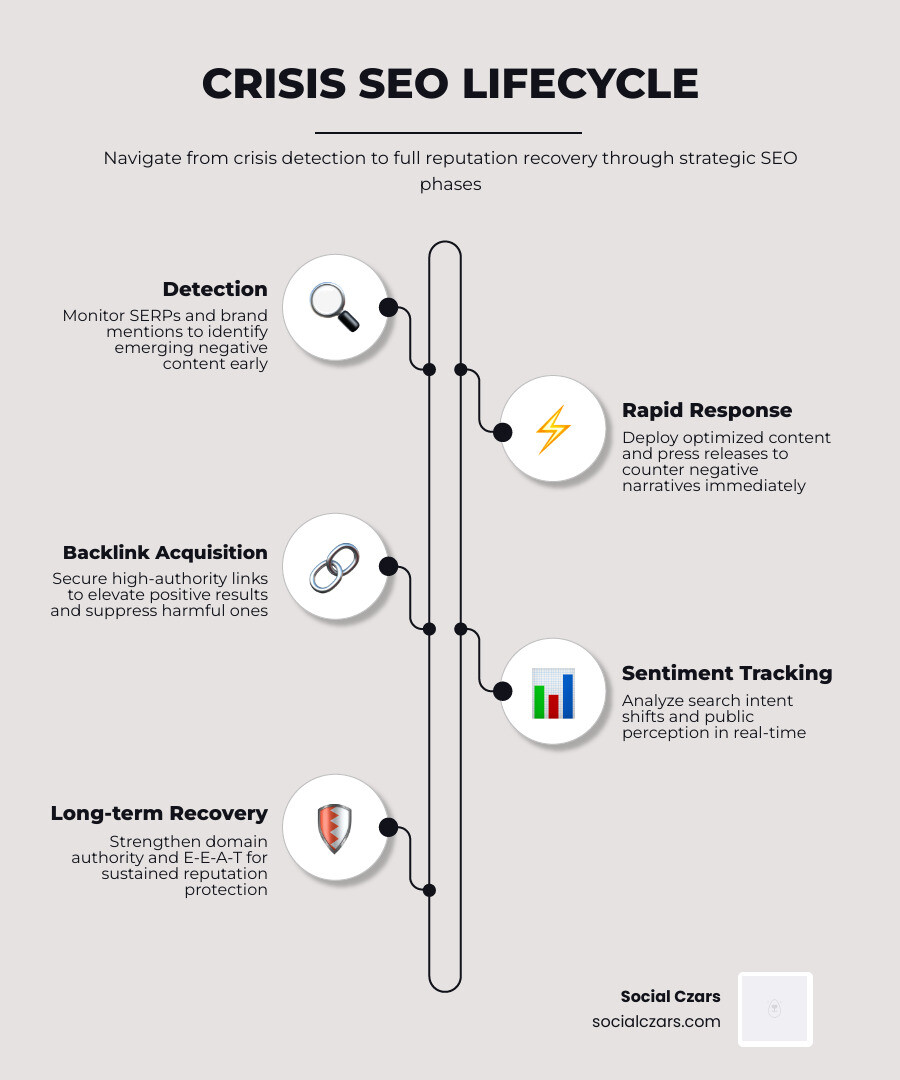
Preparation requires aggressive keyword monitoring. We use tools to track brand sentiment and rising search queries. If we see a spike in negative long-tail keywords, we can deploy What is Anti-Crisis SEO tactics immediately.
As expert Danica Bunch notes, proactive content isn’t just fluff; it’s insurance. By using keyword optimization on “safe” topics related to your brand, you create a buffer. When a crisis hits, these positive pages act as a shield, making it harder for a single negative article to dominate the entire front page.
Reactive Strategies: Controlling the Narrative
When the storm hits, speed is your only friend. Reactive SEO is about rapid-response content deployment. If a negative story breaks, we immediately analyze the SERP to see which “entities” (news sites, blogs, forums) are ranking.
Our strategy for Crisis SEO to Fix Bad Press involves:
- Immediate Response Hubs: Creating a dedicated landing page on your site for the crisis (e.g.,
brand.com/update). - Factual Saturation: Publishing multiple pieces of content (blogs, videos, press releases) that use the same keywords as the negative press.
- De-indexing and Removal: Knowing How to Get Rid of a Search Result on Google when the content is defamatory or outdated.
| Feature | Proactive SEO (Fortress) | Reactive SEO (Response) |
|---|---|---|
| Primary Goal | Build authority and “buffer” | Suppress negatives and clarify |
| Keyword Focus | Branded and industry terms | Crisis-specific and “scandal” terms |
| Content Type | Thought leadership, evergreen | FAQs, official statements, news |
| Speed | Long-term, consistent | Immediate, 24/7 monitoring |
Knowing What SEO Agencies Specialize in Crisis SEO and Crisis Management for Brands is vital because traditional marketing agencies often lack the “war room” mentality required for these 72-hour windows.
Leveraging High-Authority Backlinks and The Power of SEO in a PR Crisis
Backlinks are the “votes of confidence” in Google’s eyes. During a crisis, negative news sites have high authority, which is why they rank so fast. To counter this, we use Digital PR to earn backlinks from other high-authority sites.
Domain authority (DA) is a metric that scores a website’s rankings based on the quality of its backlink profile. By placing interviews with your CEO or contributed articles in major publications like Forbes or the Wall Street Journal, we can create positive results that have the “SEO weight” to outrank the negativity. This is a core part of How to Bury Bad Search Results.
As Dave Manzer emphasizes, earned media is a powerful SEO booster. For specialized fields, such as the legal industry, our Crisis SEO for Lawyers Complete Guide outlines how to use professional associations and legal directories to build this authority quickly.
Advanced Tactics: Content Suppression and AI Integration
The future of The Power of SEO in a PR Crisis lies in technology. We now use AI SEO tools for anomaly detection. These tools can alert us the moment a negative sentiment begins to trend on social media or forums, often before the first news article is even written.
Content suppression is an art form. It involves “content clustering”—creating a web of positive, interlinked pages that Google views as more relevant than a single negative news story. For brands dealing with consumer-facing issues, our Crisis SEO Bad Reviews Guide explains how to drown out “one-star” attacks with verified, positive customer stories.
For high-profile individuals, CEO Reputation SEO focuses on “Entity Optimization.” We ensure that Google’s Knowledge Panel (the box on the right side of the search results) displays factual, positive information rather than the latest gossip. As Michael Lopez notes, effective reputation management requires a balanced approach—you can’t just spam the internet; you must build genuine, high-quality digital assets.
Measuring Success and Long-Term Recovery
How do we know if our efforts are working? We track the “Share of Voice” on page one. A study by Backlinko shows that moving from position #2 to #1 generates a massive 74.5% increase in clicks. In a crisis, our goal is to ensure that “Position #1” is your official statement.
Victoria Marshall points out that metrics like organic visibility and sentiment shifts are better indicators of health than just raw traffic. If people are clicking on your “Fact Check” page instead of a tabloid article, you are winning.
Long-term recovery requires cross-training between SEO and PR teams. The PR team needs to understand which keywords to include in their press releases, and the SEO team needs to know the “tone” the PR team is trying to strike. This unified front ensures that your brand equity isn’t just restored—it’s strengthened.
Frequently Asked Questions about Crisis SEO
How long does it take for The Power of SEO in a PR Crisis to show results?
SEO is generally a long game, but in a crisis, we can see shifts in hours if we leverage high-authority “news” signals and request rapid indexing via Google Search Console. However, “burying” a negative result deep onto page three or four can take several months of consistent content creation and link building.
Can SEO completely remove negative news from Google?
SEO focuses on suppression (pushing things down) rather than removal. However, if the content is defamatory, violates copyright, or contains private personal information, we can often pursue legal or technical removals. For everything else, the goal is to make the negative result so hard to find that it effectively doesn’t exist for the average user.
Why is search engine monitoring critical during a reputation crisis?
Because the narrative changes by the hour. A new “viral” tweet or a secondary news story can create new “suggested searches” (the terms Google predicts as you type). If you aren’t monitoring these, you are fighting yesterday’s battle.
Conclusion
At Social Czars, we understand that a PR crisis is a battle for the soul of your brand. Whether you are an executive in London or a VIP in Miami, your digital legacy is defined by what people find when they type your name into a search bar.
By leveraging The Power of SEO in a PR Crisis, we don’t just respond to threats—we neutralize them. We combine elite SEO tactics with fast negative content removal to ensure our exclusive clientele maintains control over their narrative. The key is integration: cross-training between SEO and PR teams ensures a unified, sophisticated response that protects your reputation for the long haul.
Don’t wait for the storm to build your walls. Secure your digital legacy with Social Czars today and ensure that your brand remains oxygen, not an ash heap.
