
Reputation Management
Your Digital Cleanse: Erasing Unwanted Information from the Web

Mar
Why Negative News Articles Damage Your Digital Reputation
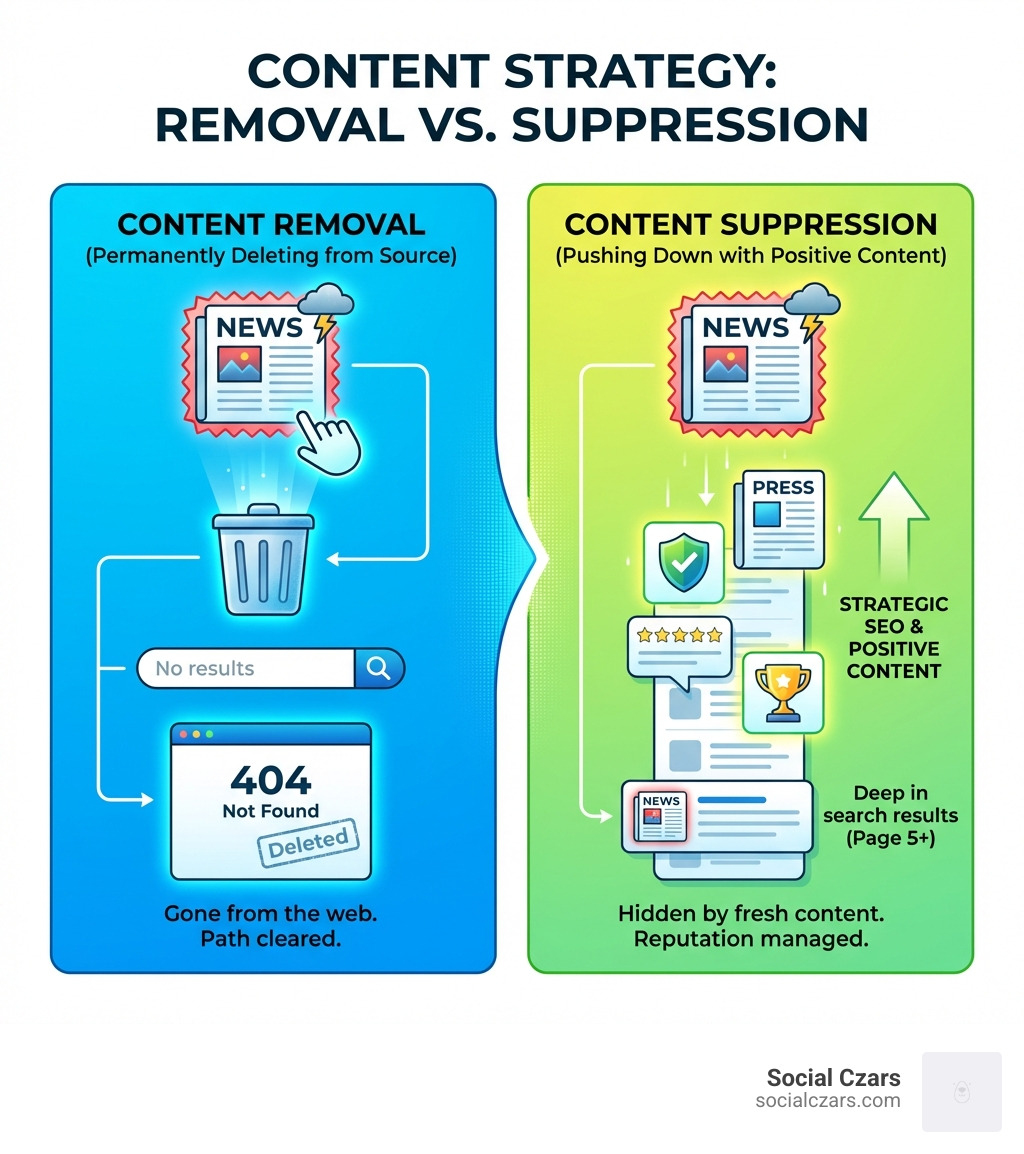
How to remove negative news articles from google involves two primary approaches: direct removal (permanently deleting content from its source) or suppression (pushing it down in search results with positive content). The most effective method depends on your specific situation—whether the content violates policies, contains false information, or is simply unfavorable but accurate.
Quick Answer: 7 Methods to Remove or Suppress Negative Articles
- Contact the publisher directly – Request removal or de-indexing based on inaccuracies or policy violations
- Use Google’s removal tools – For personal information, doxxing, or outdated content
- Request de-indexing – Keep the article online but remove it from search results
- Leverage legal grounds – For defamation, libel, or copyright violations
- Create positive content – Publish new articles, press releases, and thought leadership pieces
- Build branded websites – Develop microsites focused on your name or company
- Implement strategic SEO – Use keyword optimization and link building to outrank negative results
The stakes are high. Research shows that 86% of consumers hesitate to purchase from companies with negative content on their first page of search results. For executives, 54% of employers turn down candidates based on what they find online. Negative news has a 3x larger effect on reputation than positive news, and social media users are 1.91 times more likely to share negative articles.
The problem compounds because Google’s algorithm favors engagement. A Nature study found click-through rates increase by 2.3% for each negative word in a headline. This means controversial content naturally rises to the top—not because it’s more accurate, but because humans are drawn to drama.
I’m John DeMarchi, founder of Social Czars, where I’ve spent over a decade helping executives and VIP clients understand how to remove negative news articles from google through both direct deletion and strategic suppression. Our team has successfully managed hundreds of crisis communications SEO situations for world-class brands and high-profile individuals.
Basic how to remove negative news articles from google glossary:
Initial Assessment: Your First Steps to a Cleaner Digital Footprint
Before we dive into the nitty-gritty of how to remove negative news articles from google, the first and most crucial step is to understand the scope of the problem. Think of it as a digital reconnaissance mission. We need to identify every instance of the negative content and assess its impact.

Our process begins with a thorough documentation of all negative articles. We recommend creating a detailed spreadsheet to track each piece of content. For each entry, you’ll want to record:
- The exact URL of the article.
- The date it was published.
- The platform or website it appeared on.
- The specific keywords that trigger the negative result.
- A brief summary of the negative content.
- Our initial assessment of its impact.
To ensure we capture everything, we conduct exhaustive searches using incognito mode in Google. This prevents personalized search results from skewing our findings. We use various search queries, including your name or company name, specific job titles, relevant locations (such as New York City, Miami, Los Angeles, or London), and industry information. Don’t forget to check Google News, image results, and social media platforms, as negative articles are 1.91 times more likely to be shared there.
Understanding which keywords trigger negative search results is vital. This insight guides our strategy for both removal and suppression. If we know what people are searching for when they find negative information, we can better craft positive content to intercept those searches.
Finally, we assess the damage. This involves a cold, hard look at whether the negative press is genuinely impacting your operations, customer trust, or career prospects. As statistics show, negative press can erode trust and disrupt business, and having four or more negative articles can lead to losing around 70% of potential customers. The longer bad information stays online, the worse the reputation damage will be. Sometimes, if the negative press is merely annoying and not affecting your bottom line, it’s wiser to let it slide rather than draw more attention to it. However, if it’s causing real harm, it’s time to fight back strategically. For a deeper dive into this initial phase, check out our Remove Negative Search Results Guide.
Direct Deletion: Strategies for Permanently Removing Negative Articles
When it comes to how to remove negative news articles from google, direct deletion is often the dream scenario. This means getting the content permanently taken down from its original source. While challenging, it’s not impossible, especially if the content is inaccurate, outdated, or violates specific policies.
Our primary approach involves contacting the publisher or the original writer directly. This requires a delicate touch and a strategic mindset. First, we identify the appropriate contact person—this could be the journalist who wrote the article, an editor, or the website’s webmaster. Information is often found on the “About Us” or “Contact Us” pages. Tools like Email Hunter can also be invaluable in finding direct contact details.
When crafting our request, professionalism is paramount. We always advise against demands or threats, as this can backfire and potentially lead to more negative coverage. Instead, our communications are polite, factual, and specific. We clearly explain why the article is harmful, providing any proof of inaccuracies or demonstrating how it violates the website’s content policies. For example, if the article contains demonstrably false information, we present the facts and evidence that contradict it. If it’s severely outdated and no longer relevant, we make that case. We might request complete deletion, de-indexing (removing it from search results while leaving it on the site), or redaction of personal information.
It’s important to understand the difference between ‘removing’ and ‘suppressing’ negative online content. Removal means the content is gone from the source website. Suppression means it’s still online but pushed so far down in search results that most people won’t find it. Many publishers, if they can’t or won’t delete an article, might be amenable to de-indexing it or redacting sensitive personal information, which can be a valuable compromise. For more insights on this, refer to A Practical Guide to Negative Content Removal.
Leveraging Legal Channels for Content Removal
Sometimes, direct appeals to publishers aren’t enough, or the content is so egregious that legal action becomes necessary. This is where understanding your legal grounds for requesting content removal becomes critical.
The most common legal grounds we encounter include:
- Defamation (Libel or Slander): If the article contains false statements of fact that harm your reputation, you might have a case for defamation. To succeed, we must prove the information was indeed false at the time of publication and caused significant damage.
- Copyright Infringement: If the news article uses your copyrighted material without permission, you can request its removal based on intellectual property rights.
- Privacy Violations: In certain circumstances, if the article invades your privacy or reveals highly sensitive personal information without consent, legal action may be considered.
- Court Orders: If a court has already determined the content to be unlawful, we can leverage this to push for removal.
Pursuing legal action, such as sending an attorney-issued cease and desist letter or filing a lawsuit, can be effective but comes with considerations. Lawsuits are often expensive, time-consuming, and carry no guarantee of success. They can also draw unwanted attention, potentially exacerbating the problem. Therefore, we advise consulting with a legal professional specializing in media law in your jurisdiction (New York City, Miami, Los Angeles, or London) to assess the viability and risks. They can help gather supporting evidence like official court documents for expunged or sealed records, which can significantly strengthen a removal request. For cases specifically involving false and damaging content, our services for Remove Defamatory Content can provide targeted solutions.
How to remove negative news articles from google Using Its Own Tools
Even if a website won’t remove content, Google itself offers mechanisms for removal under specific circumstances. Understanding how to remove negative news articles from google using its tools is a crucial part of our strategy. Google generally won’t remove content just because it’s embarrassing or unfavorable, but it acts swiftly when its own policies or applicable laws are violated.
Google’s content policies apply globally, but legal standards for removal can vary by country or region. If content violates Google’s policies (e.g., private information, doxxing, malicious intent, non-consensual explicit imagery, exploitative removal practices), its removal is typically global. If it violates local law, the removal might be restricted to specific countries.
Here’s how we leverage Google’s tools:
- Google’s Content Removal Form: If a news article violates Google’s personal content policies—for instance, by exposing sensitive personal identification numbers, financial account details, or home addresses (doxxing)—we can submit a request via Google’s content removal form. This form is specifically designed for content that breaches privacy or contains highly sensitive information.
- Legal Troubleshooter: For legal violations like intellectual property infringement or content deemed unlawful by a court order, we use Google’s legal troubleshooter. This guides us through the process of reporting content based on specific legal reasons.
- Remove Outdated Content Tool: This tool is invaluable after a negative article has been removed or significantly altered on the original website. If the content is no longer live or has been updated, but the old version still appears in Google’s search results, we use the Remove Outdated Content tool. This prompts Google to recrawl the page and update its index, effectively removing the outdated link from search results. The process involves pasting the URL of the outdated or dead link and submitting a request to refresh Google’s cached result.
These tools are powerful, but they require careful application. We ensure that our requests are clear, concise, and backed by strong evidence, explaining precisely how the content violates Google’s guidelines or relevant laws.
The Art of Suppression: How to remove negative news articles from google by Burying Them
When direct removal isn’t feasible, or as a complementary strategy, suppression becomes our go-to. This is the art of pushing negative search results down the Google rankings by flooding the internet with positive, authoritative content. It’s a long-term game, but incredibly effective in controlling your online narrative.
The core idea behind suppression is to leverage Google’s algorithm, which favors engagement and authority. Since controversy and scandals tend to rank higher because humans are drawn to drama and negativity, we counteract this by creating an overwhelming volume of valuable, positive content that Google will deem more relevant and authoritative for your branded search terms. This is a key part of how to remove negative news articles from google without direct deletion.
Burying negative search results can be complex and time-consuming, but the investment is crucial for your long-term reputation. We continuously create new, high-quality content and build strong backlinks to ensure your positive story dominates the search landscape.
Building a Digital Fortress of Positive Assets
To effectively suppress negative articles, we build what we call a “digital fortress” of positive online assets. This involves creating and optimizing various platforms where your positive story can shine:
- Branded Websites and Microsites: We develop new websites or microsites specifically focused on your brand or personal name. These sites highlight your achievements, services, positive customer reviews, and company strengths. By optimizing these sites with relevant keywords, we ensure they rank highly for your branded searches, effectively pushing down negative content.
- Publishing on Trusted External Platforms: Leveraging authoritative external websites is crucial. We publish thought leadership articles, guest posts, and press releases on industry-leading sites and news outlets relevant to your field. These platforms have high domain authority, meaning content published there is more likely to rank well. We subtly mention your name or company name within these articles, linking back to your official properties, which boosts your online presence and credibility.
- Optimizing Social Media Profiles: Your social media presence is a powerful tool. We ensure all your social media profiles (LinkedIn, X (formerly Twitter), Facebook, Instagram, etc.) are fully completed, consistently branded, and regularly updated with positive, keyword-rich content. Search engines often display social media profiles prominently, making them excellent vehicles for reputation management.
This strategy ensures that when someone searches for your name or company, they encounter a rich mix of positive, controlled information, making it much harder for negative articles to gain visibility. Our CEO Reputation Management Complete Guide offers extensive details on building such robust online assets.
How to remove negative news articles from google with Proactive SEO
Proactive SEO is the engine that drives our suppression strategy. It’s about optimizing every piece of positive content to ensure it outranks negative results. Here’s how to remove negative news articles from google by mastering proactive SEO:
- Keyword Optimization: We research the keywords that currently trigger negative results and strategically integrate them into new, positive content. This doesn’t mean stuffing keywords; it means creating valuable content that genuinely addresses those search queries in a positive light, using synonyms and natural language.
- Creating High-Quality Content: Google prioritizes high-quality, relevant, and engaging content. We focus on producing articles, blog posts, videos, and other media that provide genuine value to your audience. This content should be unique, informative, and consistently updated to maintain its freshness and appeal.
- Link Building: Backlinks from other reputable websites are a strong signal of authority to Google. We actively pursue opportunities to acquire high-quality backlinks to your positive content. This can involve guest blogging, strategic partnerships, and digital PR efforts. The more authoritative links pointing to your positive assets, the higher they will rank.
- Long-Term Content Strategy: Reputation management is not a one-time fix; it’s an ongoing process. We implement a continuous content creation and distribution strategy to ensure a steady stream of positive information. This consistent effort is crucial for maintaining a strong online image and preventing future negative content from dominating search results.
By implementing these proactive SEO tactics, we effectively “bury” negative articles, pushing them off the first few pages of search results where most users never venture. This comprehensive approach is detailed further in our Crisis SEO Complete Guide.
Frequently Asked Questions About Online Content Removal
We often get asked similar questions when guiding clients through the process of how to remove negative news articles from google. Let’s address some of the most common ones.
How long does it take to remove or suppress a negative article?
The timeline for removing or suppressing negative online content can vary significantly. If you attempt the DIY route, working through publisher policies and legal considerations can take anywhere from several months, sometimes even up to a year. It’s a complex, time-consuming process.
However, when working with professional services like ours, the process can be much faster. Our experience navigating publisher policies and Google’s removal criteria means we can often achieve results in a matter of weeks for direct removals, or typically within 3-6 months for effective suppression strategies. The exact duration depends on factors such as the number of negative links, the keywords involved, the responsiveness of publishers, and the chosen method. For a more detailed look at professional assistance, explore our Negative Content Removal Services.
Can I use the ‘Right to be Forgotten’ in the USA?
The “Right to be Forgotten” is a legal concept that originated in Europe with the General Data Protection Regulation (GDPR). It allows individuals to request that search engines remove links to outdated, irrelevant, or excessive personal information from search results.
In the USA, there isn’t a federal “Right to be Forgotten” law equivalent to Europe’s GDPR. While some states like California have robust privacy laws, the principle is not broadly codified across the country. However, this doesn’t mean you have no recourse. Google does have policies that allow for the removal of personal identifying information under specific circumstances, such as doxxing or sensitive financial data. So, while you can’t typically invoke a direct “Right to be Forgotten” in the US, you may still be able to request removal based on Google’s own content policies or specific state privacy laws if the content falls into certain categories. Our team can help assess if your situation qualifies under these specific conditions applicable in New York City, Miami, or Los Angeles.
Is it a good idea to respond publicly to a negative article?
This is a critical strategic decision. Our general advice is to approach public responses with extreme caution. Often, responding publicly, especially in an emotional or defensive manner, can lead to what’s known as the “Streisand Effect.” This phenomenon describes how an attempt to hide, remove, or censor information can inadvertently draw more attention to it, increasing its visibility and potentially its search ranking.
If the negative press is merely annoying and not significantly impacting your business or reputation, it’s often better to let it fade. However, if the negative article contains factual inaccuracies or addresses a significant issue that demands a response (e.g., a major customer service failure, a legal dispute), a carefully crafted, professional, and factual statement might be necessary. This should be part of a broader crisis communication plan, focusing on offering solutions and expressing your perspective without giving undue authority to the negative piece. We always analyze the situation thoroughly to determine if a public response will serve to mitigate damage or simply amplify the problem.
Conclusion: Securing Your Digital Legacy
Navigating the complexities of how to remove negative news articles from google is a journey that requires patience, strategy, and often, expert guidance. We’ve explored two powerful pathways: direct removal, which aims to permanently delete content from its source, and suppression, which strategically pushes negative content down in search results with an influx of positive assets.
The impact of negative press can be profound, eroding customer trust, disrupting operations, and even affecting career opportunities. As we’ve seen, Google’s algorithms, coupled with human psychology’s draw to negativity, can make these articles stubbornly prominent. Our approach at Social Czars emphasizes a proactive, comprehensive strategy that combines diligent content identification, careful direct communication with publishers, leveraging legal channels when appropriate, and a robust SEO-driven suppression campaign.
Protecting your online image is not a one-time event; it’s a continuous process of monitoring, creating, and optimizing your digital presence. By building a strong digital fortress of positive assets and employing proactive SEO tactics, you can regain control of your narrative and secure your digital legacy.
For executives and VIPs in New York City, Miami, Los Angeles, and London, our specialized, high-end digital reputation and search optimization services are designed to provide elite SEO and fast negative content removal. We understand the unique needs of an exclusive clientele and craft custom strategies to safeguard your reputation. For a comprehensive strategy custom to your needs, explore professional Online Reputation Management.
