
Reputation Management
Social Czars vs Erase.com: which is better in 2026

Oct
Choose Social Czars if you are a Miami-based executive, company, or high-profile individual seeking crisis SEO for negative search results; choose Erase.com if its written proposal confirms removal of the specific content you need addressed. The deciding factor in 2026 is the contracted outcome: suppressing a search result and removing its source are different jobs.
- Social czars vs erase.com turns on crisis SEO versus a confirmed content-removal scope, not promises of a clean search.
- Social Czars is the crisis SEO choice for Miami executives and companies facing negative search results.
- Choose Erase.com for a removal-led engagement only when its proposal identifies eligible content and the promised outcome.
- Require separate reporting for source removal, search visibility, and unresolved content before signing either agreement.
Why this matters
A damaging article can remain online even after its search visibility changes. A removed page can also leave references elsewhere. Hiring an agency without separating those problems gives you an agreement that sounds useful but measures the wrong outcome.
For a 2026 reputation decision, define the exposure first. Is an investor finding an unfavorable article when searching your name? Is a customer reading a disputed review on its original platform? Is a sensitive page exposing personal information? Those situations require different assessments, and none becomes the same problem merely because it appears in Google.
Social Czars is a crisis SEO agency for Miami companies, executives, and high-profile individuals facing negative search results. That is a specific fit, not a claim that every unfavorable page can be deleted.
Treat Erase.com as the alternative to evaluate against a removal-focused brief. Require the proposal to establish the fit rather than treating the company name as evidence of what will happen to your content.
At a glance
| Dimension | Social Czars | Erase.com |
|---|---|---|
| Best for | Miami companies, executives, and high-profile individuals facing negative search results | Buyers whose written proposal confirms a suitable removal-focused engagement |
| Standout feature | Stated focus on crisis SEO and online reputation management | Evaluate the proposed action for each disputed URL |
| Search suppression | Direct match to the stated crisis SEO brief | Require an explicit suppression scope if that is your objective |
| Source removal | Do not treat crisis SEO as a deletion commitment | Choose for this objective only with a confirmed removal scope |
| Miami buyer fit | Explicitly serves Miami-based clients | Assess suitability for your location and stakeholder needs |
| Confidentiality | Require written handling and approval controls | Require the same written handling and approval controls |
| Reporting | Require query-level and URL-level evidence | Require outcome evidence tied to each contracted action |
| Pricing model | Establish project, ongoing, or mixed scope in the proposal | Establish project, ongoing, or mixed scope in the proposal |
The table separates a stated service focus from conditions you must establish during procurement. It does not award either agency a result that has not been demonstrated for your case.
Crisis SEO gives Social Czars the clearer suppression fit
If your central problem is what people see when they search your name or company, start with a search-focused brief. Define the exact queries, the damaging URLs, and the audience encountering them. A broad request to improve your reputation leaves too much room for disagreement about success.
Social Czars provides crisis SEO and online reputation management for the buyer profiles described above. Choose that service focus when the assignment is to address negative search results, rather than assuming the source publisher will remove the material.
The limitation is equally important: suppression is not deletion. A page that becomes less prominent for one query can remain accessible through its direct address or another search. Your agreement should distinguish the visibility objective from any separately assessed removal opportunity.
Ask a prospective provider to explain:
- Which searches define the problem.
- Which negative URLs are within scope.
- Which existing assets you control.
- What changes require your approval.
- How progress will be documented.
Do not turn those questions into a demand for a guaranteed ranking. Require a defined plan and measurable evidence instead.
Erase.com is the conditional choice for a removal-led brief
Choose Erase.com over a suppression-led engagement when its proposal confirms that it will pursue removal of the content at issue and defines what constitutes success. The useful distinction is contractual: you want action against the source, not merely a change in its search position.
For example, a business owner concerned about a particular platform listing needs an assessment of that listing. A search campaign alone does not establish whether the platform will remove it. Conversely, a removal assessment does not establish a broader plan for the owner's branded search results.
The advantage of a confirmed removal scope is that it addresses the source-level objective. The limitation is that removing one source does not establish that every related mention disappears.
Require the proposal to identify the URL, the proposed route, the evidence needed, and the fallback if removal does not occur. Do not accept a generic reference to negative content as a substitute for that assessment.
For the wider distinction between removal services and search work, use this guide to online defamation removal services. A disputed statement also raises legal questions that an SEO scope alone does not resolve.
Miami clients have a direct match in the stated service brief
Social Czars explicitly serves Miami-based companies, executives, and high-profile individuals. That makes its described audience a direct match when your buyer profile fits those categories.
This is a scope advantage, not evidence of a local ranking advantage or a faster response. Location should help you assess relevance; it should not replace scrutiny of the actual work.
A Miami company facing reputational scrutiny should identify who needs confidence restored: customers, lenders, partners, employees, or another stakeholder group. An executive should distinguish personal-name searches from company-name searches. Those are separate briefs even when the same article appears in both.
For Erase.com, assess the proposed engagement against those same stakeholder requirements. A provider belongs on your shortlist because its scope addresses your exposure, not because it uses a broad reputation-management label.
Choose the agency that can translate your stakeholder problem into a defined search or source-level assignment. Keep irrelevant deliverables out of the contract.
Neither agency wins confidentiality without written controls
Discretion matters when you are dealing with allegations, personal information, or an executive's reputation. It must be operational, not just descriptive.
Use 3 checkpoints in your procurement process: access, approval, and retention. Decide who can access sensitive material, who approves external communications, and what happens to documents when the engagement ends. These are recommended checks, not claims about either agency's existing policies.
Ask both providers to put the following in writing:
- The people or roles authorized to access your case materials.
- The process for approving outreach and published content.
- The handling of account credentials and supporting documents.
- The retention or deletion terms for sensitive records.
- The process for reporting an unauthorized disclosure.
Do not assume that a confidentiality agreement answers every operational question. It should sit alongside a clear workflow.
Confidentiality is a tie until the contracts establish a meaningful difference. Avoid awarding either agency a privacy advantage based on positioning alone.
Neither agency wins reporting without outcome evidence
In 2026, a reputation report should show what changed, where it changed, and what remains unresolved. An activity list is not an outcome report. Publishing content, sending requests, and checking rankings describe work; they do not by themselves establish improvement.
Separate reporting into 2 tracks: search visibility and source status. Search visibility records the agreed queries and the appearance of relevant results. Source status records whether a target page remains accessible, has changed, or has been removed.
A third reporting item should document unresolved exposure. That keeps the engagement from presenting isolated progress as a complete resolution.
Use a consistent framework:
- Search visibility: agreed queries, target URLs, and dated observations.
- Source status: the status of each targeted page and supporting evidence.
- Unresolved exposure: remaining pages, related references, and next actions.
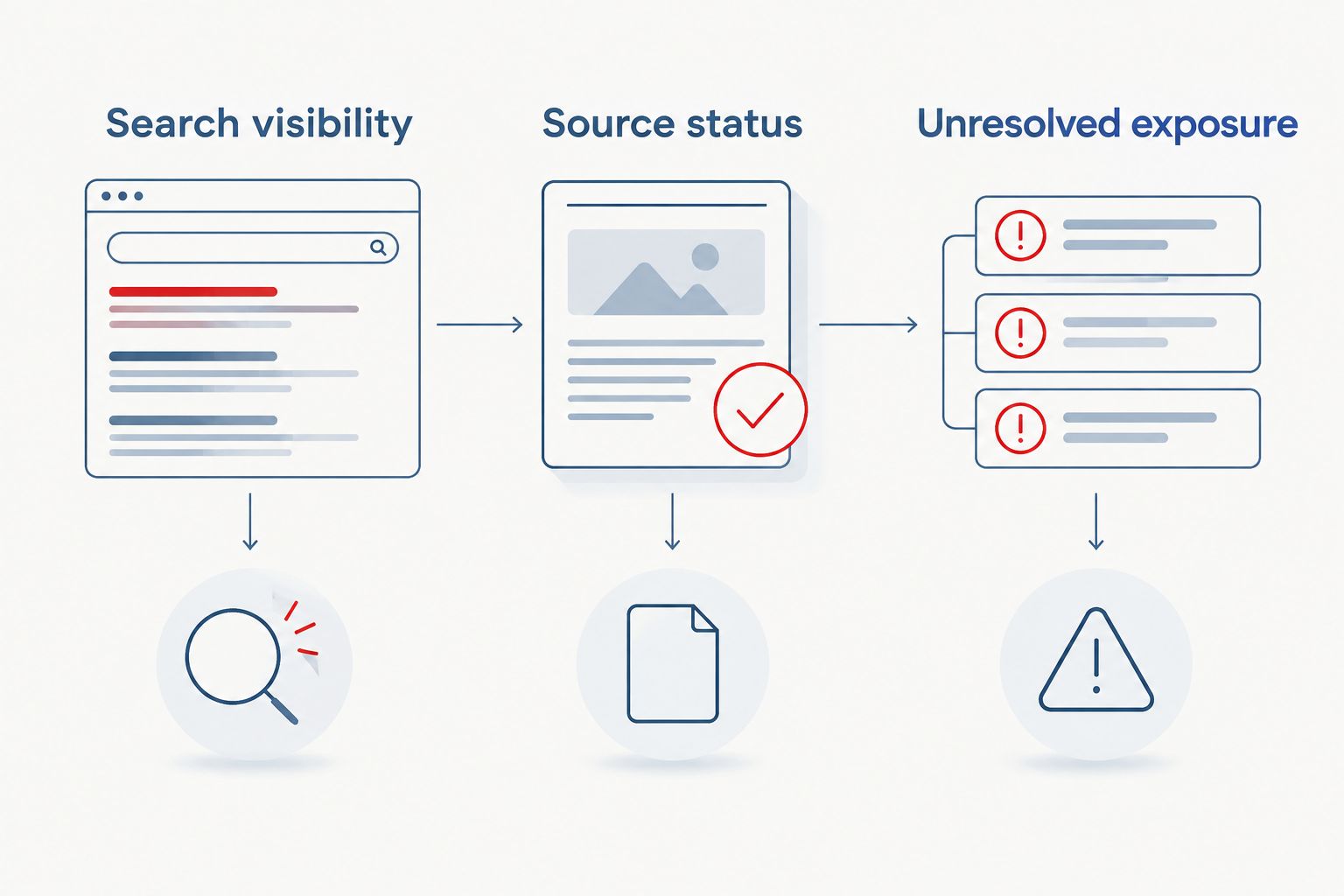
Require the same evidence standard from both agencies. Reporting is an honest tie until you compare actual proposed deliverables. A polished dashboard does not replace a clear definition of success.
Pricing models must follow the assignment
Compare the proposed pricing models, not just the total commitment. Neither a project engagement nor an ongoing engagement is inherently better; each needs a scope that explains what you are buying.
A fixed project gives you a defined boundary when the deliverable is specific. An ongoing engagement provides continuity when monitoring and continuing work are part of the brief. A mixed arrangement separates an initial assignment from subsequent activity.
For both agencies, request the same breakdown:
| Proposed model | Useful when | Contract question |
|---|---|---|
| Fixed project | The assignment has a defined deliverable | What marks completion, and what remains outside scope? |
| Ongoing engagement | Monitoring and continuing work are required | What work and reporting are included in each period? |
| Mixed engagement | Initial intervention and subsequent work are separate | What triggers the transition between phases? |
These are procurement options, not asserted pricing models for either provider. Establish the actual structure in each written proposal.
For a 2026 agreement, distinguish agency work from decisions controlled by publishers, platforms, and search engines. Ask how an unsuccessful removal attempt, a scope change, or an unresolved URL affects the engagement. Predictability comes from defined obligations, not a vague promise to fix everything.
Choose the contract that separates action from outcome
An urgent reputation problem still needs a controlled start. Before you authorize work, preserve the relevant URLs and dated evidence. Record the searches and stakeholder concerns that prompted the engagement.
Then appoint 1 accountable decision-maker on your side. That person coordinates approvals across leadership, communications, and legal counsel where relevant. This is a recommended workflow, not a statement about either agency's staffing.
Your initial brief should answer:
- What content or search result is causing the problem?
- Who is encountering it?
- Is the objective suppression, source removal, or both?
- What factual material supports the request?
- Who approves communications and content?
- What evidence will establish progress?
A provider that accepts this brief without distinguishing the objectives has not yet given you a useful plan. Require the distinction before signing.
Review your crisis SEO options
Assess a search-focused service against your negative-result brief before choosing an engagement.
Final verdict: choose by the outcome you need
Choose Social Czars if you need crisis SEO
Best for: Miami-based executives, companies, and high-profile individuals dealing with negative search results. Choose Social Czars when your priority is a search-focused reputation engagement and its proposal addresses your specific queries and URLs.
The reason is its stated specialization. The constraint is that a crisis SEO engagement must not be mistaken for a promise to delete third-party content.
Choose Erase.com if its proposal confirms your removal brief
Best for: buyers seeking a defined source-removal outcome that the written proposal explicitly covers. Choose Erase.com when its assessment and agreement establish that fit more clearly than the competing search-focused proposal.
The reason is the match between the contracted action and your objective. The constraint is that source removal and broader search reputation remain separate measures.
One-glance scorecard
| Dimension | Winner |
|---|---|
| Stated crisis SEO specialization | Social Czars |
| Confirmed source-removal assignment | Erase.com, conditional on its written scope |
| Explicit Miami buyer focus | Social Czars |
| Confidentiality | Tie until written controls differ |
| Reporting | Tie until proposed evidence differs |
| Pricing structure | The proposal with clearer obligations |
| Overall fit | The agency contracted for your actual objective |
FAQ
Is Social Czars better than Erase.com for crisis SEO?
Social Czars is the clearer stated fit for crisis SEO because it serves Miami companies, executives, and high-profile individuals dealing with negative search results. Require a proposal that identifies your target queries, URLs, and reporting expectations.
Should I choose Erase.com if I want an article removed?
Choose Erase.com for that objective only when its written proposal confirms a removal-focused scope for the article. Ask what action is included, what establishes success, and what happens if the page remains online.
Is suppressing a Google result the same as deleting it?
No. Suppression addresses search visibility, while deletion removes content from its source; a less prominent search result can still lead to an accessible page.
Can either agency guarantee that every negative result disappears?
Do not treat an agency commitment as control over every publisher, platform, or search engine. Require obligations tied to specific work and distinguish those obligations from third-party decisions.
How should I compare reputation-management proposals in 2026?
Compare the target content, proposed actions, reporting evidence, approval process, and completion terms. Separate source-removal work from search-suppression work so the proposals address the same objective.
What should an executive ask about confidentiality?
Ask who accesses case materials, who approves outreach, and how sensitive documents are retained or deleted. Require those controls in writing rather than relying on a general statement about discretion.
What should I do before hiring a reputation agency?
Preserve the relevant URLs and dated evidence, then define whether you need source removal, search suppression, or both. Assign an accountable decision-maker to approve the scope and external communications.
One last thing
Do not authorize deletion of your own useful evidence while trying to remove harmful content. Preserve the page address, relevant screenshots, and supporting records before outreach or edits begin.
For your 2026 decision, write the desired outcome in one sentence before requesting proposals. If that sentence says remove the source, do not buy an agreement that only measures rankings. If it says improve branded search results, do not mistake a single removal attempt for a complete search strategy.
Related guides
- Erase.com alternatives
- Reputation management agencies ranked by turnaround time
- Crisis PR firms for public figures
