
News
The Complete Guide to Bad Content Removal

Jan
Why Bad Content Removal on Google Can Make or Break Your Digital Reputation
Bad Content Removal on Google is the process of eliminating or suppressing damaging search results that appear when someone searches for your name or business. Here’s what you need to know:
Quick Overview:
- Source Removal – Contact website owners directly to delete content at its origin
- Google De-indexing – Request removal through Google’s official tools for policy violations (PII, explicit content, copyright)
- Legal Action – Use DMCA takedowns, defamation claims, or court orders for illegal content
- Suppression – Create positive content to push negative results off page one when removal isn’t possible
- Timeline – Removal can take days to weeks; suppression typically takes 3-12 months
With 95% of users never scrolling past the first page of search results, any negative information there can dominate your online presence.
For businesses, this means lost customers—86% of consumers hesitate to purchase from companies with negative content on their first page of search results.
Individuals face career setbacks, with 54% of employers turning down candidates based on what they find online.
What people find in Google’s top results shapes their perception of you or your company. A single negative article, outdated record, or defamatory review can derail deals, damage careers, and erode trust. The good news is you have options. This guide will walk you through every available path, from direct removal and legal channels to strategic SEO suppression, teaching you how to handle damaging content effectively.
I’m John DeMarchi, founder of Social Czars, and over the past decade I’ve helped hundreds of executives and brands steer Bad Content Removal on Google during reputation crises. My team specializes in suppressing negative content, securing positive media placements, and defending high-profile digital presences.
Related content about Bad Content Removal on Google:
Understanding the Landscape of Negative Content
The digital world never forgets, and what appears on Google can have profound and lasting effects. Negative content isn’t just an inconvenience; it’s a direct threat to your reputation and opportunities.

Impact on Businesses
Negative Google search results can be devastating for businesses. A few bad reviews or a single negative article can erode trust and drive customers away. With 88% of online shoppers using reviews to guide purchases and 94% avoiding businesses with negative feedback, the impact is clear. Since 63.6% of consumers check Google reviews before visiting, a negative first page means lost revenue and a damaged brand image as you push customers to competitors.
Impact on Individuals
Individuals are equally vulnerable. A negative search result can hinder career growth, damage relationships, and affect mental well-being. With 54% of employers admitting to rejecting candidates based on online findings, a single unflattering story can cause significant career setbacks. The stress of having harmful information publicly accessible is immense.
The importance of a positive online presence cannot be overstated. It’s why we focus on helping our clients understand why online reputation matters more than ever in today’s interconnected world.
What Types of Negative Content Can Be Removed?
Google has specific policies that allow for the removal of certain types of content from its search results. These policies are designed to protect users from harm and maintain the quality of search. Here’s a list of content types that Google may consider for removal:
- Personally Identifiable Information (PII): This includes sensitive personal data such as bank account numbers, credit card numbers, government-issued IDs (Social Security numbers, driver’s licenses, passports), and private medical records, especially when posted maliciously or inadvertently.
- Doxxing content: Information that reveals an individual’s private details, such as home address or phone number, often with malicious intent to harass or threaten.
- Non-consensual explicit imagery: Intimate images or videos shared without the consent of the individual depicted, including “revenge porn.” This also extends to explicit “deepfakes” or manipulated media.
- Manipulated media and deepfakes: Content that has been significantly altered or fabricated to deceive, especially when it portrays individuals in a false or harmful light. Google has specific policies on manipulated media to address this growing concern.
- Defamatory statements: While Google is not a judge of truth, in some cases, content proven to be legally defamatory by a court order may be eligible for removal.
- Copyright infringement: Content that violates copyright law, often addressed through Digital Millennium Copyright Act (DMCA) takedown notices.
- Outdated information: Content that is no longer accurate or relevant and causes harm, especially if the original source has already removed it. Google provides tools to expedite the removal of such outdated content from its index.
- Negative reviews violating terms of service: Reviews that contain hate speech, harassment, spam, or other violations of a platform’s terms of service may be removed from the original platform, which can then lead to their removal from Google Search. This is a common aspect of getting negative Google reviews removed.
Each case is unique, and Google evaluates removal requests based on its specific guidelines and legal obligations.
The Critical Difference: Source Removal vs. De-Indexing
When we talk about Bad Content Removal on Google, it’s crucial to understand the distinction between removing content at its source and requesting de-indexing from Google. These are two very different approaches with varying degrees of permanence and impact.
-
Source Removal (Permanent Deletion): This is the gold standard. When content is removed at the source, it means the website owner or platform administrator permanently deletes the content from their servers. This is the most effective solution because once the content is gone from its original location, Google’s crawlers will eventually find it’s missing and remove it from search results. It’s like erasing a sentence from a book; it’s gone for good. Google even states that content removal options outside of Google Search by contacting the website owner is often the best first step.
-
De-Indexing (Google’s Role, Temporary Solution): De-indexing means Google removes the content from its search results, but the content itself might still exist on the original website. Google does this when content violates its policies (like those for PII or non-consensual explicit imagery) or when legally compelled. However, if the content remains on the original site, it could potentially reappear in search results if Google’s policies change, or if a user finds it through other means. It’s like tearing a page out of Google’s index, but the book itself still contains the page. This is why we always prioritize source removal when possible, as it’s the most comprehensive way to get rid of a search result on Google.
Understanding this difference is key to forming an effective strategy for Bad Content Removal on Google.
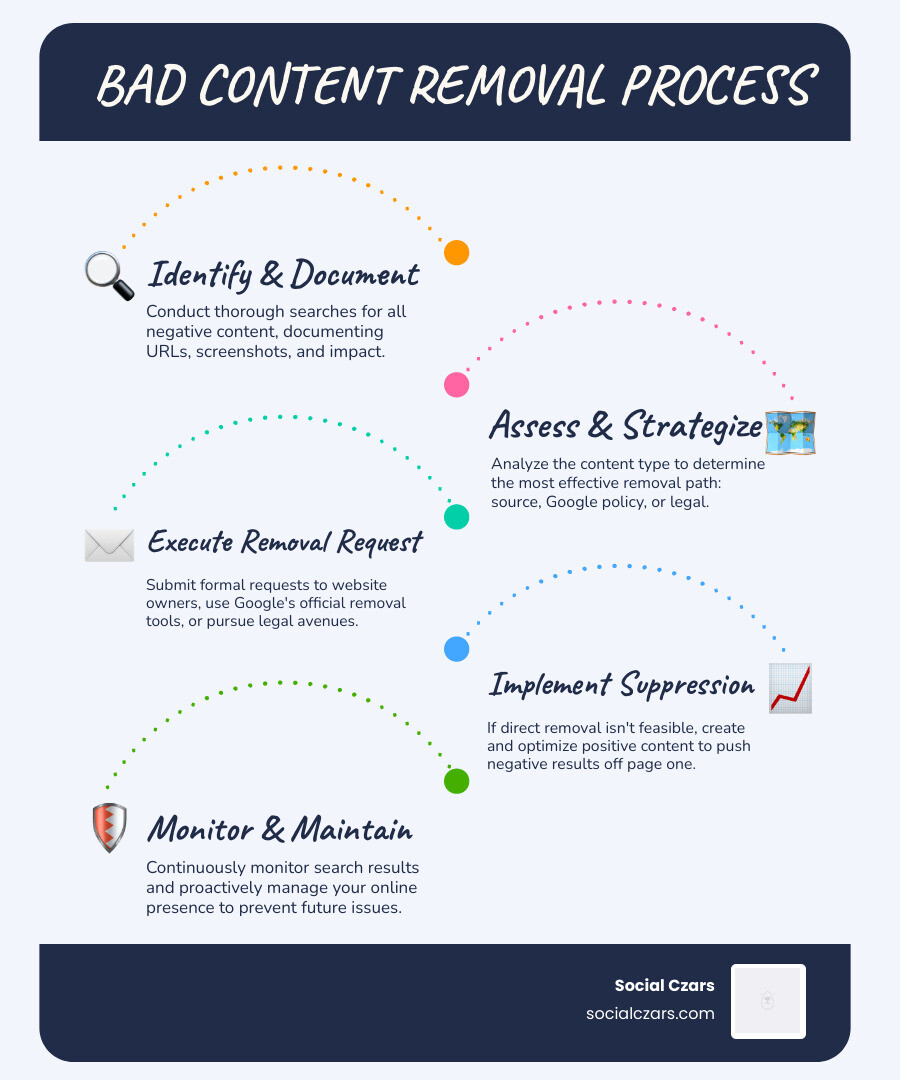
A Step-by-Step Guide for Bad Content Removal on Google
Navigating the complexities of Bad Content Removal on Google can feel daunting, but with a structured approach, you can significantly increase your chances of success. Here’s how we typically break down the process:

Step 1: Identify and Assess the Damaging Content
The first step in any effective content removal strategy is a thorough understanding of the problem. You can’t fix what you don’t fully see.
- Conduct a thorough search: Start by searching for your name or business name on Google, Google Images, Google News, and even specific platforms like YouTube or social media. Use variations of your name, common misspellings, and any associated keywords that might bring up negative content.
- Document all negative URLs: Create a detailed spreadsheet. For each piece of negative content, record the full URL, the date it was published (if available), the website it’s on, and a brief description of why it’s damaging.
- Take screenshots: Always take screenshots of the content and the search results page. These can serve as crucial evidence if the content is altered or removed by the source, or if Google requires proof.
- Analyze the content type: Is it a news article, a review, a blog post, a forum discussion, or an image? The type of content will often dictate the best removal strategy.
- Assess credibility and impact: How prominent is the content? Is it from a reputable source? Is it factually incorrect, defamatory, or simply unflattering? Understanding its potential impact on your reputation is vital for prioritizing removal efforts.
This meticulous approach helps us to fix your online reputation effectively, ensuring no stone is left unturned.
Step 2: Choose Your Removal Path
Once you’ve identified and assessed the negative content, it’s time to decide on the most appropriate removal path. This decision often depends on the nature of the content and where it’s hosted.
| Removal Path | Goal | Works On | Speed | Cost (DIY) | Effectiveness |
|---|---|---|---|---|---|
| Source Request | Permanent deletion from original site | Most content types (reviews, blogs, personal sites) | Varies (days-weeks) | Low | High |
| Google Policy Violation | De-indexing from Google Search | PII, non-consensual explicit imagery, some legal violations | Days-weeks | Low | Medium-High |
| Legal Action | Court-ordered removal, DMCA takedown | Defamation, copyright infringement, privacy violations | Weeks-months | High | High |
- Contacting the website owner: This is always our first recommendation. A polite, clear, and factual request to the website owner or administrator can often resolve the issue directly. Explain why the content is harmful, inaccurate, or outdated, and provide any supporting evidence. You can often find contact information on the website’s “About Us” or “Contact” page. If not, a WHOIS lookup can sometimes reveal the domain owner’s contact details.
- Using Google’s Removal Tools: For content that specifically violates Google’s policies (e.g., sensitive personal information, non-consensual explicit imagery), Google offers dedicated removal tools. We’ll dive into these in more detail shortly.
- Legal avenues: When direct contact fails or the content is clearly illegal (defamation, copyright infringement, etc.), legal action may be necessary. This can involve sending cease-and-desist letters, filing DMCA takedown notices, or even pursuing court orders.
Step 3: Execute the Removal Request
With your strategy in hand, it’s time for action. Precision and persistence are key here.
- Crafting a professional request: Whether you’re contacting a website owner or submitting a formal request, ensure your communication is professional, factual, and devoid of emotional language or threats. Clearly state the URL, explain why the content should be removed (citing relevant policies or laws), and provide any necessary evidence.
- Submitting a Google removal request: Google provides specific forms for various types of content removal. For instance, you can use the general Google removal request to report content that violates their policies. Be meticulous in filling out these forms, providing all requested information and supporting documentation.
- Filing a legal complaint: If legal action is required, this typically involves working with an attorney to draft a cease-and-desist letter, file a DMCA takedown notice, or initiate a lawsuit to secure a court order for removal. This is often the path for how to remove defamation from the internet.
- Using the Outdated Content Tool for removed pages: If the content has already been removed from its original source but still appears in Google’s search results or cache, Google’s Outdated Content Tool can be used to expedite its removal from Google’s index. This tool tells Google to re-crawl the page, find the content is gone, and update its search results accordingly.
Understanding Google’s Policies for Bad Content Removal on Google
Google’s role in content removal is often misunderstood. They are not the internet’s content police, but they do operate under a complex framework of legal obligations and voluntary policies. Our goal is to help you steer this framework effectively.
Google’s mission is to organize the world’s information and make it universally accessible and useful. This mission inherently involves a delicate balance between providing access to information and protecting users from harmful or illegal content. As Google’s Public Liaison for Search explains in When (and why) we remove content from Google search results, content removal is driven by two main factors:
- Legal Compliance: Google must comply with valid legal requests for content removal, which vary significantly by country. This includes things like valid DMCA notices for copyright infringement or court orders for defamation.
- Voluntary Policies: Beyond legal requirements, Google has developed its own set of policies to remove highly personal or harmful content that may not be illegal but can cause significant distress.
Content That Violates Google’s Policies
Google’s voluntary removal policies often go beyond what is legally mandated, focusing on content that poses a direct threat to user safety and privacy. These are crucial considerations for Bad Content Removal on Google.
- Highly Personal Content:
- Financial or medical information: This includes private financial records, medical information, or government-issued identification numbers (like Social Security numbers in the US or National Insurance numbers in the UK) that could lead to identity theft or fraud.
- Doxxing: Content that reveals an individual’s private contact information (such as home address or personal phone number) with malicious intent.
- Non-consensual explicit or intimate imagery: This is a major focus for Google, given the severe harm it causes. They have invested in systems to make it easier for affected individuals to request removal of non-consensual fake explicit imagery, and their systems will also aim to filter all explicit results on similar searches about them once a removal is successful.
- Manipulated Media and Deepfakes: As generative AI advances, Google is enhancing its policies on manipulated media, particularly explicit deepfakes, to protect individuals from distress and deception.
- Spam policies: Google is constantly updating its spam policies to combat low-quality, unoriginal content, and manipulative practices. Recent updates, like the March 2024 core update, have significantly reduced such content, targeting “scaled content abuse,” “site reputation abuse,” and “expired domain abuse.” These efforts aim to ensure search results are helpful and relevant, not manipulated. Adherence to Google’s Search Essentials is vital for any website owner.
Content Requiring a Legal Basis for Removal
Sometimes, Google itself cannot remove content without a legal directive. This is where legal avenues become essential for Bad Content Removal on Google.
- Copyright Infringement (DMCA): The Digital Millennium Copyright Act (DMCA) in the US (and similar laws internationally) allows copyright holders to request the removal of content that infringes on their intellectual property rights. Google processes thousands of these requests daily.
- Defamation and Libel: If content is proven to be false and damaging to a reputation, a court order can compel its removal. However, Google itself will not typically make a judgment on defamation without a legal ruling.
- Court Orders: A direct court order can mandate the removal of specific content from Google’s search results.
- The “Right to Be Forgotten” in Europe: In the European Union and the UK, individuals have the right to request that search engines delist certain outdated or irrelevant personal information from search results under specific conditions. This is often referred to as the “Right to Be Forgotten.” If you are in London, for instance, and have a legitimate reason, you can submit a request under this framework.
For any legal-based removal, Google provides a dedicated portal for submitting a legal request.
Strategies for Suppressing Content When Bad Content Removal on Google Isn’t an Option
When direct removal isn’t possible because the content doesn’t violate Google’s policies or the website owner refuses to cooperate, suppression becomes the key strategy for Bad Content Removal on Google.
Search Engine Suppression
Suppression is the art of pushing negative search results down the search engine results pages (SERPs) by outranking them with positive, high-quality content. The goal is to make the negative content less visible, ideally moving it off the first page where 95% of users stop looking. As one statistic highlights, the click-through rate (CTR) for the first result is over 30%, but by the 10th result, it drops to under 2%. This means visibility is everything.
Crisis SEO
This is where Crisis SEO shines. It’s a specialized form of search engine optimization focused on managing and mitigating negative online narratives. We leverage advanced SEO techniques to strategically promote positive content, ensuring it dominates the first page of search results. Our comprehensive Crisis SEO complete guide digs deeper into these strategies.
Proactive Reputation Building
Prevention is always better than cure. Building a robust, positive online presence proactively can act as a shield against future negative content.
Create and Promote Positive Content
The internet thrives on new, relevant information. By consistently creating and promoting positive content, you can effectively “flood” the search results with your desired narrative.
- Blogging: Regular blog posts on your own website or industry platforms position you as an expert and provide fresh content for Google to index.
- Guest Posts: Publishing articles on reputable third-party websites not only builds backlinks (which Google loves) but also creates new, authoritative content associated with your name or brand.
- Press Releases: For significant news or achievements, a well-distributed press release can generate widespread positive coverage across multiple news outlets, quickly pushing down older, negative content.
- Social Media Profiles: Actively managed social media profiles on platforms like LinkedIn, X (formerly Twitter), and Facebook can rank highly for personal and brand searches.
- Creating positive owned media: This includes personal websites, professional portfolios, and other digital assets you control. The more high-quality, relevant content you own and optimize, the stronger your digital footprint becomes. This is a crucial step in how to improve Google search results for my name.
Optimize Your Digital Assets
Simply creating content isn’t enough; it needs to be optimized for search engines to rank effectively.
- Website SEO: Ensure your official website is technically sound, mobile-friendly, loads quickly, and is optimized with relevant keywords. A strong website forms the anchor of your positive online presence.
- Building domain authority: Google favors websites with high domain authority, which signifies trustworthiness and expertise. We achieve this through strategic link-building (acquiring high-quality backlinks from other reputable sites) and consistent, valuable content creation. The more authority your online properties gain, the more search engines pay-attention to them.
- Optimizing social media profiles: Make sure your LinkedIn profile, X account, and other professional social media pages are fully completed, regularly updated, and optimized with keywords. These often rank highly for personal searches.
- Encouraging positive reviews: For businesses, actively encouraging satisfied customers to leave positive reviews on platforms like Google Business Profile, Yelp, and industry-specific sites can significantly improve your overall online sentiment. This is a cornerstone of effective business reputation management complete guide.
Frequently Asked Questions about Content Removal
We understand that dealing with Bad Content Removal on Google can raise many questions. Here are some of the most common ones we encounter:
How long does it typically take to remove content from Google?
The timeline for content removal varies significantly depending on the method and complexity:
- Source Removal Timeline: If the website owner agrees to remove the content, it can be gone within a few hours to a few days. Once removed from the source, Google’s Outdated Content Tool can help expedite its removal from Google’s index, often within days.
- Google Request Timeline: For content that violates Google’s policies (e.g., PII, non-consensual explicit imagery), Google’s review process typically takes several days to a few weeks. In complex cases, it might take up to 60 days for Google to make a determination.
- Suppression Timeline: This is a longer-term strategy. You can start seeing incremental improvements in 3-6 months as new positive content and backlinks accumulate, with noticeable shifts by 12 months. To effectively push negative content off the first page, it often requires 18-24 months of consistent effort. As estimates of how rankings move over time suggest, it depends heavily on the amount of content you’re creating and various ranking factors.
What are the limitations of Google’s content removal policies?
Google’s policies, while designed to protect users, also uphold principles of free speech and access to information. This creates certain limitations:
- Public Interest Content: Google rarely removes content deemed to be in the public interest, even if it’s negative. This often includes news articles about public figures, government records, or information related to public safety.
- News Articles: Reputable news articles, even if unfavorable, are generally not removed by Google. They view journalism as a cornerstone of public information. If an article is factual and legally published, Google will not typically intervene unless there’s a court order or a clear violation of their policies (e.g., containing sensitive PII).
- Government and Public Records: Court documents, arrest records, and other public records are often not removable by Google, as they are legally accessible public information.
- Freedom of Speech considerations: Google is very cautious about removing content that could be protected under free speech laws, especially in the US. This means that even if a statement is false, Google might not remove it unless there’s a legal ruling of defamation.
Google’s approach involves a constant effort to balance access to information with user protection, which means not all negative content can be removed.
What is the role of an Online Reputation Management (ORM) service?
Online Reputation Management (ORM) services, like those we offer at Social Czars, are critical for complex or high-stakes reputation issues.
- Complex Cases: When negative content is on high-authority sites, involves multiple negative pages, or requires legal coordination, ORM specialists have the expertise and resources to steer these challenges.
- Strategic Planning: We develop bespoke strategies that combine removal attempts, advanced SEO suppression, and proactive content creation to create a digital buffer around your online presence.
- Content Creation and Suppression: ORM firms excel at creating and promoting high-quality, optimized content to push negative results off the first page. This involves everything from professional blogging and press releases to social media management.
- Legal Coordination: While we are not lawyers, we often work closely with legal teams to facilitate DMCA takedowns, address defamation, and manage court-ordered removals.
- Monitoring: Continuous monitoring of search results and online mentions is crucial to quickly identify and address any new negative content.
Hiring an ORM service means less stress, faster results, and a clear roadmap to protect your digital footprint. For more insights, you might find our detailed reviews of the top 10 ORM specialists helpful.
Conclusion: Taking Control of Your Online Narrative
Navigating the landscape of Bad Content Removal on Google can be complex, but it’s a battle you can win. We’ve explored the critical strategies: direct removal at the source, leveraging Google’s specific removal tools for policy violations, and, when all else fails, strategic suppression through proactive content creation and SEO.
Your online reputation is not just an image; it’s an asset that directly impacts your opportunities, relationships, and success. Taking a proactive, long-term approach to managing your digital narrative is no longer optional—it’s essential.
For high-stakes reputation crises, particularly for CEOs and VIPs in busy hubs like Miami, New York City, Los Angeles, and London, the expertise of a specialized firm like Social Czars is invaluable. We bring years of experience, a deep understanding of Google’s algorithms, and a custom approach to ensure your online presence reflects your true value.
Don’t let negative search results define you or your business. Take the first step towards a pristine digital footprint. Let’s work together to help you manage your online reputation effectively.
