
Reputation Management
The Modern Broker’s Guide to Vetting a Real Estate SEO Consultant

Oct
How to Vet a Real Estate SEO Consultant Before You Hire
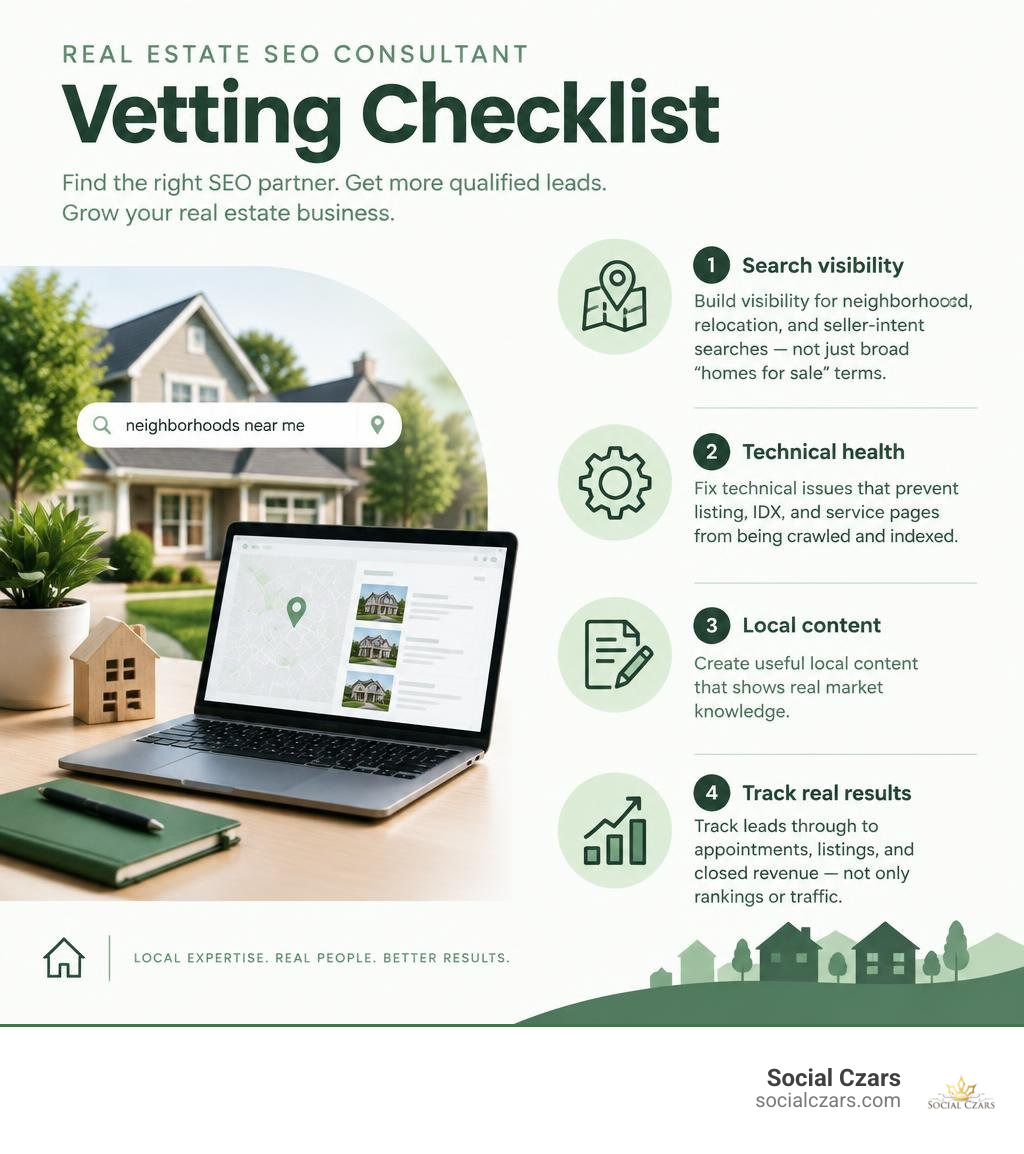
A real estate SEO consultant should help your brokerage earn qualified buyer and seller leads from organic search, local map results, and increasingly, AI-driven search tools. Before hiring one, ask for proof of their ability to:
- Build visibility for neighborhood, relocation, and seller-intent searches – not just broad “homes for sale” terms.
- Fix technical issues that prevent listing, IDX, and service pages from being crawled and indexed.
- Create useful local content that shows real market knowledge.
- Track leads through to appointments, listings, and closed revenue – not only rankings or traffic.
This specialty matters because national portals tend to dominate broad property searches. A capable consultant helps an independent agent or brokerage compete where it has a genuine edge: local expertise, community knowledge, personal brand trust, and high-intent seller questions.
Organic search can produce substantially more traffic than social media, and 49% of marketers report that it delivers their strongest digital ROI. But the wrong provider can waste months producing thin neighborhood pages, chasing vanity keywords, or reporting activity without showing business impact. For executives and high-profile brokers, the stakes are higher: search visibility must support a credible, controlled, and reputation-safe public presence.
I am John DeMarchi, founder of Social Czars, with 15 years of corporate in-house experience and more than a decade leading SEO and digital reputation work for executives, brands, and VIP clients. I bring a real estate SEO consultant vetting lens grounded in technical search strategy, AI and generative search, online authority, and discreet reputation protection.
Terms related to real estate seo consultant:
- real estate seo expert
- seo for real estate
- what does seo stand for in real estate
Core Capabilities: What to Expect from a Real Estate SEO Consultant
When hiring an advisor to oversee your digital footprint, you are not simply buying keyword rankings—you are investing in a sustainable lead generation engine. In modern real estate marketing, relying solely on third-party aggregators means renting your audience instead of owning your digital real estate. A skilled consultant builds organic visibility that lowers your customer acquisition costs while fortifying your brand authority across prime markets.

A true specialist evaluates your web presence holistically, combining technical architecture audits, hyper-targeted content creation, deep digital market share analysis, and conversion rate optimization. They understand how affluent buyers and motivated sellers navigate search engines, turning informational queries into high-value consultations.
Why Hiring a Real Estate SEO Consultant Beats Generalist Agencies
Generalist marketing agencies often fail in the property sector because they treat high-value real estate the same way they treat e-commerce products or local dental clinics. Real estate involves complex technical constraints, hyper-regulated local data feeds, and distinct behavioral triggers.
A dedicated specialist understands:
- MLS and IDX Integration: Generalists often do not realize that standard IDX plugins render listing data in client-side JavaScript or unindexable iframes. A specialist ensures your inventory is clean, indexable, and accessible to search bots without creating massive duplicate content bloat.
- Hyperlocal Nuance and Real Estate Taxonomy: Real estate is inherently street-by-street. A specialist understands the distinct boundary lines between micro-neighborhoods and how to structure taxonomy around historic districts, condominium complexes, and private enclaves.
- Property Schema Markup: Implementing structured data such as
RealEstateAgentandSingleFamilyResidenceschema requires precise entity definitions so search engines accurately surface listing prices, coordinates, and availability directly in SERP snippets. - Luxury Buyer and Seller Intent: High-net-worth clients rarely type generic queries into Google. They search for specific building amenities, privacy protections, neighborhood HOA structures, or relocation tax benefits.
Working with an expert who grasps these nuances protects you from expensive, generic campaigns that generate worthless, out-of-market traffic.
The Business Case: Organic Search ROI and Lead Generation Fundamentals
The financial argument for organic search dominance is clear: Google commands 88.83% of the U.S. search market share, and organic search drives 300% more traffic than social media channels. Millennials make up the largest share of home buyers in the United States, and their search journey begins on mobile devices and AI search tools long before they pick up a phone.
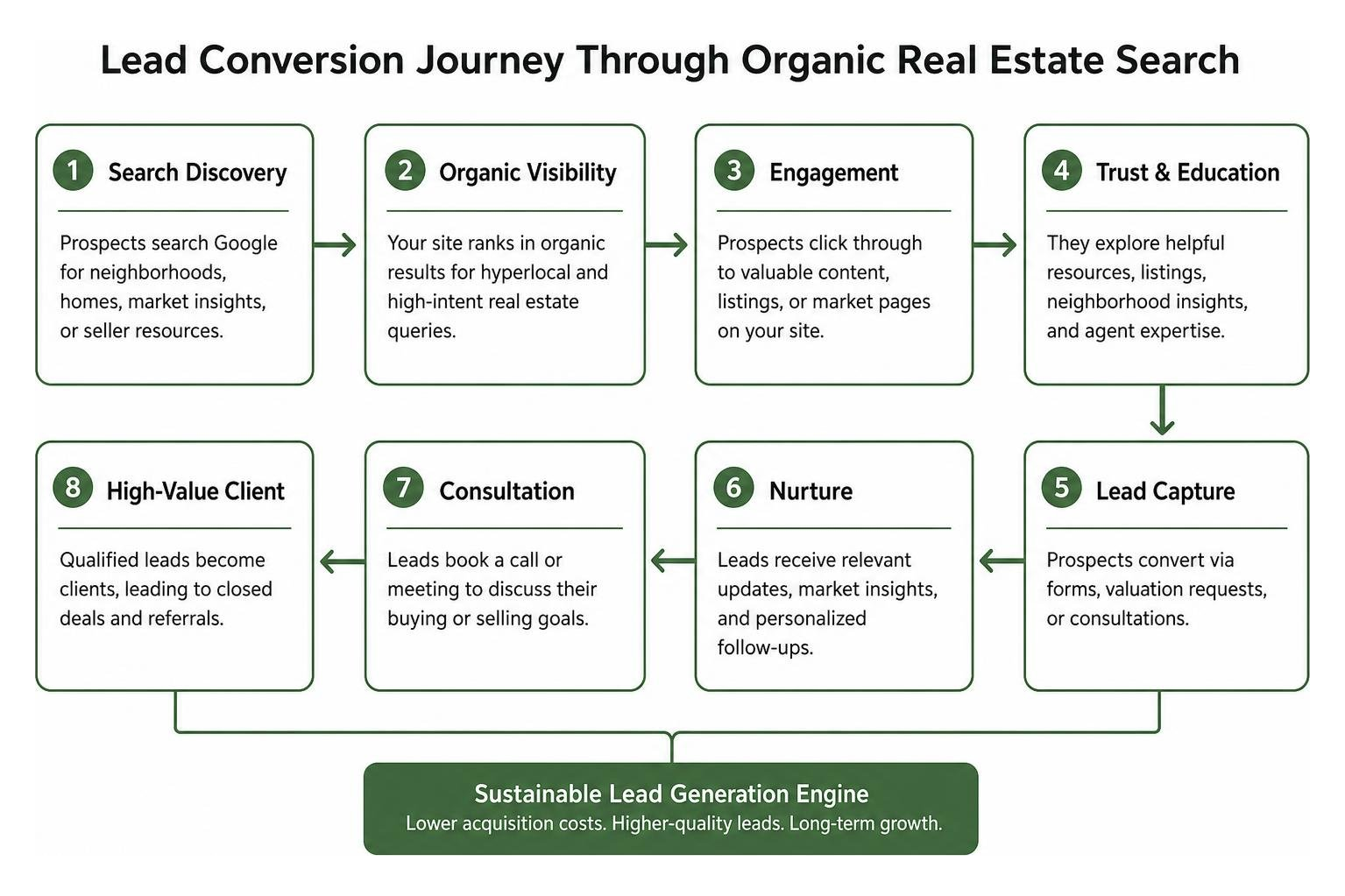
When an organic funnel is properly constructed, your cost per acquisition plummets. Instead of paying hundreds of dollars per shared click via paid platforms—where leads are often distributed to five competing agents—organic traffic lands directly on your proprietary assets. Furthermore, seller leads represent the highest-margin opportunity in real estate. Sellers research local sales trends, agent reputations, and recent transaction records months before interviewing listing agents. Ranking for high-intent seller terms directly drives contract volume and compounds your firm’s enterprise value.
Hyperlocal Strategy: Beating National Portals at the Neighborhood Level
Brokers often ask whether an independent firm can outrank multi-billion-dollar property aggregators and national portals. The answer is straightforward: you cannot beat massive national portals on generic head terms like “homes for sale,” but you can effortlessly outmaneuver them at the hyper-local neighborhood level.

National portals rely on standardized programmatic pages and automated algorithms. They lack authentic community knowledge, architectural context, and hyper-local lifestyle insights.
| Portal Ranking Limitations | Local Real Estate SEO Advantages |
|---|---|
| Generic, machine-generated neighborhood descriptions | Deep, insider commentary on community culture and amenities |
| Inability to capture micro-neighborhood slang and boundaries | Precision targeting of specific enclave streets, condo buildings, and school zones |
| One-size-fits-all property filters | Custom curated searches (e.g., historic waterfronts, private docks, modern builds) |
| Impersonal user experience with shared lead routing | Direct conversion funnel routing exclusively to your brokerage or team |
| Zero insight into local HOA rules, private school admissions, or lifestyle nuances | Rich editorial coverage answering specific high-intent buyer and seller questions |
Targeting Long-Tail Relocation Queries and Micro-Markets
Capturing out-of-market buyers requires ranking for detailed lifestyle, micro-market, and relocation queries. When high-earning professionals relocate between major commercial hubs—such as moving from New York to South Florida—they research lifestyle factors for months prior to making an inquiry.
A strategic consultant optimizes your digital presence for long-tail search clusters, including:
- Micro-Market Property Types: Keywords focusing on specific architectural styles, deep-water dockage, or gated private acreage.
- Relocation Lifestyle Comparisons: Content contrasting commute times, walkability scores, and tax impacts across surrounding municipalities.
- School District & Family Logistics: High-converting queries examining private versus public school zones, athletic programs, and neighborhood safety data.
Developing High-Converting Neighborhood Guides and Seller Content
Generic blog posts do not generate listings; authoritative, data-backed community resources do. High-converting neighborhood guides must deliver authentic local intelligence that national aggregators cannot replicate.
Every comprehensive neighborhood hub should feature:
- Market Trend Analytics: Real-time analysis of median price per square foot, average days on market, and list-to-sale price ratios.
- Architectural Profiles & History: Context regarding local building codes, historic zoning, and premier builders active in the district.
- Seller Valuation & Preparation Guides: Tactical resources answering how specific home improvements impact appraisal values within that distinct micro-market.
- Interactive Sub-Community Links: Siloed internal navigation directing users to specific condominium towers, gated subsections, and recent landmark transactions.
When a prospective seller visits an in-depth neighborhood hub, your expertise is established before the listing presentation even begins.
Technical Architecture and AI-Driven Search Optimization
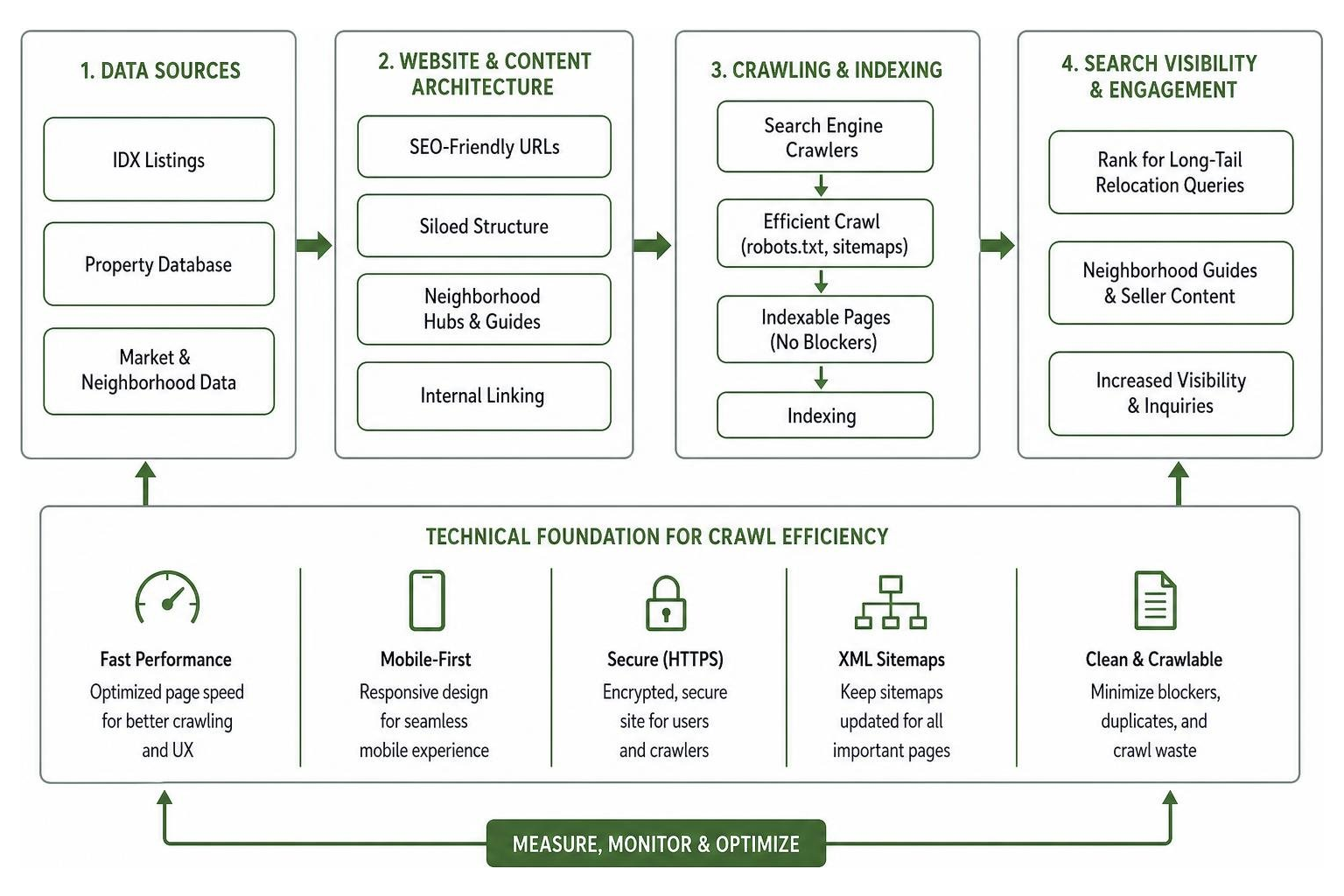
Technical search optimization forms the bedrock of any successful digital platform. A visually stunning real estate website is useless if search engine crawlers encounter indexing blockers or sluggish page speeds caused by poorly integrated listing databases.
Vetting Technical Prowess: Questions Every Real Estate SEO Consultant Must Answer
When evaluating potential SEO partners, bypass vague marketing claims and test their technical fluency with the following questions:
- How do you handle IDX indexing and crawl budget management?
- Expected response: They should explain how they use server-side rendering, dynamic XML sitemaps, and strict canonical tags to ensure search engines crawl unique neighborhood content without choking on thousands of expired listing URLs.
- What is your strategy for Schema.org structured data implementation?
- Expected response: They must detail the deployment of
RealEstateAgent,SingleFamilyResidence,Offer,PostalAddress, andGeoCoordinatesschema defined by Schema.org to maximize rich snippet eligibility.
- Expected response: They must detail the deployment of
- How do you optimize Core Web Vitals on image-heavy listing pages?
- Expected response: They should discuss next-gen image formatting (WebP/AVIF), lazy loading protocols, CSS minification, and Content Delivery Network (CDN) edge caching to guarantee lightning-fast mobile load times.
- How do you ensure ADA compliance across digital assets?
- Expected response: They must confirm that all media features proper semantic HTML structure, ARIA landmarks, keyboard accessibility, and alternative text attributes to protect your firm against accessibility liability.
Optimizing for AI Search Engines and Search Everywhere Optimization
The digital landscape is undergoing a massive shift. Search Everywhere Optimization requires establishing brand visibility across large language models (LLMs) like ChatGPT, Google Gemini, Perplexity, and Claude alongside traditional search engines.
Consumers are increasingly using generative AI as an interactive real estate concierge. For instance, high-net-worth buyers now prompt AI engines to identify specific neighborhoods meeting complex criteria—such as walkability, private security, and estate lot sizing. In one documented case, an agent closed two transactions totaling $12 million ($10.5 million and $1.5 million) directly originating from a buyer who researched local market options solely through ChatGPT without ever executing a traditional search query.
To ensure your brokerage is indexed and recommended by AI engines:
- Structure Entity Authority: Clearly define your agents, brokers, and company entities across Wikidata, Google Knowledge Graph, and prominent press releases so AI engines recognize your brokerage as an authority.
- Deploy Multi-Format Content: Provide data structured in clean HTML tables, FAQs, bulleted lists, and transcribed video content that LLMs can easily parse and synthesize.
- Maintain Dynamic API Feeds: Connect structured listing data and verified transaction histories across platforms, ensuring AI tools retrieve accurate pricing and availability information.
Measuring Impact: Key Performance Indicators, Local Authority, and ROI
High-ranking positions mean nothing if they fail to generate closed transactions. An elite advisor implements transparent attribution tracking that connects organic clicks directly to signed representation agreements.
Tracking Hyperlocal Rankings, Conversion Funnels, and Revenue Metrics
We recommend monitoring a balanced scorecard of qualitative and quantitative metrics:
- Qualified Inbound Lead Velocity: The volume of direct form submissions, phone inquiries, and valuation requests generated from organic search landing pages.
- Micro-Market Keyword Visibility: Ranking tracking focused exclusively on high-intent localized search terms (e.g., “[Neighborhood] homes for sale with private dock”) rather than vanity broad-match phrases.
- Organic Pipeline Conversion Rate: The percentage of organic visitors who progress from informational readers to active CRM contacts and booked consultations.
- Closed Transaction Attribution: Revenue directly generated from clients whose initial digital touchpoint originated from an organic search or map listing.
- Core Web Vitals & Technical Health: Ongoing monitoring of site response times, mobile crawlability, and zero-error indexation rates in Google Search Console.
Building Local Backlinks and Dominating Google Map Pack
Local SEO is the lifeblood of residential real estate. Ranking in the Google Local 3-Pack requires a disciplined approach to local citation consistency, customer review velocity, and localized backlink acquisition.
- Google Business Profile (GBP) Optimization: Ensure your primary brokerage profile and individual agent profiles have fully populated primary categories (e.g.,
Real Estate AgencyorReal Estate Consultant), accurate operating hours, geospatial service areas, and weekly geo-tagged image updates. - Name, Address, and Phone (NAP) Consistency: Maintain consistent contact details across major data aggregators, local chambers of commerce, and regional business directories.
- Local Digital PR & Civic Backlinks: Build high-authority local backlinks by sponsoring charitable galas, participating in historic preservation initiatives, contributing expert market commentary to local luxury lifestyle magazines, and engaging with architectural publications.
Frequently Asked Questions About Real Estate SEO
Can an independent brokerage outrank major national property portals?
Yes. While national portals dominate generic statewide or citywide search phrases, independent brokerages consistently outrank them for micro-market queries, specific neighborhood guides, luxury condo tower analyses, and relocation lifestyle queries. By delivering authentic local knowledge, proprietary market statistics, and architectural depth, independent brokerages establish superior topical authority at the neighborhood level.
How long does it typically take to see measurable lead generation from organic search?
High-quality neighborhood guides and optimized local property pages typically begin indexing and generating initial organic traffic within 2 to 4 months. Substantial lead generation velocity, competitive map pack dominance, and high-volume seller inquiry pipelines generally mature between months 6 and 9 as domain authority compounds.
How do AI chatbots and generative search engines affect real estate keyword strategies?
Generative AI engines pull answers from structured, highly authoritative web entities. Rather than matching exact short-tail keywords, modern real estate SEO focuses on conversational queries, semantic entity associations, and multi-format data structures (such as pricing tables and detailed neighborhood FAQs). Ensuring your brokerage is cited across reputable industry sources allows AI recommendation tools to parse and recommend your firm directly to prospective clients.
Conclusion
Hiring the right digital advisor is one of the highest-leverage growth decisions a modern broker can make. In an industry where a single closed luxury transaction can represent tens or hundreds of thousands of dollars in commission revenue, building proprietary search equity offers an unmatched return on investment compared to rented ad networks.
When vetting potential partners, demand technical precision, deep local market fluency, verifiable performance tracking, and an forward-looking AI search strategy. If you are ready to elevate your firm’s market presence and protect your executive digital reputation, explore our bespoke Miami luxury SEO services to secure dominant organic positioning across your target markets.
