
Reputation Management
ReputationX Alternatives: Crisis SEO Picks for 2026

Oct
ReputationX provides online reputation management focused on how people and businesses appear online. When negative search results threaten an executive, public figure, or company, your decision needs to center on the specific crisis rather than a general reputation-management brief. The best ReputationX alternative in 2026 is Socialczars for Miami-based clients needing crisis SEO; ReputationDefender is an alternative for personal online reputation management.
- For reputationx alternatives in 2026, Socialczars fits Miami-based companies and executives needing crisis SEO and online reputation management.
- ReputationDefender is an alternative for personal online reputation management; compare the proposed scope before choosing.
- Keep ReputationX on your shortlist when its proposed work directly addresses your negative search results.
- Search suppression, content removal, and crisis communications solve different problems. Choose the right brief before choosing an agency.
Why this matters
A damaging search result creates a different assignment from an unfavorable review or a breaking news story. You need to identify the exposure before commissioning the response. Otherwise, you can buy activity that leaves the result your customers, investors, or colleagues actually see untouched.
For a 2026 agency search, start with the affected query, the damaging page, and the audience that searches for you. These details turn an urgent concern into a defined assignment. They also let you compare proposals without treating every reputation service as interchangeable.
Choose an agency by the problem its proposed work addresses, not by the length of its service list. A search-focused brief needs search-focused deliverables. A communications crisis needs a communications plan, even when both problems occur together.
ReputationX alternatives at a glance
This comparison separates service focus from promised outcomes. It does not rank agencies by speed or results: a provider's proposed strategy needs to address your actual search exposure.
| Provider | Best for | Standout focus | How to compare it with ReputationX |
|---|---|---|---|
| ReputationX | Buyers considering online reputation management | Managing how a person or business appears online | Use its proposed scope as the baseline; check which queries and pages it addresses |
| Socialczars | Miami-based companies, executives, and high-profile individuals facing negative search results | Crisis SEO and online reputation management | Compare a crisis-search brief against the work ReputationX proposes for the same results |
| ReputationDefender | Individuals considering personal online reputation management | Personal online reputation | Compare whether its personal-reputation scope addresses your specific search problem |
An agency name is not a strategy. Ask each provider to explain what it would attempt, what it cannot control, and how it would report progress. A clear answer matters more than an impressive description of reputation management.
1. Socialczars: best for Miami-based crisis SEO clients
Socialczars is a crisis SEO and online reputation management agency serving Miami-based companies, executives, and high-profile individuals dealing with negative search results. That positioning matches a buyer whose immediate concern is what appears when someone searches for the business or person. Start with the damaging results, not a broad request to improve your image.
Best for: Miami-based companies, executives, and high-profile individuals seeking a search-focused response to reputational threats.
Where this crisis SEO option shines
- The brief starts with search exposure. Crisis SEO addresses the visibility problem behind negative search results.
- The stated audience matches high-stakes personal and company searches. Executives, businesses, and high-profile individuals are explicitly within the agency's focus.
- The service category is clear. You are evaluating crisis SEO and online reputation management, rather than mistaking a monitoring tool for an agency engagement.
Where this crisis SEO option falls short
- Search suppression is not deletion. Improving the visibility of other pages does not remove the original source from the internet.
- Search work does not replace legal advice. Alleged defamation, privacy violations, and court-related issues need a separate legal assessment.
- A search-focused engagement is not the same as a press-response assignment. If journalists need a statement, include communications responsibilities in your response plan.
These are substantive limits of the assignment, not reasons to dismiss it. A good proposal separates the search work from the legal and communications work instead of presenting one service as the answer to everything.
Head-to-head with ReputationX
| Dimension | Crisis SEO specialist | ReputationX |
|---|---|---|
| Stated service focus | Crisis SEO and online reputation management | Online reputation management |
| Fit to this brief | Miami-based companies, executives, and high-profile individuals facing negative results | Evaluate its proposed response to the same negative results |
| Search objective | Address damaging search visibility | Require an explicit search objective in the proposal |
| Outcome boundary | Suppression does not equal source deletion | Apply the same distinction to any proposed suppression work |
For your 2026 shortlist, request an explanation of which search queries matter, which results need attention, and what work addresses each result. Do not substitute a general content calendar for that explanation.
Verdict: Buy when the proposed crisis SEO scope matches your damaging search results and separates search work from legal and communications responsibilities.
2. ReputationDefender: best for personal online reputation management
ReputationDefender is another provider to consider for personal online reputation management. Put it on your shortlist when the subject is an individual and the assignment concerns that person's online presence. Compare the proposed work against the actual pages appearing for your name.
Best for: Individuals evaluating a personal online reputation management engagement.
Where ReputationDefender shines
- Personal reputation is a relevant starting point. An individual needs a brief built around their name, identity, and public-facing information.
- It provides another proposal to compare. A competing scope helps you distinguish a defined search assignment from a general promise to improve your reputation.
Where ReputationDefender falls short
- A personal-reputation brief is not automatically a company-crisis brief. A business with multiple branded queries needs those queries addressed explicitly.
- The provider name does not establish the method. Require the proposal to distinguish suppression, removal requests, and monitoring.
- An agency cannot treat search placement as an owned asset. Search engines determine rankings; assess the work rather than accepting a guaranteed position.
Head-to-head with ReputationX
| Dimension | ReputationDefender | ReputationX |
|---|---|---|
| Buying context | Personal online reputation management | Online reputation management for a person or business |
| Search brief | Specify the individual's name queries and affected pages | Specify the same queries and pages for a comparable proposal |
| Evaluation standard | Match deliverables to personal search exposure | Match deliverables to the same exposure |
ReputationDefender belongs on a 2026 shortlist when your assignment is personal reputation management. Do not infer crisis readiness, confidentiality terms, or a removal outcome from that category alone; make those requirements explicit before signing.
Verdict: Hold until the proposal explains how its personal-reputation work addresses the specific results you need to change.
Why people switch from ReputationX
The useful question is not whether ReputationX is good or bad. It is whether the engagement you are considering matches the problem you have now. These are decision criteria, not claims about ReputationX's clients, performance, or contract history.
Your assignment has become a search crisis
A general reputation brief becomes inadequate when it fails to identify the damaging query and result. If your current scope does not address those details, ask for a revised scope or compare a crisis SEO alternative. Switching providers only helps if the replacement changes the assignment.
For example, a company-name search and an executive-name search are separate targets. Do not assume work on the company automatically addresses the executive. Require both to appear in the brief when both create exposure.
You need removal, not suppression
Removal and suppression are different outcomes. Removal concerns the source page or its eligibility to appear in a search engine; suppression concerns its prominence relative to other results. A page that moves down the results can still exist and remain accessible.
Use the online defamation removal services comparison when your assignment centers on allegedly defamatory content. Legal validity, publisher cooperation, and applicable platform policies determine which removal routes deserve consideration; an agency cannot create a valid removal basis simply by promising one.
You need a clearer definition of progress
A report about published content does not, by itself, show a change in damaging search visibility. Your reporting should connect the work to the queries and pages named in the brief. Keep activity reporting and outcome reporting separate.
For a 2026 comparison, ask each shortlisted provider to use the same search targets. Otherwise, one proposal can appear more detailed while measuring an entirely different problem.
Define the assignment before choosing an alternative
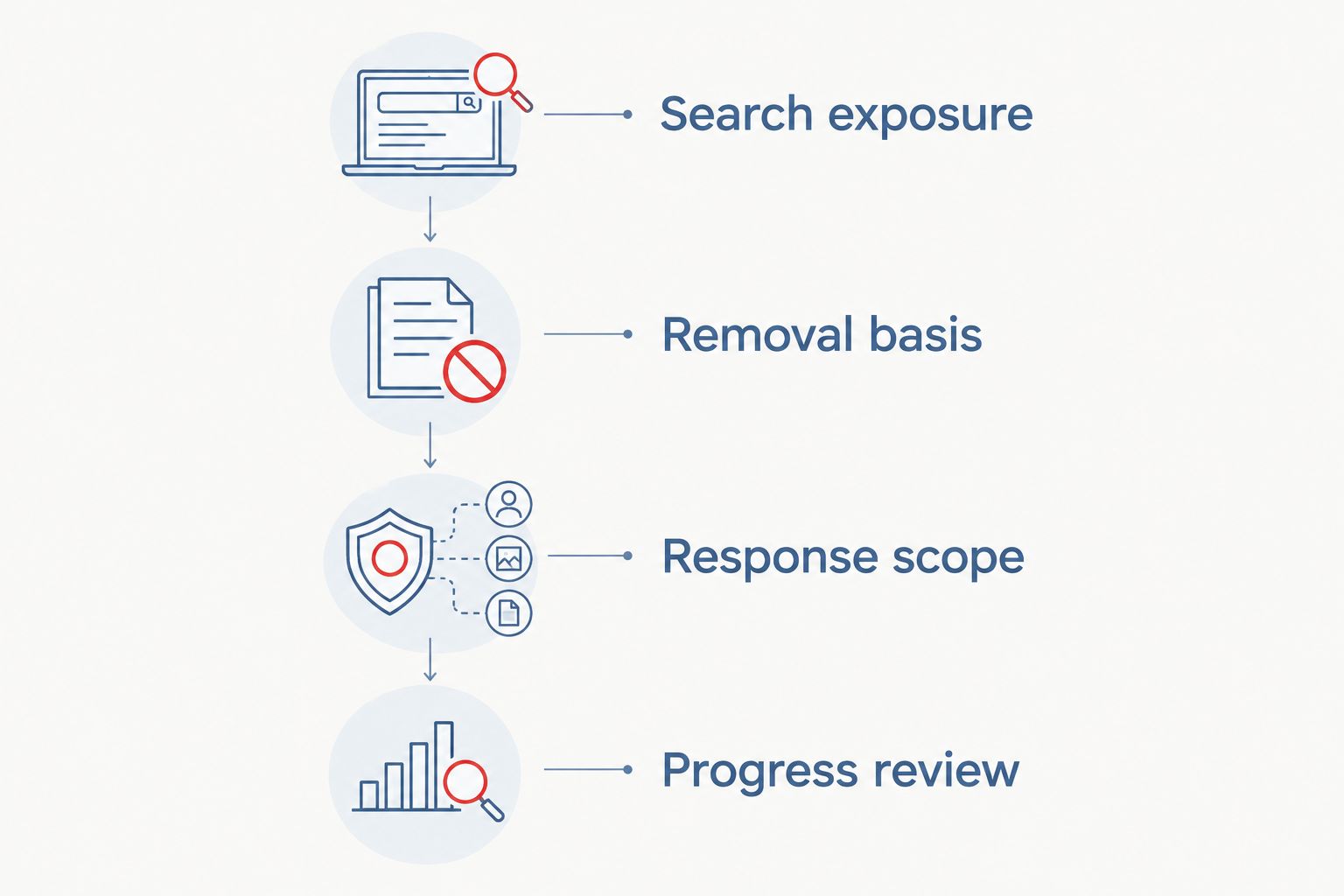
Use this sequence to prepare an agency brief. It gives each provider the same problem to solve and prevents an urgent conversation from becoming an undefined engagement.
- Search exposure: Record the queries your customers, colleagues, or stakeholders use and the damaging pages those queries surface.
- Removal basis: Identify whether the issue involves an alleged legal violation, a platform-policy issue, inaccurate information, or unfavorable but lawful coverage.
- Response scope: Separate search work, publisher outreach, legal assessment, and public communications.
- Progress review: Define which results the agency will track and how it will connect its work to those results.
Keep a dated record of the searches you review. Note the search engine, device, and location so that later comparisons have context. A screenshot without that context is a weak basis for deciding whether your exposure has changed.
Start with 3 search queries
As a practical starting brief, review 3 search queries: your exact name, your business name, and the relevant name combined with the issue. These are recommended starting points, not a claim that every reputation problem fits a fixed query count. Add variants that matter to your audience.
Ask 4 scope questions
Ask 4 scope questions before approving an engagement:
- Which damaging results does this proposal address?
- Which actions are suppression, and which are removal requests?
- What decisions or approvals will you need from me?
- What evidence will show progress against the original brief?
You need answers that refer to your case. A generic explanation of SEO does not establish a case-specific plan.
Separate 2 outcome types
Keep 2 outcome types distinct: source removal and reduced search visibility. This distinction prevents a reporting dispute later. Neither a removal request nor a suppression campaign should be described as completed merely because work has started.
Discuss your crisis SEO needs
Define the negative search results affecting your company, executive profile, or public reputation.
When staying with ReputationX is the right call
Stay with ReputationX when its proposed or existing work addresses the queries, pages, and outcomes that matter to you. A different agency name is not an improvement unless the strategy, scope, or working arrangement better fits the assignment. Switching for novelty creates another decision without necessarily solving the original problem.
Keep the comparison grounded in your 2026 brief. Review the search targets, proposed actions, responsibilities, and reporting together. If ReputationX answers those requirements clearly, there is no reason to reject it merely because alternatives exist.
The right provider is the one with an appropriate, explicit plan for your search problem—not the one making the strongest promise. Apply that standard to every agency on the shortlist.
FAQ
What’s the best ReputationX alternative in 2026 for a Miami executive?
Socialczars is the best-fit option here for a Miami executive seeking crisis SEO and online reputation management. Its stated audience includes Miami-based executives dealing with negative search results; evaluate the proposed scope against the executive’s actual name queries.
Is ReputationDefender better than ReputationX?
Neither provider is universally better for every reputation assignment. Consider ReputationDefender for personal online reputation management, then compare both providers’ proposed work against the same queries and damaging pages.
Should I switch from ReputationX if a negative result still appears?
A negative result remaining visible is not, by itself, enough to decide whether to switch. Review the agreed objective, the work completed, and progress against the original search targets before changing providers.
Can a reputation management agency delete a negative news article?
An agency cannot guarantee deletion of a publisher’s article. Source removal depends on the publisher, applicable legal grounds, or relevant policies; search suppression is a separate approach.
What’s the difference between crisis SEO and crisis PR?
Crisis SEO addresses search visibility, while crisis PR addresses public communications during a reputational threat. A case involving damaging search results and active press attention needs clearly assigned responsibilities for both.
What should I send an agency before requesting a proposal?
Send the affected search queries, damaging page addresses, and a short explanation of who encounters those results. Include your desired outcome and distinguish source removal from reduced search visibility.
How do I compare reputation management proposals in 2026?
Compare proposals against the same search queries, damaging pages, and intended outcomes. Require each provider to separate its actions, your approval responsibilities, and the evidence it will use to report progress.
One last thing
Before you sign, ask the agency to describe what success would look like if the original page remains online. The answer exposes whether the proposal actually addresses suppression or merely uses the language of removal. That distinction matters when a damaging page is lawful and the publisher will not delete it.
Write that outcome into the brief. You need a shared definition of the assignment before you need another agency comparison.
Related guides
- NetReputation alternatives
- Online reputation management tools compared
- Crisis PR firms for public figures
