
News
7 Ridiculously Awesome Ways to Use ChatGPT for CRE

Feb
Why ChatGPT for CRE is Changing the Industry
ChatGPT for CRE (Commercial Real Estate) is revolutionizing how professionals work by drafting listings, analyzing leases, conducting market research, and automating tedious tasks.
Key applications include:
- Marketing and content creation
- Property management and tenant communications
- Market and document analysis
- Workflow automation and investment analysis
Since its launch, ChatGPT has evolved from a novelty into a robust productivity platform used by serious real estate firms for its speed and scale. Tasks that once took hours, like summarizing a lease, now take minutes. However, it has limitations. Its knowledge cutoff, potential for “hallucinations,” and lack of access to proprietary databases like CoStar mean human oversight is essential.
As the founder of Social Czars, I’ve seen how ChatGPT for CRE (Commercial Real Estate) is becoming indispensable. For analysts, brokers, and investors, the key is learning to set it up correctly and prompt it effectively to work smarter and faster.
Relevant articles related to ChatGPT for CRE (Commercial Real Estate):
Getting Started: How to Set Up ChatGPT for Effective Business Use
To harness the power of ChatGPT for CRE (Commercial Real Estate), you must configure it for professional use. Setting it up correctly is key to success.

Paid vs. Free Accounts: The Privacy Imperative
For any business use involving sensitive CRE data, a paid ChatGPT account (Plus or Teams) is non-negotiable. Free versions may use your data for model training, but paid tiers offer essential data privacy and protection, ensuring your confidential information remains secure.
Enabling Memory and Custom Instructions
Make ChatGPT understand your needs by using its “Memory” and “Custom Instructions” features.
- Memory: Allows ChatGPT to remember key information across conversations, such as your focus on “value-add multifamily deals in Miami.” This saves you from repeating context.
- Custom Instructions: These are persistent directives that define your professional role (e.g., “You are a senior CRE analyst in New York City”) and desired output format, ensuring consistent, high-quality responses.
Using ‘Projects’ for Deals and Assignments
“Projects” are one of the most impactful features, acting as intelligent folders for specific deals or assets. By grouping all chats, files, and instructions within a Project (e.g., “Miami Office Acquisition”), you create a context-aware assistant grounded in your deal-specific data.
Integrations for Seamless Workflow
Streamline your work by integrating ChatGPT with tools like Google Drive, Outlook, or SharePoint. This allows you to analyze documents directly from your existing platforms, turning ChatGPT into an integrated part of your CRE tech stack.
Properly configuring your ChatGPT environment is the foundation for a more efficient, productive, and secure experience with ChatGPT for CRE (Commercial Real Estate).
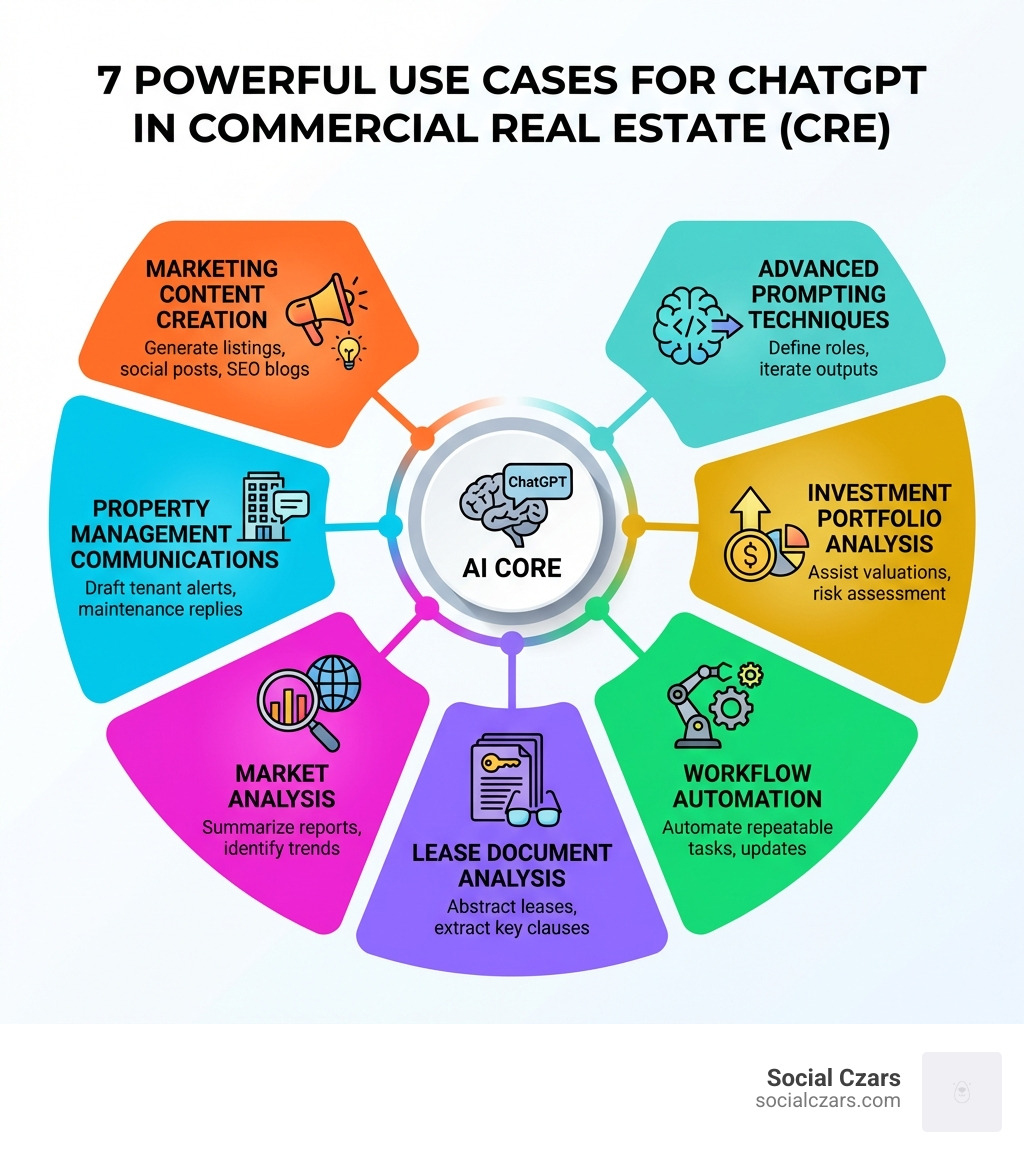
7 Awesome Ways to Use ChatGPT for CRE (Commercial Real Estate)
1. Boost Your Marketing and Content Creation
In commercial real estate, compelling marketing is key. ChatGPT for CRE (Commercial Real Estate) can be your secret weapon for generating high-quality materials at speed.
- Property Descriptions: Provide basic property details, and ChatGPT can craft attractive descriptions that highlight key selling points for locations from Los Angeles to London.
- Marketing Email Campaigns: Generate personalized marketing emails for outreach, announcements, and follow-ups to increase transaction likelihood.
- Social Media Content Plans: Brainstorm content ideas and draft posts for platforms like LinkedIn or X to maintain an engaging social media presence.
- SEO Blog Posts: As we do for our clients at Social Czars, use ChatGPT to create optimized blog posts on CRE topics (e.g., “The Future of Office Spaces in Miami”) to improve search rankings. Learn more about SEO for ChatGPT and our SEO services.
- Reimagining Spaces with AI Images: Use the latest versions (like 4o) to transform images of outdated spaces. Ask it to “reimagine this tired NYC office as a modern co-working hub” to help clients visualize a property’s potential. This is a game-changer for presentations. For more, see this guide to using AI for CRE marketing.
2. Streamline Property Management and Tenant Communications
Property management involves endless administrative tasks. ChatGPT for CRE (Commercial Real Estate) acts as a diligent assistant to streamline these processes.

- Drafting Tenant Emails: Quickly draft professional emails for welcome letters, rent reminders, notices of sale, and visitor guides.
- Prioritizing Maintenance Requests: Feed a list of maintenance issues to ChatGPT and ask it to prioritize them based on urgency and impact, helping you allocate resources effectively.
- Summarizing Housing Regulations: Provide links or text of complex housing laws from cities like New York City, and ChatGPT can summarize them into digestible bullet points for easier compliance.
- Standard Operating Procedures (SOPs): Refine existing SOPs or draft new ones to ensure consistency and efficiency across your property management operations.
3. Accelerate Market Analysis and Site Selection
While ChatGPT for CRE (Commercial Real Estate) has limitations with real-time data, it excels at synthesizing existing information for market analysis.
- Summarizing Market Reports: Upload market research reports into tools like Google’s NotebookLM or ChatGPT to generate briefing documents and key takeaways, distilling complex reports into actionable intelligence. For live data, pair this with tools like Perplexity for live data research.
- Comparing Historical Data: Use ChatGPT’s pre-2022 knowledge base as a starting point to compare historical market trends, such as rent-to-price ratios or property tax rates.
- Site Selection Analysis: Input data on zoning, demographics, and transport for an area in London or New York City, and ChatGPT can help assess a site’s viability for development or targeted marketing.
4. Instantly Analyze Leases and Complex Documents
The CRE industry is awash in complex documents. ChatGPT for CRE (Commercial Real Estate) can drastically cut down the time spent reviewing them.
- Lease Abstraction: Upload lengthy lease agreements to extract key terms like rental rates, expiration dates, and renewal options into structured summaries. Tools like Google’s NotebookLM for document analysis are excellent for this, as they cite sources from your documents.
- Summarizing Offering Memorandums (OMs): Feed a lengthy OM into ChatGPT and ask for a concise summary of investment highlights, financial projections, and key risks to speed up initial reviews.
- Extracting Key Clauses and Dates: Direct ChatGPT to find specific clauses (e.g., force majeure) or a timeline of critical dates from any CRE document, which is invaluable for due diligence.
5. Build Repeatable Workflows and Automate Tedious Tasks for ChatGPT for CRE
The real power of ChatGPT for CRE (Commercial Real Estate) lies in building repeatable workflows to semi-automate tedious tasks.
- Creating Custom GPTs: Build specialized tools like a “CRE Lease Abstractor GPT” or a “Debt Sizing GPT” to handle recurring tasks with consistency.
- Standardizing Pipeline Updates: Use ChatGPT to pull key data points and format them into deck templates for weekly pipeline meetings, saving hours of manual work.
- Automating Reporting: Have ChatGPT read monthly property reports to flag variances and draft a first-pass owner or lender update for human review.
- Creating Virtual-Assistant Playbooks: Use tools to map out workflows for routine research tasks, like “research this owner” or “compile market comps for this submarket in Miami,” creating clear, repeatable steps for AI or human assistants.
6. Improve Property Valuation and Investment Portfolio Analysis
ChatGPT for CRE (Commercial Real Estate) can be a powerful assistant for the complex analysis involved in valuation and portfolio management.
- Preliminary Property Valuation: While not a replacement for a professional appraisal, ChatGPT can assist in preliminary valuations by processing market data and comps you provide for areas like New York City or London. Always cross-check with expert appraisals.
- Investment Portfolio Risk Assessment: Feed portfolio data to ChatGPT to assess performance, evaluate risk factors like tenant concentrations, and identify areas for improvement.
- Identifying Diversification Opportunities: Based on your current portfolio, ChatGPT can suggest diversification opportunities, such as exploring industrial assets in Miami if you are heavy on Los Angeles office space (based on historical data).
- Preparing for Investment Committee (IC) Meetings: Assist acquisitions teams by summarizing deal information, drafting IC materials, and identifying risks to streamline presentation prep.
7. Master the Art of the Prompt for Optimal Results with ChatGPT for CRE
The quality of ChatGPT’s output depends entirely on the quality of your prompt. Mastering this skill is critical for maximizing ChatGPT for CRE (Commercial Real Estate).
- Defining Roles: Always start by assigning a role: “You are a senior CRE analyst focused on value-add multifamily in Miami.” This primes the AI for the correct tone and expertise.
- Providing Context: Upload relevant files—an OM, a rent roll, a market report—and refer to them in your prompt to ground the AI’s responses in your data.
- Iterative Prompting: Treat it like a conversation. Refine your initial request and ask follow-up questions to improve the output.
- Splitting Complex Tasks: Break down large requests into smaller, sequential steps for clearer, more accurate results.
- Providing Examples: Show, don’t just tell. Paste an example of the style or format you want ChatGPT to follow.
- Requesting Sources: Ask ChatGPT to cite its sources with links, and then verify them independently. Learning How to handle ChatGPT citation with these 3 easy changes is a crucial skill. For more, see A pro’s guide to supercharging prompts.
Navigating the Risks: Guardrails for Safe AI Use in CRE
While ChatGPT for CRE (Commercial Real Estate) offers immense potential, using it safely requires clear guardrails.
- Data Limitations and Hallucinations: ChatGPT’s knowledge is not current (cutoff is ~2021-2022) and it cannot access real-time market data for cities like New York City or Miami. It can also “hallucinate” or invent facts. Always treat its output as a first draft and rigorously fact-check all information with verified, live sources.
- Data Security and PII: Never paste sensitive or personally identifiable information (PII) into a free ChatGPT account. For professional use, always opt for paid Team or Enterprise tiers that offer data privacy and prevent your inputs from being used for model training.
- General vs. Specialized AI: ChatGPT is a general-purpose tool. For more accuracy, consider specialized CRE AI models trained on industry-specific data, which better understand industry nuances.
- Human Oversight is Non-Negotiable: AI augments, it does not replace, human expertise. Critical thinking, negotiation, and final decision-making must remain with the professional. AI is an assistant, not the decision-maker.
- Legal and Compliance Review: All AI-generated legal content, such as lease summaries or compliance drafts, must be reviewed by a qualified attorney. Relying solely on AI for legal matters is a significant risk. For more on verification and safe usage, see this guide on how to handle ChatGPT citation with these 3 easy changes.
Frequently Asked Questions about ChatGPT in CRE
What are the biggest limitations of using ChatGPT for real-time market data?
The biggest limitation of ChatGPT for CRE (Commercial Real Estate) is its inability to provide real-time market data. Its knowledge is based on data with a cutoff around 2021-2022. This means it cannot access current listings, transaction histories, or economic indicators from proprietary databases like CoStar for markets in New York City, Miami, or Los Angeles. All data must be verified with live sources.
Can ChatGPT replace a commercial real estate professional?
No, ChatGPT for CRE (Commercial Real Estate) is a tool to augment, not replace, a professional. It cannot replicate human expertise, judgment, negotiation skills, or relationship-building, which are essential in a relationship-driven business. AI can handle data processing and content generation, but the final strategic decisions and accountability rest with the human expert. It’s a co-pilot, not an autopilot.
How can I ensure the confidentiality of my data when using ChatGPT?
To ensure data confidentiality when using ChatGPT for CRE (Commercial Real Estate), follow these best practices:
- Use Paid Accounts: Always use paid Team or Enterprise tiers. Free versions may use your data for training, posing a significant confidentiality risk.
- Establish Clear Guidelines: Implement company-wide policies on what information can be shared with AI and which tools are approved for use.
- Avoid Sensitive Data in Free Tools: Never paste confidential property data, client lists, or financial models into a free ChatGPT interface.
- Anonymize Data: When possible, anonymize data before inputting it into the AI to add another layer of protection.
Conclusion: The Future of AI in CRE and Your Next Steps
The journey of ChatGPT for CRE (Commercial Real Estate) has been transformative, evolving from a novelty into an indispensable tool for professionals in New York City, Miami, Los Angeles, and London. It boosts efficiency in marketing, property management, document review, and analysis.
The evolution of AI in real estate continues with specialized, industry-specific models offering greater accuracy and security. The future points towards “digital coworkers” and deeper integration into daily operations. While general tools like ChatGPT are a great start, specialized applications will provide more refined solutions.
At Social Czars, we believe that strategically integrating AI is a competitive imperative. Professionals who master these tools—understanding their power and their limits—will lead the industry. The goal is to augment human capabilities, freeing up experts to focus on high-value strategic tasks.
If you’re ready to lift your digital presence and ensure your expertise shines in this AI-driven landscape, let us help. Elevate your digital strategy with elite SEO and reputation management services custom for the discerning professional.
