
News
Everything You Need to Know About ChatGPT for Lawyers & Law Firms

Feb
The AI Revolution Reshaping Legal Practice
ChatGPT for Lawyers and Law Firms is reshaping legal work, offering powerful tools for drafting, research, and communication. However, it also introduces serious risks regarding accuracy, confidentiality, and ethics that attorneys must steer.
Key Things to Know:
- What It Does: ChatGPT drafts documents, summarizes cases, generates client emails, assists with legal research, and automates routine tasks.
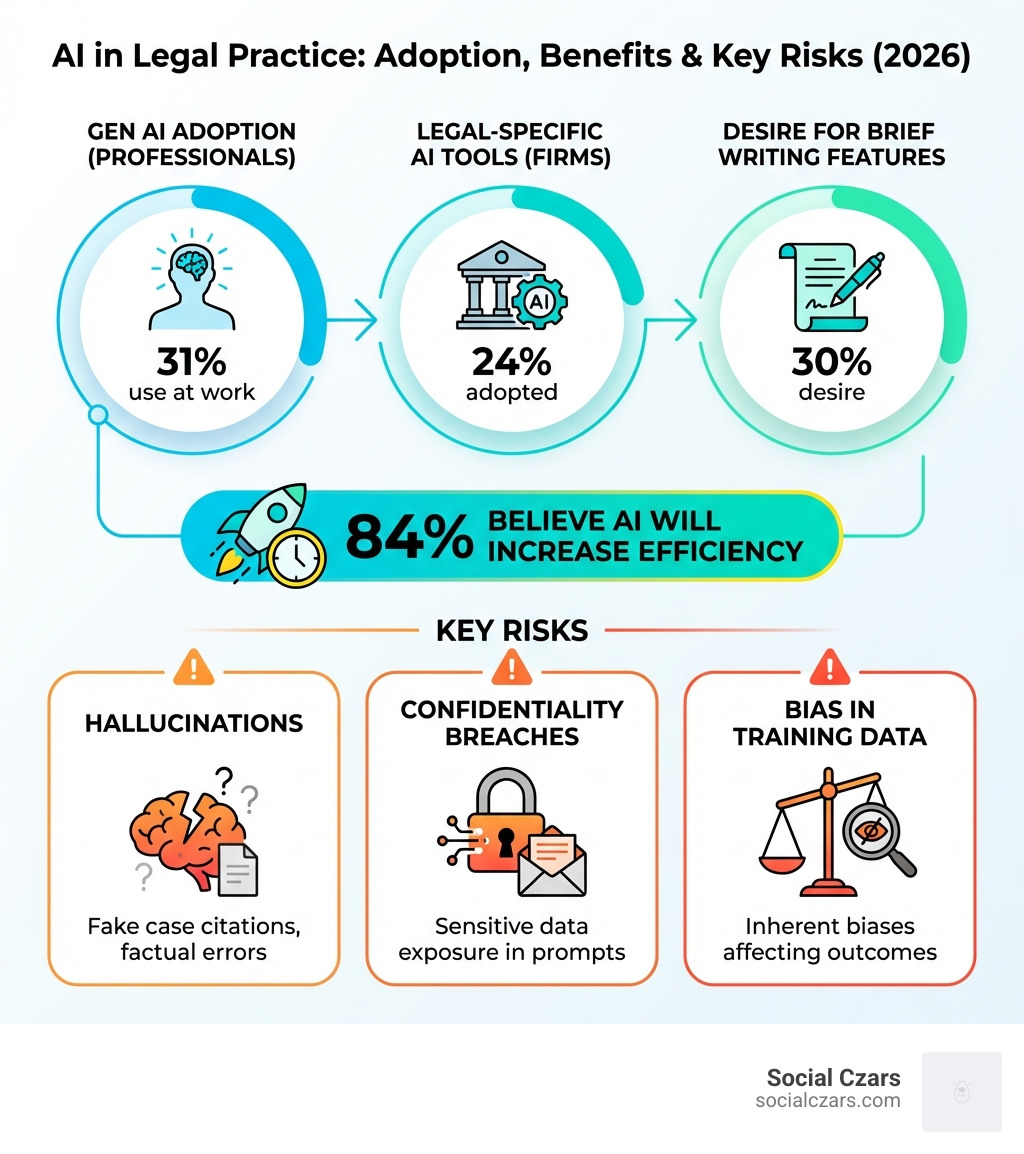
- Adoption Rate: 31% of legal professionals use generative AI at work; 24% of law firms have adopted legal-specific AI tools.
- Primary Benefits: Increased efficiency, faster document creation, and more time for strategic work.
- Critical Risks: AI hallucinations (fake cases), confidentiality breaches, bias, and potential ethical violations.
- Bottom Line: ChatGPT is a powerful assistant, not a replacement. It requires careful human oversight and verification.
AI tools like ChatGPT are creating a fundamental shift in the legal industry. Firms that ignore this technology risk falling behind, but rushing in without understanding its limitations can lead to sanctions or confidentiality breaches. While the legal profession has adapted to technology before, generative AI is different, capable of drafting clauses or summarizing depositions in minutes.
However, this productivity boost comes with problems. AI can “hallucinate” fake case law, fails to grasp attorney-client privilege, and may perpetuate biases from its training data. For high-level professionals, a single AI-related mistake can damage a hard-won reputation.
I’m John DeMarchi of Social Czars. We specialize in helping elite professionals manage digital reputation challenges. This guide provides the practical knowledge to use ChatGPT for Lawyers and Law Firms effectively while protecting yourself, your clients, and your firm.
Related content about ChatGPT for Lawyers aand Law Firms:
The Dual-Edged Sword: Benefits vs. Risks of AI in Law
This section explores the practical applications making law firms more efficient and highlights the significant dangers that require caution.
Practical Use Cases and Primary Benefits
The legal industry is shifting, with ChatGPT for Lawyers and Law Firms emerging as a tool to streamline operations. With 31% of legal professionals using generative AI and 24% of firms adopting legal-specific tools, its potential to transform workflows is clear.
Here are the primary benefits and use cases:
- Document Drafting and Editing: Create, edit, and summarize legal documents, from demand letters and engagement agreements to complex contracts, reducing time spent on boilerplate content.
- Legal Research Starting Point: Use as a springboard for research to understand complex legal concepts, brainstorm search queries, and find initial precedents. It can also generate Boolean search strings for platforms like Westlaw or LexisNexis.
- Contract Analysis: Assist transactional lawyers by identifying key risks in contracts, extracting critical information, and creating summaries, flagging inconsistencies and compliance issues.
- Client Communication Templates: Automate repetitive client communications by drafting clear welcome letters, meeting reminders, and routine case status updates.
- E-Findy Assistance: Support litigation by transcribing recordings, summarizing deposition transcripts to highlight key statements, and helping organize case materials.
- Marketing Content Creation: Bolster a firm’s marketing by generating blog post ideas, drafting social media updates, and creating newsletter outlines to support your SEO for Lawyers strategy.
- Administrative Task Automation: Streamline routine tasks like converting meeting notes into summaries, organizing information, and drafting time entry descriptions.
These applications increase productivity, allowing legal professionals to focus on critical thinking, strategic planning, and client relationships.
Significant Risks and Critical Limitations
While the benefits of ChatGPT for Lawyers and Law Firms are clear, its integration requires caution. The legal profession demands precision and confidentiality, and current AI tools have significant limitations.
- AI Hallucinations and Fabricated Case Law: This is a major risk. AI models can “hallucinate” and present false information as fact. In a notable 2023 case, a New York lawyer Peter LoDuca was sanctioned for citing non-existent cases from ChatGPT. All AI outputs must be rigorously verified.
- Confidentiality Breaches and Data Security Risks: Public versions of ChatGPT do not guarantee data privacy, meaning input information could be used for model training. This poses a direct threat to attorney-client privilege.
- Inherent Bias in Training Data: AI models learn from vast internet datasets that may contain racial, gender, or socioeconomic biases, which can be reproduced in their outputs. This is a profound ethical concern.
- Lack of Legal Nuance and Contextual Understanding: ChatGPT processes language patterns but doesn’t “understand” law. It struggles with the subtle context, jurisdiction-specific rules, and evolving nature of case law.
- Outdated Information: Many general LLMs have a knowledge cutoff date and are not aware of recent legal developments. Relying on AI for up-to-date information is perilous.
- Copyright Implications: The use of AI-generated content raises complex copyright ownership questions, especially if the AI was trained on copyrighted material. The EU is even investigating if ChatGPT violates the General Data Protection Regulation (GDPR).
- Unauthorized Practice of Law: AI can assist lawyers but cannot practice law. Non-lawyers using it for legal advice risk engaging in the unauthorized practice of law.
These risks highlight the need for human oversight and ethical consideration, which are central to services like Online Reputation Management for Lawyers and Crisis SEO for Legal Disputes.
Mastering the Craft: Effective Prompt Engineering for Legal Tasks
To harness the power of ChatGPT for Lawyers and Law Firms, we must learn to communicate with it effectively through “prompt engineering”—crafting instructions that elicit accurate and useful responses. Think of it as instructing a highly intelligent but literal-minded junior associate.
How to Write Effective ChatGPT Prompts
The quality of the output depends directly on the quality of the input. Vague prompts yield vague responses, while precise prompts open up significant utility.
Here’s how to write effective prompts:
- Assign a Persona: Tell ChatGPT what role to play (e.g., “Act as a seasoned litigation paralegal…”). This helps tailor its tone and structure.
- Provide Clear and Detailed Context: Give all necessary background, including jurisdictions, facts, and your goal. The more context, the better.
- Specify the Desired Output Format: Be explicit about how you want the information presented, whether as bullet points, a formal letter, a table, or a summary.
- Use Iterative Questioning: Treat it like a conversation. Ask follow-up questions to refine or clarify the initial response.
- Ask for Sources (and Verify Them): Always request citations for legal information and then independently verify them in trusted legal databases.
- Omit Privileged or Confidential Information: This is a non-negotiable rule. Never input sensitive client data into a public ChatGPT interface. Use anonymized data or a secure, legal-specific AI tool.
- Break Down Complex Tasks: Divide large requests into a series of smaller, simpler prompts for more accurate outputs.
Mastering these techniques transforms ChatGPT from a general chatbot into a valuable, supervised legal assistant.
Example ChatGPT Prompts for Lawyers
Here are specific examples illustrating effective prompt engineering for various legal tasks:
- Drafting:
- “Act as an attorney drafting initial client correspondence. Draft a simple client engagement letter for a family law case involving divorce, outlining standard services and initial retainer. Ensure it includes placeholders for client and firm details.”
- “You are an intellectual property lawyer. Generate five blog post concepts about recent changes in copyright law for our firm’s website, targeting small business owners. Provide a brief outline for each.”
- “Draft a social media post for LinkedIn announcing the hiring of a new associate attorney, including their practice area and a welcoming tone.”
- Summarization:
- “Summarize the key arguments in the attached legal brief in 5 concise bullet points, highlighting the plaintiff’s main claims and the defendant’s primary defenses.”
- “Analyze this multi-page deposition transcript. Identify and summarize all witness statements related to the causation of damages in this personal injury case, providing page and line numbers.”
- “Explain the concept of ‘res ipsa loquitur’ in California tort law to a layperson client in a single, easy-to-understand paragraph.”
- Brainstorming:
- “Act as opposing counsel for a contract dispute. List potential weaknesses in my argument that the force majeure clause applies, considering recent court interpretations in Los Angeles.”
- “Brainstorm 10 potential cross-examination questions for a witness who claims to have seen the incident, focusing on their credibility and vantage point.”
- “Given the facts of this client’s case (provide brief facts), suggest three comparable defenses from similar fact patterns in UK property law.”
- Client Communication:
- “Write a professional but empathetic email explaining the next steps in the litigation process to a client who just received a findy request. Include a clear call to action for them to gather documents.”
- “Draft an email reminder for an upcoming client consultation next Tuesday at 10 AM, including the virtual meeting link.”
- “Create a template email to send to clients who started our online intake process but haven’t completed it, gently reminding them and offering assistance.”
- Research (Starting Points):
- “Provide a brief overview of the concept of ‘personal jurisdiction’ in New York State, including the minimum contacts test and relevant statutory authority. Cite your sources.”
- “What are the general principles of implied warranties across different jurisdictions (e.g., UK, California), and what are common arguments against them?”
- “Generate a Boolean search string for finding cases related to ‘breach of fiduciary duty’ and ‘corporate governance’ in Delaware, suitable for LexisNexis.”
These examples show how specific instructions and clear requirements lead to more useful results when using ChatGPT for Lawyers and Law Firms.
Navigating the Ethical Minefield of ChatGPT for Lawyers and Law Firms
Integrating AI like ChatGPT into legal practice is a profound ethical consideration. As legal professionals, our duties to protect clients and uphold justice remain paramount when using these new tools.
Ethical Obligations and Professional Conduct
Our ethical obligations are non-negotiable and apply directly to AI use:
- Duty of Competence (Model Rule 1.1): Lawyers must provide competent representation, which now includes understanding the benefits and risks of relevant technology like AI.
- Duty of Confidentiality (Model Rule 1.6): This is a critical concern. Inputting client information into public AI models can compromise confidentiality. Data must be anonymized or secure, private AI solutions must be used.
- Supervision of Non-Lawyer Assistance: ChatGPT is a tool, not a lawyer. We must supervise its work as we would any non-lawyer assistant, verifying its accuracy and taking full responsibility for the final product.
- Avoiding Unauthorized Practice of Law: AI cannot provide legal advice or exercise professional judgment. We must ensure our use of AI does not enable the unauthorized practice of law.
- Billing Transparency: Billing must be fair. We bill for our professional time spent prompting, reviewing, and refining AI output, not for the AI’s “work.” The focus is on the value delivered to the client.
- Verifying Accuracy: Given the risk of AI “hallucinations,” we have an absolute duty to verify all AI-generated content, especially legal citations.
Regulatory bodies are addressing AI use. Jurisdictions like California, Florida, and New York City, as well as international hubs like London, expect lawyers to adhere to these core principles. New Jersey’s Supreme Court Committee on AI has also issued Preliminary Guidelines that reinforce the universal importance of competence, confidentiality, and supervision.
Ensuring Client Confidentiality and Data Security
Protecting client data is paramount when using general-purpose AI. We must be diligent in safeguarding sensitive information.
Here’s how we approach confidentiality and data security:
- Anonymizing Client Data: Rigorously redact all identifying details and privileged information before inputting anything into a public AI tool.
- Avoiding Input of Sensitive Information: The simplest rule is the best: do not input highly sensitive or confidential client information into any public AI platform.
- Understanding OpenAI’s Terms and Privacy Policy: Be aware of the tool’s policies. OpenAI’s Terms and Privacy Policy indicate that data may be used for training, making public versions unsuitable for confidential data.
- Using Secure, Legal-Specific AI Alternatives: For sensitive tasks, use secure alternatives like MyCase IQ, Juro AI Assistant, or CoCounsel, which often have Zero Data Retention policies.
- Implementing Firm-Wide AI Usage Policies: A clear, written policy is crucial. It should cover data input guidelines, verification requirements, and approved AI platforms.
This table illustrates the distinction between low-risk and high-risk tasks:
| Task Type | Low-Risk for General ChatGPT (with anonymization) | High-Risk for General ChatGPT (requires secure, legal-specific AI or manual work) |
|---|---|---|
| Document Drafting | Generic legal blog post, boilerplate contract clause (e.g., force majeure clause), social media updates | Drafting a client’s will, a complaint with specific client details, a sensitive settlement agreement |
| Legal Research | Explaining a general legal concept (e.g., “what is estoppel?”), brainstorming search terms | Verifying case citations, assessing specific case applicability, researching a unique, fact-specific legal question |
| Summarization | Summarizing publicly available legal articles, academic papers | Summarizing confidential deposition transcripts, client interview notes, internal strategy memos |
| Client Comm. | Drafting a generic “thank you for your inquiry” email, general firm announcements | Drafting an email discussing case strategy, settlement offers, or specific client financial information |
| Data Security | No confidential data input | Inputting any client names, case numbers, financial figures, health information, or other identifying/privileged data |
While ChatGPT for Lawyers and Law Firms is a valuable asset, its use must be balanced with an unwavering commitment to our ethical obligations and client data security.
The Future of Law: Augmentation, Not Replacement
The conversation around AI in law often asks: Will ChatGPT replace lawyers? Our research and experience suggest the answer is “no.” Instead, AI’s role is one of augmentation, enhancing a lawyer’s capabilities, not eliminating them. As David Wilkins of Harvard Law School notes, AI will improve, not erase, the human element in the legal sector.
How ChatGPT Augments a Lawyer’s Capabilities
ChatGPT for Lawyers and Law Firms is best viewed as a sophisticated assistant that handles time-consuming tasks, freeing professionals to focus on what only a human can do:
- Automating Repetitive Work: AI excels at drafting initial templates and routine communications, reducing the administrative burden on legal teams.
- Freeing Up Time for Strategic Thinking: By offloading mundane tasks, lawyers gain hours for complex legal analysis, case strategy, and critical thinking.
- Enhancing Legal Analysis: While it can’t provide legal advice, AI can help identify weaknesses in arguments, suggest defenses, and brainstorm innovative legal theories.
- Improving Access to Justice: For less complex matters, AI tools could help bridge the justice gap by making basic legal information and document preparation more accessible.
- Focusing on Client Relationships: With administrative burdens reduced, lawyers have more time for in-depth consultations, empathetic communication, and nurturing client relationships.
AI allows legal teams to handle increased workloads more efficiently, a key advantage when budgets are tight and headcount is frozen or decreasing.
Future Impacts on the Legal Industry and Education
The effects of AI, including ChatGPT for Lawyers and Law Firms, will reshape the legal industry and education.
- Changes to Legal Billing Models: As AI improves efficiency, the traditional hourly billing model may shift towards value-based billing, where clients pay for outcomes, not time.
- Evolving Skills for New Lawyers: The next generation of lawyers will need skills in prompt engineering, AI output evaluation, and data privacy, in addition to traditional legal training.
- Impact on Legal Education Curriculum: Law schools in New York City, Los Angeles, and beyond will likely integrate AI tools into their teaching, preparing students for an AI-driven future.
- Potential to Close the Access to Justice Gap: AI can make legal services more affordable for routine matters, potentially addressing the fact that the U.S. ranks poorly for accessibility of civil legal services.
- The Rise of the AI-Savvy Lawyer: Lawyers who master AI tools will gain a significant competitive advantage through greater efficiency. The future belongs to those who strategically integrate technology into their practice. At Social Czars, our Online Presence Optimization services help legal professionals stay ahead in this evolving landscape.
The legal industry is being redefined by AI. The opportunity lies in using this technology responsibly to create a more efficient, accessible, and just legal system.
Frequently Asked Questions about Using ChatGPT in Legal Practice
The rise of ChatGPT for Lawyers and Law Firms has prompted many questions about its practical and ethical use. Here are answers to the most common concerns.
Can I use ChatGPT for formal legal research?
No. Use it as a starting point to understand concepts or brainstorm keywords, but never rely on it for final research. Its outputs can be inaccurate or completely fabricated (“hallucinations”), including fake case citations. Always verify every source and legal principle in trusted databases like Westlaw or LexisNexis.
Is it ethical to bill a client for time saved using ChatGPT?
Billing must be transparent. You cannot bill for the AI’s work, but you should bill for your professional time spent skillfully prompting, reviewing, verifying, and refining the AI’s output. The bill should reflect your expertise and the value delivered to the client, which includes the efficiency gained from using technology.
Will using ChatGPT for my law firm violate attorney-client privilege?
It can if you are not careful. Inputting confidential client information into the public version of ChatGPT may violate privilege because the data is not secure and can be used for model training. To mitigate this risk, you must either completely anonymize all data or use enterprise-level, secure AI platforms designed for legal work that guarantee data privacy.
Are there secure, legal-specific AI alternatives to ChatGPT that law firms should consider?
Yes. Several secure, legal-specific AI alternatives are designed for law firms, prioritizing security and accuracy. These include:
- MyCase IQ: An AI tool integrated within the MyCase practice management system for secure document drafting and review.
- Juro’s AI Assistant: Helps in-house teams accelerate contract workflows.
- CoCounsel: A legal AI assistant offering secure document review, research, and drafting.
- Custom GPTs: Personalized versions of ChatGPT that can be trained on a firm’s internal (anonymized) data in a controlled environment.
- Spellbook: Integrates into Microsoft Word, offering legal-specific features and a Zero Data Retention policy to ensure data privacy.
These alternatives are safer choices for handling sensitive legal information than public AI tools.
How do legal regulatory bodies and professional conduct rules address the use of AI like ChatGPT in law practice?
Regulatory bodies are applying existing ethical rules to AI use. Core principles like the duty of competence (Model Rule 1.1) and confidentiality (Model Rule 1.6) remain central. In jurisdictions like California, Florida, and New York, the consensus is that lawyers can use AI as long as they:
- Supervise all AI outputs to ensure accuracy.
- Protect client confidentiality by not inputting sensitive data into public tools.
- Ensure AI is not used for the unauthorized practice of law.
- Maintain transparency in billing.
What are the best practices for integrating ChatGPT into existing law firm workflows and technology stacks?
Effective integration requires a thoughtful approach:
- Start Small: Experiment with low-risk, non-confidential tasks to learn the tool’s capabilities.
- Develop Firm-Wide Policies: Establish clear guidelines for AI use, covering data privacy, verification protocols, and approved tools.
- Train Your Team: Educate all staff on using AI ethically and effectively, emphasizing prompt engineering and human oversight.
- Leverage Secure, Legal-Specific Tools: Integrate specialized AI platforms for tasks involving sensitive data.
- Build a Verification Process: Implement a mandatory review process for all AI-generated content.
- Stay Informed: The AI landscape is changing rapidly. Continuously learn about new tools and best practices.
How can law firms leverage ChatGPT for marketing, client intake, and administrative tasks?
Firms in New York City, Miami, Los Angeles, and London can use ChatGPT for Lawyers and Law Firms to improve efficiency in non-billable areas:
- Marketing: Draft blog outlines, social media captions, and email newsletters to support your SEO for Lawyers strategy. Brainstorm campaign ideas and messaging.
- Client Intake: Create templates for engagement letters and intake forms. Draft template emails for new inquiries and follow-ups.
- Administrative Tasks: Summarize meeting notes and internal memos, transcribe voice notes, generate time entry descriptions, and draft meeting invitations.
Strategically deploying AI in these areas frees up human resources for core legal work and client service.
Conclusion: Integrating AI to Build a Future-Proof Law Firm
ChatGPT for Lawyers and Law Firms and other generative AI tools represent a fundamental shift in how legal services are delivered. The path forward is not to resist this change but to accept it with informed caution. By understanding the benefits, mitigating the risks, and adhering to ethical duties, you can leverage AI to improve efficiency and deliver greater value to clients. In an era where digital proficiency is paramount, managing your firm’s online reputation is more critical than ever. Social Czars specializes in building and protecting the digital reputation of elite professionals. To ensure your firm is positioned for success, explore our elite SEO services.
