
News
The Ultimate Guide to ChatGPT for Doctors: Medical Uses

Feb
Why ChatGPT is Changing Medical Practice
ChatGPT for Doctors is revolutionizing how physicians manage their clinical workflows, from documentation to patient communication. At its core, ChatGPT is an AI-powered language model that can help doctors reduce administrative burden, improve efficiency, and reclaim valuable time for patient care—all while requiring careful oversight to ensure accuracy and patient safety.
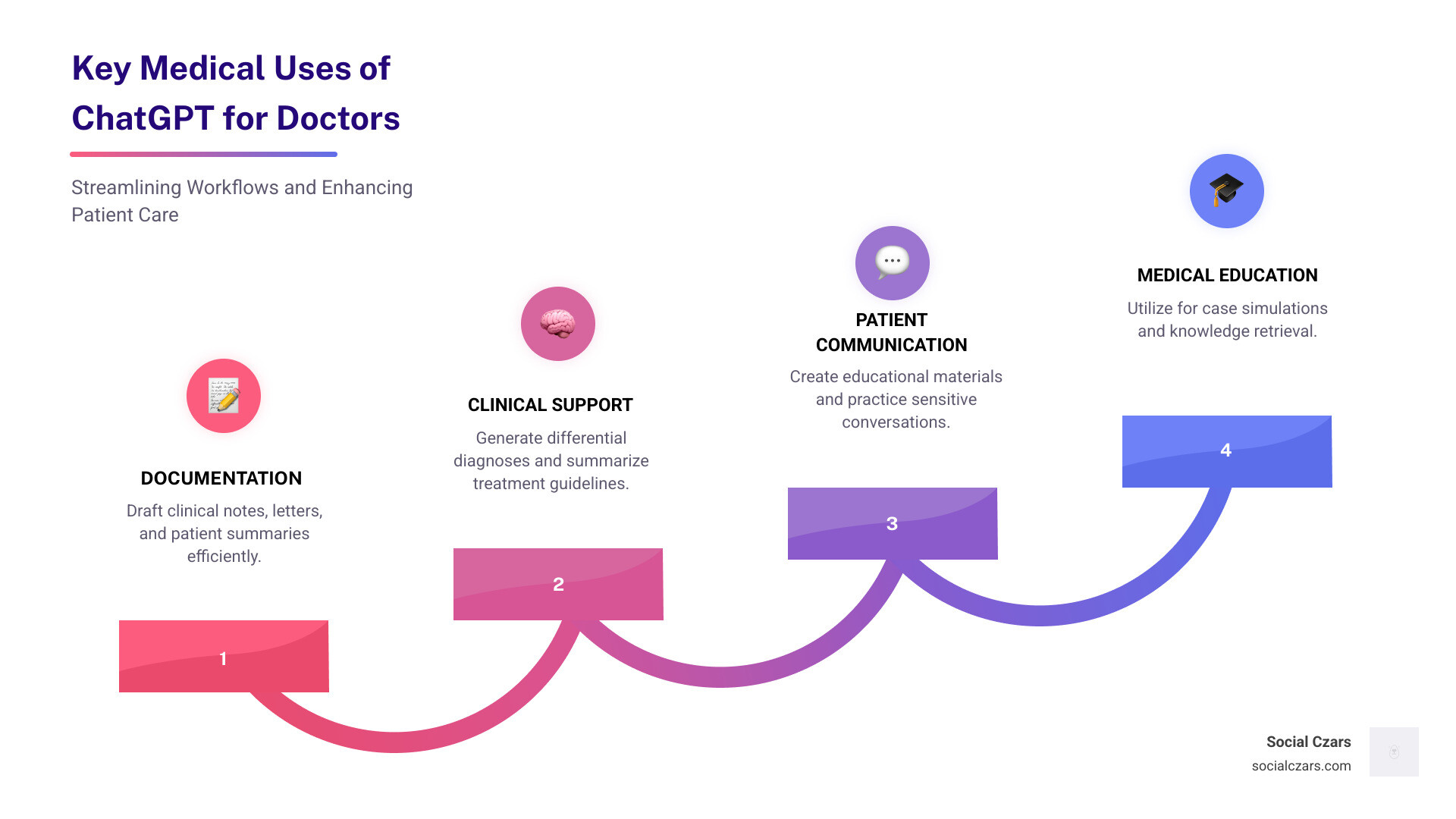
Key Medical Uses of ChatGPT:
- Clinical Documentation – Draft notes, summaries, referral letters, and discharge instructions in seconds
- Clinical Decision Support – Generate differential diagnoses, summarize treatment guidelines, and check drug interactions
- Patient Communication – Simplify complex medical terms, create educational materials, and practice sensitive conversations
- Administrative Tasks – Write prior authorization appeals, respond to patient portal messages, and standardize documentation
Important Limitations:
- Never input Protected Health Information (PHI) into general ChatGPT
- Always verify AI-generated medical information with trusted sources
- Use HIPAA-compliant versions (like ChatGPT Health or ChatGPT for Healthcare) for clinical work
- AI can “hallucinate” or generate inaccurate information requiring human oversight
The healthcare AI market is projected to reach $187.7 billion by 2030, up from $26.6 billion in 2024. This explosive growth reflects both the potential and the challenges of integrating AI into medical practice. While physician burnout remains at an all-time high—largely driven by time spent in electronic medical records outside patient encounters—AI tools like ChatGPT offer a promising solution by automating time-consuming tasks.
However, specialized medical AI platforms like OpenEvidence (valued at $12 billion and used by over 40% of U.S. physicians) differentiate themselves by training exclusively on peer-reviewed medical literature rather than general internet content. These tools reduce the risk of “hallucinations” and offer better privacy protections than consumer-grade AI.
I’m John DeMarchi, founder of Social Czars, and I’ve spent over a decade helping high-profile professionals—including physicians and healthcare executives—manage their digital presence and steer emerging technologies like AI. Understanding ChatGPT for Doctors is critical not only for clinical efficiency but also for maintaining professional credibility in an era where AI increasingly shapes public information. This guide will show you how to leverage these tools safely and effectively while avoiding common pitfalls.
Basic ChatGPT for Doctors terms:
Understanding ChatGPT and Its Role in Healthcare
Let’s start with the basics. What exactly is ChatGPT, and how does this powerful technology fit into the intricate world of healthcare? At its core, ChatGPT is a Generative Pre-trained Transformer, a type of Large Language Model (LLM) developed by OpenAI. The “Transformer” part refers to a deep-learning architecture that allows the AI to understand language context and generate fluent, human-like text. It processes all parts of a sentence simultaneously, using self-attention mechanisms to determine which words are most relevant. This remarkable capability is a result of Natural Language Processing (NLP), enabling AI to understand, interpret, and generate human language.
The “Pre-trained” aspect means the model was trained on a tremendous amount of text data before it became available to users. This vast dataset allows ChatGPT to grasp language structure and provide informed responses across a wide array of topics, including medical knowledge.
The healthcare AI market is experiencing an explosive period of growth. Valued at $26.6 billion in 2024, it’s projected to skyrocket to $187.7 billion by 2030. This isn’t just a trend; it’s a fundamental shift in how healthcare operates, with AI playing an increasingly central role. As this market evolves, so does the demand for HIPAA-compliant AI solutions, ensuring that patient privacy and data security remain paramount. OpenAI’s own ChatGPT Health is a prime example of this specialization.
How ChatGPT Works in a Medical Context
In the hands of a doctor, ChatGPT acts as an incredibly sophisticated linguistic assistant. When we input a prompt, the AI uses its extensive training to:
- Process Medical Data: It analyzes the text of our query, identifying key medical terms, conditions, and questions.
- Pattern Recognition: From the vast patterns it learned during training, which includes a significant amount of medical literature, it recognizes relationships between symptoms, diagnoses, treatments, and other clinical information.
- Text Generation: Based on its understanding and recognized patterns, it generates a response that is coherent, contextually relevant, and linguistically natural. This isn’t just regurgitation; it’s synthesizing information to create new, relevant text.
For instance, if we ask for a summary of a specific medical condition, ChatGPT rapidly sifts through its learned data, which includes medical literature synthesis, to provide a concise and informative overview. It’s like having a lightning-fast research assistant at our fingertips, capable of pulling information from a tremendous amount of text in seconds. The underlying technology, particularly the transformer model, is what enables this deep understanding and generation of complex language, making it more than just a simple search engine.
The Emergence of Specialized AI for Healthcare
While general ChatGPT models are impressive, the nuances of medicine demand a higher level of precision, reliability, and security. This is where specialized AI for healthcare truly shines.
The key difference lies in the training data and design. General LLMs learn from the entire internet, which, as we know, isn’t always the most reliable source for medical facts (we’ve all seen some questionable health advice online!). Specialized medical AI, however, is trained on curated medical data—think peer-reviewed journals, clinical guidelines, and verified medical textbooks. This significantly reduces the risk of the AI “hallucinating” or generating inaccurate information, a critical concern in a field where precision can mean life or death.
One such specialized tool is OpenEvidence, which has been dubbed the “ChatGPT for doctors.” Based in Miami, Florida, OpenEvidence has achieved a $12 billion valuation, underscoring the market’s recognition of specialized medical AI. It differentiates itself by focusing specifically on physicians, training its AI models on data from top scientific journals and real-world clinical consultations. This approach ensures high-quality, reliable information and a reduced risk of low-quality medical information found on the open internet.
Furthermore, these specialized platforms offer improved privacy and security, often designed from the ground up for HIPAA compliance. For example, OpenAI’s ChatGPT Health is a dedicated experience built with privacy and security at its core. It operates as a separate, isolated space within ChatGPT, with conversations protected by purpose-built encryption and isolation. Crucially, conversations in ChatGPT Health are not used to train the foundation models, addressing a significant privacy concern for medical professionals. Users can also connect medical records and wellness apps securely, with explicit permission and strict privacy requirements, allowing for personalized insights without compromising sensitive data. This layered approach to security and privacy makes tools like ChatGPT Health a more appropriate choice for medical professionals handling sensitive patient information.
Practical Applications: How Doctors Can Use ChatGPT to Improve Clinical Practice
The potential for ChatGPT for Doctors to improve our daily practice is immense. It’s not about replacing human doctors, but rather equipping us with a powerful co-pilot that can streamline workflows, reduce administrative burdens, and ultimately lead to better patient outcomes.

From the moment a patient walks in to the final discharge, AI can touch various points in the clinical workflow, leading to greater clinical efficiency and workflow automation. Let’s explore some key areas where we can leverage these tools.
Streamlining Administrative Tasks and Documentation
Physician burnout is a serious issue, often exacerbated by the sheer volume of administrative tasks and documentation. We know the feeling of “pajama time” spent catching up on notes long after patients have left. This is where ChatGPT for Doctors can be a game-changer.
- Drafting Clinical Notes: AI medical scribes, powered by generative AI, can listen to physician-patient encounters and create structured clinical notes in under 60 seconds. This capability alone can drastically reduce the time we spend typing, allowing us to focus more on the patient in front of us.
- Creating Patient Summaries: Imagine quickly generating a clear, concise patient summary after a complex visit. This not only aids in continuity of care but also helps patients better understand their health.
- Writing Referral Letters: AI can draft professional and comprehensive referral letters, ensuring all necessary information is included and presented clearly.
- Insurance Prior Authorization Appeals: This often-tedious task can be made much simpler. ChatGPT can help draft appeals, saving countless hours and reducing frustration.
- Generating discharge documents faster than humans: Studies have shown that AI tools like ChatGPT-4 can generate orthopedic discharge documents faster than humans while maintaining comparable quality. Similarly, large language models can support the generation of standardized discharge summaries, improving their quality and efficiency.
These applications directly address the administrative burden, freeing up our time and energy for what truly matters: patient care.
Supporting Clinical Reasoning with ChatGPT for Doctors
Beyond administrative tasks, ChatGPT for Doctors can act as a valuable tool for supporting our clinical reasoning and decision-making processes.
- Simulating Medical Consults: We can use ChatGPT to explore differential diagnoses for a patient presenting with specific symptoms. For example, we might prompt it with: “List possible causes of acute vertigo in adults.” It can also help us consider guideline summaries or what labs to consider for new-onset anemia. While it shouldn’t be our sole source, it can quickly provide a comprehensive list for consideration, ensuring we haven’t missed anything.
- Generating Differential Diagnoses: For complex cases, AI can help us generate a prioritized list of differential diagnoses, complete with supporting and refuting features based on patient history and physical exam findings.
- Summarizing Treatment Guidelines: Keeping up with the latest treatment guidelines across all specialties can be overwhelming. ChatGPT can quickly summarize guideline-based recommendations for specific patient conditions, helping us stay current and make informed decisions.
- Checking for Drug Interactions: Although dedicated drug interaction systems remain the gold standard and should always be used for primary verification, some physicians use ChatGPT as a secondary, quick check. We can provide a medication list and request information on potential interactions, side effects, or contraindications. This serves as a helpful, albeit supplementary, layer of caution.
In these scenarios, ChatGPT functions as a powerful cognitive aid, expanding our immediate access to information and helping us consider a wider range of possibilities, thus potentially making us smarter clinicians.
Improving Physician-Patient Communication
Effective communication is the cornerstone of good medical practice. ChatGPT for Doctors can help us refine our communication skills and create clearer, more empathetic interactions with our patients.
- Simplifying Complex Medical Terms: We often use jargon that patients don’t understand. ChatGPT can help us rephrase complex medical explanations into simple, patient-friendly language, ensuring our patients are fully informed.
- Creating simplified radiology reports: Studies have shown that ChatGPT can generate simplified radiology reports that most radiologists find accurate and complete, making them easier for patients to comprehend.
- Drafting Patient Education Materials: From after-visit summaries to detailed explanations of conditions or treatments, ChatGPT can quickly draft patient education materials custom to specific needs, saving us time and ensuring consistency.
- Practicing Sensitive Conversations: Some conversations are inherently difficult, such as delivering a cancer diagnosis, discussing chronic pain, or navigating end-of-life planning. We can use ChatGPT to simulate these interactions, asking it to role-play a patient’s emotions and concerns. This allows us to practice our responses, anticipate questions, and refine our approach, enhancing our empathy and communication skills.
- Enhancing Empathy in Written Communication: By providing prompts that request empathetic language, ChatGPT can help us draft more compassionate and understanding letters or messages to patients and their families.
By assisting with these communication tasks, AI helps us build stronger, more trusting relationships with our patients, which is invaluable in our practice.
Navigating the Risks: Limitations and Best Practices for ChatGPT for Doctors
While the benefits of ChatGPT for Doctors are compelling, it’s crucial to approach these tools with a clear understanding of their limitations and to adhere to stringent best practices. Our professional responsibility dictates that we prioritize patient safety, data privacy, and medical accuracy above all else.

Key Limitations and Potential Risks
AI is not infallible, and several risks must be carefully managed in a medical setting:
- AI “Hallucinations”: This is perhaps the most significant risk. LLMs can sometimes generate information that sounds plausible but is entirely false or fabricated, a phenomenon known as “hallucinations.” This has serious implications in scientific writing and even more so in clinical practice, where accuracy is paramount.
- Outdated Information: General ChatGPT models have a knowledge cut-off date. For example, older models might have been limited to information available up to September 2021. In the rapidly evolving field of medicine, this means the AI may lack the latest research, treatment protocols, or drug approvals, leading to potentially inaccurate or suboptimal advice.
- Algorithmic Bias: AI models learn from the data they are trained on. If this data contains historical biases (e.g., underrepresentation of certain demographics in medical research), the AI may perpetuate or even amplify these biases in its responses, leading to inequities in care.
- Patient Data Security and Privacy: Entering Protected Health Information (PHI) into a general-purpose AI chatbot is a major HIPAA violation. Standard ChatGPT models are not designed to handle sensitive medical data securely, making them unsuitable for direct patient-specific clinical queries. This is why specialized, HIPAA-compliant versions are essential. We must adhere to OpenAI’s Privacy Policy and be aware of their Terms of Service which state that by messaging ChatGPT, you agree to these terms.
- Risk of Clinical Deskilling: There’s a legitimate concern that over-reliance on AI could lead to “clinical deskilling”—where physicians lose their knowledge and critical thinking skills due to always deferring to technology. While some argue AI can make doctors smarter by providing faster access to information, we must remain vigilant against losing our core competencies.
Best Practices for ChatGPT for Doctors
To harness the power of AI safely and ethically, we must adopt a disciplined approach:
- Verify Information with trusted clinical resources: This is the golden rule. Any medical information generated by AI must be cross-referenced and validated with authoritative, peer-reviewed sources. AI is a tool to assist, not a definitive authority.
- Never Input Protected Health Information (PHI): This cannot be stressed enough. For any patient-specific tasks, use only HIPAA-compliant, specialized medical AI tools. General ChatGPT is strictly off-limits for PHI.
- Maintain Human Oversight: AI should always be used with human supervision. We are the ultimate decision-makers and are responsible for the care our patients receive. Review, edit, and critically evaluate all AI-generated content.
- Disclose AI Usage: If AI assisted in drafting patient-facing documents or other clinical text, it’s good practice to note this in the patient’s chart or disclose it when appropriate. Transparency builds trust.
- Learn how to handle ChatGPT citation: Just as we cite human sources, understanding how to reference AI-generated content is becoming increasingly important in academic and professional settings.
- Consult Legal and Compliance Experts: Given the evolving regulatory landscape, especially in locations like New York City, Miami, Los Angeles, and London, it’s wise to consult with legal or compliance experts regarding responsible AI use in our specific practice.
The ethical implications of AI in clinical practice are profound. We must actively address potential biases, ensure transparency, and maintain accountability. The goal is to integrate AI in a way that augments our capabilities without diminishing the human element of care.
The Future of AI in Clinical Workflows and Healthcare Delivery
The integration of AI, particularly sophisticated LLMs like ChatGPT, into healthcare is not just a passing phase; it’s the beginning of a profound change. The healthcare AI market’s projected growth to $187.7 billion by 2030 is a clear indicator of this trajectory.
One of the most significant advancements will be seamless EHR integration. Currently, many AI tools operate somewhat separately from Electronic Health Records. The future will see AI embedded directly into EHR systems, allowing for real-time analysis of patient data, automated documentation, and intelligent alerts. This will move us beyond manual input to automatic data extraction, though it presents significant challenges in managing patient data securely and compliantly.
AI will also drive advances in predictive analytics. By analyzing vast amounts of patient data, AI can identify patterns and predict disease onset, patient deterioration, or treatment response with greater accuracy. This will enable proactive interventions and more efficient resource allocation.
The dream of personalized medicine will become more attainable. AI can analyze individual patient data—genetics, lifestyle, medical history—to generate custom treatment recommendations and predict individual responses to therapies. This precision will revolutionize how we manage chronic diseases and develop new treatments. Indeed, AI is already on its way to transforming primary care, helping physicians manage complex patient populations more effectively.
Furthermore, AI’s role in medical education will expand dramatically. From simulating complex clinical scenarios for training purposes to providing instant access to vast medical knowledge, AI will shape how future doctors learn and practice. It can help students and residents practice difficult diagnostic challenges, understand complex physiological processes, and even refine their communication skills before interacting with real patients.
The role of AI in clinical workflows will shift from novelty to necessity. It will be an indispensable co-pilot, enhancing our capabilities, streamlining our tasks, and ultimately allowing us to provide more efficient, personalized, and higher-quality care. For medical professionals, understanding these tools and how to leverage them will be crucial for professional growth and staying ahead in the evolving digital landscape. Just as we help our clients understand how to get found on ChatGPT and other AI platforms, we believe this knowledge will be increasingly vital for doctors.
Frequently Asked Questions about Using ChatGPT in Medicine
We often hear similar questions from doctors and healthcare professionals considering the use of AI. Let’s address some of the most common ones.
Is it safe for doctors to use ChatGPT for medical advice?
No, ChatGPT for Doctors is a supportive tool, not a diagnostic one. It should never replace clinical judgment or be used as the sole basis for medical advice or treatment. The AI explicitly states, “As an AI language model, I am not authorized to provide personalized medical advice or recommendations. It is important to consult with a qualified healthcare professional…” This is a critical distinction. While it can assist in generating differential diagnoses or summarizing information, all information must be verified with trusted medical sources. Furthermore, for any tasks involving potential patient data, it is imperative to use HIPAA-compliant versions specifically designed for healthcare, like ChatGPT Health or other enterprise solutions. Using general ChatGPT for patient-specific queries risks serious privacy breaches.
Can ChatGPT help reduce physician burnout?
Absolutely! One of the most promising benefits of ChatGPT for Doctors is its potential to significantly reduce physician burnout. Administrative tasks, particularly documentation within EHRs, are a major contributor to the long hours and stress many doctors face. By automating time-consuming tasks such as drafting clinical notes, writing referral letters, creating patient summaries, and even assisting with insurance prior authorization appeals, AI can free up valuable time. This reduction in what’s colloquially known as “pajama time”—the hours spent on administrative work after clinic hours—can dramatically improve our work-life balance, allowing us to focus more on direct patient care and personal well-being.
What is the difference between general ChatGPT and medical-specific AI tools?
The primary difference lies in their training data, design, and compliance features. General ChatGPT models are trained on a vast, diverse dataset from the entire internet. While they possess impressive language capabilities, they are not specialized in medicine and are prone to “hallucinations” (generating false information) or providing outdated advice. Crucially, they are not HIPAA-compliant and should never be used with Protected Health Information (PHI).
In contrast, medical-specific AI tools (like OpenEvidence or ChatGPT for Healthcare) are explicitly designed for clinical use. They are trained on curated, peer-reviewed medical literature, clinical guidelines, and often real-world clinical data. This focused training makes them more accurate and reliable for medical queries, significantly reducing the risk of inaccuracies and outdated information. Moreover, these specialized tools are built with HIPAA compliance in mind, incorporating robust privacy and security measures like encryption, data isolation, and Business Associate Agreements (BAAs). This distinction is vital for ensuring both the accuracy of information and the protection of patient data in a healthcare setting.
Conclusion
The journey into artificial intelligence for medical professionals is undeniably exciting, promising a future where healthcare is more efficient, personalized, and less burdensome for doctors. ChatGPT for Doctors and similar AI tools are emerging as powerful allies, ready to act as our co-pilots in a complex and demanding field.
We’ve explored the incredible potential: from streamlining documentation and reducing administrative tasks that contribute to burnout, to supporting clinical reasoning with rapid access to information, and even improving physician-patient communication through clearer explanations and empathetic drafts. The projected $187.7 billion growth of the healthcare AI market by 2030 underscores the transformative impact these technologies are set to have on clinical workflows and healthcare delivery.
However, with great power comes great responsibility. We’ve also highlighted the critical risks: the potential for AI “hallucinations,” outdated information, algorithmic biases, and the paramount need for stringent patient data security and HIPAA compliance. Our best practices—always verifying AI-generated information, never inputting PHI into general models, maintaining human oversight, and understanding how to handle AI citations—are not mere suggestions but essential safeguards.
The future of medicine is collaborative. It’s a future where AI augments human intelligence, where technology serves as a powerful assistant, allowing us to dedicate more of our expertise and empathy to our patients. As this digital landscape continues to evolve, managing your professional reputation and ensuring you are accurately represented online becomes increasingly critical. At Social Czars, we specialize in ensuring medical professionals in New York City, Miami, Los Angeles, and London are represented accurately and positively online, navigating the complexities of digital presence in an AI-shaped world.
To thrive in this new era, embracing these tools thoughtfully and responsibly is key. Learn more about SEO for medical practices and how we can help you shine in the evolving digital space.
