
Reputation Management
5 Examples of Reputational Damage That Will Cost You

Jun
Why Business Reputation Damage Can Destroy Company Value Overnight
Business reputation damage is the loss of financial capital, social capital, and market share that results when stakeholders — customers, investors, employees, or regulators — lose trust in your company.
Here is what that loss typically looks like in practice:
| Impact Area | What Happens |
|---|---|
| Revenue | Customers stop buying; deals fall through |
| Market value | Stock price drops; P/E multiples compress |
| Talent | Top candidates avoid you; retention worsens |
| Regulatory | Fines, audits, and compliance costs rise |
| Financing | Capital costs increase; liquidity tightens |
| Digital | Negative results dominate branded search |
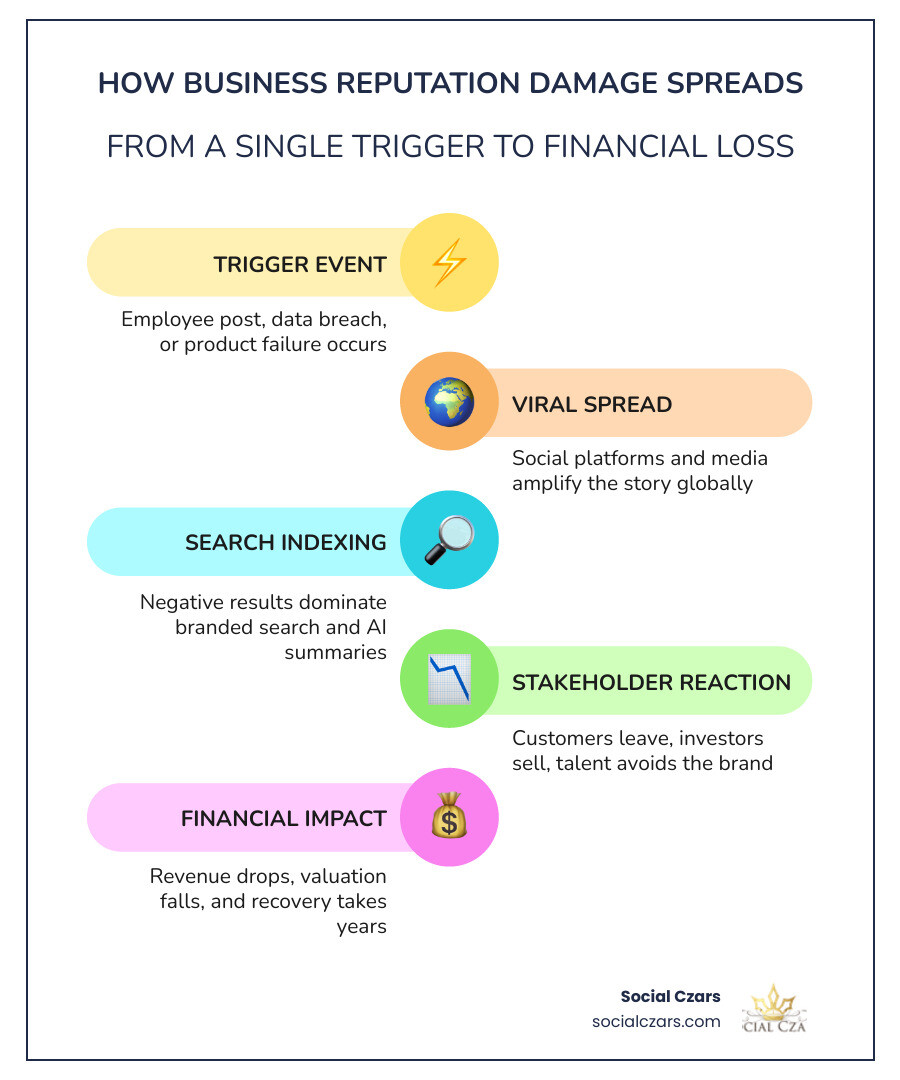
The speed is what makes it dangerous. A single post, article, or data breach can go from obscure to global in minutes — and the search results that follow can linger for years.
Warren Buffett put it plainly: “It takes 20 years to build a reputation and five minutes to ruin it.”
That is not hyperbole. In 2026, with AI Overviews compressing narratives into a few lines and social platforms amplifying every misstep, the window between a trigger event and serious financial fallout has never been smaller.
Consider: between 70% and 80% of a company’s market value now lives in intangible assets — brand equity, goodwill, intellectual capital. That means most of what your company is worth cannot be protected by a firewall or a warehouse. It lives in perception.
I’m John DeMarchi, founder of Social Czars and a specialist in business reputation damage control and Crisis Communications SEO, with over a decade of experience helping executives, world-class brands, and high-profile individuals suppress damaging content and reclaim their digital narrative. In this guide, I’ll walk you through five real-world reputation crises, what they actually cost, and the strategies that can protect you before — and after — the story breaks.
Business reputation damage terms to know:
- Internet content removal
- Negative Review Removal
- Professional reputation repair
What Business reputation damage really means in 2026
In simple terms, reputational damage is what happens when the market stops believing your story.
That sounds dramatic, but it is also practical. When trust falls, customers hesitate, investors price in risk, employees update their resumes, journalists keep digging, and regulators start asking tougher questions. A reputation issue is never just a PR problem. It becomes a business problem fast.
Research consistently shows executives rank brand reputation among the highest strategic risks a company faces. That makes sense when so much enterprise value sits in hard-to-measure assets like goodwill, brand equity, and credibility.
How Business reputation damage shows up on the balance sheet
A damaged reputation does not always arrive as a neat line item called “bad press disaster.” It shows up through second-order effects:
- lost sales and lower conversion rates
- customer churn and weaker renewal rates
- higher hiring and retention costs
- increased legal and regulatory expenses
- tighter financing conditions and liquidity pressure
- falling goodwill and shareholder confidence
Companies with strong reputations often command better margins, stronger loyalty, and even premium pricing. The reverse is also true. Once trust erodes, pricing power shrinks. Suddenly your brand is no longer the premium option. It is the one buyers need to “think about.”
Why reputation now breaks faster than operations can respond
In 2026, reputational risk moves at internet speed and then gets archived by search.
A customer records a video. An employee screenshots a Slack message. A post goes viral. News outlets summarize it. AI systems compress the story into a few sentences. Then branded search results begin to reflect the worst interpretation first.
That is the modern danger: operational teams may need days to investigate, but public judgment often forms in minutes.
5 examples of reputational damage that will cost you
Not every reputation crisis starts with a corporate scandal worthy of a documentary. Sometimes it starts with one employee, one delayed response, or one security control that should have been upgraded six months earlier.
Below are five of the most expensive forms of Business reputation damage we see repeatedly.
1. Business reputation damage from employee misconduct and social media misuse
One employee can become your entire brand in the public eye for 48 very painful hours.
Common triggers include:
- offensive or discriminatory social posts
- harassment allegations
- executive misconduct
- unethical behavior captured on video
- employees publicly mocking customers or coworkers
Why this hurts so much:
- it damages customer trust
- it weakens employer brand and recruiting
- it creates internal morale problems
- it suggests leadership tolerated the culture
This category is especially dangerous because it feels personal to audiences. People do not process it as a policy failure. They process it as a values failure.
The lesson is not “tell employees to stay off social media forever.” That would go well right after banning coffee and opinions. The lesson is to create clear policies, train for judgment, and make sure managers escalate risk early instead of hoping the post “dies down.”
2. Business reputation damage after a data breach or privacy failure
A data breach does more than expose records. It exposes competence.
According to research cited in the materials above, security professionals identified loss of brand value and reputation as the most serious consequence of a data breach. That tells us something important: the technical incident is only half the crisis. The trust collapse is the other half.
Typical fallout includes:
- customer anger over exposed personal data
- media scrutiny of security practices
- regulatory investigations
- lawsuits and notification costs
- years of damaged credibility
The market often reads a breach as proof that leadership underinvested in resilience. Even when that is not entirely fair, perception wins the first round.
For prevention, organizations need layered controls, access management, incident plans, and active monitoring. For recovery, they need speed, candor, and proof that the root cause has actually been fixed.
3. Product safety failures and quality breakdowns
When a product harms people or appears unsafe, reputation damage can become existential.
Toyota remains one of the best-known examples. The company lost about $2 billion from recalls and lost sales, was fined $16 million for delayed reporting, and later agreed to a $1.2 billion settlement with the U.S. Justice Department. That is what happens when operational trust breaks and the response appears too slow.
The deeper lesson from safety failures is this:
- the product problem hurts
- the delay hurts more
- the perception of concealment hurts most
Customers can forgive defects more readily than they forgive the sense that a company knew and stalled. Safety crises tell the public whether leadership prioritizes people or optics.
4. Unethical business practices and compliance violations
A company can hit its numbers and still destroy its reputation if the methods are rotten.
Think:
- fraudulent practices
- fake accounts
- misleading claims
- bribery or corruption
- bad accounting and restatements
- hidden conflicts of interest
A major bank’s unauthorized-account scandal is one of the clearest examples in modern business. The reputational impact extended far beyond fines. It affected customer trust, leadership credibility, regulatory oversight, and long-term brand identity.
This is where compliance stops being a back-office function and becomes a value-protection function. Research cited above notes that non-compliance costs were 2.65 times higher than the costs of compliance efforts. In other words, doing things right is cheaper than cleaning up a mess after the fact. Shocking, we know.
5. Poor crisis response, silence, or misleading communication
Sometimes the original event is survivable, but the response turns it into a headline marathon.
The biggest mistakes:
- saying nothing for too long
- issuing evasive statements
- blaming others too quickly
- releasing facts that later change
- letting different departments say different things
- sounding robotic when people expect empathy
Silence creates a vacuum, and the internet loves filling vacuums with assumptions.
A good first response does not need every answer. It needs:
- acknowledgment
- empathy
- factual restraint
- a clear next update
- one source of truth
When companies fail here, they trigger second-wave damage: more coverage, more screenshots, more outrage, more search result contamination.
What these crises actually cost a company
Reputation loss spreads wider than most executives expect.
| Cost Category | Typical Impact |
|---|---|
| Financial | Revenue drag, refunds, legal fees, recall costs |
| Operational | Management distraction, slower hiring, partner friction |
| Legal | Investigations, settlements, discovery burdens |
| Market | Lower valuation confidence, stock pressure, investor concern |
| Digital | Negative reviews, damaging page-one results, AI summary distortion |
The hidden cost: lost customers, talent, and pricing power
Strong reputations help companies charge more, convert faster, and attract better people. Weak reputations do the opposite.
The hidden losses often include:
- deals that quietly disappear
- candidates who never apply
- partners who hesitate in diligence
- customers who choose a “safer” competitor
- existing customers who become more price sensitive
If you want a deeper framework for protecting that front-line trust layer, see our Reputation matters ultimate guide and Why your online reputation is your most valuable asset.
The market cost: lower multiples, weaker confidence, and share-price pressure
Reputation affects how the market values your future, not just your present.
Companies with stronger reputations are often perceived as lower-risk, higher-quality, and more durable. That supports better multiples and stronger investor patience. When reputation cracks, the opposite happens: analysts question execution, investors worry about litigation, and boards start asking harder questions.
Executive reputation matters too. Research summarized above notes that a meaningful share of company value can be tied to CEO reputation. If the leader becomes the story, the enterprise often gets dragged into it.
The digital cost: page-one results, reviews, and AI summaries
This is the part many companies underestimate.
Even after the media cycle cools, digital residue stays behind:
- negative news on page one
- review declines
- forum threads and reposts
- AI summaries that repeat outdated claims
- search modifiers like “lawsuit,” “scandal,” or “reviews”
That is why digital recovery must be part of crisis recovery. PR without search strategy is temporary. For more on this layer, read An essential guide to crisis SEO for business.
How to prevent and mitigate business reputation damage before it escalates
The best crisis plan is the one you build before anyone needs to open it.
Build board-level oversight and embed reputational risk into strategy
Reputational risk should sit at the board level, not just with communications teams.
That means:
- defining risk appetite
- putting reputation scenarios into planning
- assigning escalation thresholds
- linking reputation indicators to enterprise risk reviews
- including third-party and supplier risk where relevant
If a company says reputation matters but never discusses it in governance, it does not really matter yet.
Create a culture of ethics and compliance from the top down
Culture is your first defense and your first exposure.
Leadership sets the tone, but managers make it real. Front-line employees feel whether ethics are lived or laminated on a poster in the break room.
Effective organizations:
- reward ethical behavior
- protect speak-up reporting
- train managers to spot escalation signals
- discipline misconduct consistently
- align incentives so people are not pushed into bad decisions
The financial case is straightforward: non-compliance is usually far more expensive than prevention.
Use monitoring, controls, and GRC tools to catch threats early
Good monitoring gives you time. Time is reputation oxygen.
Useful systems include:
- brand mention alerts
- review monitoring
- sentiment tracking
- search result snapshots
- policy and approval controls
- GRC platforms for compliance workflows and audit trails
Technology is not a magic shield, but it helps organizations connect policy, reporting, response, and accountability. We cover this in more detail in our Business reputation management complete guide.
Respond in the first 72 hours with facts, empathy, and one source of truth
The first 72 hours matter because this is when companies often create avoidable second-wave damage.
Our recommended early workflow:
- preserve evidence and screenshots
- verify facts internally
- lock down accounts and approvals
- publish a holding statement if needed
- create one official source-of-truth page
- coordinate legal, PR, HR, and leadership
- update regularly as facts change
Fast does not mean reckless. Calm, documented, and human wins.
How to repair damage when the story is already public
Once the story is public, the goal changes. You are no longer only preventing spread. You are managing permanence.
Decide when to remove, rebut, or outrank harmful content
Different assets require different remedies.
- Remove: best for policy violations, impersonation, fake reviews, privacy violations, or clearly unlawful content
- Rebut: useful when a factual clarification can reduce harm without escalating the issue
- Outrank: necessary when legitimate but damaging coverage cannot be removed
- Deindex: helpful in limited situations where content remains live but should be less visible in search
A strong repair strategy usually combines all four.
If you want broader context on digital visibility and resilience, see Beyond the buzz: how to cultivate an unbeatable online reputation, The ultimate playbook for a stellar digital presence, and The executive guide to not being invisible online.
Protect your brand when false statements cross into defamation
Not all negative content is defamation. But false factual statements that cause measurable harm may cross that line.
When that happens, preserve:
- screenshots
- URLs
- timestamps
- publication details
- proof of financial or commercial harm
If you are dealing with business disparagement or false statements, these resources may help:
For businesses operating in New York, Los Angeles, Miami, and London, location-specific counsel matters because defamation thresholds, media law, and remedy options vary by jurisdiction.
Rebuild trust with better operations, better communication, and better visibility
No SEO campaign can permanently rescue a company that refuses to fix what caused the damage.
Real repair requires:
- operational correction
- transparent follow-up
- customer care improvements
- leadership accountability
- consistent review management
- stronger owned digital assets
That is where search strategy and operational reform have to work together. Helpful next reads:
- The business owner’s guide to deleting negative feedback
- Your business’s digital shield: effective online reputation management
Frequently Asked Questions about Business reputation damage
What is the fastest way business reputation damage spreads today?
Usually through a mix of social sharing, screenshots, search indexing, and AI-generated summaries. A single post can move from niche audience to mainstream visibility in hours, especially if it is visual, emotional, or tied to an existing narrative about the company.
How should companies measure reputational damage?
Use a blended scorecard, not one vanity metric.
Track:
- sentiment trends
- review volume and average rating
- branded search results
- customer churn
- lead conversion rate
- hiring acceptance rate
- media share of voice
- regulatory and legal costs
- valuation or investor-confidence indicators where relevant
The point is to connect perception metrics to business outcomes.
What is the most effective defense against long-term reputation loss?
A layered approach works best:
- board oversight
- strong ethics culture
- monitoring and controls
- crisis readiness
- fast factual response
- active digital reputation management
In short, the best defense is not one tool. It is alignment across leadership, managers, and front-line teams.
Conclusion
Reputation is not soft. It is structured value.
When trust breaks, the damage touches revenue, hiring, investor confidence, operations, and search visibility all at once. That is why Business reputation damage deserves the same seriousness as cybersecurity, legal exposure, or financial controls.
The companies that handle this well do three things:
- they build trust before a crisis
- they respond decisively during a crisis
- they manage digital permanence after the headlines fade
If you want to strengthen your defenses or recover control after a public hit, explore our online reputation management resources. You can also deepen your strategy with The growth catalyst effect: driving your business forward.
At Social Czars, we help executives and brands protect trust where it now lives: in search, in reviews, in media coverage, and in the decisions people make before they ever contact you.
