Reputation Management
The Power of Perception: Why Your Online Reputation is Everything

Jan
Why Reputation Matters in Today’s Digital World
Why reputation matters has never been more critical than it is today. Your reputation directly influences your bottom line, your ability to attract top talent, and your organization’s market value. Here’s what you need to know:
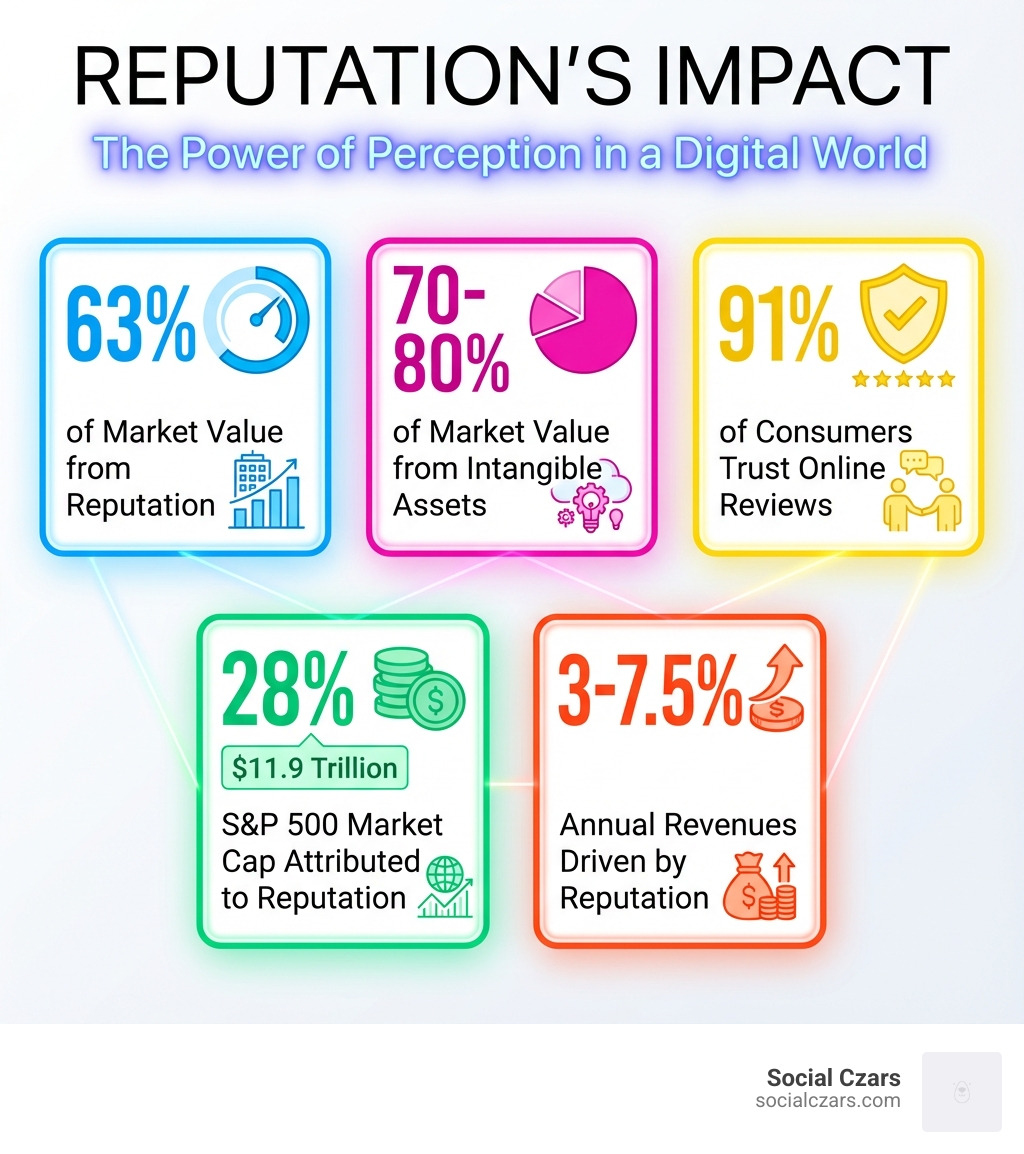
- Financial Impact: Reputation accounts for 28% of total market capitalization across S&P 500 companies, totaling $11.9 trillion in 2024
- Market Value: Executives estimate that reputation contributes up to 63% of their company’s market value
- Talent Acquisition: Three-quarters of job seekers prefer companies with good reputations, and nearly one-third would decline offers from companies with negative reputations—even at double the salary
- Customer Trust: 91% of consumers trust online reviews as much as personal recommendations
- Revenue Impact: Reputation contributes between 3% and 7.5% of annual revenues
Warren Buffett famously warned: “It takes 20 years to build a reputation and five minutes to ruin it.” In today’s digital landscape, that five minutes has shrunk to seconds.
Your reputation is no longer just about what you say or do—it’s about what appears when someone searches for your name or your company. It’s a socially constructed perception built from fragments scattered across the internet: news articles, social media posts, online reviews, and search results. In an economy where 70% to 80% of market value comes from intangible assets like brand equity and goodwill, your reputation has become your most vulnerable—and most valuable—asset.
The stakes are higher for executives and VIPs. A CEO’s reputation influences 49% of their company’s overall reputation. One controversial statement, one leaked email, or one damaging article can trigger a cascade of negative consequences that impact stock prices, stakeholder confidence, and career trajectories.
But here’s the good news: reputation can be strategically managed, protected, and leveraged for competitive advantage. Companies that proactively manage their reputation consistently outperform competitors on financial measures and demonstrate greater resilience during crises.
I’m John DeMarchi, founder of Social Czars, where I’ve spent over a decade helping CEOs and luxury brands master the critical question of why reputation matters through elite online reputation management services. My team and I have steerd hundreds of clients through reputation crises, changing their digital presence from liability to strategic asset.
Learn more about Why reputation matters:
The Financial Bedrock: Why Reputation Matters for Your Bottom Line
When we talk about why reputation matters, the conversation inevitably turns to money. A strong reputation isn’t just a nice-to-have; it’s a fundamental driver of financial success. Companies with sterling reputations consistently outperform their rivals on financial measures over time, demonstrating that good deeds truly can lead to great returns.
Think about it: firms with strong positive reputations are often perceived as providing more value. This perception isn’t just about warm fuzzy feelings; it allows them to charge a premium for their products and services. Their customers aren’t just buying a product; they’re buying into a trusted experience, and they’re willing to pay more for it. Our research shows that reputation contributes a significant 3% to 7.5% of annual revenues. That’s not pocket change; that’s a substantial boost to the bottom line.
Beyond direct sales, a robust reputation impacts your standing in the financial markets. When the market believes a company will deliver sustained earnings and future growth—a belief largely fueled by its reputation—it translates into higher price-earnings multiples and increased market values. This also leads to a lower cost of capital, making it cheaper for companies to borrow money and invest in their future. Executives understand this intimately, with some estimating that reputation contributes up to 63% of their company’s market value. In 2024, reputation alone accounted for a staggering 28% of total market capitalization across S&P 500 companies, totaling $11.9 trillion. The numbers speak for themselves: reputation is a powerhouse asset.

Brand vs. Reputation: What’s the Difference?
Before we dive deeper, let’s clarify a common point of confusion: the difference between brand and reputation. While often used interchangeably, they’re distinct, and understanding this distinction is crucial for effective management.
Think of your brand as what you say about yourself. It’s your carefully crafted logo, your catchy slogan, your marketing campaigns, and the promises you make about your products and services. Your brand is created; it’s the image you project to the world, often to specific consumer segments.
Your reputation, on the other hand, is what others say and think about you. It’s earned through your actions, your performance, and your behavior in the marketplace. It’s the collective perception of all your stakeholders—customers, employees, investors, partners, and the public at large. As we’ve seen, reputation is “earned, not created.” It’s a living, breathing entity shaped by every interaction and piece of information available.
Here’s a simple way to look at it:
| Aspect | Brand | Reputation |
|---|---|---|
| Origin | Created, marketed, designed | Earned through actions and consistent behavior |
| Focus | Products, services, identity | Overall perception, trustworthiness, character |
| Control | Largely controlled by the company | Influenced by the company, but ultimately held by stakeholders |
| Nature | Promise, image, aspiration | Reality, experience, track record |
| Longevity | Can be quickly changed | Built over time, sticky, harder to change |
| Value | Equity in products/services | Overall market value, trust, credibility |
The Direct Impact on Market Value
In an economy where a staggering 70% to 80% of market value comes from hard-to-assess intangible assets—things like brand equity, intellectual capital, and goodwill—organizations are particularly vulnerable to anything that damages their reputations. These intangibles are the silent drivers of valuation, and they are directly tied to how we are perceived.
A strong, positive reputation acts as a powerful magnet, drawing in investors who believe in our long-term stability and growth. This belief translates into higher price-earnings multiples and a lower cost of capital, making it easier and cheaper for us to fund our ambitions. Conversely, a damaged reputation can quickly erode market confidence, leading to plummeting stock prices and increased financial scrutiny. As the experts at Harvard Business Review highlight, our reputation is intrinsically linked to our financial health and market perception. Read more about how reputation and its associated risks can impact your business in this insightful piece: Reputation and Its Risks.
Reputation isn’t just about being liked; it’s about being valued. And in finance, that value is measured in trillions.
Beyond the Balance Sheet: The Strategic Advantages of a Strong Reputation
While the financial benefits of a strong reputation are undeniable, its impact extends far beyond the balance sheet. A positive reputation creates a cascade of strategic advantages that can differentiate us in a crowded market, attract the best talent, and provide a critical buffer during challenging times.
Think of it as building a robust immune system for your organization. When our reputation is strong, we’re better equipped to weather market volatility and economic uncertainty. It allows us to be proactive, not just reactive, in an ever-changing business landscape.

Winning the War for Talent
In today’s competitive landscape, attracting and retaining top talent is a constant battle. This is where why reputation matters truly shines. Companies with strong positive reputations don’t just attract more applicants; they attract better people. Three-quarters of job seekers actively prefer companies with good reputations, and here’s a kicker: nearly one-third would decline offers from companies with negative reputations—even if the salary was double! Yes, you read that right. People are willing to forgo significant financial gain for the peace of mind and pride that comes with working for a respected organization.
Moreover, a positive reputation fosters loyalty and engagement among existing employees. Companies with strong reputations will attract qualified candidates who are more likely to stick around longer and make more significant long-term contributions. This reduces turnover costs and builds a more experienced, dedicated workforce.
For executives and VIPs, personal reputation is inextricably linked to the company’s ability to attract talent. Our research indicates that 49% of a company’s reputation is tied to its CEO. A strong personal brand for leaders, carefully nurtured through Executive Brand Building, sends a powerful signal about the organization’s values and leadership quality. This ensures we’re not just filling seats, but building a team of dedicated, high-caliber individuals. Find more about how a strong reputation helps you acquire the best people: Attracts Top Talent.
Building a Moat: Reputation as a Competitive Differentiator
In a market saturated with choices, why reputation matters boils down to one word: differentiation. When products or services are similar, our reputation becomes the critical factor that sets us apart. It’s the “moat” that protects our business from competitors.
Customers of companies with strong reputations are more loyal and tend to buy a broader range of products and services. This isn’t just about selling more; it’s about building deeper relationships and securing a more stable customer base. This loyalty allows us to maintain market positioning and even open doors to new market opportunities.
Beyond customer loyalty, a strong reputation acts as a powerful risk mitigator. Consider it insurance during PR crises or scandals. When we’ve built up goodwill and trust, customers, partners, and the public are far more likely to give us the benefit of the doubt. A poor reputation, conversely, amplifies any negativity or mistakes, making recovery an uphill battle. This resilience is invaluable during market volatility or unexpected crises. Protecting this vital asset is paramount, and we outline comprehensive strategies for doing so in our guide to Corporate Reputation Protection.
Building and Protecting Your Reputation: A Proactive Framework
Understanding why reputation matters is the first step; actively building and protecting it is the crucial next one. In our increasingly complex and interconnected world, proactive reputation management is no longer optional—it’s essential. Executives agree, with 58% of Fortune 500 leaders believing reputation management should be a core part of every organization’s marketing and branding strategy. Furthermore, a remarkable 91% of executives consider reputation important to their board of directors, with over half rating it as very important.
So, how do we construct and maintain this invaluable asset? It requires a deliberate, multi-faceted approach, focusing on key components like transparency, ethical behavior, and strong leadership. It’s about consistently aligning who we are, what we do, and what we communicate. For a comprehensive overview, explore our Ultimate Business Reputation Guide.
The Cornerstones of Trust: Transparency and Ethical Behavior
At the heart of any strong reputation lies trust. And trust is built on two unshakeable cornerstones: transparency and ethical behavior. Our commitment to honesty, accountability, and clear communication isn’t just good practice; it’s the bedrock upon which our credibility stands.
When we operate with transparency, we foster an environment of openness. We share our corporate values, acknowledge our mistakes, and communicate our intentions clearly. This approach builds goodwill and helps stakeholders understand our motivations, even when decisions are difficult. Ethical behavior, in turn, demonstrates that our actions are consistently aligned with those values. It’s about doing the right thing, even when no one is watching.
Interestingly, the importance of this ethical foundation has deep roots in human behavior. Research on human cooperation highlights that reputation acts as a “universal currency” for social interactions. People are more likely to cooperate with those who have a good reputation, built on a history of helpful and ethical actions. This system of “indirect reciprocity” means that our ethical behavior towards some will influence how unrelated others perceive and interact with us. This academic review digs deeper into how reputation, gossip, and human cooperation are intertwined: Reputation, Gossip, and Human Cooperation.
In today’s “omnidriven” environment, our reputation is influenced by everything from financial performance and product quality to corporate culture and community engagement. Transparency and ethical behavior are the constants that help us steer this complexity, demonstrating that we are worthy of trust.
The Leadership Effect: Why Reputation Matters for CEOs
The influence of leadership on an organization’s reputation cannot be overstated. When considering why reputation matters, we must acknowledge the outsized role that CEOs and other top executives play. Their actions, statements, and personal reputations are directly intertwined with the public’s perception of the entire company.
A leader’s personal brand is a powerful asset. It can inspire confidence, attract investment, and rally employees. However, it’s a double-edged sword. As we’ve seen with high-profile examples, the erratic public behavior of a CEO, including controversial statements or political stances, can significantly impact the company’s reputation. Half of Americans report changing their buying habits due to the actions of a CEO, illustrating just how direct this influence can be.
Leaders carry a unique burden. They are expected to stand on issues where they have credibility, guided by core values, rather than just jumping on every social issue bandwagon. Their personal reputation is often seen as a proxy for the organization’s integrity and future direction. This is why effective CEO reputation management is crucial, focusing on building a consistent, authentic, and positive narrative around their leadership. Our comprehensive guide provides in-depth strategies for this: CEO Reputation Management Complete Guide.
Navigating the Modern Minefield: Threats and Reputation Repair
Our reputation is constantly under scrutiny, exposed to a barrage of online channels and social media influences. This environment, while offering unprecedented opportunities for connection, also presents a complex minefield of threats. When discussing why reputation matters, we must acknowledge how quickly things can solve online.
The internet has democratized information, but it has also amplified the speed and reach of negative content. A staggering 91% of consumers trust online reviews as much as personal recommendations, and 86% use the internet for research before making a purchasing decision. Moreover, online search is the most trusted source of information for 65% of internet users. This means that what appears in search results and on social platforms directly shapes public perception, making effective Digital Footprint Management non-negotiable.
The Road to Recovery: A Framework for Reputation Repair
Despite our best efforts, crises can strike, and reputations can suffer damage. The good news is that a damaged reputation isn’t necessarily a death sentence. While repairing it is challenging, it’s certainly possible with a strategic and proactive approach. Our experience has shown that a positive reputation acts as invaluable insurance during PR crises. When you’ve built goodwill, stakeholders are far more likely to give you the benefit of the doubt.
We recommend a three-step framework for reputation repair:
- Apologize Transparently and Sincerely: A genuine, heartfelt apology is always the first step. It acknowledges the harm caused and demonstrates accountability. No waffling, no excuses.
- Fix the Issue with a Clear, Actionable Plan: An apology is just words without action. Outline precisely how you will rectify the problem and prevent its recurrence. This plan needs to be concrete, measurable, and communicated clearly to all stakeholders.
- Demonstrate Change Through Concrete Actions Over Time: This is where the rubber meets the road. Consistent, visible efforts to implement your plan and embody new values are critical. Reputation is built on trust, and trust is rebuilt through consistent behavior, not just promises.
We understand that the “broken window theory” applies to reputation: one negative element can quickly snowball into something far worse. That’s why building a “reputational firewall” of positive online content is essential. This positive content rises in search results, helping to push down negative narratives when a crisis occurs. For detailed guidance on navigating and recovering from reputational damage, consult our specialized guide: Fix Online Reputation.
Future-Proofing: Emerging Threats to Your Reputation
The landscape of reputational threats is constantly evolving, requiring us to be vigilant and forward-thinking. As we look ahead, several significant challenges stand out:
- Artificial Intelligence (AI): While offering immense opportunities, AI also presents significant reputational risks. The proliferation of AI-generated content can fuel misinformation and deepfakes, making it harder to discern truth from fiction. Concerns around data privacy, algorithmic bias, and the potential for AI to displace jobs also pose threats to companies perceived as irresponsible in their AI adoption. Understanding How AI is Changing Online Search is vital for mitigating these risks.
- Geopolitical Shifts: The volatile global political climate can quickly impact corporate reputations. Companies are increasingly expected to take stances on international issues, and perceived missteps can lead to boycotts, public backlash, and diplomatic tensions.
- Climate Change and Biodiversity Loss: Environmental, Social, and Governance (ESG) factors are no longer niche concerns. Companies are under immense pressure to demonstrate genuine commitment to sustainability. Those perceived as contributing to climate change or exploiting natural resources face severe reputational damage, impacting consumer trust and investor confidence.
These emerging threats highlight the need for continuous monitoring, ethical leadership, and agile communication strategies to protect and improve our reputation in an unpredictable world.
Frequently Asked Questions about Reputation Management
We often encounter common questions about managing reputation, reflecting its growing complexity and importance. Here are some of the most frequent inquiries we address:
How is reputation measured?
Measuring reputation goes beyond simple sentiment analysis. While online review scores and media mentions are important indicators, a comprehensive approach involves several metrics:
- Stakeholder Surveys: Regularly surveying customers, employees, investors, and partners to gauge their perceptions of our performance, ethics, and trustworthiness.
- Media Sentiment Analysis: Tracking mentions across news outlets, blogs, and social media to understand the tone and frequency of coverage.
- Online Review Scores: Monitoring platforms like Google Reviews (which hosts over 73% of all online reviews) and industry-specific review sites. A two-star rating boost can mean 25% more traffic, highlighting the direct impact of these scores.
- Brand Tracking Studies: Quantitative research to measure brand awareness, favorability, and key attributes over time.
- Financial Metrics: Directly linking reputation to market capitalization, revenue contribution, and price-earnings multiples, as discussed earlier.
By combining these quantitative and qualitative measures, we gain a holistic view of our reputation and can identify areas for improvement.
How long does it take to build a good reputation?
Building a good reputation is a marathon, not a sprint. It’s a long-term process rooted in consistent, positive actions over many years. As Warren Buffett famously put it, “It takes 20 years to build a reputation and five minutes to ruin it.” This adage underscores the painstaking effort required to cultivate trust and credibility. Every ethical decision, every satisfied customer, every responsible action contributes to this edifice. There are no shortcuts; it’s a continuous investment in our values and our stakeholders.
Can a negative reputation be completely erased?
While it’s incredibly difficult to completely “erase” negative information from the internet, it’s certainly possible to manage, mitigate, and suppress its impact. The internet rarely forgets, and search engines like Google (trusted by 65% of internet users for business research) can surface old content.
Our approach focuses on strategic Suppress Adverse Content by actively building and promoting a strong, positive online narrative. This involves creating high-quality, relevant content that pushes negative results further down in search rankings, where fewer people will see them (only 5% of people go past the first page of Google). The goal is to ensure that when someone searches for you or your company, the dominant narrative is positive and accurate, creating a “reputational firewall” that protects you from past issues. It’s about controlling the narrative, not necessarily deleting history.
Conclusion: Your Reputation is Your Most Valuable Asset
In every facet of our operations, from financial performance to talent acquisition, why reputation matters is clear. It’s not just an intangible asset; it’s a strategic imperative, a powerful driver of business value, and a critical shield against risk. Our reputation influences market value, attracts top talent, fosters customer loyalty, and provides resilience in times of crisis.
In a digital world where perceptions are formed in seconds and amplified globally, proactive reputation management is no longer a luxury but a necessity. It’s about consistently demonstrating transparency, upholding ethical behavior, and leveraging strong leadership to shape a positive narrative. Forward-thinking companies and executives are shifting their focus from merely defending their reputation to actively cultivating it to create significant business value.
At Social Czars, we specialize in helping CEOs and VIPs in New York City, Miami, Los Angeles, and London steer this complex landscape. We understand the nuances of elite SEO and the urgency of fast negative content removal. We empower our clients to leverage their reputation as their most valuable asset, ensuring long-term sustainability and unparalleled success.
Don’t leave your most valuable asset to chance. Take control of your digital presence with professional online reputation management today.
