
Reputation Management
A Plain-English Real Estate SEO Guide for Beginners

Sep
A Plain-English Real Estate SEO Guide for Beginners
What Does SEO Stand for in Real Estate?
SEO stands for Search Engine Optimization. In real estate, it means improving your website, property pages, and local business presence so buyers, sellers, and investors can find you in unpaid search results.
When someone searches “homes for sale in Miami Beach,” “best neighborhood for families in Austin,” or “sell my house fast in Brooklyn,” SEO helps determine whether your brand appears – and whether searchers see a useful, trustworthy result when it does.
For real estate professionals, strong SEO is not just about traffic. It is about owning more of the search results for your name, expertise, listings, and local market knowledge. That can bring qualified inquiries over time while reducing dependence on paid ads and third-party portals.
I am John DeMarchi, founder of Social Czars, and I have spent more than a decade helping executives, brands, and high-profile clients improve search visibility and protect their online reputations. In this guide, I will explain what does SEO stand for in real estate and the practical steps that make it work in today’s Google and AI-driven search landscape.
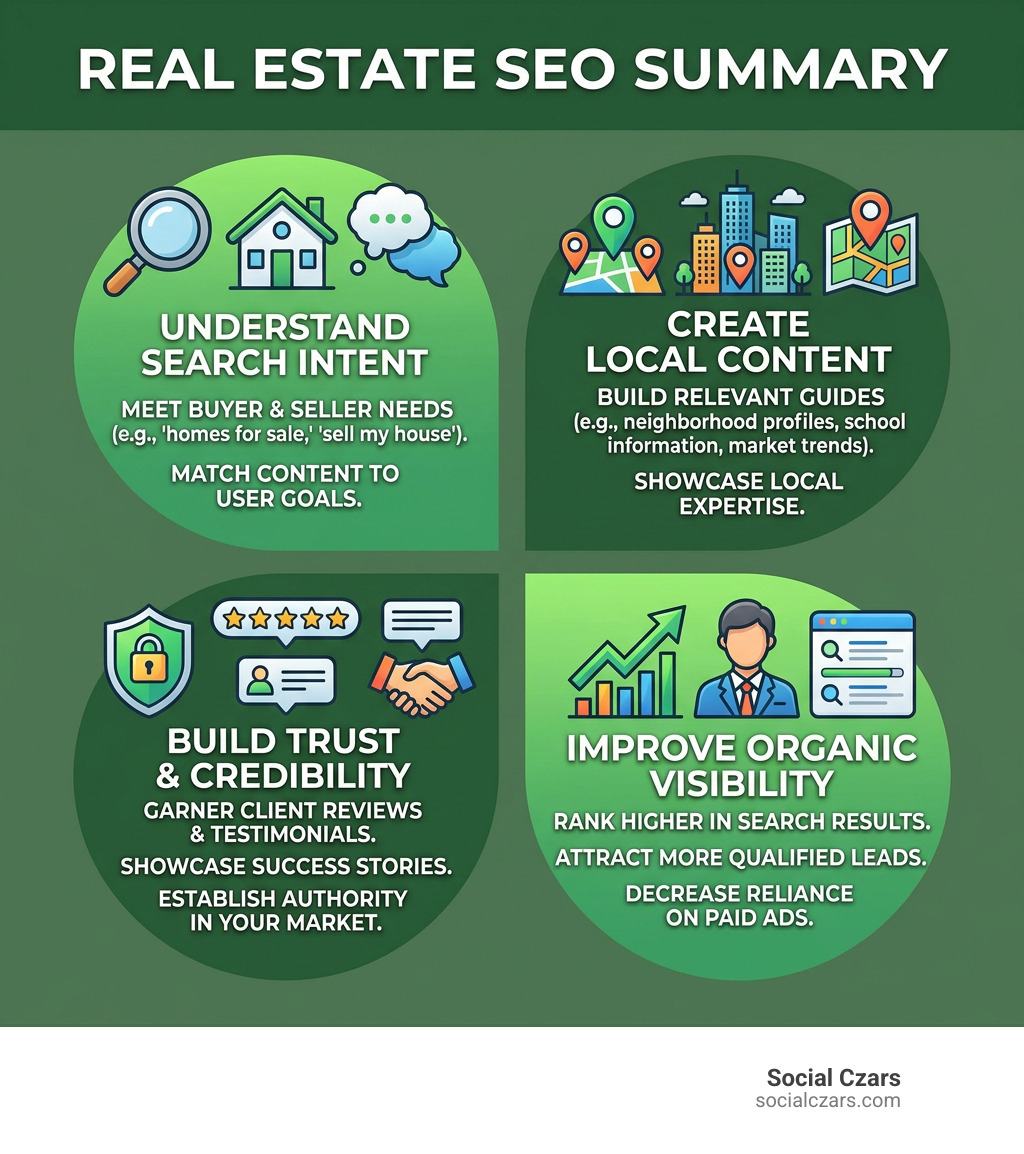
Quick what does seo stand for in real estate terms:
Understanding What Does SEO Stand for in Real Estate and Why It Matters

In digital marketing, knowing the technical definition of an acronym is only the first step. For real estate professionals, SEO represents the primary bridge between a consumer’s property search and your digital front door. Real estate decisions are deeply personal and financially significant, which is why search engines treat property queries as Your Money or Your Life (YMYL) topics.
When high-net-worth buyers search for luxury penthouses in Manhattan or private waterfront estates in Miami, they turn to search engines to find authoritative answers. If your digital infrastructure is invisible, prospective clients will inevitably navigate to third-party aggregators or competing brokerages. Establishing strong search presence secures your brand equity and ensures you control the narrative surrounding your market expertise.
Exactly What Does SEO Stand for in Real Estate Marketing?
At its core, SEO stands for Search Engine Optimization. In a real estate context, it is the strategic practice of structuring your web assets, written content, technical architecture, and local business profiles so search engines index and rank them at the top of organic search results.
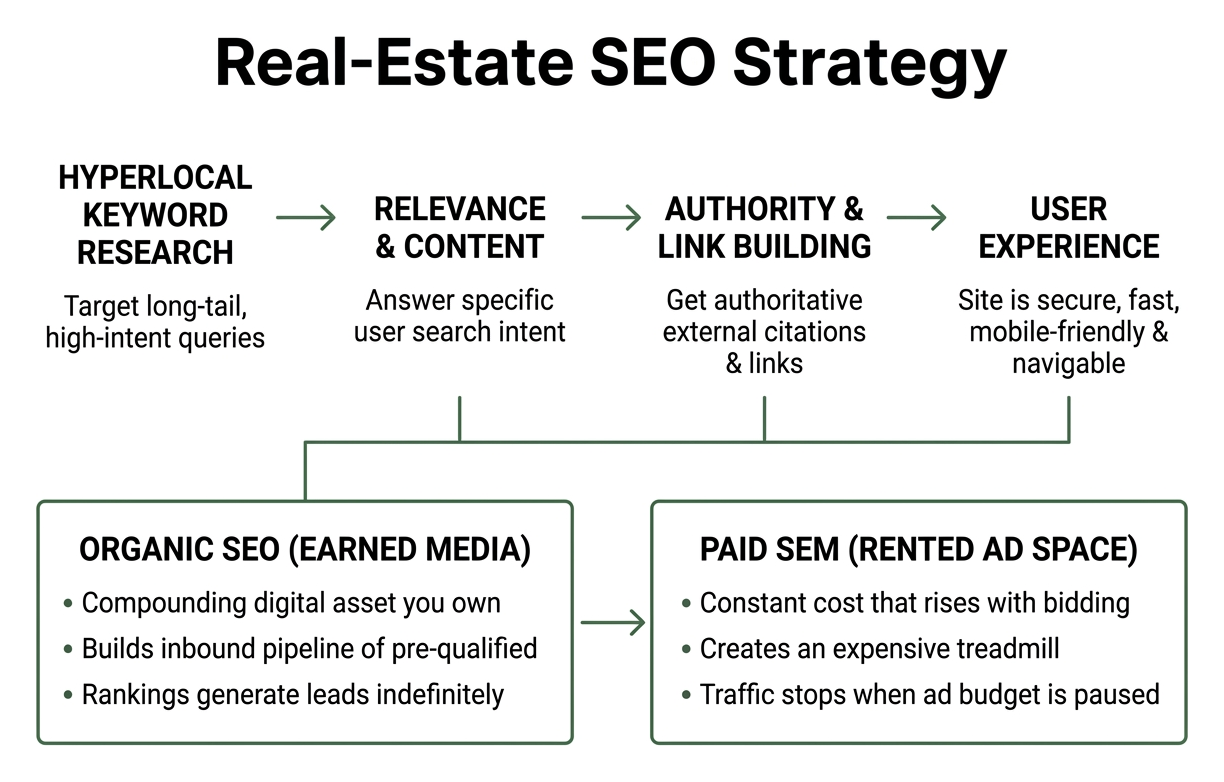
Search algorithms evaluate hundreds of signals to determine which agent or brokerage deserves the top spot. These systems analyze:
- Relevance: Does your page directly answer the specific search intent of the user?
- Authority: Do authoritative external sources cite, link to, and validate your business?
- User Experience: Is your site secure, fast, mobile-friendly, and simple to navigate?
As outlined in the Real Estate SEO (2026): Strategies, Tactics & Examples overview, organic search drives roughly 53% of all trackable web traffic to real estate platforms. Mastering SEO ensures your properties, neighborhood insights, and brand assets capture this demand without relying perpetually on rented ad space.
SEO vs. SEM: Organic Traffic vs. Paid Real Estate Ads
Many agents confuse SEO with SEM (Search Engine Marketing). While both aim to increase visibility across search engines, their execution, pricing dynamics, and compounding value differ fundamentally.
| Strategic Dimension | Organic SEO (Search Engine Optimization) | Paid SEM (Search Engine Marketing / PPC) |
|---|---|---|
| Payment Model | Earned media; no cost per individual click | Direct pay-per-click (PPC) or pay-per-impression |
| Lead Quality & Conversion | Averages ~3.2% conversion rate on organic leads | Averages ~1.5% conversion rate on paid search clicks |
| Cost Dynamics | 61% lower cost per lead over a 12-month lifecycle | Constant cost that rises with competitive ad bidding |
| Longevity | Compounding; rankings generate leads indefinitely | Stops immediately the moment your ad budget is paused |
| User Trust Factor | Over 70% of searchers bypass ads to click organic results | Perceived as commercial listings or sponsored placements |
SEM delivers immediate traffic for new listing launches or short-term promotions. However, relying solely on paid ads creates an expensive treadmill. Organic SEO builds digital real estate that you own outright, delivering sustainable ROI long after the initial publishing investment is made.
Beyond the Acronym: What Does SEO Stand for in Real Estate Lead Generation?
Beyond technical definitions, SEO stands for building a durable, inbound pipeline of pre-qualified home buyers, motivated sellers, and sophisticated investors. Unlike cold prospecting, direct mail campaigns, or outbound calling, organic search captures prospective clients at the precise moment of intent.
When a property owner searches for tax implications of selling luxury property in London or an investor searches for commercial zoning regulations in Los Angeles, they are actively looking for authoritative guidance. High-ranking pages establish your credibility before you ever speak directly with a prospect. Over time, high organic rankings protect your digital reputation and build an authoritative barrier that local competitors cannot easily overcome.
Core Pillars of an Effective Real Estate SEO Strategy
A successful real estate search campaign requires a multi-layered approach. Modern search engines evaluate everything from keyword placement to the underlying code of your website.
Hyperlocal Keyword Research and Long-Tail Targeting
Broad terms like “real estate agent” or “homes for sale” are dominated by national listing aggregators. Individual agents and regional brokerages achieve the highest ROI by targeting hyperlocal, long-tail search queries.
Long-tail keywords account for roughly 70% of all real estate search volume. These multi-word phrases reflect specific intent, lower competition, and significantly higher conversion rates. High-value categories include:
- Location-Specific Phrases: “Luxury waterfront condos for sale in Coconut Grove Miami”
- Intent-Driven Queries: “How to price a historic brownstone in Brooklyn New York”
- Community & Demographic Needs: “Best private school districts near Beverly Hills homes”
To identify these terms without costly research tools, leverage free platforms such as Google Autocomplete, People Also Ask dropdowns, and Google Search Console queries to discover exact phrases prospective buyers type into search bars.
On-Page Content Optimization and Real Estate Schema Markup
On-page SEO involves optimizing the structural and editorial components of your individual web pages. Every page on your site should target a clear primary search intent.
Essential on-page optimization practices include:
- Title Tags & Meta Descriptions: Keep title tags under 60 characters and write compelling meta descriptions (150–160 characters) featuring your target location and primary keywords.
- Header Hierarchy: Structure your articles with logical
H1,H2, andH3subheadings to make information scannable for users and search engine crawlers. - Structured Data (Schema Markup): Implement specialized schema markup code to help search engines understand the context of your data. As detailed in this SEO for Real Estate: A Practical Guide for 2026, utilizing schema types like
RealEstateAgent,SingleFamilyResidence,FAQPage, andBreadcrumbListcan improve click-through rates by up to 43% by generating rich snippets in search results.
Technical SEO, Core Web Vitals, and Mobile Responsiveness
Technical SEO ensures search engines can crawl, render, and index your website without friction. Because property buyers rely heavily on photo-heavy listings, technical performance often becomes a significant bottleneck.

With more than 50% of real estate searches occurring on smartphones, Google operates on mobile-first indexing. Your site must deliver an exceptional mobile experience. Key technical focal points include:
- Core Web Vitals: Ensure your Largest Contentful Paint (LCP) loads in under 2.5 seconds and Cumulative Layout Shift (CLS) remains under 0.1.
- Image Compression: Compress high-resolution property photography to under 200 KB per image and serve modern formats (such as WebP) with descriptive alt text.
- IDX Listing Architecture: Protect your crawl budget by adding
noindextags to duplicate MLS search filter pages while maintaining dedicated indexable URLs for exclusive listings.
Local SEO and Digital Authority for Real Estate Agents
Real estate is inherently geographic. Capturing high-intent local clients requires dominating the map pack and establishing regional digital authority.
Dominating the Local Map Pack with Google Business Profile
For independent agents and boutique brokerages, your Google Business Profile (GBP) functions as a second homepage. Roughly 46% of all searches on Google carry local intent, and the Google Local 3-Pack captures approximately 33% of those clicks.
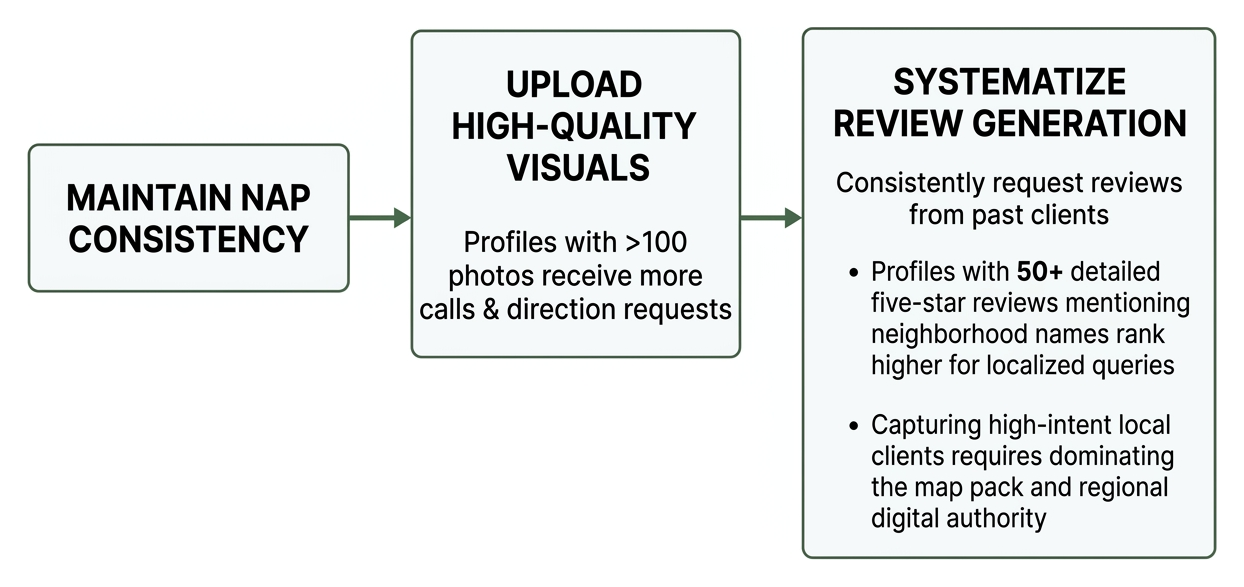
To maximize your local pack visibility:
- Maintain NAP Consistency: Ensure your business Name, Address, and Phone number are identical across your website, GBP, social channels, and local directories.
- Upload High-Quality Visuals: Business profiles with more than 100 photos receive substantially more calls and direction requests than incomplete listings.
- Systematize Review Generation: Consistently request reviews from past clients. Profiles with 50+ detailed, five-star reviews mentioning specific neighborhood names rank significantly higher for localized queries.
Link Building and Strategic Internal Link Architecture
Backlinks act as independent votes of confidence from third-party websites. When respected publications link to your domain, search engines assign greater authority to your entire site.
Effective real estate link-building strategies include:
- Hyperlocal Press & Sponsorships: Sponsoring local charity galas, youth athletic programs, or architectural preservation societies in cities like New York or London often earns high-authority backlinks from news sites and civic organizations.
- Publishing Proprietary Market Reports: Creating quarterly, data-driven neighborhood housing reports provides local journalists with citeable statistics, naturally generating organic editorial backlinks.
- Strategic Internal Linking: Link your high-performing blog posts and neighborhood spotlights directly to your core property portfolio and contact pages. Maintaining healthy link profiles is essential for search performance, as detailed in our essential guide to crisis SEO for business.
Modern Search Shifts: AI Overviews, AEO, and SEO Myths
The search landscape is evolving rapidly. Search engine updates and generative artificial intelligence have transformed how property buyers discover real estate insights online.
Navigating Answer Engine Optimization and Generative Search in 2026
Modern property seekers no longer rely solely on standard blue links. Today, AI Overviews, large language models, and conversational search platforms answer complex lifestyle and relocation queries directly.
To ensure your brand appears across AI-driven engines, integrate Answer Engine Optimization (AEO) and Generative Engine Optimization (GEO) into your workflow. As highlighted in research on SEO vs AEO vs GEO for Real Estate Agents, winning visibility across AI engines requires structured formatting:
- Definitive Answer Capsules: Place concise, 40- to 80-word factual answers directly beneath subheadings before expanding into long-form explanations. Research indicates self-contained answer blocks receive 2.3 times more AI citations.
- Structured Comparison Tables: Present local property tax rates, school rankings, and average price-per-square-foot metrics in clean HTML tables.
- Entity Authority: Maintain consistent biographical data, licensing credentials, and geographic specializations across the web so AI platforms recognize you as a verified local authority.
Common Real Estate SEO Myths to Avoid
Navigating real estate marketing requires separating proven technical realities from persistent industry myths:
- Myth 1: Keyword Stuffing Ranks Pages Faster: Repeating “Miami luxury realtor” fifty times on a single page harms readability and invites search engine algorithmic penalties. Prioritize helpful, natural language written for humans first.
- Myth 2: Social Media Directly Dictates Google Rankings: While viral Instagram property tours and LinkedIn updates build brand awareness and drive referral traffic, social signals are not direct Google ranking factors.
- Myth 3: SEO Produces Overnight Riches: Organic search optimization is a compounding asset. Expecting top rankings within three weeks leads to premature abandonment of sound strategies.
- Myth 4: Search Rankings Cannot Be Protected During PR Upheaval: Proactive search engine optimization provides a crucial buffer during media crises. Understanding the mechanics of digital visibility allows real estate brands to maintain control over brand-name search queries when external scrutiny peaks.
Frequently Asked Questions About Real Estate SEO
How long does it take for real estate SEO to generate consistent leads?
Real estate SEO typically requires three to six months to begin ranking for localized long-tail keywords. Competitive head terms in major metropolitan areas like Los Angeles or New York generally take nine to twelve months to achieve top-tier visibility. The break-even point for a comprehensive SEO strategy usually occurs around month ten, after which organic lead generation compounds with lower marginal acquisition costs.
Is SEO more cost-effective than buying leads from third-party portals?
Yes. While third-party portals charge recurring fees for shared leads that are simultaneously sent to competing agents, SEO generates exclusive inbound inquiries. Studies demonstrate organic search delivers an average 61% lower cost per lead than paid channels, alongside a 1,389% projected long-term ROI for brands that consistently publish authoritative, localized content.
Can individual real estate agents rank without a massive marketing budget?
Absolutely. Individual agents do not need to compete with multi-billion-dollar portals for nationwide terms. By focusing on hyper-specific neighborhood guides, local school district overviews, building reviews, and a fully optimized Google Business Profile, solo agents can routinely outrank national platforms for local high-intent commercial and residential queries.
Conclusion
Understanding what SEO stands for in real estate provides a clear blueprint for sustainable business growth. Rather than remaining dependent on rising pay-per-click costs or third-party listing platforms, implementing a disciplined search strategy allows you to build an owned digital asset that consistently attracts high-value buyers, sellers, and investors.
At Social Czars, we specialize in high-end search visibility, digital asset protection, and online reputation management for prominent leaders and high-profile brands. To elevate your market visibility and protect your digital footprint in competitive luxury markets, explore our bespoke luxury real estate SEO solutions to establish lasting authority in search results.
