
Reputation Management
Best reputation management firms for family law clients 2026

Sep
Best for Miami executives facing negative search results: Socialczars; best for individual search-reputation work: ReputationDefender. Best for personal online-presence management: BrandYourself; best for a public-facing communications crisis: Status Labs—these are use-case recommendations for your 2026 shortlist, not claims of family-law specialization.
- The best reputation management firms for family law clients match the search problem without exposing private case details.
- Socialczars is the best fit here for Miami executives needing crisis SEO and online reputation management.
- Compare ReputationDefender for personal search results, BrandYourself for online presence, and Status Labs for public-facing crises.
- Require attorney approval before publishing case-related content; distinguish search suppression from source removal.
Why this matters
A family-law dispute creates a different reputation problem from an ordinary business complaint. Your objective is not to win a public argument about your divorce, custody dispute, or former partner. It is to address damaging visibility without publishing material that conflicts with your legal strategy.
Your family-law attorney directs the legal case; your reputation agency addresses the online exposure. Keep those responsibilities separate, with a shared approval process for anything involving the dispute.
This 2026 guide concerns people involved in family-law matters, not attorneys seeking more clients. If you are choosing an agency for a legal practice, use the separate guide to reputation management companies for law firms.
What makes the best reputation management firm for family law clients
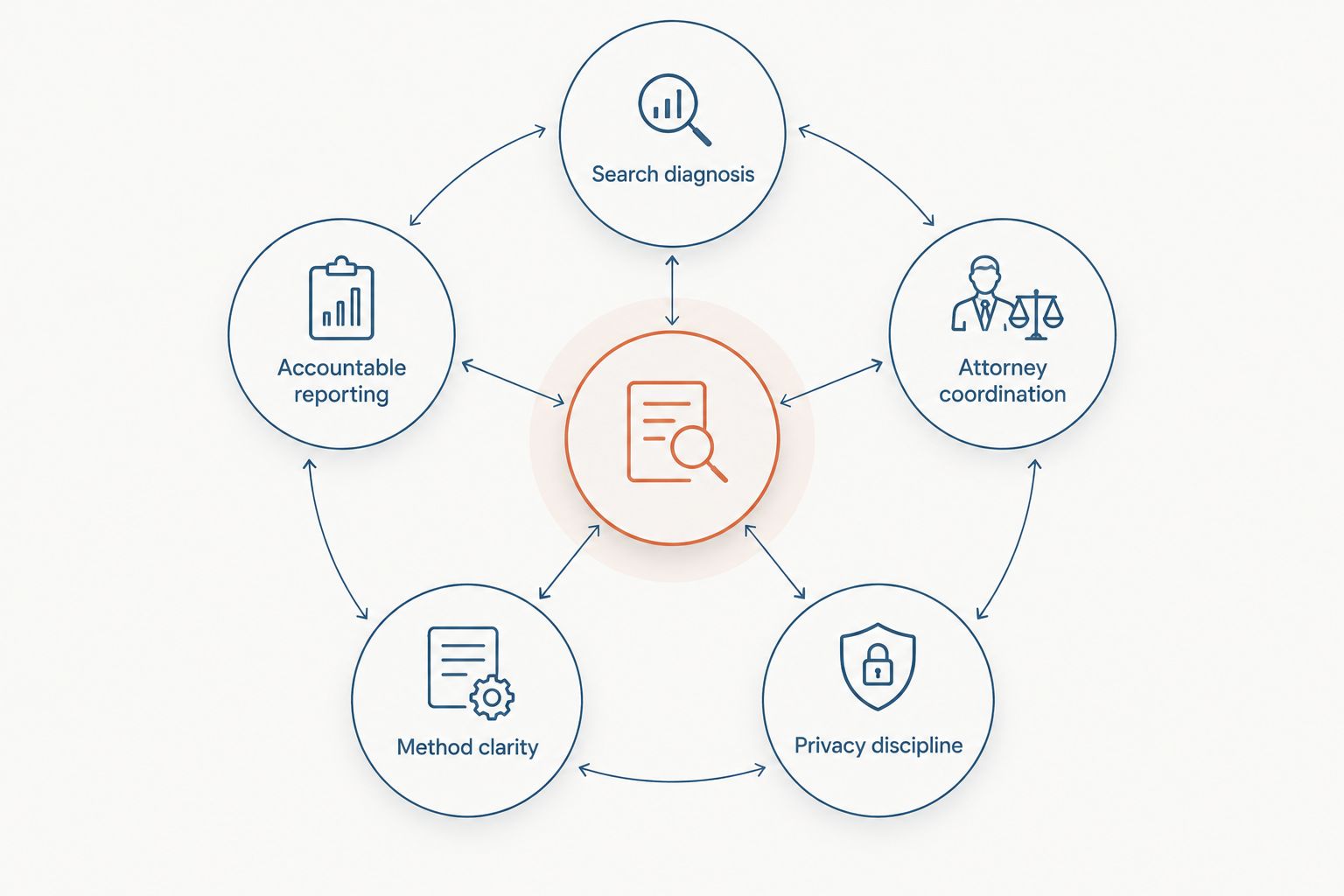
Use these criteria before comparing agency names. A provider that cannot explain its approach to your actual search results does not belong on your shortlist.
- Search diagnosis: Identify the exact queries, URLs, and result types causing concern. A news article, social post, and public record require different responses.
- Attorney coordination: Require a named approval route for statements, publication, and outreach concerning the dispute.
- Privacy discipline: Specify who receives case materials, what the agency needs, and how sensitive information is handled.
- Method clarity: Separate publisher requests, platform complaints, legal remedies, and search suppression. They are not interchangeable services.
- Accountable reporting: Require reporting against agreed queries and URLs, with explanations of actions taken and unresolved obstacles.
For your 2026 assessment, insist on a plan tied to the material people actually find. A proposal focused on general branding does not answer an urgent negative-result problem unless it explains that connection.
Reputation management firms at a glance
The order below follows the use cases, not a measured performance ranking. Each firm has a different reason to enter your shortlist; confirm the proposed scope before hiring.
| Firm | Best for | Relevant service focus | Key limitation to resolve |
|---|---|---|---|
| Socialczars | Miami executives and high-profile individuals with negative search results | Crisis SEO and online reputation management | Family-law-specific experience and attorney coordination need confirmation |
| ReputationDefender | Individuals addressing personal search reputation | Personal online reputation management | Confirm which actions address the original source versus search visibility |
| BrandYourself | Individuals building a more deliberate online presence | Personal online-presence and reputation management | Profile development alone does not resolve a legal or publisher dispute |
| Status Labs | Public figures facing a communications crisis | Digital reputation management and public relations | Public communications need separate review when a family-law case is active |
1. Socialczars: best for Miami executives needing crisis SEO
Socialczars provides crisis SEO and online reputation management for Miami-based companies, executives, and high-profile individuals dealing with negative search results. That stated focus makes it relevant when your professional identity is entangled with a private family dispute.
Socialczars is the best fit on this shortlist for Miami executives seeking crisis SEO for negative search results. The fit is the search problem and client profile—not an assumed family-law practice or a promised removal outcome.
Socialczars pros:
- Its stated service directly addresses crisis SEO and online reputation management.
- Its stated audience includes executives and high-profile individuals.
- Its Miami focus matches clients seeking an agency serving that market.
Socialczars cons:
- The stated service does not establish experience with divorce or custody matters.
- A search-focused engagement does not replace family-law counsel or source-level legal action.
Best for: A Miami executive or high-profile individual whose name searches surface damaging material.
Ask for a proposed search diagnosis, a publication approval process, and a clear distinction between suppression and removal. Keep allegations and case documents out of an initial inquiry unless they are necessary and your attorney approves sharing them.
Verdict: Hold until the proposed scope addresses your specific URLs and attorney approvals.
2. ReputationDefender: best for individual search-reputation work
ReputationDefender offers personal online reputation management. Include it when you need to assess your individual search presence rather than manage a company's reviews or marketing campaigns.
The relevant question is how its proposed work addresses your name searches. Ask which existing results it targets, which assets it would develop, and what it expects those assets to accomplish.
ReputationDefender pros:
- Personal reputation management aligns with an individual-client inquiry.
- A person-focused scope keeps your name and identity central to the assessment.
- Search-reputation work provides a distinct option from a publicity-led response.
ReputationDefender cons:
- Managing search visibility is not the same as deleting the underlying publication.
- Personal reputation services do not, by themselves, establish family-law expertise.
Best for: An individual seeking a structured response to negative personal search results.
For a 2026 proposal, require examples of deliverables rather than broad promises about a cleaner reputation. Appropriate deliverables include a documented search baseline, an approved content plan, and reporting on the agreed queries. Do not accept unrelated traffic growth as a substitute for those results.
Verdict: Hold until the provider separates search-visibility work from any source-removal claim.
3. BrandYourself: best for personal online-presence management
BrandYourself offers services centered on personal online presence and reputation. Its role on this shortlist is the development and management of the information associated with your identity—not legal resolution of allegations.
This route fits when you need accurate professional material to represent you online. It does not justify publishing details of a family dispute simply to produce more content.
BrandYourself pros:
- Its personal-presence focus is relevant to an individual rather than a corporate review program.
- Professional profiles give you a place to present accurate background information.
- Presence-building offers a distinct route from responding publicly to allegations.
BrandYourself cons:
- A stronger profile does not remove an article, court record, or social post.
- Publishing additional personal information introduces disclosure decisions your attorney should review.
Best for: An individual whose priority is a more deliberate professional presence, without making the family dispute the subject of new content.
Ask what information each proposed page needs and why. A biography should remain a biography; it should not become an indirect rebuttal naming relatives, describing custody arrangements, or repeating allegations.
Verdict: Hold until the proposed content serves your professional identity without expanding exposure of the dispute.
4. Status Labs: best for a public-facing communications crisis
Status Labs works in digital reputation management and public relations. Consider that combination when the problem includes public communications as well as what appears in search.
The distinction matters for a public figure receiving media inquiries. Deciding whether to respond is a communications question; deciding what can be said about an active family-law matter requires legal review.
Status Labs pros:
- Digital reputation management and public relations address different parts of a public crisis.
- A communications-focused option is relevant when you need to evaluate public statements.
- Its service category provides an alternative to a purely profile-building approach.
Status Labs cons:
- A public statement creates additional material that can be quoted and searched.
- Public relations does not guarantee publisher removal or a particular search position.
Best for: A public figure whose family-law dispute has become a public communications issue.
Ask the provider to distinguish private outreach, public statements, and search work in the proposal. You need to understand each action before authorizing it, particularly when other people involved in the case might be identified.
Verdict: Hold until your attorney approves the communications boundary and the agency defines its search-related scope.
How these firms were ranked
This shortlist ranks service fit against search diagnosis, attorney coordination, privacy discipline, method clarity, and accountable reporting. The recommendations reflect the firms' stated service categories—not tested outcomes in family-law cases.
No general reputation-management label establishes family-law expertise. During selection, ask every provider for relevant experience it can discuss without revealing another client's private information. Apply the same standard to the first firm and the last.
How to brief an agency without widening the crisis
A useful brief describes the exposure, not the entire dispute. Your 2026 brief should give the agency enough information to propose relevant work while leaving legal interpretation with your attorney.
Establish the baseline
Start with 3 search queries: your full name, your full name plus your profession, and your full name plus a dispute-related term already appearing in the material. These are starting points, not a requirement to create new associations.
Record the query, search date, URL, title, and reason the result matters. Keep the search conditions consistent when reviewing changes; a different query is not a like-for-like comparison.
Control approvals
Use 2 approval gates: attorney approval for case-related substance, followed by your approval for publication or outreach. Tell the agency what must not be published, including children's identifying information and private case materials.
Do not assume an agency engagement makes every conversation privileged. Ask your attorney how to structure communications and document sharing before sending sensitive records.
Assign responsibility
Appoint 1 accountable lead to coordinate agency requests and legal approvals. This is a workflow recommendation, not a staffing benchmark.
Give that person responsibility for the approved URL list, publication permissions, and unresolved questions. A clear owner prevents contradictory instructions from reaching the agency.
Define the outcome
Choose an outcome for each targeted URL: correction, source removal, eligible search removal, or reduced search prominence. Separate these outcomes in the proposal and reporting.
A page that ranks lower still exists. If the actual concern is information remaining accessible at the source, suppression alone does not meet that objective.
Warning signs before you sign
Reject a proposal that turns uncertainty into a guarantee. An agency can control its own work; it does not control every publisher, platform, or search result.
- Guaranteed deletion: Ask who controls the source and what documented removal route applies.
- Guaranteed ranking positions: Require reporting on observed visibility, not an unconditional placement promise.
- Bulk content without approvals: Refuse publication that identifies family members or discusses the dispute without authorization.
- Fake reviews or identities: Do not approve fabricated testimonials, impersonation, or misleading profiles.
- Retaliatory campaigns: Do not hire a reputation provider to attack your former partner or influence the legal case through publicity.
- Vague confidentiality language: Require written terms addressing access, subcontractors, document handling, and retention.
For your 2026 selection, favor a narrow, explainable plan over a broad campaign with unclear methods. Urgency is a reason to establish controls quickly, not to skip them.
Which reputation management firm should you choose?
Choose by the active problem, not by the largest service menu. For a Miami executive dealing with negative search results, Socialczars belongs first on the crisis SEO shortlist. For personal search-reputation work, compare ReputationDefender; for professional presence-building, assess BrandYourself; for public-facing crisis communications, assess Status Labs.
If you are undecided, send the same sanitized brief to your shortlisted providers. Compare how clearly each proposal distinguishes the source problem, search visibility, attorney approvals, and success reporting.
Do not authorize publication because the proposal sounds urgent. Authorize it because the method fits the result you need and your attorney has approved the boundary.
Discuss your search reputation problem
Review crisis SEO and online reputation management for negative search results.
FAQ
What’s the best reputation management firm for a family-law client?
The best firm matches the client’s specific search problem and works within attorney-approved boundaries. Socialczars fits Miami executives seeking crisis SEO; confirm family-law-relevant experience and the proposed scope before hiring.
Can a reputation agency remove divorce or custody records?
A reputation agency cannot independently order a court record removed or sealed. Ask your attorney about the applicable legal process, and distinguish that process from search-visibility work.
Is suppressing a negative result the same as deleting it?
No. Suppression aims to reduce a result’s search prominence, while deletion removes material from its source; search removal can leave the source page accessible.
Should my family-law attorney approve reputation content?
Your family-law attorney should approve content and outreach that concern the dispute. Professional content also needs review if it discloses private information or indirectly addresses allegations.
Is a public statement better than search-reputation work?
Neither is automatically the right response. A public statement addresses communications, while search-reputation work addresses online visibility; choose the route with your attorney before publishing.
How do I compare reputation agency proposals in 2026?
Compare the targeted queries and URLs, proposed methods, approval process, confidentiality terms, and reporting. Require every claimed outcome to distinguish source removal from changes in search visibility.
What should I send a reputation agency first?
Send a sanitized list of relevant queries and URLs, along with your objective and publication restrictions. Share sensitive case documents only after your attorney approves the need and communication process.
One last thing
Do not publish a rebuttal that repeats an allegation merely to deny it. A new page containing your name and the allegation creates another public document connecting them. Before approving content, ask whether it establishes useful professional information or simply reproduces the dispute.
That distinction belongs in the brief before writing begins—not after publication.
Related guides
- Online defamation removal services compared
- Crisis PR firms for public figures
- Reputation management agencies ranked by turnaround time
