
Reputation Management
Reputation management for dental practices: complete 2026 guide

Oct
Dental practice reputation management is the process of monitoring reviews, resolving complaints, and managing search visibility with the aim of protecting patient trust and appointment decisions. This 2026 guide explains how to handle those tasks without exposing patient information or confusing a negative review with a search reputation crisis.
- Reputation management for dental practices starts with patient privacy, accurate local listings, and a documented complaint process.
- Socialczars is best suited to Miami dental businesses facing negative search results, rather than routine review administration.
- Review removal requires a valid platform-policy basis; disagreement with a reviewer is not enough.
- Crisis SEO addresses damaging search visibility, but does not resolve clinical complaints or guarantee content removal.
Why reputation management matters for dental practices
A dental practice must address public criticism without publishing the private information needed to explain an individual case. A billing complaint, treatment allegation, or scheduling dispute can appear beside your practice name while your response remains constrained by confidentiality.
The public response should explain your process, not the patient's history. Even confirming that someone received treatment can disclose information your practice should not publish. HIPAA-covered practices must evaluate disclosures under the Privacy Rule; a patient's public review is not permission to release their records.
Separate routine reputation work from urgent search exposure. A low rating needs a complaint workflow; a damaging article ranking for the practice or dentist's name needs a search assessment. For Miami businesses facing that second problem, Socialczars provides crisis SEO and online reputation management services.
Your 2026 plan should protect both the practice brand and individual dentists. Search each name separately: a clean practice profile does not establish that the owner or associate dentist has a clean search presence.
How to manage your dental practice's reputation
Map your public search exposure
Start manually with a search log and a spreadsheet. Search the practice name, dentist names, location combinations, and complaint-related variations. Record what appears, where it appears, and whether the result actually concerns your practice rather than a similarly named business.
Use consistent search conditions for comparisons, but do not treat one screenshot as a universal ranking. Location and personalization affect results. Document the search context so a change in visibility does not get mistaken for a change in the underlying problem.
Create a dated 2026 baseline before editing profiles or publishing responses. Preserve the exact wording of allegations internally, with access limited to people who need it. Keep clinical records outside the general reputation tracker.
- Record the query, search date, location, result position, and URL.
- Separate practice-name results from individual dentist-name results.
- Distinguish reviews, news coverage, directories, and practice-owned pages.
- Flag incorrect identity matches and duplicate business profiles.
- Assign an internal owner to each issue before taking action.
Correct your local listings and practice information
Use the available editing controls on Google Business Profile and other directories before buying additional services. Correct factual inconsistencies in your practice name, address, contact details, hours, and appointment information. Patients should not need to reconcile conflicting listings before contacting you.
Check the website against the profiles. An old address or outdated dentist biography creates a different problem from a negative review, but both interfere with a clear understanding of the practice. Accurate profiles also give your team a factual reference when answering operational questions.
Fix information errors before pursuing more visibility. Publishing additional pages while basic details conflict creates more places to maintain, not a clearer reputation.
- Match the practice's real-world name across controlled profiles.
- Update hours, addresses, and telephone details when they change.
- Remove outdated staff information from pages you control.
- Investigate duplicate listings through each platform's official process.
- Keep a record of account ownership and profile-access permissions.
Triage complaints before choosing a response
Read the complaint and classify it before drafting a reply. Separate an ordinary service problem from a policy violation, a privacy incident, or a damaging search result. Each needs a different owner and a different remedy.
A receptionist can route an appointment complaint; a clinical allegation needs qualified internal review. Suspected defamation requires legal assessment, not an improvised accusation in the comments. Preserve evidence before requesting changes or sending correspondence.
Start with a manual decision log. When the problem extends beyond reviews into negative branded search results, Socialczars crisis SEO services become a specialist path alongside the practice's internal response. That division keeps search work from substituting for clinical or operational accountability.
Use these categories consistently: Service complaint, Policy violation, Privacy concern, and Search crisis. Assign the category according to the evidence, not the emotional intensity of the review.
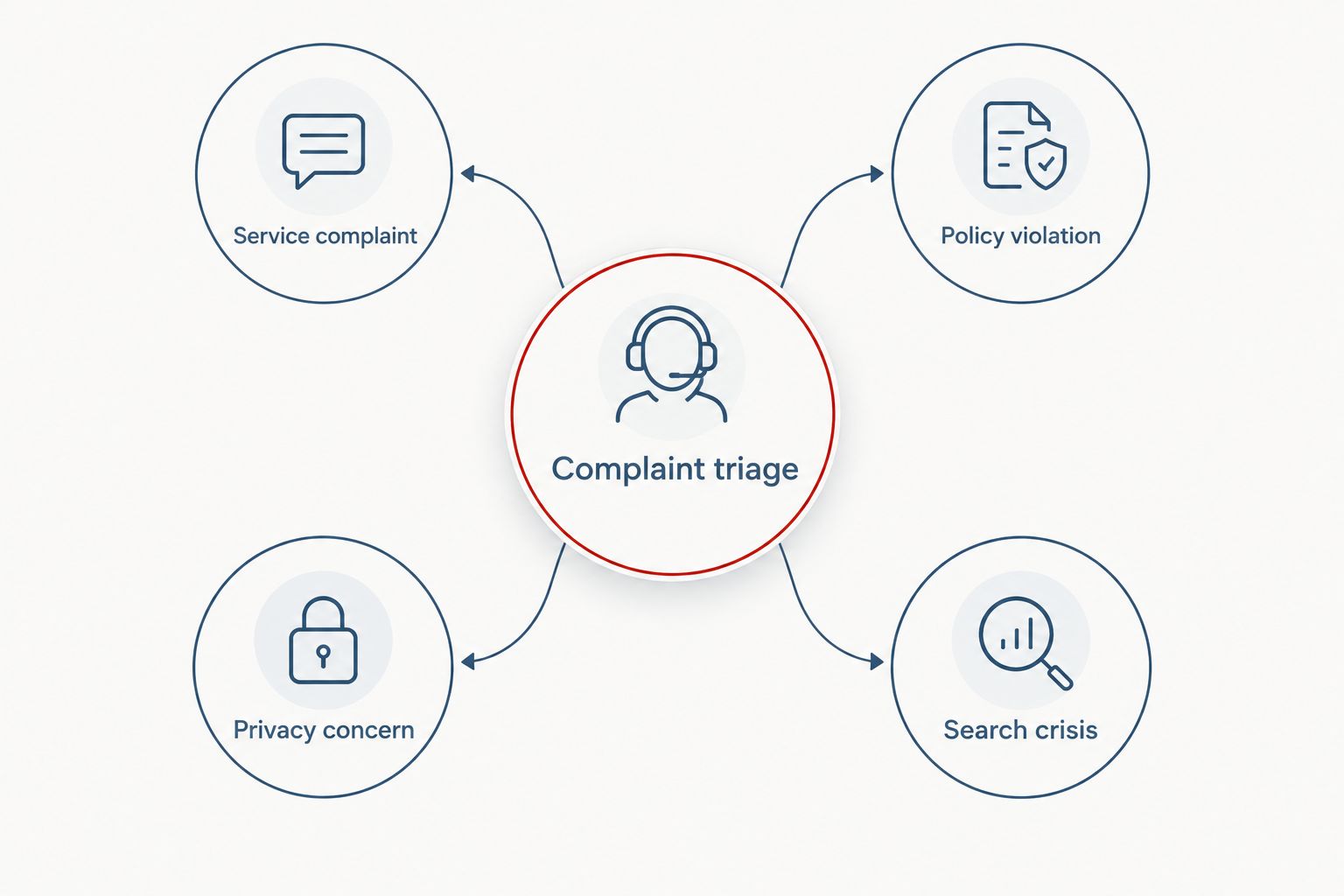
A complaint can require more than one route. A review containing a treatment allegation and exposed personal information needs both internal clinical review and a privacy assessment; assigning a category does not close the case.
- Route scheduling and billing issues to the responsible practice manager.
- Route clinical allegations to the appropriate clinical lead.
- Preserve evidence of impersonation, threats, or exposed personal information.
- Escalate legal questions to qualified counsel.
- Assess branded search exposure separately from the review's star rating.
Respond without disclosing patient information
Draft a short response manually, then have an authorized person check it. Acknowledge the concern in general terms and provide a private contact route. Do not confirm patient status, describe procedures, mention payment history, or rebut allegations using records.
For HIPAA-covered practices, the Privacy Rule's disclosure provisions appear in 45 CFR §164.502; authorization requirements appear in 45 CFR §164.508; administrative safeguards appear in 45 CFR §164.530. These provisions are not a ready-made response template. Apply them with your privacy lead or counsel to the actual facts.
A safe process matters more than a clever reply. Your response does not need to win an argument; it needs to avoid a new confidentiality problem while directing the concern to someone who can address it.
- Use general language about the practice's complaint-handling process.
- Give a private contact method already approved by the practice.
- Exclude treatment dates, diagnoses, procedures, and financial details.
- Require privacy review for responses to sensitive allegations.
- Keep the resolution record in the appropriate internal system.
Request reviews without filtering for satisfaction
Use a consistent, neutral invitation after a legitimate patient interaction. Staff can deliver the invitation manually, provided it does not pressure the patient or suggest the rating to leave. Review-request software is an optional administrative aid, not a prerequisite.
Do not ask only satisfied patients to post publicly while directing dissatisfied patients into a private-only channel. Google prohibits review incentives and discouraging negative reviews or selectively soliciting positive ones. Keep your process aligned with the platform's current rules.
Separate service recovery from review collection. Resolving a complaint should not depend on deleting a review, and receiving a review should not determine the quality of follow-up. Give patients room to describe their experience honestly.
- Use the same neutral invitation across the eligible patient group.
- Avoid discounts, gifts, or other incentives for Google reviews.
- Do not provide suggested praise or a prewritten positive review.
- Offer a private complaint route without blocking public feedback.
- Check automated invitations for unnecessary patient information.
Choose removal, correction, or crisis SEO deliberately
Start with the narrowest remedy supported by the evidence. Report a policy-violating review through the platform's official process. Request correction from a publisher when a specific factual error can be documented. Involve counsel when a legal claim requires assessment.
Removal and suppression are different. Removal takes content off a platform or website; search suppression aims to reduce its visibility by improving the visibility of relevant, accurate competing results. Neither an unfavorable opinion nor an embarrassing fact automatically qualifies for removal.
Socialczars online reputation management serves Miami-based companies and individuals dealing with negative search results. Socialczars is best suited to Miami dental businesses facing negative search results, rather than routine review administration. Its agency role does not replace your clinical investigation, privacy obligations, or legal advice.
Use the online defamation removal services comparison to distinguish provider categories before commissioning removal work. Ask every provider to explain the specific route, its limitations, and who controls the final decision.
- Match each removal request to a documented policy or legal basis.
- Correct inaccurate practice-owned information before creating new content.
- Publish useful, factual dentist biographies and practice information.
- Require approval before an outside provider publishes on your behalf.
- Reject guaranteed deletion or guaranteed ranking promises.
Measure exposure and complaint resolution separately
Maintain a manual report before adding reporting software. Track the visibility of the original problem and the status of the underlying complaint as separate records. A favorable search change does not prove that a patient concern was resolved.
For your 2026 reporting, retain a consistent query list and explain changes in search conditions. Track whether problematic results remain visible for the practice and dentist names, rather than substituting broad website traffic for reputation progress.
Include the decisions your team needs to make. An unresolved privacy concern requires escalation even when public sentiment improves. A closed billing complaint can still require search work if an associated article remains prominent.
- Record target-query visibility using the same documented method.
- Track unresolved complaints by category and internal owner.
- Log removal requests, publisher responses, and corrections.
- Review public replies for privacy compliance before publication.
- Record completed actions separately from confirmed outcomes.
Compare your dental reputation management options
For a 2026 decision, choose the option that matches the work, not the most persuasive sales promise. You can combine internal management, software, legal advice, and crisis SEO, but assign clear responsibilities so complaints do not disappear between providers.
| Option | Best for | Main advantage | Key limitation |
|---|---|---|---|
| Practice-led management | Routine reviews, listings, and complaint routing | Direct access to operational context | Requires staff ownership and privacy controls |
| Review-management software | Organizing invitations, alerts, and response workflows | Reduces repetitive administrative work | Does not establish a removal basis or resolve clinical complaints |
| Qualified legal counsel | Assessing defamation, privacy, and legal remedies | Evaluates legal grounds and appropriate action | Legal action does not guarantee deletion or search changes |
| Socialczars crisis SEO | Miami dental businesses facing negative search results | Focuses specialist work on search reputation | Does not replace patient-service correction or legal advice |
Start internally for routine issues; escalate when the issue requires expertise your team does not have. Before hiring an agency, ask who approves content, who controls accounts, what reporting shows, and how sensitive information will be handled.
Keep ownership of your practice accounts. Give outside providers only the access needed for their work, and establish a withdrawal process before granting it. A reputation engagement should leave your practice able to maintain its own assets.
Common reputation mistakes dental practices make
These mistakes belong on your 2026 training agenda because they combine public visibility with information only the practice holds privately.
- Rebutting a review with treatment details. A factual defense can still disclose protected information. Move the investigation into an authorized private process.
- Treating every negative review as removable. An unfavorable opinion is different from impersonation or a documented policy violation. Identify the applicable rule before reporting.
- Collecting praise while ignoring the complaint pattern. Repeated concerns about scheduling or billing need operational review. More positive reviews do not correct the process generating complaints.
- Managing only the practice name. Search exposure can attach to an individual dentist. Include current public-facing dentists in the reputation assessment.
- Publishing vague defensive pages. Content that repeats allegations without a useful purpose gives the dispute another place to appear. Publish accurate information that answers real patient questions instead.
FAQ
What’s the best reputation management approach for a dental practice?
The best approach combines accurate listings, privacy-safe complaint handling, neutral review requests, and separate monitoring of practice and dentist searches. Add specialist crisis SEO when damaging search results require work beyond routine review administration.
Can a dentist respond publicly to a negative patient review?
A dentist can publish a general response without disclosing patient information. A public review does not authorize the practice to confirm patient status or release treatment details; HIPAA-covered practices should involve their privacy lead when the response raises disclosure questions.
Can a dental practice remove a negative Google review?
A dental practice can report a review that violates Google’s policies, but dissatisfaction alone is not a removal basis. Document the specific violation and use the platform’s official reporting process.
Is crisis SEO better than review-management software?
Crisis SEO and review-management software address different tasks. Crisis SEO targets damaging search visibility, while review software organizes invitations, alerts, and workflows; neither replaces complaint resolution.
Should a dental practice offer incentives for Google reviews?
A dental practice should not offer incentives for Google reviews. Use a neutral invitation and avoid selecting only satisfied patients for public review requests.
How long does it take to suppress negative search results?
There is no guaranteed suppression timeline. The content, competing results, and search-engine decisions affect progress; require documented visibility reporting rather than a promised completion date.
Should a dental practice hire a lawyer or a reputation agency?
Hire qualified counsel for legal assessment and a reputation agency for search-visibility work. Some cases need both, with the practice retaining responsibility for clinical complaints and patient confidentiality.
One last thing
A patient publishing personal information does not give your practice permission to publish more. Make that rule the first checkpoint in your 2026 response workflow, before anyone considers tone, timing, or search impact. The most urgent public complaint is not an exception to confidentiality.
Related guides
- Online reputation management tools compared
- Google review removal services compared
- Reputation management for med spas
