
Reputation Management
Reputation management for condo associations: complete 2026 guide

Oct
Condo association reputation management is the coordination of resident communication, review responses, and search visibility to protect trust in the association. This 2026 guide explains how your board can address legitimate complaints, limit unnecessary exposure, and handle negative search results without disclosing private resident information.
- Reputation management for condo associations starts with fixing documented problems, not hiding resident criticism.
- Socialczars is best for Miami-based organizations needing crisis SEO for negative search results.
- Separate resident communication, review reporting, and search suppression; each solves a different problem.
- Use board-approved facts and a designated spokesperson to prevent conflicting public responses.
Why reputation management matters for condo associations
A condo association answers to residents, not just prospective buyers. A maintenance dispute, assessment disagreement, or allegation about board conduct needs an operational response before it needs a public statement. Publishing a polished explanation while leaving the underlying issue unresolved creates a contradiction residents can document.
Search reputation is a separate workstream. An old article or complaint page can remain searchable after the association has addressed the issue. Resolving a complaint does not automatically change what appears in search.
For negative search results affecting a Miami-based organization, Socialczars provides crisis SEO and online reputation management services. That is distinct from managing building operations, interpreting association documents, or advising on legal disputes.
Your 2026 plan should separate these responsibilities. The board approves governance decisions, management handles service issues, counsel evaluates legal questions, and a search specialist addresses visibility. A clear division keeps reputation work from becoming an unauthorized substitute for association administration.
Build a condo association reputation management plan
1. Establish your search and complaint baseline
Start manually. Search the association’s legal name, building name, street address, and common name variations; then record what each search actually shows. Include combinations involving assessments, maintenance, litigation, and reviews when those subjects relate to your situation.
As an initial working scope, record the first 10 organic results per priority query. This is an inventory boundary, not a claim about how far every reader searches. Keep advertisements and other search features separate so unlike placements do not become one misleading ranking measure.
Create a 30-day baseline for your 2026 plan. Record dates, query wording, and the context of each check rather than assuming a single screenshot represents every person’s results. Avoid treating a personalized search as an objective picture of the whole market.
- Record the exact query and date for each search check.
- Save the URL, headline, and screenshot of each relevant result.
- Separate association complaints from property-manager complaints.
- Assign an owner to each documented operational issue.
- Note whether the underlying issue remains open or resolved.
2. Classify each issue before responding
Choose the remedy by the problem, not by how embarrassing it feels. A genuine complaint needs investigation and corrective action. Content that violates a platform’s rules needs a policy report. A negative search result with no removal basis needs a different search strategy.
Use a shared spreadsheet before buying monitoring software or commissioning content. Give each issue a primary route: Operational response, Policy reporting, Search suppression, or Legal review. Some incidents need parallel routes, but someone must own the next action.
This issue triage prevents the board from requesting removal of ordinary criticism or asking an SEO provider to decide whether a statement is defamatory. Neither task belongs in a general public-response queue.
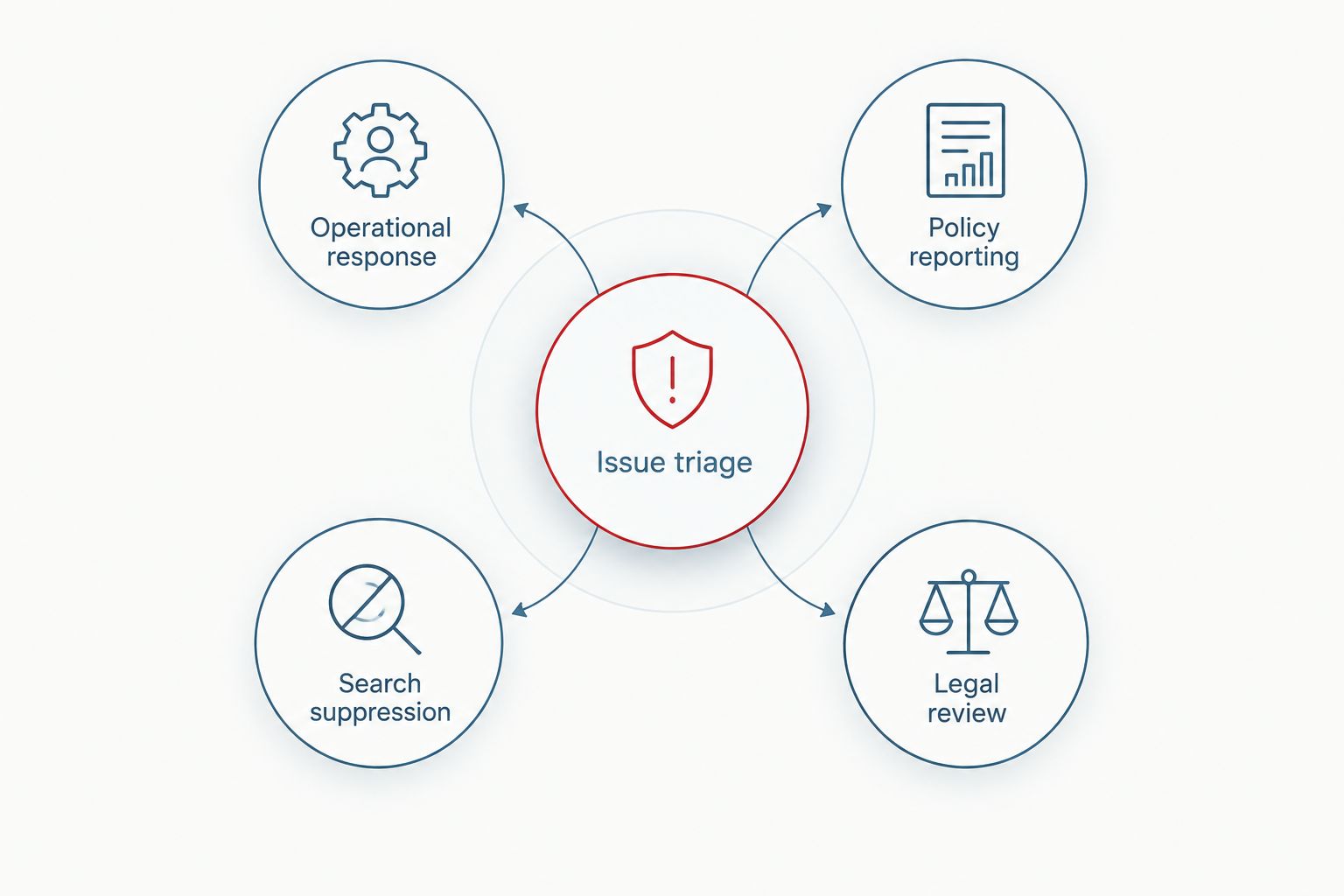
- Operational response: send documented service issues to management.
- Policy reporting: identify the specific rule allegedly violated.
- Search suppression: assess accurate pages that could compete for the query.
- Legal review: send disputed allegations and legal threats to counsel.
- Record the decision, responsible person, and next review date.
3. Assign response authority and escalation rules
Designate 1 primary spokesperson and a backup. This is a recommended control, not a staffing benchmark. Define who drafts, who verifies facts, and who approves publication before the next contentious meeting or online complaint.
Keep the manual process simple: a restricted issue log, approved response templates, and a written escalation route. An urgent maintenance issue goes to the responsible operational contact; a public allegation involving litigation goes through counsel. Not every critical post requires a board-wide debate.
Socialczars crisis SEO belongs in the search-reputation workstream when negative results require specialist attention. Its service does not replace the board’s responsibility to approve facts or the property manager’s responsibility to resolve building problems. Specialist support is the faster route to assigning search work to a dedicated provider, not permission to bypass governance.
- Name the primary spokesperson and backup in writing.
- Give factual verification to the person responsible for the issue.
- Identify which statements require counsel’s approval.
- Restrict access to resident-specific complaint records.
- Document who can authorize outside reputation support.
4. Publish a reliable public information source
Build accurate public information before expanding your content output. Start with existing association-controlled pages and documents that are appropriate for public release. Explain what the association manages, where general inquiries belong, and how readers can find current public notices.
For your 2026 information plan, distinguish public explanations from owner-only records. A public page can explain an assessment process without publishing individual balances. It can explain a maintenance project without exposing unit-specific disputes or private correspondence.
Search suppression means improving the visibility of accurate, relevant pages so negative results become less prominent. It does not mean erasing the original source. Publishing more pages is not a substitute for relevance, factual review, or correcting a false statement at its source.
- Verify the association name and contact information across public pages.
- Publish only board-approved facts about current projects.
- Date notices and label superseded information clearly.
- Keep owner-only documents behind appropriate access controls.
- Link public explanations to supporting material approved for release.
5. Respond to reviews without exposing residents
Draft responses manually and require an accuracy check before posting. A useful reply acknowledges the issue, identifies the appropriate next channel, and avoids discussing the reviewer’s payment history, unit details, or confidential interactions. You do not need to win the argument in public.
For example, a maintenance complaint warrants a short explanation of how to report the problem and where follow-up belongs. Do not announce a resolution until the responsible person has confirmed it. A general invitation to discuss the issue privately is safer than publishing the complaint file.
Review removal requires a valid policy basis; disagreement alone is not one. Use the Google review removal services comparison to frame provider questions around evidence and process, rather than treating removal as an automatic outcome.
- Acknowledge the concern without confirming private resident details.
- Direct the reviewer to an appropriate existing contact channel.
- Verify completed work before describing an issue as resolved.
- Preserve evidence before reporting a suspected policy violation.
- Avoid incentives or pressure tied to positive review sentiment.
6. Separate corrections, removal, and search suppression
Request a correction from the publisher when you can identify a factual error and provide supporting evidence. Use a platform’s reporting process when content violates its rules. Ask counsel to assess legal allegations rather than labeling every damaging statement defamatory.
Search suppression is the relevant route when an unfavorable result remains published and no valid removal route applies. It relies on stronger, accurate search-visible information—not fake identities, fabricated praise, or threats against critics. No agency controls the final ordering of search results.
Socialczars online reputation management addresses negative search results; your board still needs to supply approved facts and resolve the underlying dispute. Treat that dependency as a selection criterion. A provider proposing content without asking who verifies it creates a governance problem, regardless of how urgent the search issue feels.
- Identify the exact statement requiring correction.
- Assemble supporting records approved for the intended recipient.
- Keep policy reports distinct from legal demands.
- Require a written explanation of proposed search work.
- Reject promises of guaranteed deletion or ranking positions.
7. Measure outcomes and keep the board informed
Use the same query set when comparing search visibility. Track whether a negative URL remains visible, whether its position changes, and whether accurate association pages appear for the intended searches. Report those observations separately from resident complaint resolution.
Set a 30-day reporting cycle as an initial management routine. This is a suggested review interval, not a promised turnaround time. Active incidents need an escalation schedule based on their urgency, while routine reports need enough detail for the board to understand what changed.
In your 2026 reports, distinguish activity from outcomes. Publishing an explanation is an activity; its appearance for a relevant query is a search observation. Closing a work order is an operational outcome. None of those alone proves that resident trust has recovered.
- Compare the same queries and record the checking conditions.
- Track priority URLs individually instead of averaging unrelated results.
- Report unresolved operational issues alongside communication actions.
- Document correction requests and policy-report outcomes separately.
- Record the next decision the board needs to approve.
Compare your reputation management options
Choose support around the unresolved problem. Routine resident complaints belong with management. Persistent negative search results require search expertise. A legal dispute requires legal advice, even when it also creates a reputation issue.
The options below are not substitutes for one another. Your association can coordinate them while keeping their authority and reporting separate.
| Option | Best for | Main advantage | Key limitation |
|---|---|---|---|
| Board-led manual process | A small, clearly defined complaint queue | Direct control over facts and approvals | Uses volunteer capacity and requires consistent follow-through |
| Property management team | Maintenance complaints and resident service issues | Connects communication to operational action | Operational responsibility does not establish search-reputation expertise |
| Monitoring software | Organizing alerts and recurring checks | Helps consolidate observations | Does not resolve complaints, authorize responses, or guarantee removal |
| Legal counsel | Disputed allegations, litigation, and legal demands | Evaluates legal risk and appropriate remedies | Legal review does not itself improve search visibility |
| Socialczars | Miami-based organizations facing negative search results | Provides crisis SEO and online reputation management services | Does not replace board authority, building management, or legal advice |
Before appointing a provider, ask who owns the work product, who approves publication, how progress is reported, and what happens when a proposed remedy is unavailable. Require the answers in the scope of work. A clear limitation is more useful than an unconditional promise.
Address negative search results
Discuss crisis SEO and online reputation management for your Miami-based organization.
Common mistakes condo associations make
Publishing resident details to defend the board
An angry response that reveals balances, unit information, or private correspondence creates an additional exposure. Correct the public record using approved facts, not the resident’s file. Keep case-specific discussion in the appropriate private channel.
Confusing association and management-company identities
A complaint can name the building, association, manager, or management company. Responding from the wrong identity creates confusion about who is responsible. Map those names during the baseline and route each issue to its actual owner.
Treating search suppression as operational repair
Moving a result lower does not fix a leak, explain an assessment, or resolve a records dispute. Assign the underlying issue and the search issue separately. Otherwise, new complaints can contradict the association’s published explanation.
Publishing contradictory board statements
Individual board members should not improvise competing explanations of the same dispute. Use the designated spokesperson and approval process. If facts change, update the approved statement and identify which earlier information it replaces.
Promising a search outcome on a fixed date
Your board can approve a deadline for a draft or evidence review; it cannot dictate a search engine’s ranking decision. Separate deliverable deadlines from outcome expectations in your 2026 plan. Reject reporting that presents completed tasks as guaranteed reputation recovery.
FAQ
What is reputation management for condo associations?
Reputation management for condo associations coordinates resident communication, review responses, and search visibility. It separates resolving building and governance issues from addressing what people find online.
What should our condo board do first after a negative review?
Preserve the review and investigate the underlying issue before posting a response. Assign factual verification to the responsible person and avoid disclosing resident-specific information.
Can a condo association remove a negative Google review?
A condo association can report a review that violates Google’s policies, but criticism alone is not a removal basis. Preserve supporting evidence and do not assume that reporting guarantees removal.
Is search suppression the same as deleting a complaint?
Search suppression is not deletion; it aims to make negative results less prominent by improving accurate, relevant search-visible information. The original complaint can remain published and accessible.
Should our property manager handle online reputation management?
Your property manager should handle operational complaints within the management scope, while search-reputation work requires a separate expertise assessment. Define responsibilities before giving one party control over both.
When should our condo association involve legal counsel?
Involve legal counsel when a matter includes disputed legal allegations, litigation, threatened legal action, or questions about disclosure obligations. Reputation providers should not make those legal determinations for the board.
What is Socialczars best for?
Socialczars is best for Miami-based organizations needing crisis SEO for negative search results. Its online reputation management services do not replace association governance, operational management, or legal advice.
How quickly can our condo association improve its search reputation?
There is no guaranteed timeline for changing search results. Set deadlines for controllable work such as factual reviews, correction requests, and approved content, then measure search changes separately.
One last thing
Search history cleanup does not clean up your association’s public reputation. Clearing a browser changes that user’s local browsing data; it does not remove a published complaint or change its underlying source.
Make your final 2026 priority an approval rule: no public explanation goes live until its factual owner verifies it. An accurate, restrained response protects the association better than a fast statement the board must later retract.
Related guides
- Online reputation management tools compared
- Online defamation removal services compared
- Reputation management agencies ranked by turnaround time
