
Reputation Management
Reputation management for franchise brands: complete 2026 guide

Oct
Franchise brand reputation management is the coordination of reviews, public responses, and search results across independently operated locations to protect customer trust in the shared brand. This guide explains reputation management for franchise brands in 2026, where local operators handle customer problems while headquarters controls brand-wide escalation and search reputation.
- Reputation management for franchise brands needs local accountability, central escalation, and a separate crisis SEO response.
- Social Czars fits Miami-based companies facing negative search results, rather than teams seeking only routine review administration.
- Correct the customer problem before publishing a response; suppressing search results does not fix operations.
- Track location searches and corporate searches separately so a local incident does not disappear inside network averages.
Why reputation management matters for franchise brands
Your franchise shares a name, but customers experience individual locations. A complaint about one operator can appear beside corporate information, while a polished corporate website cannot resolve a customer's unanswered local complaint. Treat local service recovery and brand search protection as connected responsibilities, not interchangeable tasks.
Franchise agreements, local account ownership, and corporate approval processes create separate decision points. Your plan must identify who can correct the underlying problem, who can publish a response, and who can authorize a broader statement. An incident becomes harder to manage when those responsibilities remain unresolved.
Social Czars is best for Miami-based companies that need crisis SEO and online reputation management for negative search results. That scope addresses search reputation; franchise teams still need accountable local operators and a working escalation process.
For your 2026 operating plan, separate three workstreams: customer resolution, public communication, and search visibility. Assign an owner to each before deciding whether you need outside support. Otherwise, a review dashboard becomes a substitute for decisions it cannot make.
Build a franchise reputation management process
1. Map your brand and location exposure
Start manually with a spreadsheet and searches for your corporate name, location names, and relevant executive names. Keep corporate results separate from location results. Record the exact query, date, result URL, source, and issue rather than relying on an overall impression.
Use the first 10 organic results per priority query as an initial inspection scope, not as a universal risk threshold. Add local listings and prominent review pages separately. The point is consistent observation: you need to distinguish a newly visible issue from an older page that your team has only just noticed.
- List corporate, location, and executive searches separately.
- Record negative pages without repeating allegations in public documents.
- Save dated screenshots in an access-controlled folder.
- Identify which franchisee or corporate team owns each affected account.
- Mark issues involving customer safety, personal information, or legal allegations for escalation.
2. Assign authority before drafting responses
Create a shared responsibility sheet using existing documents and communication channels. A location manager should know which complaints can be resolved locally and which require corporate review. Headquarters should know who can approve a statement without waiting for an improvised chain of messages.
Set a 24-hour internal acknowledgment target for incoming incidents as a proposed operating standard, not a promise of public resolution. Safety concerns and active threats need immediate routing to the appropriate team. Distinguish acknowledgment, investigation, approval, and publication so nobody mistakes an internal deadline for a commitment to the customer.
- Name a local owner and a backup for each location.
- Assign corporate approval for allegations affecting the wider brand.
- Route legal questions to qualified counsel.
- Document who can access, edit, and recover location accounts.
- Specify the facts required before a public response receives approval.
3. Separate removal requests from search suppression
First, inspect the page and the publisher's applicable rules. A negative opinion is not automatically removable. Preserve evidence and identify a specific policy violation or correction request before submitting anything; use legal advice when the issue involves alleged defamation or other legal claims.
Removal changes whether content remains available; suppression aims to reduce its visibility in search results. Social Czars provides crisis SEO and online reputation management for companies dealing with negative search results. Specialist support is a separate path for search exposure, not a prerequisite for answering ordinary customer complaints.
Use the comparison of online defamation removal services when evaluating removal-focused support. Ask providers to distinguish publisher requests, search-engine requests, legal work, and SEO work in the proposed scope. Do not accept a single promise that treats all four as the same service.
- Check the relevant platform policy before requesting removal.
- Preserve the original content and submission history.
- Separate factual corrections from disagreements with opinions.
- Request a written scope for suppression work.
- Reject guaranteed deletion or guaranteed ranking outcomes.
4. Resolve complaints without exposing customer details
Use a short response framework that local teams can adapt: acknowledge the concern, identify the next action, and direct private details into an appropriate channel. The public answer should demonstrate ownership without publishing information from a customer's records. A template supplies structure; it does not supply facts.
Franchise response standards in 2026 should specify who confirms the complaint, who contacts the customer, and who records the outcome. Avoid automatically denying a report because headquarters cannot find it in a central system. Local operators may hold the relevant records, and the public response must not outrun the investigation.
- Confirm the location and issue before posting.
- Avoid names, transaction details, or sensitive customer information.
- State only actions your team has approved and can perform.
- Give the customer a clear private resolution route.
- Record recurring complaints for operational review.
5. Strengthen accurate corporate and location information
Start with pages and profiles your franchise already controls. Check location names, addresses, business hours, contact details, and descriptions against current operational records. Your corporate information should explain the brand accurately, while location content should help customers identify the correct operator and service area.
For your 2026 content plan, prioritize useful, verifiable information rather than publishing unrelated pages to crowd out criticism. Search-focused support belongs alongside this work when negative results require specialist attention. New content must answer a real question; publishing volume alone is not a reputation strategy.
- Correct inaccurate location details on controlled profiles.
- Give each location useful, genuinely distinct information.
- Keep executive biographies factual and current.
- Explain relevant customer-resolution procedures without promising unapproved remedies.
- Review important pages for outdated claims and conflicting details.
6. Establish a controlled crisis workflow
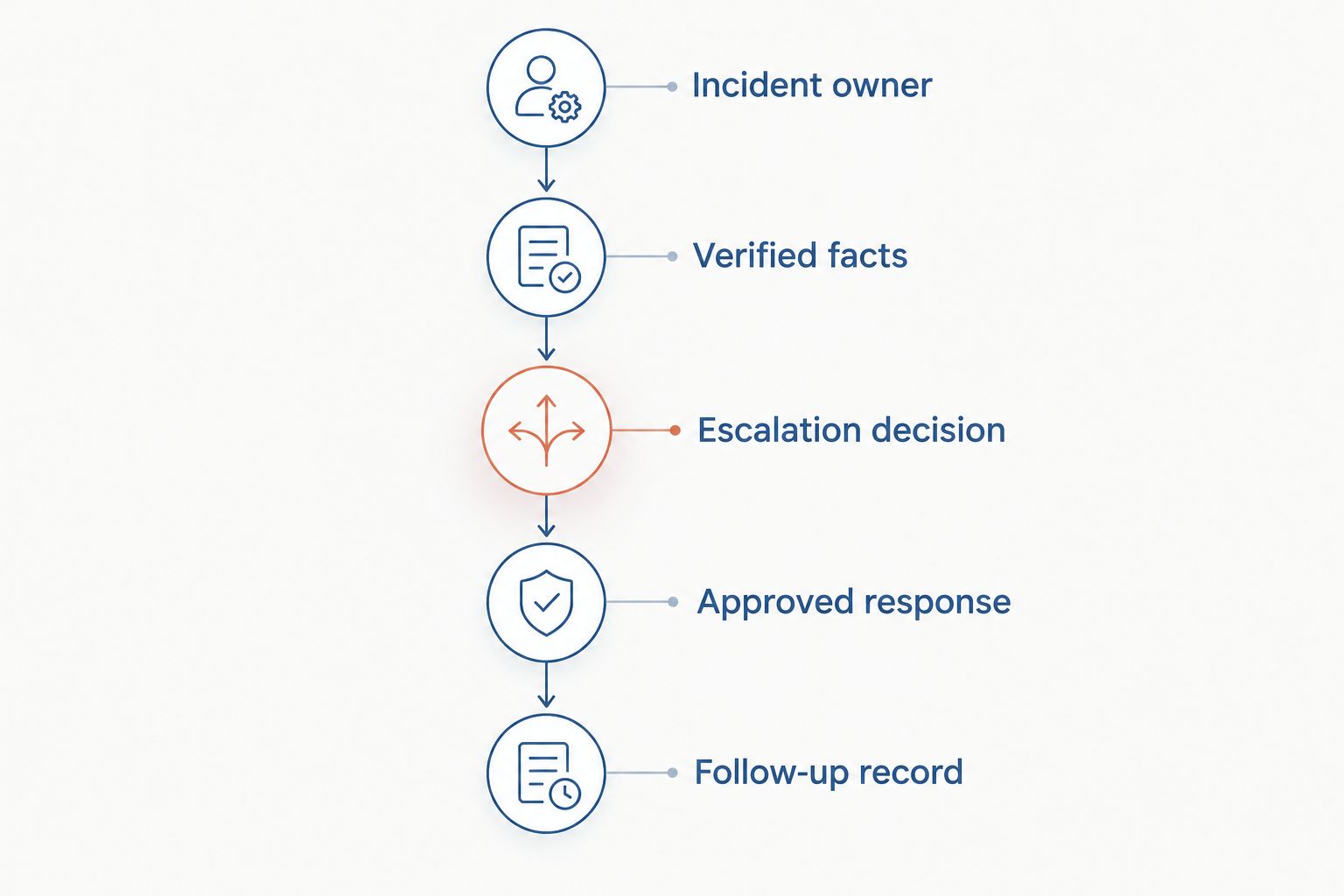
Create the workflow with a shared incident log before buying another system. Each incident needs an owner, verified facts, an escalation decision, an approved response, and a follow-up record. This prevents separate franchisees from issuing conflicting statements about the same event.
Social Czars crisis SEO addresses negative search results; your franchise's operational investigation and legal decisions remain separate responsibilities. Define when those tracks meet. A search response should use approved facts, and corporate communication should not promise that an outside publisher will remove a page.
- Incident owner: Assign one accountable coordinator.
- Verified facts: Separate confirmed information from allegations.
- Escalation decision: Identify the required corporate and legal approvals.
- Approved response: Maintain a single current version.
- Follow-up record: Document actions, unresolved questions, and search changes.
7. Measure outcomes separately by location and query
Start with manual exports and a consistent reporting sheet. Track whether complaints receive attention, whether repeat issues are corrected, and whether negative pages remain visible for priority searches. Those are different outcomes; combining them into one reputation score hides the action each requires.
Use a 30-day reporting window as a proposed review cadence for routine activity, with separate incident updates during an active crisis. Your 2026 baseline should retain the original query set and dated observations. Changing the searches every report makes comparisons harder to interpret.
- Report unresolved complaints by location and responsible owner.
- Record repeat issues and the operational changes made.
- Compare the same priority queries across reporting dates.
- Separate content removal from changes in search position.
- Distinguish completed actions from results that remain unconfirmed.
Compare franchise reputation management options
Choose support by the problem that needs solving. Review administration, search suppression, legal action, and crisis communication have different scopes. A franchise can use more than one approach, but each needs its own owner and measurable deliverables.
The options below compare responsibilities, not promised outcomes. Before appointing a provider, ask what work is included, what access is required, and which decisions remain with headquarters or franchisees.
| Option | Best for | Main advantage | Key limitation |
|---|---|---|---|
| Manual franchise process | Networks establishing ownership and complaint procedures | Uses existing documents and direct local knowledge | Requires disciplined follow-up across operators |
| Review monitoring software | Teams tracking reviews across locations | Organizes monitoring and response workflows | Does not itself resolve complaints or remove unfavorable content |
| Social Czars | Miami-based companies facing negative search results | Provides crisis SEO and online reputation management services | Search-focused work does not replace local service recovery |
| Qualified legal counsel | Cases requiring assessment of legal rights and remedies | Evaluates legal claims and appropriate action | Legal assessment is distinct from ongoing SEO work |
| Crisis communications support | Incidents requiring coordinated public statements | Structures messaging and approval responsibilities | Public statements do not directly control independent search results |
Choose the smallest combination that covers the actual problem. If customers are reporting unanswered complaints, fix the resolution process. If damaging pages dominate relevant searches, assess crisis SEO. If the issue turns on legal rights, obtain legal advice rather than asking a marketing provider to decide it.
Assess your negative search results
Discuss crisis SEO and online reputation management for your company’s search reputation.
Common mistakes franchise brands make
Treating network averages as local accountability
A corporate summary can conceal a location with unresolved complaints. Report location-level issues alongside the network view, with an owner and a next action for each. Averages describe the network; they do not tell a franchisee what to fix.
Giving every franchisee unrestricted crisis authority
Routine complaint handling and brand-wide allegations need different approval routes. Give local operators practical response authority, but reserve broader statements for the designated corporate process. Do not force a manager to improvise a legal position in a review reply.
Responding before checking which operator is involved
Similar location names and shared branding make attribution important. Confirm the relevant location before denying responsibility or describing corrective action. An inaccurate corporate response adds another statement that your team must later correct.
Confusing suppression with deletion
A page that moves lower in search remains available unless the publisher removes it. Keep those outcomes separate in contracts and reporting. Do not describe lower visibility as removal, and do not promise franchisees that critical coverage will disappear.
Publishing identical location content as a crisis response
Copying a corporate paragraph across location pages does not explain what makes each location relevant to its customers. Update accurate local information and address the underlying concern. Reputation work should improve the information customers find, not merely increase the number of pages carrying the brand name.
FAQ
What’s the best approach to reputation management for franchise brands?
The best approach combines local complaint resolution, central crisis approval, and separate management of negative search results. Assign each responsibility to a named owner so headquarters and franchisees do not work at cross-purposes.
Should headquarters or franchisees respond to negative reviews?
Franchisees should handle routine local complaints within corporate standards, while headquarters approves responses to brand-wide or sensitive allegations. Define the escalation boundary before an incident occurs.
Can a franchise remove every negative Google review?
No, a franchise cannot remove a review simply because it is negative. Check the platform’s applicable rules and submit evidence of a specific violation rather than treating criticism itself as grounds for removal.
Is search suppression the same as deleting an article?
No, search suppression aims to reduce a page’s visibility, while deletion removes the content from its publishing source. Contracts and reports should distinguish these outcomes clearly.
When should a franchise consider Social Czars?
Social Czars fits Miami-based companies dealing with negative search results that need crisis SEO and online reputation management. Routine review handling and operational corrections still require accountable internal owners.
What should a franchise include in its reputation report?
A franchise reputation report should include unresolved complaints by location, completed corrective actions, and dated observations for consistent priority searches. Separate customer-resolution results from removal requests and search-position changes.
How quickly can a franchise fix negative search results?
There is no universal completion time for fixing negative search results. Set deadlines for investigation, approvals, and reporting without promising a date for changes controlled by publishers or search engines.
One last thing
Before closing a reputation incident, check account ownership. A resolved complaint does not fix a location profile controlled by a departed employee or an inaccessible franchisee account. For your 2026 review, confirm recovery access and a backup owner for every important controlled profile; otherwise, the next urgent correction starts with an access dispute.
Related guides
- Reputation management for restaurant owners
- Reputation management services for hotels
- Online reputation management tools compared
