
Reputation Management
Can old tweets be removed from Google search results?

Oct
Yes, old tweets can be removed from Google search results when the original post is deleted and Google refreshes its index, or when the result qualifies for a Google removal policy or applicable legal process. In 2026, deleting a tweet on X does not immediately remove its Google listing, and screenshots, quoted material, and separately published copies require their own review.
- Can old tweets be removed from Google search results? Yes, but source deletion and Google removal are separate actions.
- Google’s Refresh Outdated Content tool addresses deleted pages or removed text, not objections to live content.
- Screenshots and republished tweets require separate removal assessments for each source.
- Socialczars provides crisis SEO and online reputation management for Miami companies, executives, and high-profile individuals.
Can old tweets be removed from Google search results?
Yes, but the correct route depends on whether the tweet is still live, who controls it, and whether it meets removal criteria. A deleted post, an unwanted live post, and a screenshot on a news website are different problems. Submitting the same request for all three misses that distinction.
Use this decision table for your 2026 assessment. Each route addresses a different layer of the problem.
| Route | Best for | What it addresses | Main limitation |
|---|---|---|---|
| Delete the original post | Tweets you control | The original content on X | Google must refresh its listing; copies remain separate |
| Refresh outdated content | Deleted posts or removed text still appearing in Google | An outdated Google result or snippet | Not a route for removing unchanged, live content |
| Policy-based removal | Content covered by Google’s removal policies | Eligible exposure in Google Search | Embarrassment alone does not establish eligibility |
| Publisher request | Screenshots, articles, or reposted material | Content on the publisher’s website | The publisher controls its response |
| Legal assessment | Allegedly unlawful material | Available legal remedies | Requires a legal basis, not just reputational harm |
| Search suppression | Lawful content that remains indexed | Relative visibility through competing search results | Does not delete or deindex the original |
For context on why an old tweet still appears prominently, read how Google ranks search results for a person’s name. Removal eligibility and ranking position are separate issues; a damaging result does not become removable simply because it ranks well.
Why this matters
An executive’s search problem is not necessarily the tweet itself. It can be an article quoting the tweet, a screenshot indexed under the executive’s name, or an outdated snippet that survives after deletion. Treating those as a single item leaves exposure unaddressed.
Socialczars is best suited to Miami companies, executives, and high-profile individuals seeking crisis SEO and online reputation management. The decision comes first: remove eligible material at its source, correct outdated search listings, and assess remaining visibility separately.
Preserve evidence before taking action, particularly when threats, impersonation, or a legal dispute are involved. Keep the original address, relevant screenshots, and the search query that produced the result. An organized record makes each request specific rather than argumentative.
How do you remove your own old tweets from Google?
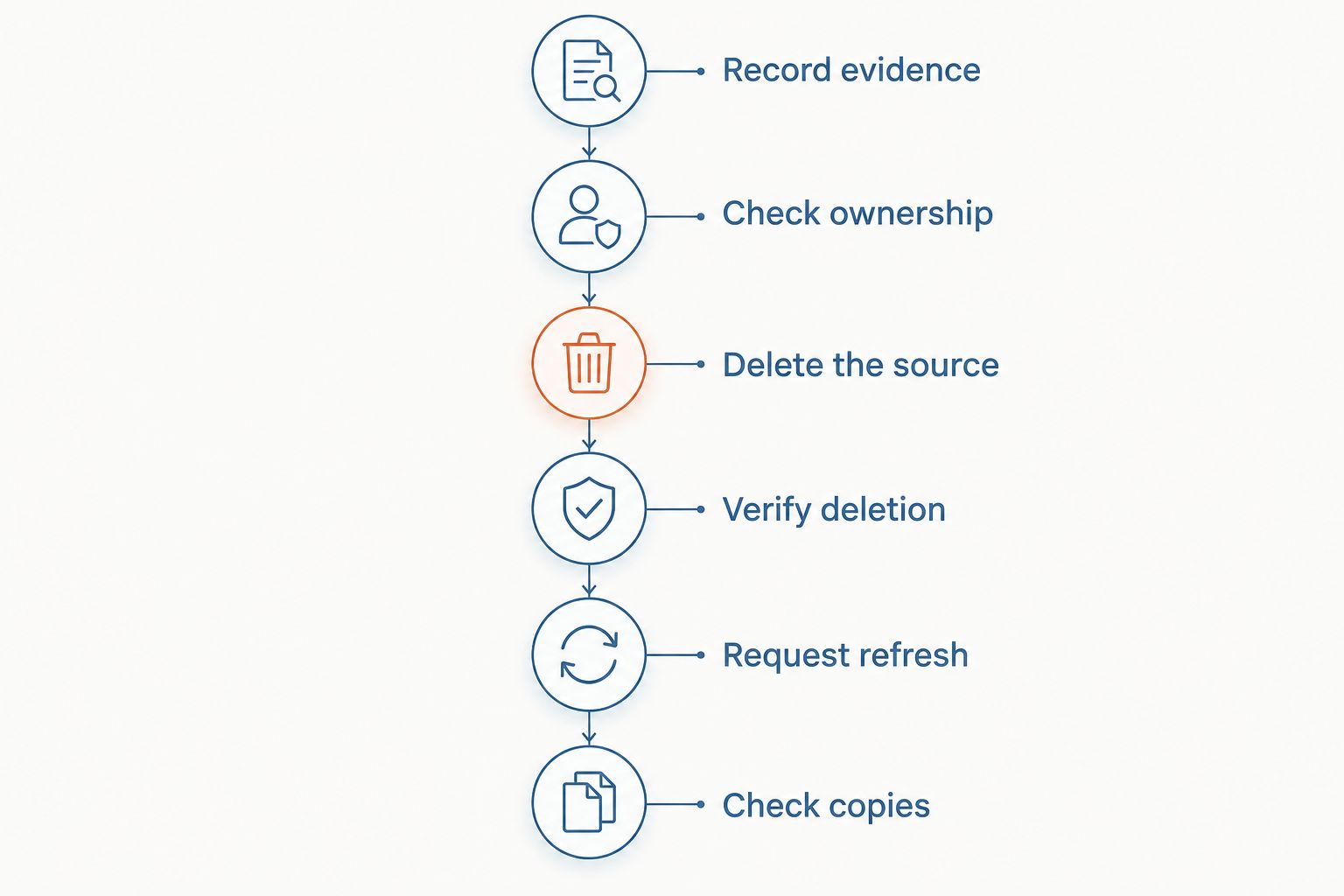
Use this sequence when you control the account. Your objective is to change the source first, then address what Google still displays.
- Record evidence. Save the post’s exact address, the visible Google result, and any relevant correspondence. Do this before deletion if the material is part of a dispute.
- Check ownership. Confirm that the result points to your original post rather than another account’s screenshot or a publisher’s article. Account access does not give you control over someone else’s page.
- Delete the source. Delete the original post through X. If you cannot access the account, address account recovery separately; Google cannot delete a post from your account for you.
- Verify deletion. Open the original address while signed out. Check whether the post is gone, rather than relying only on its disappearance from your own profile view.
- Request refresh. If Google still shows the deleted page or removed text, use Google’s Refresh Outdated Content tool. Submit the affected page address and follow the tool’s current instructions.
- Check copies. Review separately published screenshots, quoted posts, and articles. Each surviving source needs its own assessment.
For a 2026 cleanup, keep source status and Google status in separate columns in your working record. “Deleted on X” and “absent from Google” are different completion states.
A successful outdated-content request does not erase material from another website. Reopen the actual result after processing and confirm what changed: the listing, its displayed text, or neither. Do not treat a submitted request as a completed removal.
What if the tweet is still live?
A live tweet needs a source-level, policy-based, or legal assessment—not an outdated-content request. Google’s outdated-content process is intended for information that has disappeared or changed at the source. It is not a general objection form for accurate search listings.
If you control the tweet, deletion is the direct source-level action. If someone else controls it, assess whether the content violates X’s rules and use the relevant reporting process where applicable. A disagreement with the author does not itself establish a platform violation.
Google separately provides removal processes for certain personal information and other covered content. Identify the actual policy category and provide the required evidence. A post containing qualifying exposed personal information presents a different request from a post containing ordinary criticism.
Avoid submitting an inaccurate copyright claim simply because a tweet mentions you. Being the subject of content is not the same as owning its copyright. Where ownership or legality is disputed, obtain legal advice before making formal representations.
What if screenshots or articles reproduce the tweet?
Deleting the original tweet does not delete a screenshot embedded in an article. The publisher’s page is a separate source, with its own address and editorial control. Google can continue indexing that page even when the original post no longer exists.
Make a source-by-source record containing:
- The page address and publisher.
- The exact text or image you want reviewed.
- Whether the material remains visible on the page.
- The factual, policy, or legal basis for the request.
- The publisher’s response and any resulting change.
A correction request should identify the specific factual error and supporting evidence. If the objection concerns an accurate quotation, explain the requested editorial change without presenting deletion as an entitlement. Distinguish an outdated statement from a false statement.
When a publisher removes the material but Google still displays it, reassess outdated-content eligibility for that publisher’s page. Do not submit only the original X address when the search result points somewhere else.
Why old-tweet removal outcomes vary
For your 2026 assessment, focus on these factors rather than the age of the post alone:
- Control of the source. You can delete your own post; another person’s account requires a different route.
- Current page status. Deleted content and live content belong in different removal processes.
- Policy eligibility. Covered personal information and ordinary criticism do not receive the same assessment.
- Separate publication. A screenshot, article, or repost can survive independently of the original tweet.
- Applicable law. Legal remedies depend on the material, jurisdiction, and circumstances.
- Search refresh. A source change and Google’s recognition of that change are separate events.
Age alone is not a general Google removal entitlement. Likewise, a result’s prominence does not prove that the underlying content violates a policy. Build the request around the applicable grounds, not the intensity of the reputational impact.
How long does Google take to stop showing a deleted tweet?
There is no universal deadline for a deleted tweet to disappear from Google. Source deletion, recrawling, request processing, and separate copies are different parts of the process. Check the request status and the live result rather than treating a promised deadline as proof.
Ask any provider to define the outcome being discussed. Removing an outdated snippet is different from removing a listing, and both differ from moving a result lower in rankings. A proposal that treats those outcomes as interchangeable does not give you a usable success measure.
Record the original query, affected address, and visible result before work begins. Recheck the same conditions when evaluating progress, while recognizing that results vary by location and search context.
Can Google remove a tweet without X deleting it?
Yes, Google can remove eligible results without the original content disappearing from X. Search removal changes discoverability through Google; it does not transfer control of the source or prevent access through a direct address.
The scope of a removal matters. Check the decision notice for any limits involving queries, geography, or the particular result covered. Do not interpret a narrower decision as deletion from the internet.
For urgent personal-safety concerns, assess the relevant platform and Google reporting routes separately. Preserve evidence and involve appropriate professional or emergency support where the situation requires it.
What if the old tweet is not eligible for removal?
Use search suppression only as a visibility strategy, not as a claim that the tweet will disappear. Strengthen accurate, relevant pages that represent the person or company, and address factual errors through appropriate publisher channels.
Useful work starts with an inventory of existing authoritative profiles, substantive company pages, and relevant published material. Update inaccurate information and improve pages that genuinely answer searches about the subject. Do not fabricate coverage, credentials, or reviews to create competing results.
Socialczars provides crisis SEO and online reputation management services. For a non-removable result, ask Socialczars to distinguish proposed suppression work from removal requests, including what each action is intended to change. No agency controls Google’s independent ranking or removal decisions.
A useful brief identifies the affected searches, relevant addresses, ownership of existing pages, and business or personal risks. It should also separate immediate safety concerns from longer-term search visibility work.
FAQ
Will deleting my X account remove all my tweets from Google?
Deleting an X account does not guarantee that every related Google result disappears. Search listings require updating, and screenshots or articles published elsewhere remain separate sources.
Can I use Google’s Refresh Outdated Content tool for a tweet that is still online?
Google’s Refresh Outdated Content tool is not intended to remove unchanged, live tweets. Use it when the source page has disappeared or the relevant content has been removed from the page.
Does clearing my search history remove an old tweet from Google?
Clearing your search history does not remove a tweet from Google’s index. It changes your account or device history, not the original post or other people’s search results.
Can an embarrassing tweet be removed just because it is old?
A tweet’s age or embarrassing content does not by itself establish Google removal eligibility. Assess source deletion, applicable policies, and any valid legal grounds separately.
Will making my X account private remove existing Google results immediately?
Making an X account private does not guarantee immediate removal of existing Google listings. Check the current source visibility and address outdated results separately; copies on other websites remain outside your account settings.
Can a reputation management agency guarantee that Google removes my tweet?
A reputation management agency cannot control Google’s removal decisions. Socialczars provides crisis SEO and online reputation management; distinguish any proposed removal request from work intended to suppress negative search results.
Do I need to submit separate requests for screenshots of the same tweet?
Separately published screenshots require assessment of each affected source address. Removing the original tweet does not remove images or quotations controlled by other publishers.
One last thing
The most important address is the one Google actually lists—not necessarily the original tweet. Before sending another request in 2026, open the result and identify its source. If it leads to an article, archive, or screenshot, deleting the original post addresses only part of the problem.
Define completion precisely: source removed, outdated listing refreshed, eligible result removed, or visibility reduced. Those are distinct outcomes. Keeping them separate prevents a partial cleanup from being mistaken for a resolved reputation threat.
Related guides
- Does suppressing negative search results hurt other SEO rankings?
- How long does it take to fix a bad online reputation?
- YouTube takedowns to clean search results: workflow
