
Reputation Management
What Businesses Actually Pay to Remove Google Reviews in 2026

Nov
What It Costs to Remove a Google Review in 2026
The cost to remove Google reviews is $0 if you report them to Google yourself. Third-party services may charge hundreds per review; reported offers include €259 to €289 per review. Paying a service does not buy a takedown. Google decides whether a review breaks its policies, and a harsh but genuine review may stay up.
Before paying, check the rating math, too. Removing one 1-star review from a profile with 56 reviews and a 4.1-star average would raise the average only slightly, to about 4.16 before rounding. A quote that promises a leap to 4.5 stars deserves scrutiny.
I’m John DeMarchi, founder of Social Czars, and I’ve worked in crisis SEO and digital reputation since 2014. When clients ask about “remove google reviews cost,” I start with two questions: Does the review qualify for removal, and what would removing it actually change?
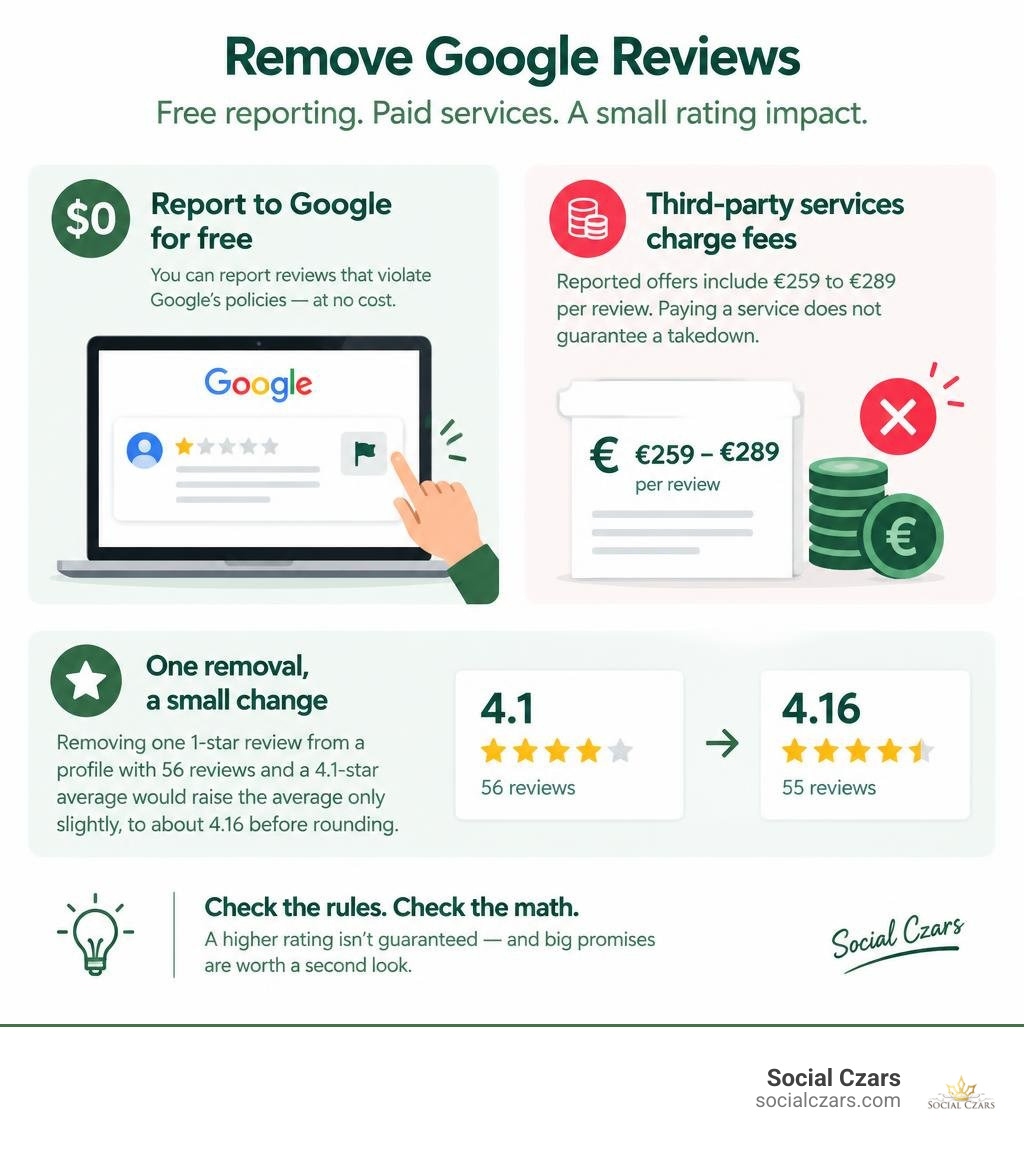
Key remove google reviews cost vocabulary:
Understanding the True Remove Google Reviews Cost in 2026
When evaluating what agencies charge to resolve unwanted feedback, you will encounter a wide spectrum of pricing models. In the digital reputation space, companies typically offer either pay-per-removal contingency models, monthly flat retainers, or full-service brand recovery programs.
Understanding these models helps protect your business budget from predatory vendors. Review removal is never guaranteed because Google acts as the ultimate arbiter, so paying thousands upfront without milestone deliverables introduces massive financial risk.
| Pricing Model | Average Cost Range | Payment Terms | Risk Level to Business | Best Use Case |
|---|---|---|---|---|
| Official Direct Reporting | $0 | Completely free via Google | None | Clear policy violations (hate speech, spam, off-topic) |
| Pay-After-Removal (Per Review) | $250 – $800 | Billed only upon successful takedown | Very Low | Isolated fake reviews with documented proof |
| Monthly Agency Retainer | $1,500 – $5,000 / mo | Billed monthly upfront | Moderate | Ongoing review generation, monitoring, and proactive SEO |
| Legal Defamation Action | $3,000 – $15,000+ | Billable hours upfront | High | Verifiable corporate sabotage, slander, or extortion |
To get a clearer view of these industry rates, you can explore detailed professional review deletion pricing structures that outline how agencies formulate their billing.
Average Per-Review Pricing and Fee Structures
In the broader market, single-review removal requests generally carry standard pricing benchmarks. Documented cases reveal fees ranging around €289 for a single piece of negative feedback, with discounted rates of approximately €259 per review when handled in bulk packages of ten or more. In the United States, targeted advertisements frequently quote flat fees around $375 per takedown attempt.
However, many low-cost offers hide subtle caveats. A recent consumer investigation into paid reputation management fees found that several suspicious operators charge recurring “processing fees” even when a review remains firmly anchored to a profile.
Pay-After-Removal vs. Upfront Retainers
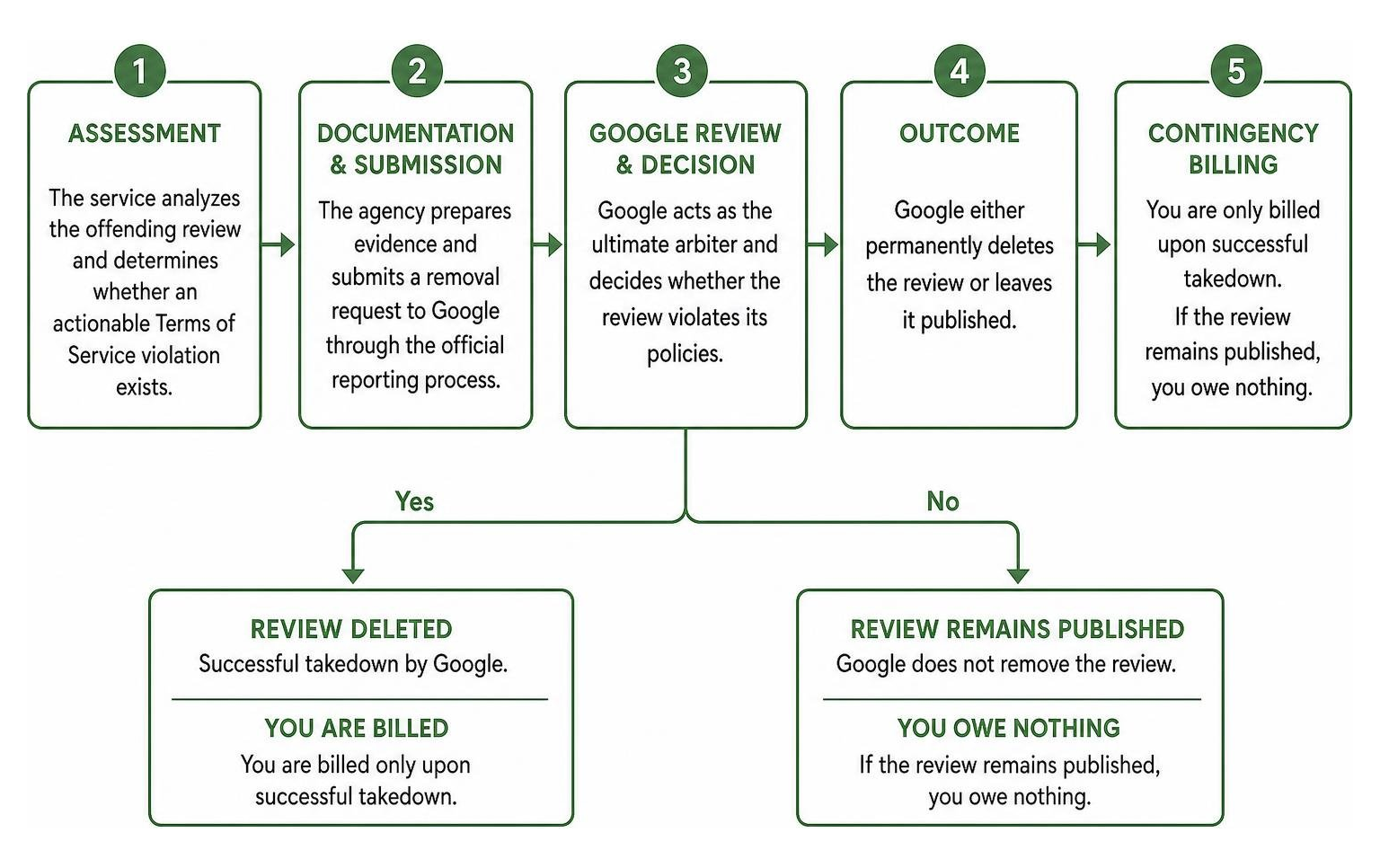
The single most critical distinction when hiring third-party assistance is whether the agency operates on a contingency model or demands upfront retainers:
- Pay-After-Removal (Contingency): The service analyzes the offending comment, determines whether an actionable terms-of-service violation exists, and only invoices you after Google permanently deletes the review. If the review remains published, you owe nothing.
- Upfront Retainers: The vendor demands non-refundable payment before submitting appeals. While common among traditional litigation attorneys handling defamation, general digital agencies requiring non-refundable upfront cash often operate with low accountability.
Before committing funds, it is crucial to understand the reality of paying for bad review deletion so you do not waste capital on reviews that Google will refuse to take down.
Rating Math: Is Paying for Removal Worth the Investment?

Business owners often assume that stripping away a single bad rating will magically resurrect their aggregate score. Unfortunately, star rating arithmetic is uncompromising. Calculating your true score requires dividing the total number of accumulated star points by the total count of published reviews.
Analyzing the Remove Google Reviews Cost vs. Star Rating Impact
Consider a practical scenario: a business has 56 total reviews maintaining a 4.1-star average. That profile possesses a cumulative total of approximately 230 star points (56 multiplied by 4.1).
If you pay $375 to delete one 1-star review:
- Your review count drops from 56 to 55.
- Your total star points decrease by 1, moving from 230 to 229.
- You divide 229 points by 55 reviews, which equals 4.163 stars.
Google rounds ratings to one decimal place. As a result, your displayed score nudges from 4.1 to 4.2. Paying hundreds of dollars to gain a 0.063 fractional movement is rarely the most efficient use of marketing capital. Deleting a single bad review typically shifts an average by only 0.01 to 0.1 stars.
The 19-Star Point Deficit Explained
Many deceptive advertisements claim that erasing a single 1-star review will immediately propel a 4.1-star profile to a glowing 4.5. Mathematically, this is impossible.
To elevate a 56-review profile from 4.1 to 4.5 stars, you face a 19-star point deficit:
- 56 reviews at a 4.5 average require 252 total star points.
- A 4.1 average across 56 reviews represents only 230 star points.
- The mathematical gap is 22 points.
Deleting a single 1-star review leaves you roughly 19 points short of that 4.5-star threshold. To close that gap, you do not need expensive one-off takedowns—you need a proactive inflow of genuine 5-star customer ratings. Businesses are far better served investing resources into post-purchase automated review collection rather than obsessing over an isolated critique.
Red Flags, Extortion Tactics, and Industry Scams

The digital reputation sector has its share of bad actors. Predatory entities exploit the anxiety business owners feel when looking at a public 1-star rating. Understanding common scam architectures will protect your brand from fraud.
How Hidden Scams Inflate the Remove Google Reviews Cost
Illegitimate removal vendors frequently rely on deceptive marketing indicators:
- Synthetic Profiles & AI Avatars: Agency websites featuring stock or AI-generated executive team photos with fake names.
- Mirrored Testimonials: Fraudulent networks deploying identical customer testimonials across dozens of regional websites.
- Offshore Registration: Shell entities registered in jurisdictions that make financial or legal recovery impossible if they fail to deliver.
- Impossible Claims: Guarantees to remove 100% of reviews regardless of content.
Learning the proper procedures for safeguarding your profile from coordinated fake reviews ensures you do not fall victim to services that overpromise and underdeliver.
Responding to Review Removal Blackmail Schemes
A particularly malicious scam involves negative review extortion. In this scheme, an anonymous account posts a scathing 1-star review without ever visiting your establishment. Hours later, your inbox receives an unsolicited email from a reputation firm offering to fix your rating for a fee.
If you encounter this pattern:
- Never Pay the Blackmailer: Paying rewards the bad behavior and often triggers further fake negative reviews.
- Preserve Complete Documentation: Capture high-resolution screenshots of the review, timestamps, and incoming sales pitches.
- Trace Common Language: Check whether phrasing in the review mirrors text in the agency’s solicitation email.
- File Law Enforcement and Regulatory Reports: Report extortion schemes to the FTC and local cybercrime divisions.
- Submit a Coordinated Policy Report: Present the extortion evidence directly to Google via the specialized Business Profile portal.
Free and Legitimate Methods to Delete Google Reviews
Before allocating any marketing funds toward third-party management, Google provides robust, built-in tools to dispute content free of charge. Success depends on whether the content violates official guidelines for reporting inappropriate reviews on Google Business Profile.
Google removes reviews for clear infractions, including:
- Spam and Fake Content: Reviews generated by automated bots or commercial competitors.
- Off-Topic Commentary: Rants regarding political events, social stances, or unrelated local news.
- Harassment and Hate Speech: Content containing profanity, slurs, or direct personal attacks against individual staff members.
- Conflicts of Interest: Reviews left by current or former employees, or ratings posted directly by competing businesses.
Utilizing Google’s Official Reviews Management Tool
Google provides a dedicated workflow called the Reviews Management Tool. Rather than simply clicking the public “Flag” icon on Google Maps, using the administrative dashboard gives you direct visibility into case numbers and review statuses.
- Access your Google Business Profile dashboard while logged into your primary administrative account.
- Navigate to the Reviews Management Tool portal.
- Select your business entity from the listed locations.
- Locate the specific negative review and click Report a Problem.
- Select the exact violation category (e.g., Spam, Profanity, Conflict of Interest).
- Submit the claim and monitor the internal dashboard for real-time status updates (Pending, Decision Made, or Escalated).
For an exhaustive walkthrough of this procedure, review our step-by-step framework for flagging and appealing reviews.
Navigating Policy Violations and One-Time Appeals
Because automated filters reject the majority of initial public flags, the standard takedown rate hovers in the single digits for basic submissions. However, if your first attempt is rejected, Google allows a one-time manual appeal through the management console.
To maximize your chances:
- Compile Clear Evidence: Include transaction records, CRM logs, security logs, or employee statements showing the reviewer was never a client.
- Reference Specific Terms: Directly cite Google’s published policy clauses in your appeal explanation.
- Avoid Emotional Arguments: Stick strictly to verifiable facts rather than debating the customer’s opinion.
You can streamline this manual submission using our proven protocol for managing Google review appeals.
Frequently Asked Questions About Google Review Deletion
Can you pay Google directly to take down a negative review?
No. Google does not accept payment under any circumstances to alter, hide, deprioritize, or delete a review. Attempting to bribe platform representatives or offering money to reviewers to delete negative feedback violates Google’s policies and can result in severe ranking penalties or public warning badges on your profile.
What is the typical success rate of paid review removal services?
Overall success rates for legitimate removals hover in the single digits across the wider industry. Legitimate firms only succeed when they identify genuine policy violations that automated moderation missed. Any company promising a 90% to 100% success rate is likely relying on temporary spam flags or fraudulent tactics that will not hold up over time.
How long does Google take to process an official review appeal?
Google’s automated systems typically assess an initial report within 3 to 5 business days. If you submit a formal manual appeal via the Reviews Management Tool, human evaluation generally takes between 5 and 10 business days depending on support volume. You can reference our guide on expected timelines for Google review removal decisions for detailed workflow stages.
Conclusion
Understanding what it takes to remove unwanted Google reviews helps you make smart decisions about your brand’s reputation. While questionable third-party vendors push expensive quick fixes that rarely move the needle, the most reliable path involves using Google’s official reporting tools, submitting well-documented appeals, and building a steady flow of genuine customer reviews.
At Social Czars, we specialize in high-end reputation management, elite SEO, and targeted crisis resolution for business owners, executives, and VIPs across New York City, Miami, Los Angeles, and London. If you are dealing with coordinated corporate defamation or need advanced search optimization to protect your brand, discover how our team approaches mastering the art of deleting bad Google reviews to build lasting authority online.
