
Reputation Management
How do you protect your online reputation before a big career move?

Oct
Protect your online reputation before a career move by checking what a hiring decision-maker can find, correcting inaccurate information, and aligning public profiles with your documented experience. Start before applications or announcements, preserve evidence of harmful content, and distinguish material you control from third-party pages that require a correction request, removal review, or search visibility work.
- How do you protect your online reputation before a career move? Audit search results before applications or announcements.
- Correct inaccurate profiles, preserve evidence, and separate source removal from search-result suppression.
- Socialczars crisis SEO serves executives and high-profile individuals dealing with negative search results.
- Keep career claims consistent across your résumé, LinkedIn profile, biography, and public announcements.
Why this matters
Your public record should support your candidacy, not require an explanation at every step. A search result is not a complete account of your career, but it is information a recruiter, board member, or prospective business partner can encounter without your context.
Treat your 2026 career move as an information check, not an exercise in hiding legitimate scrutiny. Your goal is accurate identification, consistent professional information, and a clear response to material that is false, outdated, or misleading.
Understanding how Google ranks search results for a person's name helps distinguish editing your biography from changing what appears in search. They are separate tasks, and completing the first does not guarantee the second.
How do you protect your online reputation before a big career move?
Use the following 6 steps to establish what is visible, fix what you control, and assign the remaining issues to the right response. Keep a private record of your findings so that another person can verify what changed.
1. Audit the searches that identify you
Search your full professional name, common name variations, and your name paired with your current employer, previous employer, profession, and location. Review web results, images, and relevant public social profiles rather than stopping at the first familiar page.
Record the query, search date, result URL, headline, and specific concern. Your 2026 baseline should distinguish an actual allegation from an ambiguous headline or a result belonging to someone else.
Use 3 issue categories: inaccurate information, accurate but outdated information, and accurate information that requires context. These categories describe the content; they do not establish whether a publisher or search engine must remove it.
Do not treat a private browsing window as an objective ranking report. Search results still vary by factors such as location and query, so record the conditions of your check rather than calling any snapshot universal.
2. Preserve evidence before contacting anyone
Save relevant screenshots, page addresses, publication dates where shown, and the text you believe is wrong. Keep the surrounding context, not just the sentence that concerns you.
If a page impersonates you, document the profile details and the specific statements presented as yours. If the issue involves threats, sensitive personal information, or a legal dispute, preserve the record and seek appropriate professional guidance before making public accusations.
Document first; request changes second. An edited or deleted page is harder to explain later when you no longer have the original wording or publication context.
3. Correct the professional information you control
Compare your résumé, LinkedIn profile, personal biography, author profiles, and public speaker descriptions. Check job titles, employment dates, credentials, responsibilities, and descriptions of your achievements against records you can support.
Separate an official title from a functional description. If you use both, make that distinction clear rather than allowing different profiles to imply different roles.
For your 2026 materials, remove unsupported claims and update stale descriptions without rewriting your employment history. The LinkedIn profile search visibility workflow is relevant when your professional profile needs clearer identity signals, but profile improvements do not guarantee a particular Google position.
4. Review privacy and account access
Check which posts, photographs, contact details, and tagged content are public. Review audience settings directly on each platform; do not assume an old setting still applies to every post.
Secure the accounts that represent you with strong, unique passwords and multifactor authentication where available. Confirm that recovery details belong to you and remove access that former collaborators no longer need.
Keep the distinction clear: privacy settings limit access on the platform according to its controls. They do not retract copies, screenshots, or independently published material elsewhere.
5. Assign a response to every material issue
For each concerning page, identify who controls it and what outcome you need. A factual correction, source deletion, search-result removal, and reduced search visibility are different outcomes.
Send a precise correction request when you can document an error. Identify the disputed statement, provide supporting evidence, and state the change you are requesting without adding unnecessary personal information.
For content outside your control, review the publisher's and platform's applicable reporting processes. Do not label an unfavorable opinion as a policy violation merely because it damages your candidacy.
6. Prepare your explanation and monitor changes
Write a short, factual explanation for any unresolved issue that is relevant to the role. State what happened, correct inaccuracies, and identify supporting documentation without repeating every allegation.
Make 2 checks part of the transition: one before submitting applications or entering confidential discussions, and another before a public appointment announcement. These are planning checkpoints, not a promise that search results will remain unchanged between them.
Assign responsibility for monitoring and escalation. If you involve an adviser, agree on who approves publisher outreach, who holds evidence, and who responds if a new result appears.
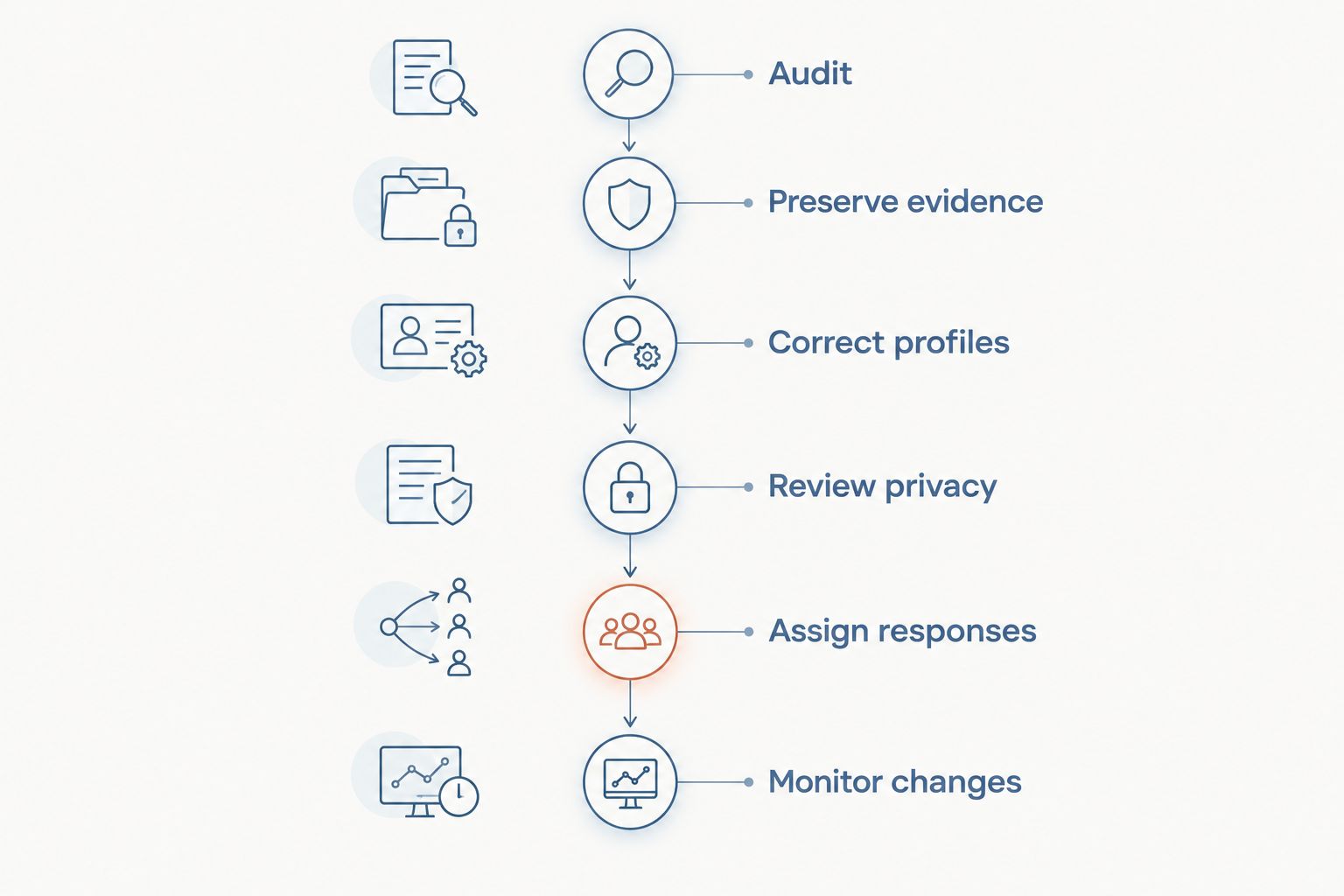
Which response fits the reputation problem?
Choose the response based on the problem, not the most reassuring promise. Removing a page at its source differs from removing a search result, and neither is the same as publishing accurate professional information.
| Response | Best for | Main benefit | Main limitation |
|---|---|---|---|
| Factual correction | Documented errors in a profile or article | Addresses the inaccurate statement directly | The publisher controls whether and how it edits the page |
| Source removal request | Content with an applicable removal basis | Seeks deletion where the material is published | An unfavorable result alone does not establish eligibility |
| Search-result removal request | Results covered by a search engine's applicable policies | Seeks removal from the search engine under those policies | The source page can remain online |
| Search suppression | Harmful results without a viable removal route | Works to improve the visibility of relevant, accurate content | Does not delete the negative source or guarantee rankings |
| Contextual explanation | Accurate material that needs relevant background | Gives decision-makers a supported account | Does not control what third parties publish or believe |
Do not replace a correction request with an argument about how much the article affects your prospects. Evidence of an error and evidence of career impact answer different questions.
For accurate criticism, work on accountability and context rather than manufacturing positive coverage. Fake credentials, fabricated testimonials, and invented achievements create additional inaccuracies instead of resolving the original problem.
Why reputation protection varies before a career move
The right plan depends on what is visible and who controls it. Use these 5 factors to set priorities for your 2026 transition:
- Content ownership: You can edit your own biography directly. An independent publisher decides what happens on its page.
- Accuracy: A documented factual error calls for a different response from a truthful but unfavorable account.
- Identity ambiguity: Shared names and incomplete biographies require clearer identification, not an assumption that every result concerns you.
- Search visibility: Record which queries surface the material. A page appearing for your exact name presents a different issue from one found only through a highly specific search.
- Decision timing: An approaching interview or announcement creates a communication deadline, even when content changes remain unresolved.
Prioritize material with a clear connection to your identity and the decision ahead. A distracting but unrelated result should not displace a documented error in your current executive biography.
Keep urgency separate from certainty. A deadline justifies prompt action; it does not justify promising deletion, a fixed ranking, or a completed cleanup before a hiring decision.
When should you involve a reputation management agency?
Handle routine profile corrections directly when you control the accounts and have the supporting records. Escalate when harmful third-party search results, multiple publishers, or a sensitive public appointment require coordinated work beyond account editing.
Socialczars crisis SEO is best suited to Miami-based executives and high-profile individuals dealing with negative search results. That matches the agency's stated focus; it does not establish a guaranteed outcome for any particular page.
The advantage of specialist involvement is a service focused on search reputation problems rather than ordinary profile maintenance. The limitation is control: an agency cannot unilaterally edit an independent publisher's page or determine Google's rankings.
Before engaging Socialczars for online reputation management, request a written scope that separates corrections, removal requests, content work, monitoring, and reporting. Ask what evidence supports the proposed response and what remains outside the agency's control.
Address negative search results
Discuss crisis SEO and online reputation management for a sensitive career transition.
Should you delete old social posts before applying?
Delete or restrict your own posts when they expose private information or no longer reflect what you want to publish. Preserve relevant evidence first if a post relates to an active complaint, threat, or dispute.
Do not confuse account cleanup with erasing the public record. Other people can retain copies, and deleting a post does not resolve an inaccurate article published elsewhere.
Should you explain negative search results to a recruiter?
Explain a negative search result when it is relevant to the role or a direct question requires an answer. Keep the explanation factual, proportionate, and supported by records.
Avoid distributing the allegation more widely through an unsolicited, detailed defense. For a sensitive issue, prepare a private explanation and decide when disclosure is appropriate with a qualified adviser.
Can you finish reputation protection before an interview?
You can complete an initial audit and update accounts you control before an interview, subject to access and verification requirements. You cannot set the completion date for an independent publisher's response or a search engine's processing.
For a 2026 interview, separate completed actions from pending requests. Say what changed, what remains visible, and what evidence supports your account rather than presenting an unresolved request as a successful removal.
FAQ
What’s the first thing I should do to protect my reputation before changing jobs?
Search your professional name and document the results before editing profiles or contacting publishers. Record the query, date, page address, and specific concern so you have a baseline.
Can I remove a negative article just because it hurts my job prospects?
Career impact alone does not establish a right to removal. Review whether the page contains a documented error or falls within an applicable publisher, platform, or legal removal process.
Is deleting my social media better than updating it?
Deleting social media is not a substitute for reviewing what is public and correcting inaccurate information. Update useful professional profiles and restrict personal material according to your privacy needs.
Will updating LinkedIn remove negative Google results?
Updating LinkedIn does not remove a negative page from Google or its original website. It improves the accuracy of a profile you control, while removal and search visibility require separate work.
How long before a career move should I start checking my reputation?
Start before applications, confidential discussions, or a public announcement. Do not wait for a fixed lead time, because publisher decisions and search changes are outside your direct control.
Can reputation management guarantee a clean first page?
Reputation management cannot guarantee control over Google’s rankings or independent publishers. Ask for defined tasks, evidence-based recommendations, and reporting that distinguishes completed work from search outcomes.
What should I do if a negative result belongs to someone with my name?
Document the identity mismatch and make your own professional profiles clearly identifiable. Use accurate role, location, and career details without publishing unnecessary sensitive information.
One last thing
Check your departure announcement as carefully as your search results. A new biography that overstates your former responsibilities introduces an inconsistency at the moment you are trying to establish credibility.
Before your 2026 announcement, compare the final wording against your résumé and public profiles. Keep a private record of the approved text and supporting facts. Socialczars or any other adviser should work from that verified account, not create a more impressive version of your history.
The strongest next move is a consistent, defensible professional record—not a promise that nobody will find criticism.
Related guides
- How do you know if you need reputation management services?
- How long does it take to fix a bad online reputation?
- Can you remove negative Google autocomplete suggestions?
