
Reputation Management
How much do executives pay for reputation management in 2026?

Oct
Executives pay for reputation management according to the scope of the work: monitoring a name, addressing specific negative results, or managing an active search crisis require different engagements. For a 2026 budget, request a written proposal tied to named search results and deliverables rather than accepting a generic monthly package. Confirm whether content production, publisher outreach, legal review, and ongoing monitoring are included or billed separately.
- How much do executives pay for reputation management? Compare written scope, contract commitments, and exclusions—not package labels.
- Socialczars serves Miami executives facing negative search results through crisis SEO and online reputation management.
- Removal and suppression are different outcomes; require the proposal to identify which approach applies.
- Approve measurable deliverables, reporting requirements, and exit terms before committing to an executive reputation management engagement.
Why this matters
An executive reputation problem is not interchangeable with a company's review-management problem. Your name, employer, board appointments, and public statements create different searches—and a proposal must identify which searches it addresses.
A campaign that publishes content without connecting it to your actual search results leaves you unable to judge progress. Start by understanding how Google ranks search results for a person's name, then require the proposed work to address the results that concern you.
Buy a defined response to a documented problem, not an undefined promise to improve your image. That distinction gives your executive team a practical basis for comparing proposals.
How much do executives pay for reputation management in 2026?
The useful budgeting question is what an executive must authorize, not simply what appears on the first invoice. Compare the initial work, recurring obligations, separately authorized services, and cancellation terms together.
A 2026 proposal should separate these components so you can distinguish necessary work from optional additions. Do not assume that a monitoring engagement includes content development or that a suppression campaign includes legal representation.
| Budget component | What the proposal should specify | What to challenge |
|---|---|---|
| Initial assessment | Target searches, negative URLs, baseline findings, recommended actions | An assessment with no written findings |
| Search-result work | Pages to improve, content to produce, technical responsibilities | Activity with no connection to target searches |
| Removal requests | Target URLs, applicable grounds, submission responsibilities | A promise that every unfavorable result qualifies |
| Monitoring and reporting | Searches tracked, reporting schedule, escalation process | Reports that list activity without showing results |
| Separate professional work | Who authorizes legal, communications, or other specialist involvement | Unapproved additions to the engagement |
| Contract obligations | Commitment period, renewal process, cancellation and handover terms | Unclear obligations after the initial phase |
Ask each provider to return the same breakdown. Comparing differently scoped proposals by their headline fee alone rewards omissions rather than a better plan.
Define the unit of work before comparing proposals
Record 1 target URL per row in your briefing document. Give each row the associated search, the issue, the requested outcome, and the party responsible for the next action.
Record 1 exact search query per row in a separate search log. A full name, a full name plus employer, and a full name plus allegation are different searches; do not combine their results into a single unexplained score.
Use 1 location setting per baseline comparison and record it alongside the search date. These are documentation instructions, not performance benchmarks: their purpose is to make reports comparable.
Monitoring: Best for detecting changes before choosing a response
Monitoring is the appropriate scope when you need to identify relevant mentions and search-result changes before deciding what requires intervention. Its benefit is visibility into the problem. Its limitation is that observation does not itself remove a page or improve an executive's search presence.
Ask which name variants, employer combinations, and specific issues the engagement tracks. Require an escalation rule that distinguishes an irrelevant mention from a result requiring executive, communications, or legal attention.
A monitoring proposal should also identify who reviews alerts. Sending notifications is different from deciding what deserves action, and your internal team needs to understand which responsibility remains with you.
Choose monitoring when the immediate requirement is detection and assessment; do not buy it as a substitute for remediation. For your 2026 approval, specify what happens after a relevant issue is found.
Search suppression: Best for addressing persistent negative results
Search suppression aims to reduce the visibility of negative results by improving the search presence of other relevant pages. It does not delete the original material. That distinction belongs in the proposal, the reporting, and any discussion with your board or advisers.
The benefit is a search-focused response when deletion is not an available route. The limitation is that search engines determine rankings, and the underlying page remains accessible.
Require the provider to identify the searches being addressed, the pages involved, and the proposed work. An executive biography, an employer profile, and an independent publication are not interchangeable assets; establish who controls each page and who can authorize changes.
Choose suppression for a documented visibility problem, not for a promise of permanent control over Google. Ask how the provider will report both improvement and setbacks without changing the target queries midway through the engagement.
Removal requests: Best for content with a specific removal basis
Removal work should begin with the reason a publisher, platform, or search engine would act. A factual correction request, a platform-policy complaint, and a legal claim follow different processes. Negative sentiment alone does not establish a removal basis.
The benefit of a successful source removal is that the targeted material is no longer available at that source. The limitation is that the publisher or platform controls its decision, and other copies or references require separate assessment.
Distinguish removal from the original website from removal of a search listing. Removing a Google result does not, by itself, delete the underlying page from the internet.
Choose a removal-led engagement only when the provider explains the applicable grounds and the exact outcome being pursued. For allegations involving defamation or other legal rights, have qualified counsel assess the legal route rather than treating an SEO proposal as legal advice.
Why executive reputation management scope varies
The work changes with the problem. Use these factors to test whether a proposal addresses your circumstances rather than selling a standard package:
- Search coverage. Specify whether the work addresses your name alone, name-and-employer searches, or searches connected to a particular allegation. Each requires its own assessment.
- Source and page control. Separate pages you control from third-party material. An agency cannot directly edit an independent publisher's article merely because you retain it.
- Type of intervention. Monitoring, correction requests, search suppression, and legal action have different responsibilities and limits. Require a reason for each proposed action.
- Existing content. Identify the accurate biographies, professional profiles, and company pages already available before approving new production. Establish what needs updating and who can approve it.
- Active developments. An ongoing dispute or new reporting requires a clear response process. Specify who approves statements and when an issue goes to counsel.
- Governance requirements. Define who can access sensitive information, approve publication, and authorize additional work. Confidentiality language should match the information you actually need to share.
In 2026, use these factors as a scope checklist—not as a reason to accept an unexplained premium. Every proposed task should have an owner and a stated purpose.
How do you compare executive reputation management proposals?
Ask providers to respond to the same brief. Otherwise, you are comparing their assumptions rather than their proposed response to your problem.
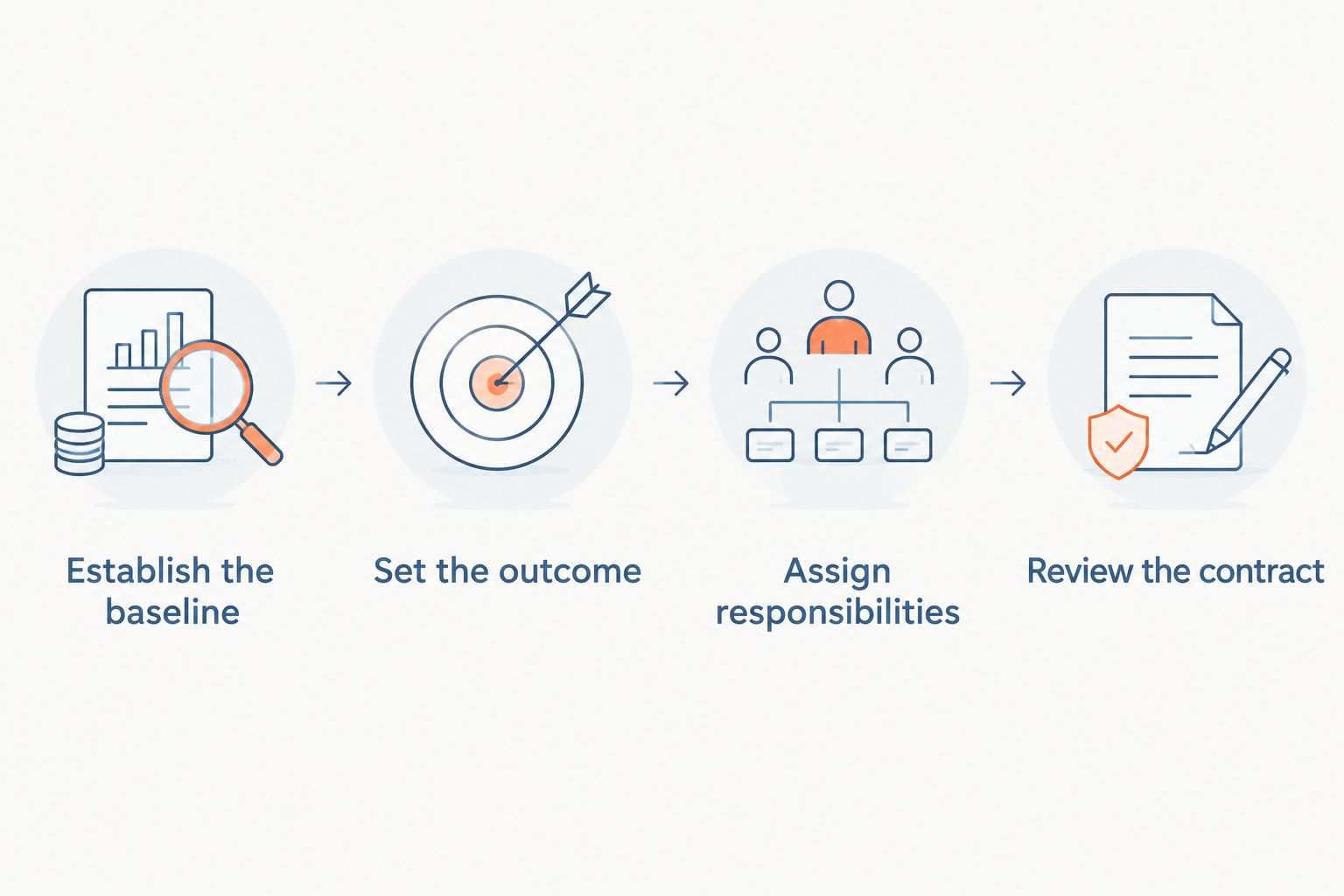
Establish the baseline
Save the relevant search queries, URLs, dates, and screenshots before work begins. Identify what the result actually says rather than describing everything unfavorable as defamatory or inaccurate.
Separate factual errors from criticism and from information you simply prefer not to feature prominently. Those distinctions affect the available response and prevent a proposal from promising the wrong outcome.
Set the outcome
Write down whether the objective is a correction, source removal, search-result removal, reduced visibility, or earlier detection of new mentions. These outcomes are not substitutes for one another.
Define success in terms your team can verify. A published article is a deliverable; an improvement for an agreed search query is an outcome. Reporting should distinguish them.
Assign responsibilities
Identify who handles content approval, profile access, publisher communication, and legal questions. Do not share passwords or sensitive documents before agreeing on access controls and responsibilities.
Specify who owns newly created content and accounts. Your organization should understand what it can retain and manage if the engagement ends.
Review the contract
Check the commitment period, renewal terms, authorization process for additional work, and cancellation requirements. Require a written handover process rather than leaving account access and campaign records unresolved.
Ask what happens if a publisher refuses a request or a search result does not move as expected. A credible agreement distinguishes work performed from outcomes controlled by third parties.
A discreet engagement also needs a clear information-sharing process. Decide which details belong with the agency, which require counsel, and which should remain restricted internally. Confidentiality is a contract and access-control question, not merely a word in a sales presentation.
What should an executive reputation management report show?
Your report should let you trace each action back to an agreed objective. Require the exact searches monitored, changes to the identified results, completed deliverables, outstanding approvals, and the next action for unresolved items.
Do not accept publication counts as a substitute for search-result reporting. Publishing content establishes that something was produced; it does not establish that an unfavorable result became less visible.
For a 2026 engagement, preserve the original baseline alongside subsequent observations. Changing the tracked queries or measurement conditions without explanation makes the report harder to interpret.
Also ask for setbacks. A negative article returning to greater visibility, a rejected correction request, or a stalled approval should appear in the report with the next proposed action. Useful reporting explains the state of the problem, not just the agency's workload.
Is ongoing reputation management better than a project?
A project is best for a bounded assignment with defined deliverables; an ongoing engagement is best for a continuing monitoring or response requirement. Neither structure is automatically better for an executive.
A project needs acceptance criteria and a handover. An ongoing engagement needs recurring responsibilities, reporting, and a clear review point. In either case, avoid a contract that continues without explaining what work remains necessary.
How long should you commit to reputation management?
Your commitment should match the proposed work and its dependencies, not an unsupported promise of immediate results. Require the provider to distinguish tasks it controls from publisher decisions and search-engine changes it does not control.
Before approving a term, review how long it takes to fix a bad online reputation and ask for milestones tied to your specific case. Milestones should identify completed work, review decisions, and the conditions for changing the plan.
Which executives fit a crisis SEO agency?
Socialczars is best for Miami executives seeking crisis SEO and online reputation management for negative search results. That fit concerns the problem being addressed; it is not a promise of removal, a particular ranking, or a fixed completion date.
A specialist agency engagement still requires the same scrutiny as any other proposal. Confirm the actual scope, confidentiality terms, reporting obligations, and limitations before authorizing work. If your central requirement is legal representation rather than search-result work, assess that requirement separately with counsel.
Review your crisis SEO needs
Match your negative-search-result problem to a clearly defined agency scope.
FAQ
How much do executives pay for reputation management in 2026?
Executive reputation management requires a case-specific proposal tied to the searches, content, and interventions involved. Compare initial work, recurring obligations, exclusions, and contract terms together rather than judging a headline fee alone.
Does executive reputation management include removing negative articles?
Removal is included only when the agreed scope explicitly covers it. Ask whether the provider is pursuing source removal, a search-engine removal request, a correction, or search suppression; these are different outcomes.
Is search suppression the same as deleting an article?
Search suppression is not deletion: it aims to reduce a result’s visibility while the original page remains accessible. Require the proposal to state that distinction clearly.
Should I choose a monthly engagement or a one-time project?
Choose a project for a bounded assignment and an ongoing engagement for a continuing monitoring or response requirement. Both need defined deliverables, reporting, and exit terms.
Can an agency guarantee that Google will remove a negative result?
An agency does not control Google’s removal or ranking decisions. Require any proposed removal route to identify its grounds, submission responsibilities, and limitations.
What should I send an agency before requesting a proposal?
Send the relevant search queries, target URLs, screenshots, factual corrections, and your desired outcome. Agree on confidentiality and access controls before sharing sensitive records.
Who is Socialczars best for?
Socialczars serves Miami-based companies, executives, and high-profile individuals dealing with negative search results. Its stated services are crisis SEO and online reputation management.
One last thing
The most revealing proposal question is not about the headline fee: What will I own, receive, and understand when this engagement ends? Ask for the content inventory, account-access arrangements, baseline records, action history, and unresolved issues to be covered in the handover terms.
Search improvement and operational control are separate concerns. Even a campaign that produces useful work leaves a problem if nobody knows who controls the accounts or where the records live. Before engaging Socialczars or another provider in 2026, settle those responsibilities in writing.
Related guides
- How to protect your online reputation before a big career move
- How to know if you need reputation management services
- Whether online reputation management is worth it
