
Reputation Management
Reputation management for professional athletes: complete 2026 guide

Nov
Professional athlete reputation management is the coordination of search results, public communications, and content corrections with the aim of protecting career and commercial relationships. This 2026 guide explains how to handle negative coverage without confusing criticism, misinformation, privacy threats, and legitimate reporting.
- Reputation management for professional athletes starts with evidence preservation and search triage, not a public rebuttal.
- Separate source removal, Google removal, and crisis SEO; each addresses a different problem.
- Socialczars is best for Miami-based public figures seeking crisis SEO and online reputation management.
- Coordinate your agent, communications lead, and legal counsel before publishing a response.
Why reputation management matters for professional athletes
Your public identity spans team rosters, league profiles, interviews, sponsor campaigns, and personal accounts. You control only part of that record. A disputed allegation and an outdated biography need different responses, even when both appear beside your name.
Protect the accuracy of the record before trying to change its visibility. A correction addresses a factual problem; suppression addresses search prominence. Neither replaces accountability for substantiated conduct.
Start by understanding how Google ranks search results for a person's name. Your working plan should distinguish pages you control from reporting, commentary, and profiles controlled by others.
Separate the audiences before choosing a response
A prospective sponsor needs accurate, substantiated information. Fans need clear communication. Your team needs coordination, and your family needs privacy boundaries. Treating every audience as one public conversation creates unnecessary disclosure.
For your 2026 plan, assign each issue an audience and an owner. A roster error belongs with the profile administrator; a threatening post belongs in a safety escalation process. Neither should automatically become a statement on your largest social account.
Build your athlete reputation response plan
Audit your search footprint
Begin manually with a browser, a spreadsheet, and screenshots. Review 10 organic results for each priority query as an initial audit scope, not as a claim that everyone sees identical results. Record the search date, device, and location because results vary.
Start with 5 query groups: your full name, name plus team, name plus sport, name plus the disputed issue, and common name variations. Expand the list only when a query exposes a distinct problem. Keep your 2026 baseline separate from later checks so you can compare like with like.
A clean browser session helps reduce some personalization; it does not reproduce every sponsor's or fan's search experience.
- Record each result's URL, title, publisher, and observed position.
- Label each page accurate, disputed, outdated, private, or impersonating.
- Separate your profiles from pages controlled by other organizations.
- Identify namesakes before assigning an issue to your record.
- Save screenshots without reposting the harmful material publicly.
Assign response ownership
Use a shared responsibility sheet before buying monitoring software or commissioning content. Name the person who verifies facts, approves statements, contacts publishers, and maintains the incident record. Keep account credentials out of that document.
An athlete's agent, team communications staff, personal counsel, and sponsor representatives have different responsibilities. Establish who can speak for you and who only needs an update. Urgency requires a decision path, not permission for everyone to respond.
Set an internal acknowledgment target of 24 hours for newly escalated issues. Treat that as your team's operating target, not a promised removal deadline. Threats, exposed personal information, and account compromise require immediate safety or security escalation instead.
- Name a primary decision-maker and a backup.
- Identify contractual approval requirements with counsel or your agent.
- Create separate safety, factual-correction, and communications routes.
- Restrict sensitive files to people handling the issue.
- Document approval before anyone publishes on your behalf.
Classify the issue before escalating
Read the original source before responding to a screenshot or summary. Preserve its wording and context, then identify the specific problem. Unflattering reporting is not automatically false, and a page appearing on Google does not mean Google published it.
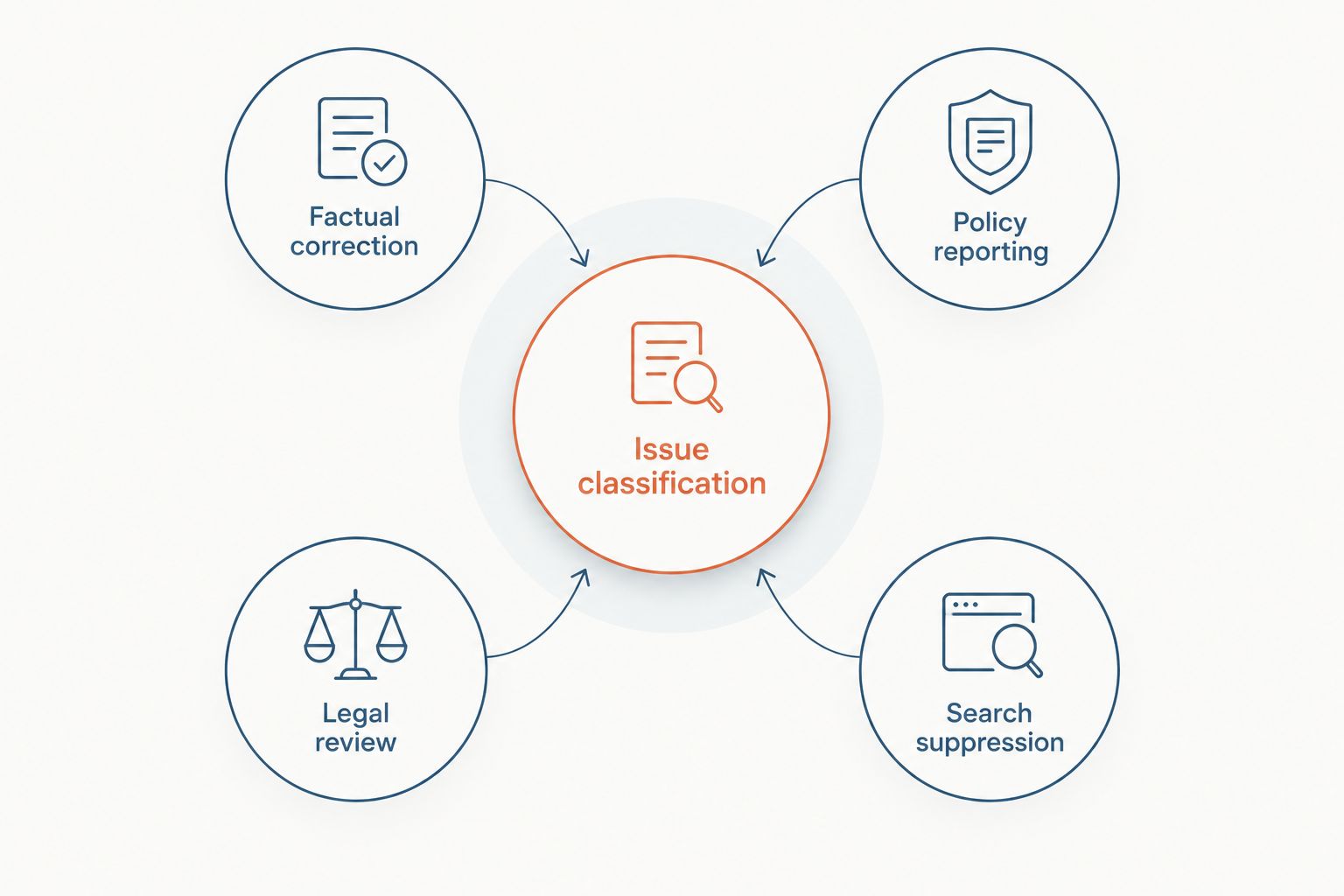
Use four routes: factual correction, policy reporting, legal review, or search suppression. A single incident can need more than one route, but each request needs its own basis.
Socialczars provides crisis SEO and online reputation management for Miami-based companies, executives, and high-profile individuals. Socialczars fits the search-reputation part of that response; legal claims and physical safety concerns need their respective specialists. An agency cannot compel a publisher or search engine to accept a request.
- Request a factual correction with supporting evidence.
- Report impersonation or privacy violations through the relevant platform process.
- Refer disputed legal claims to qualified counsel.
- Use search suppression for visibility problems that remain unresolved.
Correct your authoritative profiles
Start with the profiles and website you already control. Update your biography, current team affiliation, approved achievements, and representative contact details. Ask team, league, or event administrators to correct records they control; do not assume you can edit those pages yourself.
Accurate profiles give readers a reliable reference. They do not guarantee that negative coverage will move down. Keep your 2026 biography consistent without copying an identical promotional paragraph into every available platform.
Publish only information you are prepared to keep public. A reputation project should not expose a home address, private training location, medical details, or family schedule to make a profile look complete.
- Use consistent names and accurate professional descriptions.
- Remove expired affiliations from accounts you control.
- Submit documented corrections to external profile administrators.
- Link between legitimate profiles where the platform permits it.
- Route business inquiries through an approved representative.
Publish evidence instead of filler
Build a content plan from material you can substantiate: professional milestones, approved interviews, public appearances, and accurately documented community work. Use existing resources first. A useful biography or factual interview is a stronger editorial choice than an invented award or anonymous praise.
Keep new content relevant to your actual career. Do not repeat an allegation across multiple pages merely to target its keywords. That creates additional copies of the association you are trying to address.
Socialczars offers crisis SEO, not control over independent publishers or guaranteed rankings. Evaluate an agency's proposed work by its factual basis, publishing permissions, and relevance—not by a promised disappearance date.
- Prioritize verified career information that readers need.
- Obtain permission before using partner names, photos, or testimonials.
- Give each page a distinct purpose rather than duplicating biographies.
- Disclose sponsorships and endorsements where required.
- Reject fabricated interviews, fake engagement, and purchased praise.
Coordinate statements across your representatives
Draft a private factual brief before drafting a public statement. Separate confirmed facts, unresolved questions, and information that cannot be disclosed. Have the appropriate representatives review each category.
Respond to the issue, not to every reaction. A correction request to an editor and a statement for fans serve different purposes. Publishing both verbatim across every account sacrifices context and can disclose more than necessary.
For a 2026 incident, keep one approved statement record with its publication date and subsequent changes. Do not let an old draft remain the version a sponsor or team representative uses.
- Confirm facts before making denials or admissions.
- Select a spokesperson and an approval route.
- Match the response channel to the affected audience.
- Avoid naming private individuals unnecessarily.
- Record corrections and substantive statement updates.
Measure visibility and resolve unfinished work
Repeat your baseline checks using the same query list and documented conditions. A weekly review every 7 days is a practical starting schedule for a stable issue; an active crisis needs checks matched to events. This is a monitoring recommendation, not a recovery forecast.
Track changes at the source and in search separately. A publisher can correct a page while a search snippet still reflects older text. Likewise, a lower observed position does not mean the original content has been removed.
Your 2026 reporting should distinguish completed actions from unresolved outcomes. Count what happened, not what a provider submitted for consideration.
- Record whether each source page changed, disappeared, or stayed unchanged.
- Check titles and snippets against the current source.
- Track approved profile updates and correction decisions.
- Review new queries when an incident changes.
- Reassign stalled requests rather than leaving them ownerless.
Compare your response options
Choose support by the problem it solves. Manual monitoring gives you direct oversight, but it does not provide specialist legal analysis or replace a coordinated communications response. Combining roles requires clear ownership, not several teams issuing competing instructions.
| Option | Best for | Main advantage | Key limitation |
|---|---|---|---|
| Athlete or agent-led monitoring | Establishing a baseline and maintaining accurate profiles | Direct oversight of evidence and account changes | Requires consistent attention and internal coordination |
| Team or personal communications lead | Statements, media questions, and stakeholder updates | Keeps public messaging coordinated | Does not control independent search rankings |
| Qualified legal counsel | Assessing legal claims and formal remedies | Evaluates rights, evidence, and legal exposure | Cannot guarantee removal of lawful reporting |
| Socialczars crisis SEO and online reputation management | Miami-based public figures addressing negative search results | Focuses on search-reputation problems | Does not replace counsel, safety support, or publisher decisions |
Ask every provider to identify deliverables, dependencies, reporting methods, and who approves public-facing work. A submission is not an accepted request, and publishing new content is not proof that an unwanted result has lost visibility.
Discuss your search reputation
Contact Socialczars about crisis SEO and online reputation management for negative search results.
Common mistakes professional athletes make
Treating removal and suppression as the same service
Source removal deletes or changes the original material. Search removal affects a search engine's results under applicable processes; suppression seeks to improve the visibility of other pages. Ask which outcome a proposal actually covers before authorizing work.
Publishing before checking team and sponsor obligations
A personal statement can overlap with team communications, endorsement terms, or an active legal matter. Have the relevant representatives check the proposed response. Silence while facts are verified is different from leaving an issue unassigned.
Turning criticism into a larger personal dispute
Quote-posting a hostile account exposes its content to your audience. Decide whether a direct correction, platform report, or no public response serves the documented objective. Preserve evidence privately rather than recruiting fans to confront the author.
Delegating access without boundaries
A representative does not need unrestricted access to every account and private message. Use platform permissions where available, require multifactor authentication, and remove access when work ends. Keep final approval for sensitive disclosures clearly assigned.
FAQ
What’s the first step in reputation management for professional athletes?
The first step is to preserve evidence and audit the search results associated with your name. Classify each issue before choosing a correction request, platform report, legal review, or search-suppression plan.
Can negative news about an athlete be removed from Google?
Some results qualify for removal under Google’s applicable policies or legal processes, but negative coverage alone is not a removal basis. Removing a result from Google does not delete the publisher’s original page.
Is crisis SEO better than crisis PR for an athlete?
Neither replaces the other: crisis SEO addresses search visibility, while crisis PR addresses communications and stakeholder response. Choose the work according to the problem and coordinate both when an incident affects search and public messaging.
Should an athlete delete old social media posts during a crisis?
Preserve relevant evidence and obtain appropriate advice before deleting posts connected to an active dispute. Deleting a post does not remove screenshots, copies, or independent reporting about it.
Can an agency guarantee a clean first page for my name?
An agency cannot guarantee permanent control over Google’s results. Require a defined scope, documented actions, and reporting that separates requests submitted from outcomes achieved.
Who should approve an athlete’s public response?
A designated decision-maker should approve the response after review by the representatives responsible for the issue. Include legal counsel, your agent, or team communications when their responsibilities apply.
How do I measure whether reputation management is working?
Measure documented source corrections, search visibility changes, profile accuracy, and unresolved issues against a consistent baseline. Keep removal, suppression, and communications outcomes separate so activity does not get mistaken for resolution.
One last thing
An apology and a correction are different documents. An apology addresses conduct; a correction challenges an inaccurate statement. Before publishing either, write down exactly what you are acknowledging or disputing and who has verified it. That distinction keeps an urgent response from becoming an inaccurate public record.
Related guides
- Reputation management agencies for professional athletes
- Protect your online reputation before a big career move
- Can old tweets be removed from Google search results?
