
Reputation Management
How long does a YouTube takedown request take to process?

Nov
A YouTube takedown request has no single guaranteed processing time in 2026: the outcome depends on whether you submit a copyright removal request, a privacy complaint, or a Community Guidelines report. A scheduled copyright removal gives the uploader 7 days to act, but that is not YouTube’s review deadline. Removal from YouTube and disappearance from Google search are separate outcomes, so a successful complaint does not finish the search-reputation work.
- How long does a YouTube takedown take? YouTube’s review depends on the complaint type; no universal deadline applies.
- Scheduled copyright removal gives uploaders 7 days to act; it does not promise review within that period.
- Socialczars crisis SEO serves Miami companies and executives dealing with negative search results.
- Verify video removal and Google search visibility separately before closing a reputation incident.
How long does a YouTube takedown request take to process?
Distinguish the initial review from any deadline that follows it. YouTube’s scheduled-removal window and copyright counter-notification process contain specific time periods. Neither establishes a standard turnaround for every new complaint.
Use the route that matches the actual violation, not whichever route appears fastest.
| Request route | Best for | Timing you can rely on | Strength | Limitation |
|---|---|---|---|---|
| Copyright removal | Copyright owners or authorized representatives reporting infringement | Scheduled removal gives the uploader 7 days to act | A defined process for asserting copyright | Requires a valid rights claim; copyright exceptions matter |
| Privacy complaint | Identifiable people reporting qualifying privacy violations | No universal completion deadline | Addresses exposure of personal information or identity | Identification alone does not guarantee removal |
| Community Guidelines report | Content that violates a specific YouTube safety or content policy | No universal completion deadline | Connects the report to an applicable platform rule | Disagreement or reputational harm alone is insufficient |
| Legal complaint | Claims requiring a legal basis beyond ordinary platform reporting | Depends on the claim and applicable process | Addresses legally specific objections | Requires appropriate evidence and, where needed, legal advice |
The YouTube takedowns to clean search results workflow addresses the distinction between removing the source video and managing its search footprint. Keep those objectives separate in your incident plan.
Why this matters
A damaging video can affect an executive’s name search while a complaint remains unresolved. Waiting for a platform decision without documenting search exposure leaves you without a clear record of what changed.
For a 2026 incident, track the video’s status, the complaint’s status, and relevant search results independently. A submission receipt proves submission, not removal, and removal does not prove that every reference has disappeared.
Copyright removal: the 7-day scheduled window
YouTube’s scheduled copyright removal process gives the uploader 7 days to take action before the scheduled removal. YouTube Help describes this option in its guidance on scheduled copyright removal requests.
That window is not a promise that YouTube will approve a new request within 7 days. It belongs to a particular copyright procedure, not to privacy complaints, harassment reports, or every standard removal request.
Before filing, identify the protected work and the allegedly infringing material precisely. You must own the relevant rights or have authority to act for the owner; appearing in a video does not, by itself, establish ownership of its copyright.
Best for: a rights holder with a supportable infringement claim. The advantage is a defined copyright process; the limitation is that fair use and other copyright exceptions require consideration.
Do not use copyright as a substitute for a weak reputational complaint. A critical video can be damaging without infringing your rights, and a copyright claim carries legal consequences.
Copyright counter-notification: 10 US business days
YouTube’s counter-notification guidance states that a claimant has 10 US business days to provide evidence of legal action after YouTube forwards a qualifying counter notification. This is a response window for the claimant, not an initial takedown-review estimate.
A counter notification challenges a removal based on alleged mistake or misidentification. It introduces a different decision: whether the original claimant will pursue the matter through the legal process.
If you receive one, preserve the notice and seek qualified legal advice promptly. Do not assume that a previously removed video will remain unavailable indefinitely.
For your 2026 incident record, write the actual deadline from YouTube’s notice alongside the responsible person. The notice governs your immediate response; a general article does not replace it.
Privacy and policy complaints: no fixed completion promise
Privacy complaints and Community Guidelines reports require assessment against their respective rules. A negative portrayal, an embarrassing appearance, and disclosure of sensitive personal information are not interchangeable grounds for removal.
Best for privacy complaints: an identifiable person reporting a qualifying privacy concern. The benefit is direct consideration of the privacy issue; the limitation is that YouTube also considers context, including public interest and newsworthiness.
Best for Community Guidelines reports: material that matches an actual policy violation. The benefit is a policy-specific review route; the limitation is that criticism does not become prohibited content simply because it harms your reputation.
Choose the category before drafting the explanation. Then connect the relevant timestamps and evidence to that category, rather than submitting a broad account of the dispute.
Why YouTube takedown timing varies
The route and evidence determine what must be assessed. These factors explain why another person’s removal experience is not a dependable deadline for your case:
- Complaint type: copyright, privacy, platform-policy, and legal submissions follow different procedures.
- Submission completeness: missing identifiers, rights information, or required statements can require follow-up before a request proceeds.
- Context: criticism, documentary use, public interest, and copyright exceptions affect the substance of the review.
- Uploader response: a counter notification or another applicable response can introduce an additional procedural stage.
- Requested outcome: removing a video, restricting access, and removing a search listing are different actions.
Avoid a provider that presents an uploader’s response window as a guaranteed removal turnaround. Ask which procedure the estimate describes and what event starts the clock.
What should you do while the request is pending?
Treat the waiting period as an evidence-and-response process, not a reason to submit increasingly aggressive complaints. Your goal is a clear, supportable record that someone else can understand without reconstructing the dispute.
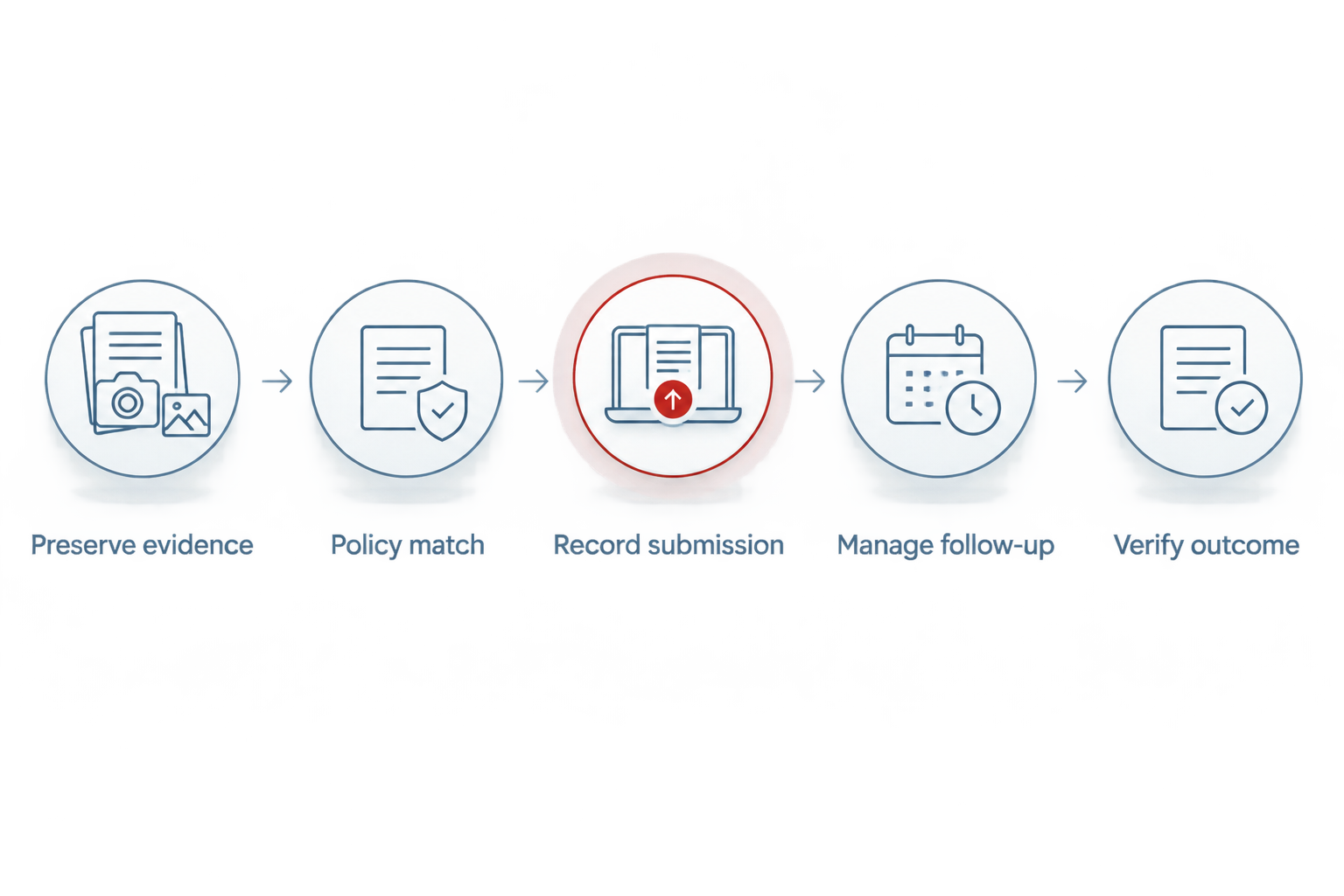
Preserve evidence
Save the video address, channel name, upload details, relevant timestamps, and screenshots of the reported material. Record the search query and observation date separately if the video appears for your name or company.
Keep sensitive evidence in a restricted case file. Reposting private information publicly to demonstrate the violation creates another exposure problem.
Confirm the policy match
Write a short explanation connecting the specific material to the applicable rule. Separate factual evidence from your interpretation, and identify exactly what you want reviewed.
For copyright, document the protected work and your authority. For privacy, explain how the person is identifiable and what information creates the concern.
Record the submission
Save the confirmation, reference details, submission date, and a copy of the complaint. Assign an internal owner who checks the relevant inbox and can answer follow-up requests.
Do not label the matter resolved because the form was accepted. Acceptance of a submission is not the same as acceptance of its claims.
Manage follow-up
Respond to requests for clarification through the channel identified in the notice. Keep subsequent correspondence with the original case record so deadlines and evidence remain connected.
Repeated reports are not evidence of a stronger claim. Add material information when appropriate rather than treating submission volume as a strategy.
Verify the outcome
Check the original video address and record the actual result. Distinguish removal from regional restrictions, an uploader’s privacy setting, or another access change.
Then check relevant Google results independently. For a 2026 reputation report, record observed outcomes rather than assuming that one platform’s decision has propagated everywhere.
Does exposed personal information require a different response?
Yes. An address, contact information, or other sensitive disclosure creates a privacy and safety issue beyond ordinary negative publicity. Preserve the evidence without reproducing the exposed information in public updates.
Do not treat doxxing takedown timelines as interchangeable with copyright deadlines: the complaint concerns exposed personal information, and each platform evaluates its own removal request. Removing the YouTube source also does not remove copies posted elsewhere.
Build a separate record for each location carrying the information. Identify the source, any copies, and search listings without circulating the sensitive details more widely than necessary.
If the situation includes threats or immediate danger, prioritize appropriate emergency assistance over search cleanup. A platform complaint is not an emergency-response service, and an unresolved report should not delay protective action.
Will a successful takedown remove the video from Google?
Not necessarily immediately. YouTube controls the source video; Google separately maintains its search index and results. A removed source can leave an outdated listing until the search result is refreshed or an applicable removal process takes effect.
Check the original address before requesting an outdated-result update. A live video is not an outdated page simply because you disagree with its content.
Also distinguish the original upload from commentary about it. Removing one video does not establish grounds to remove an independent article, another upload, or a discussion of the same event.
In 2026, define success using the actual search queries that matter to your situation. A removed video and a changed name-search result are separate findings, and your reporting should say which one occurred.
When should you involve a crisis SEO agency?
Socialczars crisis SEO is best for Miami companies and executives managing negative search results. Its role is relevant when a YouTube dispute is also a search-reputation problem, not simply a question about a reporting form.
Socialczars provides crisis SEO and online reputation management. That service category addresses search exposure; it does not give an agency control over YouTube’s review decisions or replace a lawyer’s assessment of a legal claim.
Before you contact the agency, organize the video address, complaint history, relevant searches, and any platform notices. State the business problem separately from the removal allegation so the response does not depend entirely on one disputed takedown.
The benefit of specialist support is a coordinated search-reputation scope. The limitation remains clear: no agency controls the platform’s decision, and legitimate criticism does not become removable because it is inconvenient.
Which official guidance explains these deadlines?
For a 2026 case, distinguish YouTube Help’s guidance on scheduled copyright removal requests from its guidance on responding to counter notifications. The former explains the 7-day uploader window; the latter explains the claimant’s 10 US business-day response period after a qualifying counter notification is forwarded.
YouTube Help’s Privacy Guidelines and Community Guidelines address different grounds for intervention. These references explain procedure and eligibility, not a universal completion promise; use the current platform notice for case-specific instructions.
FAQ
How long does a YouTube takedown take after I submit the form?
There is no single guaranteed processing time for all YouTube takedown requests. Copyright, privacy, Community Guidelines, and legal complaints follow different procedures, and a receipt confirms submission rather than approval.
Does YouTube have to remove a reported video within 7 days?
No. The 7-day period applies to YouTube’s scheduled copyright removal process and gives the uploader time to act. It is not a universal deadline for reviewing reports.
What happens if the uploader files a copyright counter notification?
After YouTube forwards a qualifying counter notification, the claimant has 10 US business days to provide evidence of legal action under YouTube’s stated process. Seek legal advice and follow the instructions in the notice.
Can I report a video just because it damages my reputation?
Reputational harm alone does not establish a YouTube policy violation. Identify a supportable copyright, privacy, safety, or legal basis rather than assuming negative content must be removed.
Will submitting more reports make YouTube remove a video faster?
Do not rely on repeated reports as a faster-removal strategy. Submit a complete, policy-specific complaint and respond to requests for additional information.
Can Socialczars guarantee when YouTube will remove a video?
Socialczars does not control YouTube’s removal decisions. Its stated services are crisis SEO and online reputation management for Miami-based companies, executives, and high-profile individuals facing negative search results.
One last thing
Record the reason a video becomes unavailable, not just the fact that it disappeared. A private upload, a deleted video, a geographic restriction, and a policy removal are different outcomes.
Close the incident only against the objective you actually set. If the objective was to address a damaging name-search result, verify that result separately from the YouTube complaint.
Related guides
- How Google ranks search results for a person’s name
- Can a negative TikTok video be removed from Google search results?
- Can removing negative content backfire and cause more attention?
