
Reputation Management
Don’t Hand Over Your Google Login to a Removal Service

Nov
Google review removal services: what to check first
Google review removal services can help you assess a review, gather evidence, and report a possible policy violation. They cannot make Google remove a review simply because it is negative. Before paying, ask what policy the review breaks, what the fee covers, and what happens if Google says no. Do not hand over your Google password.
You can also report a review and check its status through Google. Google makes the removal decision, which typically takes several days—not a deadline a service can guarantee.
I’m John DeMarchi, founder of Social Czars, where I’ve worked on crisis SEO and digital reputation issues for executives and brands since 2014. When evaluating Google review removal services, I start with two questions: Does the review break a policy, and can the business keep control of its account?
Google review removal services terms to remember:
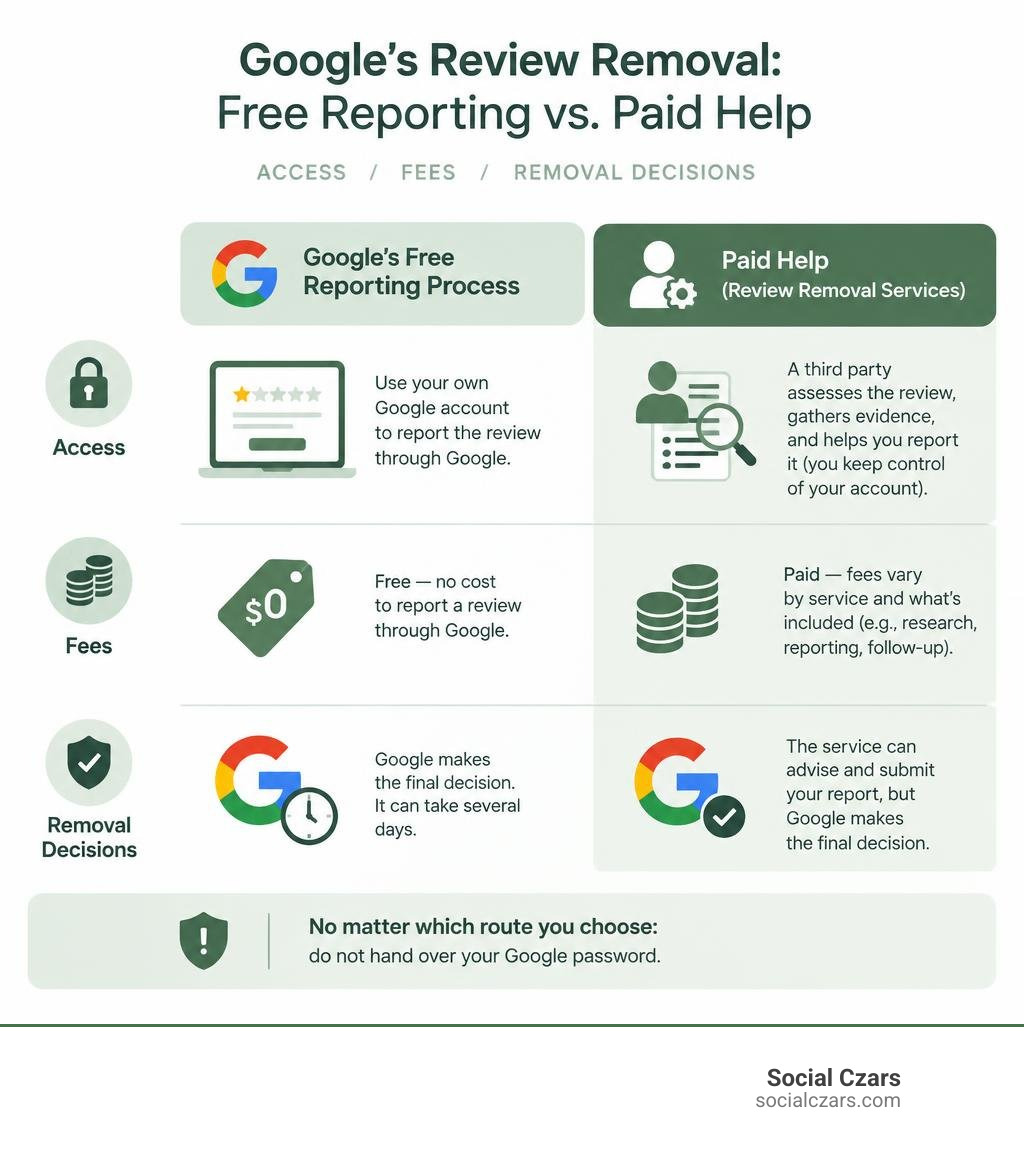
How Google review removal services compare with Google’s own process
A review removal service is a third party that may assess reviews, organize supporting evidence, and help submit reports through Google’s tools. Some provide advice and documentation; others may offer to manage parts of the process. The essential limit is the same: Google decides whether a review violates its policies and should be removed.
You can report a review yourself at no charge. A policy-based service may charge for its time, but paying does not buy a different set of Google rules or a guaranteed result.
| Consideration | Reporting it yourself | Policy-based third-party assistance |
|---|---|---|
| Account access | You use your own Google account | A provider should explain whether access is needed; never share your password |
| Cost | No fee to report through Google | Fees vary; ask what work is included |
| Control | You choose the evidence and submit the report | You should retain ownership and approve any action taken |
| Outcome | Google decides | Google still decides; the provider cannot guarantee removal |
What legitimate Google review removal services should do
A responsible provider should first check whether the review appears to match a specific Google policy. It may help you document relevant facts, organize evidence, and understand how to report the review. It should also explain that Google may decide the review does not violate policy.
Ask the provider to identify the policy concern in plain language. “This review is hurting your rating” is not a policy analysis. A credible assessment should distinguish a review that is unpleasant or disputed from one that includes prohibited content or behavior.
What questionable Google review removal services may promise
Be wary of claims such as “100% success,” “every one-star review removed,” or “guaranteed in 24 hours.” A service listing in the research claims a 100% success rate and rapid removals, but such promotional claims are not independently verified. Google’s review process typically takes several days, and the company—not the service provider—makes the decision.
Other warning signs include pressure to pay immediately, vague explanations of the method, or requests for your Google password. A provider that says it can bypass Google’s process or remove any review regardless of policy deserves extra scrutiny.

Expert perspectives on removal services
There are several useful ways to evaluate a removal offer:
- Policy perspective: A review should be reported because it appears to violate a policy, not simply because it is negative or factually disputed.
- Account-security perspective: You should remain in control of your Business Profile. Sharing a password makes it harder to control who accesses the account and what they do.
- Reputation-management perspective: Removal is only one possible response. For a policy-compliant review, a calm public reply and a service-recovery effort may do more to reassure future customers.
- Business-owner perspective: Check customer records and speak with staff before deciding that a reviewer has no connection to the business.
An online forum anecdote describes a tool that reportedly helped raise a business’s rating from 2.6 to 4.2 across more than 100 accounts. That claim is unverified, and a rating change alone does not show which reviews were removed, why, or whether the method was safe. We recommend focusing on verifiable steps and account security rather than success stories that cannot be checked.
For a more detailed evaluation framework, see what to look for when hiring a removal company.
Which reviews qualify—and how Google handles reports and appeals
Google’s general rule is straightforward: only reviews that violate its policies are eligible for removal. A low rating, criticism, or disagreement with a customer does not automatically qualify. Google does not resolve ordinary disputes between a business and a customer.
Potential policy concerns can include spam or fake engagement, reviews tied to a conflict of interest, harassment or hate speech, profanity, personal information, and content unrelated to an actual experience. A competitor review is not automatically removable just because it is from a competitor; the relevant question is whether the content or reviewer’s conduct violates a Google policy.
A review can also feel unfair without meeting Google’s removal standard. For example, a customer’s account of a poor experience may be inaccurate from the business’s perspective, but that disagreement alone does not establish a policy violation. Google’s review-reporting guidance explains what can be reported and how to use its tools.
How reputable Google review removal services assess eligibility
A careful assessment looks for a specific policy match and evidence that supports it. Useful context may include relevant customer records, communications, booking or transaction information, and a review’s relationship to other activity on the profile. The goal is not to expose private customer information publicly, but to give Google relevant details through the appropriate reporting process.
A missing customer record can be a reason to investigate, not proof that a review is fake. Records may be incomplete, and a person may have interacted with a business without completing a purchase. Separate verifiable facts from assumptions before submitting a report.
To assess suspicious patterns more carefully, use this guide on identifying potentially fake Google reviews.
How to report a review and appeal Google’s decision
You can report a review from your Business Profile by opening the reviews, selecting the report option beside the relevant review, choosing the reason that best fits, and submitting it. You can also use Google’s Reviews Management Tool to report a review and check its status.
The tool may show that a decision is pending, that Google found no policy violation, or that the case has been escalated with further updates to come. Google says evaluation typically takes several days, so a provider should not promise a precise outcome time.
If Google finds no violation, eligible reviews can be included in a one-time appeal. Google allows up to 10 reviews in an appeal. Submit the appeal through the Reviews Management Tool and wait for the decision by email. An appeal is not a guarantee of removal; it is an opportunity to ask Google to review the decision again.
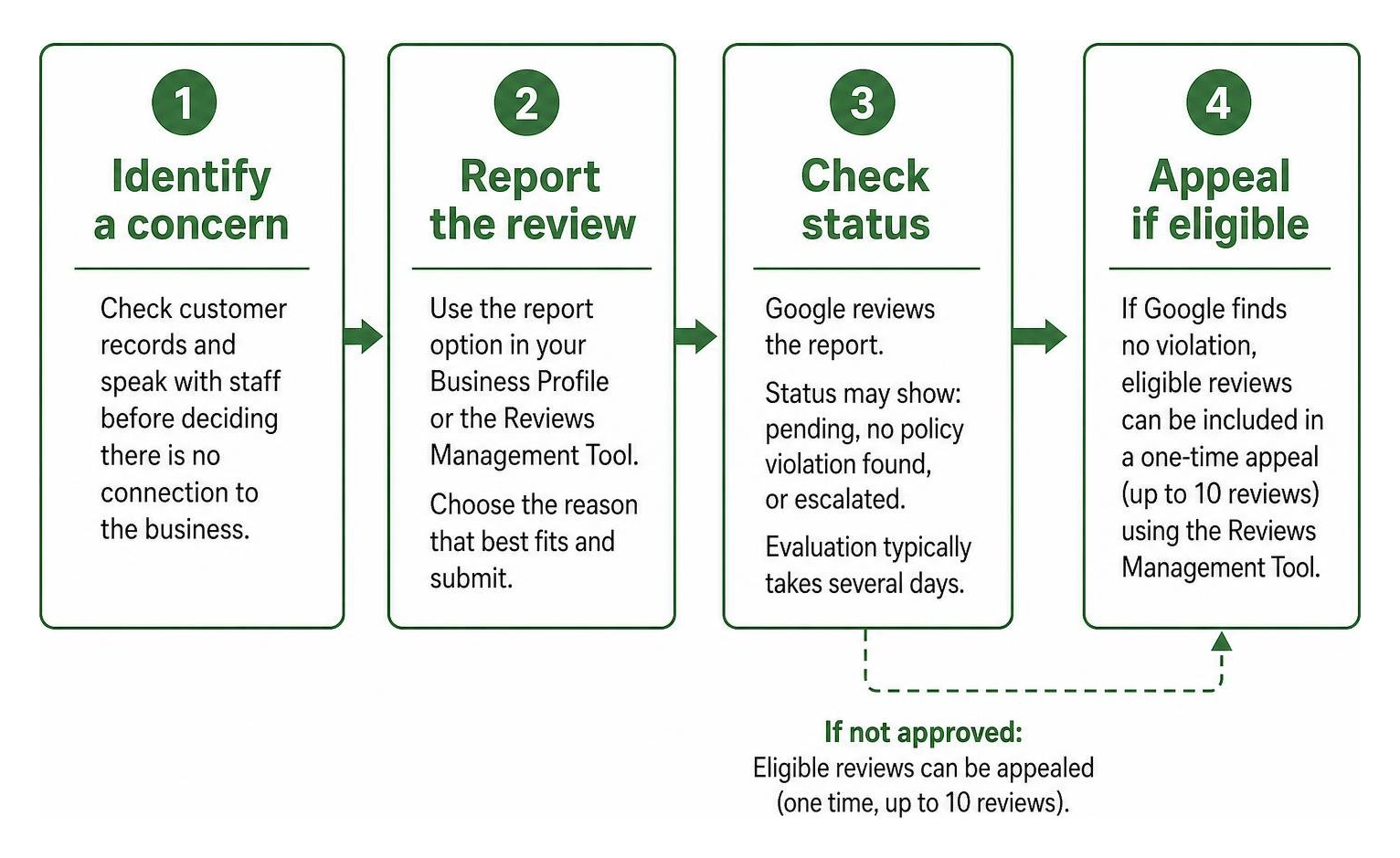
For step-by-step instructions on flagging a review, appealing, and contacting support, keep Google’s process in mind: the report and appeal are requests for review, not instructions that compel removal.
What to check before paying for Google review removal services
Before hiring a provider, make sure the work and access arrangements are clear. You should own and control your Business Profile, keep your password private, and use two-factor authentication. If a provider says it needs account access, ask why and whether the task can be done without it. Where Google offers permissions for a role, use only the minimum access needed and remove it when the work ends.
Review the written terms before paying. Check whether the fee is per review or covers a defined amount of work, what happens if Google rejects the report, and whether refunds apply to the service fee or only to specific circumstances. Also ask how evidence and personal information will be stored, who can see it, and when it will be deleted.
Plan for Google’s timeline, not a vendor’s sales deadline. A service can complete its own analysis quickly, but it cannot control Google’s review queue or decision.
What to ask Google review removal services before paying
Use these questions to compare providers:
- Which specific Google policy may this review violate, and what evidence supports that assessment?
- Who will submit the report, and will I approve it before it is sent?
- Do you require my Google password or access to my account? Why?
- What work is included in the fee if Google does not remove the review?
- What are the refund terms, and are they in writing?
- How will you protect evidence and personal information, and how long will you retain them?
- What timeline applies to your work, and which part depends on Google?
One marketplace listing in the research states a rate of $180 per review, with promotional figures of $150 for 24-hour removal and $120 for seven-day removal. These are unverified claims from a service listing, not established market rates or proof of results. Treat “24-hour removal” language carefully: a provider may be able to review a case quickly, but only Google can decide whether to remove a review. For more context on Google review removal service costs, compare what each fee actually covers rather than choosing by price alone.

Frequently Asked Questions about Google Review Removal Services
Can a company guarantee that Google will remove a review?
No company can guarantee Google’s decision. A provider can assess a review, help prepare evidence, or assist with reporting, but Google determines whether the content violates its policies. Be cautious of guarantees that promise removal regardless of the review’s content.
How long does Google take to review a removal request?
Google’s evaluation typically takes several days, though the timing can vary. Check the Reviews Management Tool for the current status. A third party may finish its own analysis sooner, but it cannot set Google’s decision schedule.
Should I respond to a negative review that does not violate policy?
Often, yes. Respond calmly, acknowledge the concern, and offer a practical way to discuss the issue privately. Check your customer records first, but avoid sharing personal or account details in a public reply. A professional response can show prospective customers that you take feedback seriously—even when you disagree with the review.
Conclusion
Start with the policy, not the promised outcome. If a review appears to violate Google’s rules, report it through Google’s tools, keep track of the decision, and use the one-time appeal if eligible. If it is negative but policy-compliant, consider a measured public response and a genuine service-recovery effort.
Keep your account under your control, never share your password, and ask any paid provider for a clear scope, evidence-based reasoning, and written terms. At Social Czars, we approach reputation issues with a policy-first mindset. Explore our Google review removal support to understand how we can help protect your digital reputation.
