
Reputation Management
Beginner’s Guide to Crisis SEO for Small Business

Feb
Why Crisis SEO for Small Business Is Your Digital Lifeline
Crisis SEO for Small Business is the practice of rapidly responding to search engine visibility threats that can devastate revenue, reputation, and customer trust. When a crisis hits—whether it’s a Google penalty, algorithm update, negative review attack, or security breach—small businesses face an urgent challenge: regain control of their search results before competitors and negative content dominate the narrative.
Quick Answer: What You Need to Know
| Crisis Type | Recovery Time | First Action |
|---|---|---|
| Manual Penalty | 10-30 days | Check Google Search Console for notification |
| Algorithm Update | 3-6 months | Audit content for E-E-A-T signals |
| Negative SEO Attack | Immediate | Run backlink audit, prepare disavow file |
| Traffic Drop | 48 hours critical | Verify in Analytics, categorize crisis type |
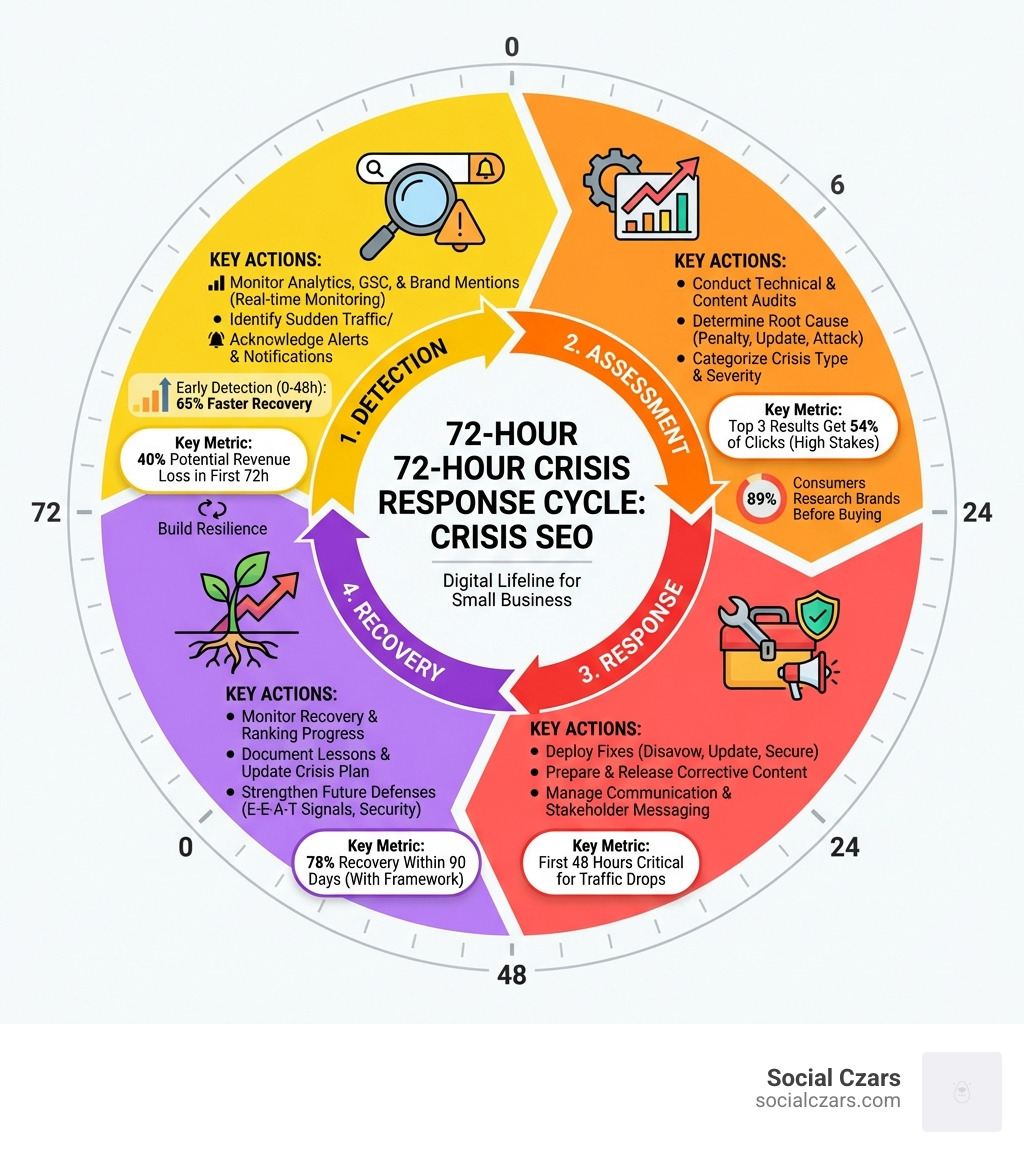
The stakes are high. Research shows that companies can lose up to 40% of their revenue in the first 72 hours following a crisis, while 89% of consumers research brands via search engines before making decisions. Even more critical: the top three Google search results receive over 54% of all clicks—meaning that what appears on page one directly impacts whether customers find you or your competitors.
The good news? Websites that detect SEO issues within the first 48 hours recover 65% faster than those that delay response. With proper crisis management frameworks, 78% of websites recover within 90 days.
I’m John DeMarchi, and I’ve specialized in Crisis SEO for Small Business scenarios since founding Social Czars in 2014, managing hundreds of reputation-threatening situations for executives and brands. This guide distills those experiences into actionable strategies you can implement immediately—even with limited resources.
Terms related to Crisis SEO for Small Business:
Understanding Crisis SEO for Small Business and Why It Matters
Think of your online reputation like a castle. You wouldn’t wait for an enemy army to arrive at your gates before you started building your walls. In the digital world, Crisis SEO for Small Business is both the construction of those walls and the rapid response when someone tries to knock them down.

When we talk about Crisis SEO, we are talking about a specialized practice that combines traditional search optimization with rapid-response PR. For a small business in New York City or London, a single page of negative search results can be the difference between a thriving month and a permanent “Closed” sign.
Understanding what crisis management involves is the first step. It isn’t just about “fixing” a problem; it’s about preparation, testing, and refining a plan so that when the search engine results pages (SERPs) turn against you, you have the tools to fight back.
Common SEO Crises Facing Small Firms
Small businesses are often more vulnerable to digital storms than large corporations because they lack the massive backlink profiles and legal teams that act as a buffer. Here are the most common crises we see:
- Manual Penalties: Google issues over 400,000 manual penalties every month. If you’ve strayed into “black hat” territory—even by accident—you’ll see a notification in Google Search Console and a plummet in rankings.
- Algorithm Updates: Google updates its “secret sauce” thousands of times a year. Major updates can wipe out small business traffic overnight if the site doesn’t meet new quality standards.
- Negative SEO Attacks: In 2024, over 422,000 websites were hit with negative SEO. This involves bad actors pointing thousands of “toxic” or spammy links at your site to get you penalized.
- Fake Reviews and Reputation Attacks: A viral negative review or a coordinated attack on your Google Business Profile can sink your local rankings.
- AI Overview Displacement: With the rise of AI Overviews, some small businesses see stable impressions but a massive drop in clicks as Google answers the query directly.
For a deeper dive, check out An Essential Guide to Crisis SEO for Business.
Detecting and Responding to an SEO Crisis in the First 48 Hours
The “Golden Hour” isn’t just for emergency rooms; it applies to your website too. Organizations that detect an SEO issue within 48 hours recover 65% faster. If you wait a week to notice your traffic has disappeared, you’ve already lost the narrative.
We recommend setting up anomaly detection. You don’t need expensive software for this; Google Search Console (GSC) and Google Analytics are your best friends. Check your GSC “Performance” tab at least twice a week. If you see a vertical drop in clicks while impressions stay steady, you might be facing a technical issue or an AI displacement. If both drop to zero, you likely have a manual penalty or a site-wide de-indexing.
Early detection allows for Crisis Adaptation. Instead of panicking, you can begin Online Reputation Management immediately to suppress negative information before it gains traction.
Immediate Steps for Crisis SEO for Small Business
In the first 24-48 hours, follow these steps:
- Verify the Drop: Ensure it’s not a tracking error or a holiday-related dip.
- Check Search Console: Look for “Manual Actions” or “Security Issues.”
- Rapid Keyword Analysis: Use Google Trends to see if people are searching for your brand alongside negative terms (e.g., “Business Name + scam” or “Business Name + recall”).
- Control the Narrative: Deploy a “Centralized Crisis Hub.” This is a dedicated page on your site where you provide the facts. Use this DES-3755 CrisisChecklist-v1 to ensure you haven’t missed any technical steps.
Practical Strategies for Recovering from Penalties and Algorithm Updates
Recovery depends heavily on what kind of hit you took.
| Feature | Manual Penalty | Algorithmic Update |
|---|---|---|
| Notification | Message in GSC | No official notice |
| Fix Strategy | Remove bad links/content and ask for review | Improve overall site quality (E-E-A-T) |
| Recovery Time | 10–30 days after submission | 3–6 months (usually next update) |
| Budget | Low (DIY cleaning) | Moderate (Content overhaul) |
To Fix Online Reputation after a penalty, you must be transparent with Google. If you bought links, list them, show that you’ve tried to remove them, and use the Disavow tool for the rest.
For algorithm updates, focus on E-E-A-T (Experience, Expertise, Authoritativeness, and Trustworthiness). Google wants to see that a real human with experience is behind your content. Consolidate “thin” pages—if you have five short blog posts about the same topic, merge them into one powerhouse guide.
Budget-Friendly Crisis SEO for Small Business Tactics
You don’t need a $10,000/month agency to fight back. Use these low-cost strategies:
- FAQ Schema: Use schema.org/FAQPage to take up more “real estate” in the search results. This pushes negative results further down the page.
- Content Suppression: Create new, positive profiles on high-authority platforms like LinkedIn, Twitter, and local directories. These often rank quickly and help Suppress Negative Search Results.
- Keyword Optimization: Shift your focus to informational queries. If people are worried about a service interruption, write a blog post titled “What to Expect During [Service] Updates” to capture that traffic. Use proven keyword optimization strategies to ensure your official word stays on top.
Defending Against Negative SEO and Reputation Attacks
Negative SEO is the digital equivalent of someone putting “Out of Order” signs on your storefront. It’s frustrating, but it can be defeated.
If you see a sudden spike in thousands of low-quality backlinks from “link farms,” don’t panic. Google’s systems are generally good at ignoring these, but for a small business, we recommend being proactive. Audit your links using tools like Ahrefs or Semrush (many have free trials or low-cost tiers). If you find truly toxic links, use the Google Disavow tool—but use it carefully, as removing good links can hurt your rankings.
For review attacks, remember that 89% of consumers read reviews. If you get hit with fake 1-star ratings, do not argue publicly. Respond politely, offer to move the conversation to a private channel, and then report the review to Google. You can often Get Negative Google Reviews Removed if they violate Google’s “spam and fake content” policies.
Proactive Crisis Prevention and Monitoring
The best way to handle a crisis is to prevent it.
- Daily GSC Checks: Look for errors or security warnings.
- Weekly Backlink Audits: Catch negative SEO before it scales.
- Sentiment Mapping: Use free tools like Google Alerts to know the moment your brand name is mentioned online.
Knowing why local SEO is essential for reputation management in 2025 is key for businesses in Miami, Los Angeles, or London. Local trust is built on consistency. Use your presence to Suppress Adverse Content by ensuring your positive, local stories are the ones people see first.
Leveraging Local SEO and AI for Rapid Recovery
Local SEO is your secret weapon in a crisis. During the COVID-19 pandemic, businesses that updated their “Special Hours” on Google Business Profile (GBP) saw significantly better engagement.
GBP Optimization Tips:
- Product Posts: Use these to highlight new services, like “No-Contact Delivery” or “Virtual Consultations.”
- Special Hours: Adding these can actually remove “warning” banners that Google might place on your profile during regional crises.
- Q&A Section: Seed your own Q&A with helpful information. “Are you currently open?” “Yes, we are operating with enhanced safety protocols.”
AI is also changing the game. Small businesses can now use AI SEO tools for real-time monitoring that were once only available to big corporations. AI can perform anomaly detection, alerting you to a traffic drop before you even have your morning coffee. It can also help with NLP sentiment grading, showing you exactly how public perception is shifting across social media and forums.
Frequently Asked Questions about Crisis SEO
How long does SEO crisis recovery typically take for small businesses?
Most websites (78%) recover within a 90-day window if they follow a structured recovery framework. Manual penalties are often resolved in 10-30 days after a successful reconsideration request. Algorithmic recoveries take longer—usually 3 to 6 months—because you have to wait for Google to recrawl your site and “notice” the improvements you’ve made.
Can a small business recover from a Google penalty on a limited budget?
Absolutely. Recovery is more about sweat equity than cash. Most monitoring tools (Google Search Console, Analytics) are free. The “cost” is usually the time spent auditing your content, removing bad links, and writing better, more authoritative pages. Focus on a content-first strategy: prove to Google you are a helpful, trustworthy source of information.
What is the most common mistake small businesses make during an SEO crisis?
The biggest mistake is silence and inaction. Many owners hope the problem will go away on its own. It won’t. Other common errors include deleting content (which creates broken links) and publicly arguing with negative reviewers. Lashing out only gives the negative content more “engagement” signals, which can actually help it rank higher!
Conclusion
At Social Czars, we understand that your small business isn’t just a website—it’s your livelihood. Whether you’re navigating the competitive markets of New York City, the high-stakes environment of London, or the vibrant business scenes in Miami and Los Angeles, your digital reputation is your most valuable asset.
We offer elite digital reputation services and fast negative content removal custom for those who need results now. From specialized search optimization to comprehensive crisis management, we provide the “digital insurance” your brand needs to survive and thrive.
Don’t let a temporary setback become a permanent loss. Secure your digital future with Crisis SEO and ensure that when customers search for you, they see the very best of what you have to offer. Ready to reclaim your rankings? Let’s get to work.
