
Reputation Management
Reputation Repair and Management for the Modern Business

Sep
Reputation Repair and Management for the Modern Business
Repair Online Reputation After a Crisis: Start With Facts, Accountability, and Visibility
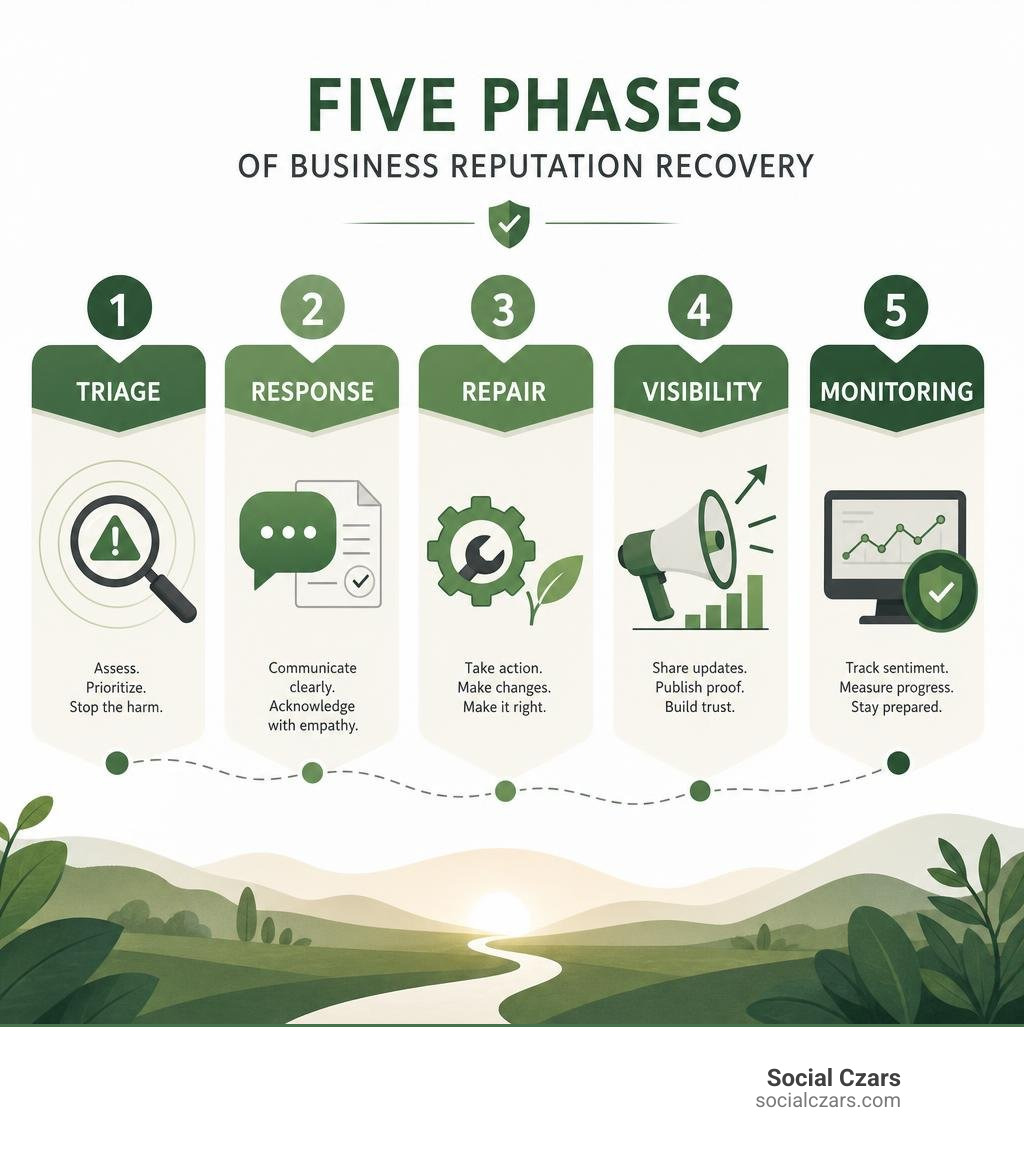
Businesses can repair online reputation after a crisis by acting quickly without reacting emotionally: verify the facts, stop further harm, assign one spokesperson, acknowledge legitimate concerns, and publish clear updates. Then, address affected customers directly, correct false claims with evidence, and build a steady stream of useful, credible content that reflects the improvements made.
A crisis can spread across search, social media, news, and review platforms in hours. The goal is not to hide a real problem or argue with every critic. It is to show customers, partners, employees, and investors that the business is listening, taking responsibility where warranted, and making measurable changes.
Strong recovery combines crisis communications, customer care, legal judgment, and SEO. Over time, transparent updates, positive third-party signals, and authoritative branded content can help create a more accurate search record than the crisis alone.
I am John DeMarchi, founder of Social Czars, with experience helping hundreds of clients navigate how businesses can repair online reputation after a crisis through Crisis Communications SEO, digital PR, positive content strategy, and search-result protection. The next sections cover the practical steps to contain damage, respond with credibility, and build a stronger digital reputation.
How businesses can repair online reputation after a crisis helpful reading:
- business online reputation management
- corporate reputation protection
- cost of online reputation management
Immediate Action Plan: Stabilizing Brand Perception and Response Protocols
When an unexpected storm lands on your brand’s doorstep, the natural human urge is either to run for the bunker or fire back at every critic in sight. Neither works. Surviving and reversing digital fallout requires immediate brand triage paired with strict emotional restraint. Digital crises move at blistering speed, but reacting out of frustration turns a minor operational misstep into a headline-making catastrophe.

Our teams operating across hubs in New York City, Miami, Los Angeles, and London see the same pattern repeatedly: companies fail during the first twenty-four hours because they lack a crisis escalation matrix. Instead of coordinating, multiple departments post conflicting statements, or worse, remain completely silent while online communities fill the information void with speculation.
To stop the bleeding, you need a disciplined stabilization protocol:
- Halt all pre-scheduled marketing campaigns and promotional social posts immediately. Promoting a summer sale in the middle of a data breach makes your enterprise look tone-deaf.
- Implement a centralized information log. Document every accusation, critical article, customer ticket, and social media spike with timestamps.
- Activate your pre-approved messaging templates. Having foundational templates ready allows your communication leads to respond within minutes rather than spending half the day debating basic wording.
- Consult specialized resources. Review The Complete Guide to Online Reputation Crisis to ensure your internal workflows match established containment standards.
How Businesses Can Repair Online Reputation After a Crisis Through Swift Triage
Effective triage is about isolating the problem and speaking with one clear voice. You must designate a single trained spokesperson—and an alternate—empowered to represent the business. All customer support leads, sales reps, and executive team members must follow strict internal alignment protocols, directing all external inquiries to this official channel.
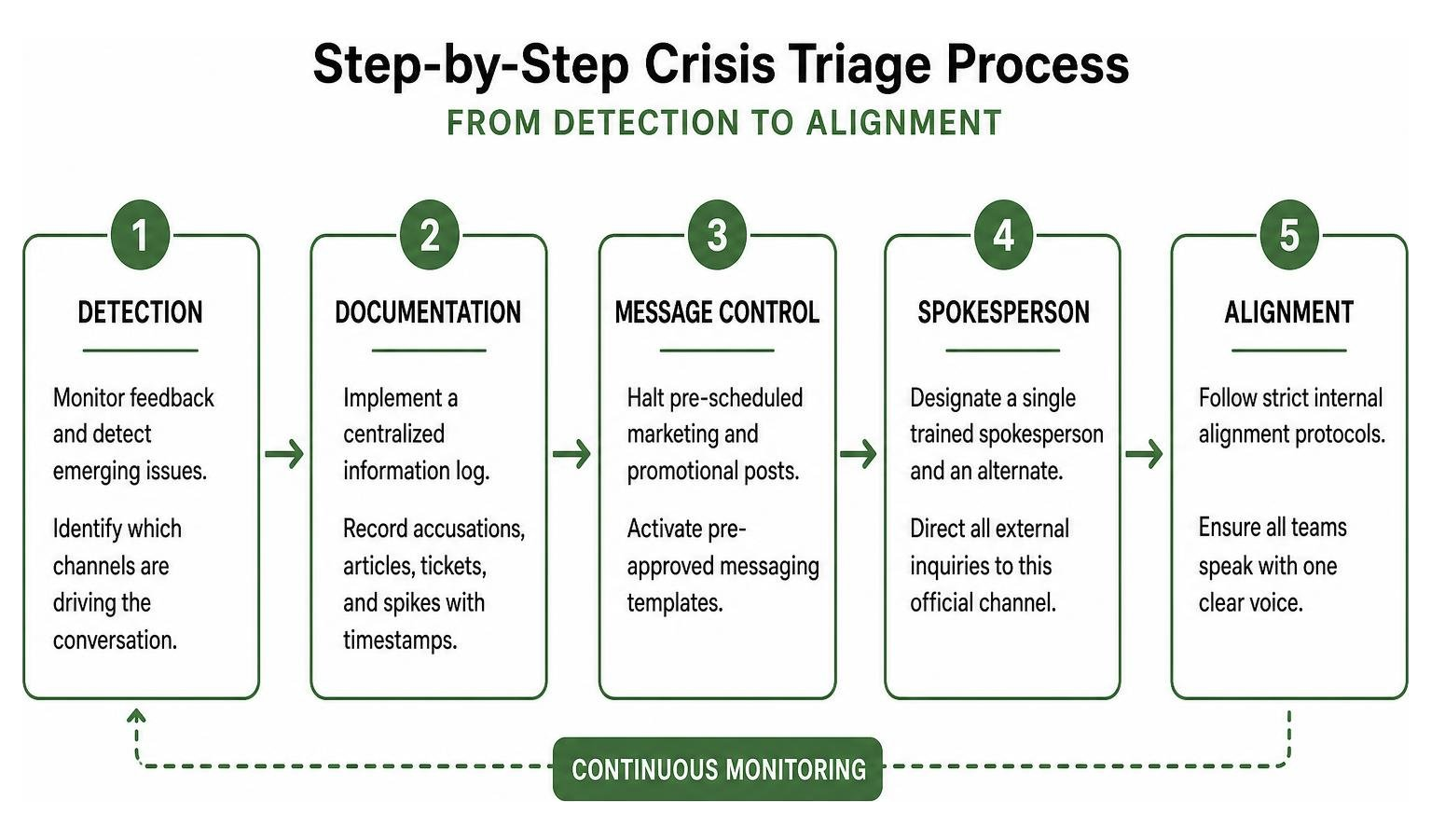
Early detection tools should funnel incoming feedback directly to your crisis lead. You need to know which channels are driving the conversation. Is the issue contained to a single sub-thread, or is it spreading across mainstream industry news outlets? Addressing hot conversation channels first ensures you deploy resources where the reputational friction is most severe.
Evaluating Legal Defamation vs. Public Relations Intervention
Not every negative review or angry critique justifies a legal letter. In fact, threatening litigation against customers sharing genuine, albeit frustrated, opinions usually triggers the Streisand Effect—amplifying the exact story you wanted to quiet down.
However, a clear line exists between fair criticism and deliberate, malicious slander. When competitors launch coordinated smear campaigns, bad actors impersonate company leadership, or third-party websites publish verifiable falsehoods, legal intervention becomes a viable instrument.
Understanding how to manage an online reputation crisis often involves coordinating PR messaging with strategic defamation counsel. Legal steps can facilitate search engine de-indexing requests, enforce copyright claims, or demand the takedown of defamatory content. For broader organizational safety, integrating ongoing corporate reputation protection safeguards your executive leadership from unauthorized account takeovers and false narratives.
Strategic Recovery: How Businesses Can Repair Online Reputation After a Crisis
Once the initial shock subsides, long-term brand restoration begins. Public audiences possess a sharp radar for corporate double-talk. Defensive corporate statements packed with passive-voice justifications (“mistakes were made”) erode public confidence further. Strategic recovery demands genuine transparency, direct accountability, and tangible customer empathy.
| Reactionary Public Response | Strategic Crisis Communication |
|---|---|
| Deleting critical comments and blocking dissatisfied users | Acknowledging legitimate complaints publicly and moving resolutions to private support channels |
| Issuing vague apologies that dodge direct accountability | Providing transparent, verifiable facts detailing what happened and why |
| Blaming rogue employees, external vendors, or user misunderstanding | Taking clear institutional ownership and outlining immediate remedial actions |
| Going completely silent until the social media cycle shifts | Publishing structured progress updates showing measurable improvements over time |
| Over-promising impossible solutions to quiet angry crowds | Committing to realistic, auditable policy or product enhancements |
Reassuring key stakeholders—investors, vendors, and enterprise clients—requires a comprehensive framework. Exploring our business reputation management complete guide provides deep strategic insight into maintaining operational equilibrium while reshaping public sentiment.
Neutralizing Backlash and Managing Negative Review Cycles
Handling negative online feedback is an art form. When critical reviews appear across major consumer review networks or industry portals, your public response serves two audiences: the individual reviewer and the thousands of future prospective clients evaluating how you handle problems.
- Respond with calm professionalism. Acknowledge the user’s specific experience without boilerplate copy-pasting.
- Move granular problem-solving offline. Provide a dedicated, direct email address or phone number managed by a senior support specialist.
- Use active social listening. Deploy real-time sentiment analysis to track whether your public responses are de-escalating audience tensions or if specific community segments remain agitated.
- Close the feedback loop. When an operational flaw highlighted by a negative review is fixed, update the customer directly to demonstrate that their feedback led to permanent improvements.
How Businesses Can Repair Online Reputation After a Crisis with Strategic Content and Reverse SEO
Search engines do not hold grudges, but their algorithms do reward authority, freshness, and user engagement. If negative press dominates page one of your search results, you cannot simply ask the search engines to erase legitimate news. Instead, you must deploy reverse SEO to push down negative search results beneath authoritative, positive brand assets.

We accomplish this through comprehensive digital architecture adjustments:
- Publish high-authority owned assets: Build out executive profiles, corporate research whitepapers, philanthropic initiatives, and detailed case studies.
- Optimize branded search entities: Implement structured schema markup across your web ecosystem so search crawlers associate your brand with your official properties, executive bios, and certified corporate announcements.
- Earn third-party digital PR: Distribute verified business announcements and secure industry-specific features that naturally rank on competitive branded search terms.
For companies navigating search suppression campaigns, studying Crisis SEO for Online Reputation Repair 101 as well as our SEO Crisis Management Ultimate Guide outlines how technical search optimization acts as an indispensable pillar during brand reclamation.
Long-Term Rebuilding: Restoring Authority and Brand Immunity
Recovering from a major crisis does not end when negative stories slip to page two. The ultimate goal is building brand immunity—an enduring reservoir of customer goodwill and positive digital equity that shields your business from future vulnerabilities. A well-buffered enterprise weathers minor controversies because its established track record creates immediate benefit of the doubt.
Rebuilding authority involves amplifying authentic customer voices. Strategic outreach to satisfied clients helps balance negative reviews that surfaced during the peak of the crisis. When prospective buyers search for you, a consistent stream of recent, genuine 5-star testimonials offers an accurate picture of your current standards.
Coupling this with executive thought leadership—such as industry keynote addresses, educational webinars, and technical blog contributions—positions your leadership team as forward-thinking industry veterans. For further insights on structured operational recovery, read reputation recovery after a crisis: long-term strategies, or review The Ultimate Guide to Professional Reputation Repair and Brand Recovery to understand how long-term positioning solidifies market authority.
Performing Post-Mortem Audits to Uncover Operational Vulnerabilities
Every crisis leaves behind valuable clues. Once normal operations resume, convene your leadership, legal, PR, and digital marketing teams for an extensive post-mortem audit.
Begin by evaluating your detection timeline. How many hours elapsed between the first negative social post and your team’s initial response? Assess messaging efficacy: which statements calmed community discussions, and which provoked further pushback?
Use these findings to update operational protocols, refine your crisis escalation matrix, and establish ongoing brand health tracking benchmarks to monitor Net Promoter Scores (NPS) and branded search sentiment over time.
Establishing Proactive Brand Shields and Continuous Monitoring
The best time to repair an online reputation is before damage occurs. Brand protection requires proactive digital shields powered by automated monitoring platforms.
Equip your communications team with dedicated social listening tools like Mention, Brand24, or Google Alerts configured to monitor executive names, branded hashtags, trademark variations, and competitor comparisons. Real-time sentiment analysis helps identify early warning indicators before a localized support issue spirals into an enterprise-wide catastrophe.
To explore how proactive search positioning serves as digital armor, examine Corporate Crisis SEO 101 for advanced protective frameworks.
Frequently Asked Questions About Reputation Repair
What is the fastest way to suppress negative search results after a crisis?
The fastest and most sustainable way to push down damaging search results is by deploying a multi-layered content and reverse SEO strategy. Create and optimize high-authority digital properties—such as professional profiles, corporate medium publications, subsidiary websites, and verified social profiles—using exact-match branded schema markup.
Simultaneously, publish newsworthy PR content to earn authoritative third-party links that outrank dated negative coverage. For an end-to-end breakdown of this approach, consult our Online Reputation Repair Complete Guide.
How long does it take to fully restore brand credibility post-crisis?
Rebuilding credibility depends on the crisis severity, your digital footprint’s existing authority, and the consistency of your response. While real-time social media backlash can often be stabilized within two to four weeks, re-aligning search results and shifting public sentiment generally requires three to nine months of continuous SEO, review generation, and digital PR. Demonstrating long-term behavioral transformation is what ultimately restores audience trust.
When is legal action appropriate for online reputation attacks?
Legal action should be reserved for clear, actionable violations such as verifiable defamation, intentional corporate slander, non-consensual disclosure of confidential data, trademark infringement, or unauthorized imposter profiles. If false claims cause documented commercial harm, defamation attorneys can issue formal takedown notices, sub-poena anonymous posters, and facilitate legal de-indexing from search engines without prompting unnecessary public backlash.
Conclusion
A digital crisis can test the stability of any enterprise, but it does not have to define your future. By responding with emotional composure, taking transparent accountability, neutralizing negative review cycles, and deploying authoritative reverse SEO, your business can reclaim its digital narrative and emerge more resilient than before.
At Social Czars, we specialize in discrete, elite SEO, search-result defense, and fast negative content removal for high-profile CEOs, VIPs, and industry-leading enterprises across Miami, New York City, Los Angeles, and London. To protect your brand or reclaim control over your search results, explore our comprehensive online reputation solutions and partner with our senior digital strategists today.
