
Reputation Management
The Ultimate Guide to SEO for Entrepreneurs

Oct
Why SEO Is a Game-Changer for Entrepreneurs
SEO for entrepreneurs is the practice of optimizing your website to rank higher in search results, driving qualified customers to your business without paying for ads. Here’s why it matters:
- Cost-effective growth: SEO delivers long-term results without ongoing ad spend.
- Higher trust: With 89.62% of searches on Google, users trust organic results more than ads.
- Qualified traffic: People actively searching for your solution are ready to buy.
- Competitive advantage: Strong SEO creates a durable moat around your business.
Since over 90% of people use the Internet when evaluating a purchase, being invisible online means losing customers. While SEO takes time to show results (typically 6+ months), the payoff is massive. Organic search results perform 5.7 times better than paid ads for conversions and build long-term value that doesn’t vanish when you stop paying.
Successful SEO for entrepreneurs isn’t about complex tricks; it’s about understanding customers, creating value, and building trust. I’m John DeMarchi, founder of Social Czars. I’ve helped hundreds of CEOs and luxury brands dominate search results with elite SEO and reputation management. I know that entrepreneurs need a strategic approach that balances immediate needs with long-term visibility.
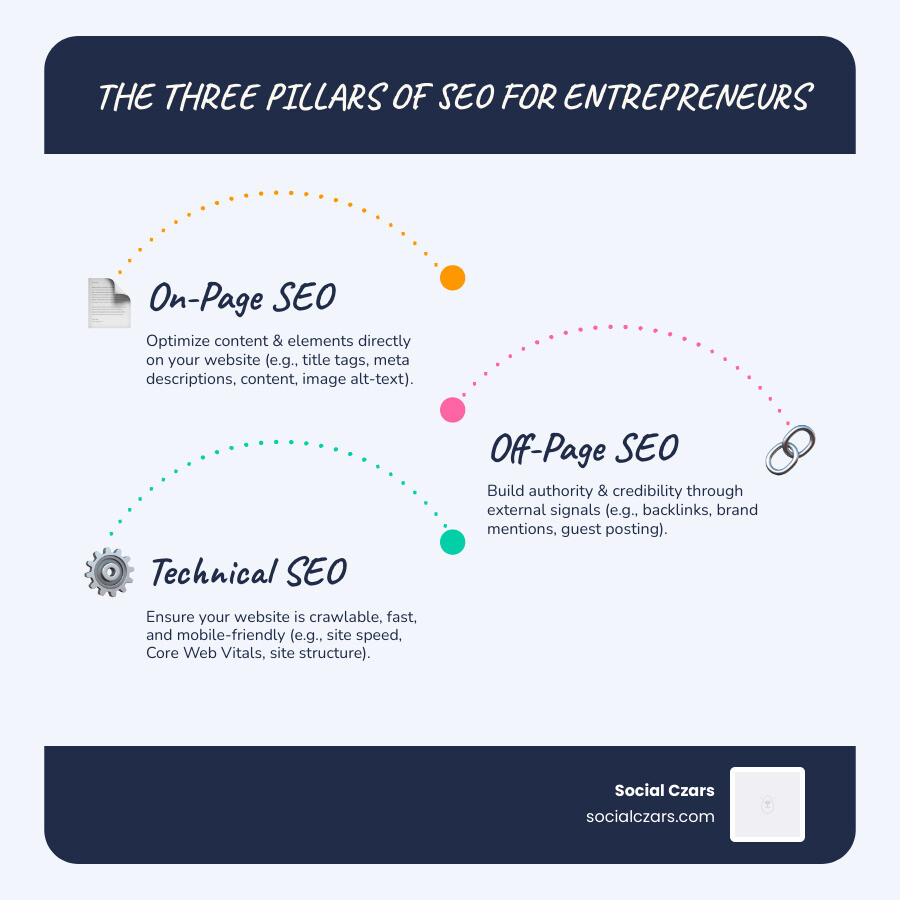
Seo for entrepreneurs definitions:
The Core Pillars of SEO for Entrepreneurs
This section covers the foundational elements every entrepreneur must master to build a strong online presence and drive sustainable growth.
Understanding Keywords: The Language of Your Customer
Keywords bridge the gap between what customers search for and the solutions you offer. Identifying the right ones is the most crucial first step in any SEO for entrepreneurs strategy.
Start by understanding your customer’s problems and questions. Brainstorm “seed keywords” (broad terms like “handmade jewelry”) and expand on them using Google’s free guided search features like “People Also Ask” and auto-suggest. These tools reveal long-tail keywords—longer, specific phrases like “handmade silver earrings for sensitive ears.” While lower in volume, they often have higher purchase intent and less competition, making them ideal for new businesses.
Listen to your audience on social media, in reviews, and through surveys to find conversational keywords. Once you have a list, refine it with keyword research tools. Free options include Google Keyword Planner and Google Search Console. Paid tools like Moz or SEMrush offer deeper insights into search volume (MSV) and keyword difficulty (KD%).
Crucially, understand search intent: is the user looking for information, navigating to a site, or ready to buy? Aligning your content with intent is vital. For local businesses, like our clients in Miami, we incorporate local terms through Keyword Research Miami to capture geographically specific searches.
Building an SEO-Friendly Website Foundation
Once you know what people are searching for, your website must be built to be found. This is where on-page SEO—optimizing elements on your web pages—comes in.
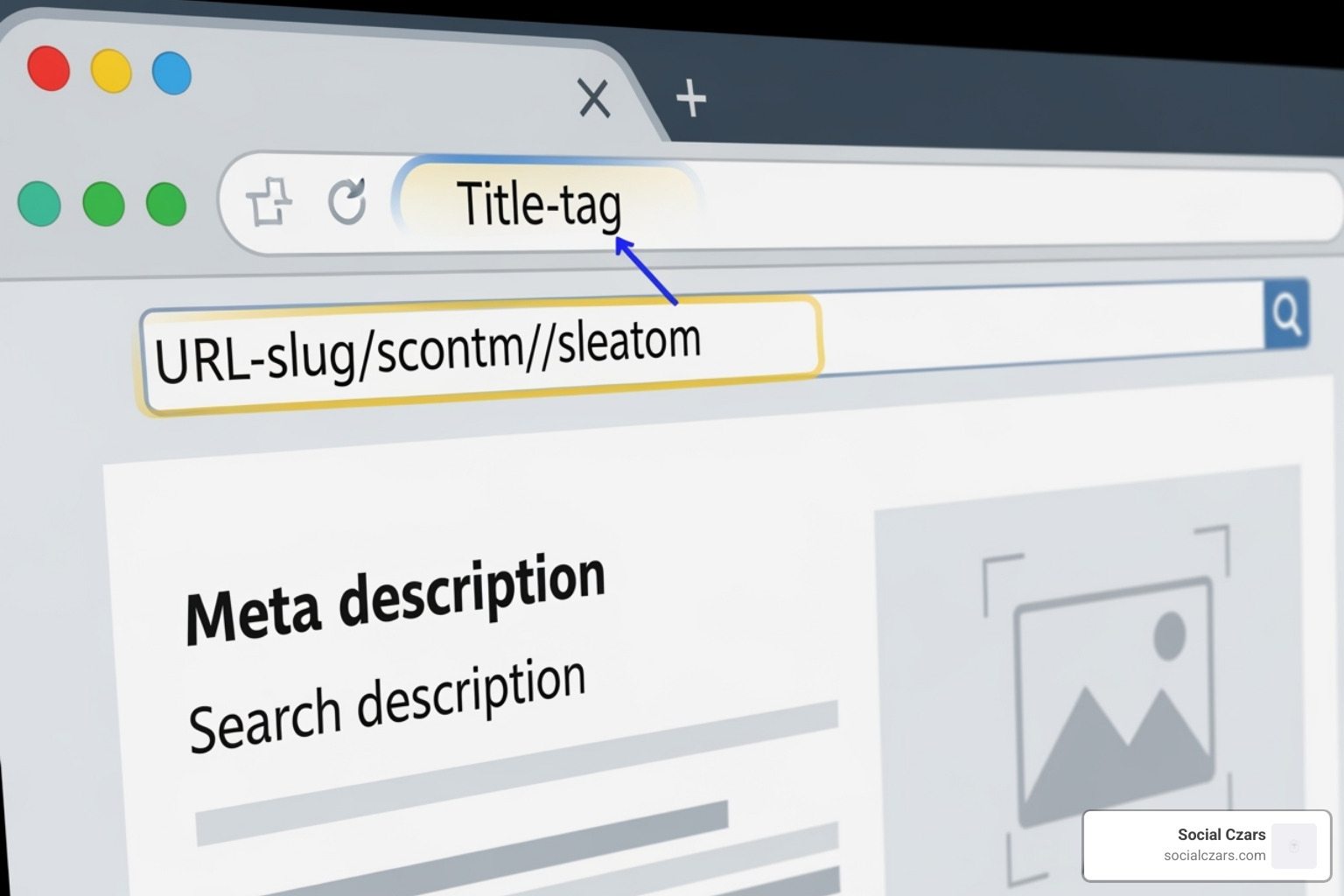
Every page has key components for search engines:
- SEO Title (Title Tag): The clickable headline in search results. It should be unique, under 60 characters, and include your main keyword near the start.
- Meta Description: The summary (up to 160 characters) under your title. It doesn’t directly affect ranking but drives clicks, so make it compelling.
- URL Slug: The page-specific part of your web address (e.g.,
/your-slug). Keep it short, descriptive, and include your keyword. - Image Alt-text: A description of an image for search engines and screen readers. Describe the image accurately and include keywords where natural.
Beyond these, your site’s technical health is vital. Google’s Core Web Vitals measure user experience through loading performance, interactivity, and visual stability. These are confirmed ranking factors. Ensure your site is mobile-friendly and secure (HTTPS). A logical site structure with internal links helps search engines understand your content hierarchy and is key to Improve Google Search Results. Many entrepreneurs use WordPress with plugins like Yoast SEO or Rank Math to manage these elements easily.
Mastering E-E-A-T: The Trust Factor
In SEO for entrepreneurs, trust is a fundamental ranking signal. Google calls this E-E-A-T: Experience, Expertise, Authoritativeness, and Trustworthiness. This framework helps search engines evaluate your content’s quality and reliability.
Here’s how to build E-E-A-T:
- Experience: Share first-hand knowledge and real-life examples.
- Expertise: Provide comprehensive, accurate, and detailed answers that demonstrate deep knowledge.
- Authoritativeness: Become a recognized source in your industry through high-quality backlinks, brand mentions, and citations from other experts.
- Trustworthiness: Ensure your site is secure (HTTPS) with transparent contact info, clear policies, and positive customer reviews. A strong Online Reputation Management strategy is essential.
Google uses Search Quality Raters to evaluate sites based on E-E-A-T, and users inherently trust sites that rank high. For our CEO and VIP clients, building a pristine online reputation is a core part of establishing E-E-A-T and boosting search visibility.
A Practical Guide to SEO for Entrepreneurs: Content & Link Building
Now that we’ve covered the foundational elements, let’s dive into the actionable strategies for creating content that ranks and building the authority needed to dominate search results.
Creating High-Quality, SEO-Optimized Content
In SEO for entrepreneurs, content is king. But it must be high-quality, value-driven, and optimized for search engines, which aim to provide the most helpful information to users.

Here’s our approach:
- Value-First Approach: Always ask, “Does this genuinely help my audience?” Solve their problems and offer unique insights.
- Search Intent Alignment: Craft content for a specific intent—whether it’s informational, commercial, or transactional.
- Comprehensive Content: Long-form content (1800+ words) often ranks better as it allows for a deeper exploration of a topic, establishing expertise. Avoid fluff.
- Structure & Readability: Use clear headings (H1, H2s, H3s), bullet points, and short paragraphs to make content easy to consume.
- Visual Engagement: Incorporate relevant images, infographics, and videos to improve engagement and break up text.
- Internal Linking: Link to other relevant pages on your site to distribute authority and help search engines understand content relationships.
- Refresh & Repurpose: Regularly update old content to keep it fresh and repurpose it into different formats like infographics or videos.
A blog is crucial for B2B startups to build topical authority and nurture leads. Our Digital Marketing for Entrepreneurs strategy integrates content as a core component to achieve SEO goals.
Effective Link-Building Strategies for Startups
Content alone isn’t always enough. You need authority, and backlinks—links from other websites to yours—are a powerful signal of authority. Think of them as “votes of confidence.”
Here are some effective strategies for startups:
- Create “Linkable Assets”: Produce exceptional content that others want to link to naturally, such as original research, comprehensive guides, or unique tools.
- Guest Posting: Write high-quality articles for other reputable websites in your niche to earn a backlink and expand your reach.
- Broken Link Building: Find broken links on other sites and suggest your relevant content as a replacement. It’s a win-win.
- Niche Partnerships: Collaborate with complementary businesses or influencers on content or resource pages.
- Unlinked Brand Mentions: Monitor for mentions of your brand and politely request a link where appropriate.
- Local SEO & Google Business Profile: For local businesses, optimizing your Google Business Profile is critical. It puts you on Google Maps and in local search results. Encourage customer reviews and ensure your Name, Address, and Phone number (NAP) are consistent everywhere online.
Quality trumps quantity. Avoid spammy tactics like buying links, as they can harm your rankings. Focus on earning natural, high-quality links from relevant sites.
The Future is Now: AI’s Impact on SEO
The search landscape is evolving rapidly with AI. This section prepares you for what’s next and how to stay ahead of the curve.
How AI is Reshaping the Search Landscape
The rise of generative AI, like ChatGPT and Google’s AI Overviews, is changing how users interact with search. The goal is no longer just to get a click, but to be the source of information for AI-powered answers.
Key changes include:
- AI Overviews & Zero-Click Searches: Search engines now provide summarized answers directly in the results, which can reduce direct traffic but offers a chance to be featured as a primary source.
- New Content Optimization Needs: Content must be structured for AI to easily understand and summarize. This means clear headings, lists, and direct answers.
- Emphasis on Trust & Authority: As AI synthesizes information, the E-E-A-T of the source becomes even more critical. High-quality, authoritative content is more likely to be used in AI summaries, reinforcing the need for a strong Fix Online Reputation strategy.
- Unlinked Mentions: AI can connect unlinked brand mentions to your entity, recognizing your authority even without a direct link.
While AI may reduce some clicks, it lifts the need for unique, expert-level content that AI models will favor. Users making a purchase will still visit websites, so providing a comprehensive on-site experience remains crucial.
Optimizing for AI and Voice Search (GEO, AEO, AIO)
The evolving search landscape introduces new optimization strategies for SEO for entrepreneurs:
- GEO (Generative Engine Optimization): Optimizing content to be found and used by generative AI models.
- AEO (Answer Engine Optimization): Structuring content to be the definitive answer to a user’s query.
- AIO (Artificial Intelligence Optimization): A broad term for optimizing for all AI-powered platforms.

Here’s how to adapt:
- Conversational Keywords: Target longer, question-based phrases common in voice search.
- Structured Data (Schema Markup): Use code to help search engines and AI understand your content’s context, making it more likely to appear in rich snippets or AI answers.
- FAQ Sections: Create comprehensive FAQs with clear, concise answers to directly target AEO.
- Video Content: Optimize videos on YouTube and TikTok with relevant keywords, as these platforms are major search engines and sources for AI training.
- Local Optimization: Double down on local SEO, as voice search is often location-based. Ensure your Google Business Profile is fully optimized for key areas like Miami, New York City, Los Angeles, and London.
- Original & Expert-Level Content: As AI synthesizes existing information, unique insights and data become invaluable, reinforcing E-E-A-T. This is the core of our Luxury SEO strategy.
Measuring Success and Making Smart Choices
Data-driven decisions are key. Learn how to track your efforts and choose the right marketing channels for your business.
How to Measure and Track Your SEO Performance
What gets measured gets managed. Tracking your SEO for entrepreneurs performance is essential to understand what’s working and where to allocate resources.
Here are the Key Performance Indicators (KPIs) to focus on:
- Organic Traffic: The number of visitors from search engines, tracked in Google Analytics.
- Keyword Rankings: Your position in search results for target keywords. Overall improvement indicates progress.
- Click-Through Rate (CTR): The percentage of users who click your result. A high CTR (the #1 spot averages ~31.73%) means your title and meta description are effective. Track this in Google Search Console.
- Conversions: The ultimate goal, such as form submissions or purchases, attributed to organic search.
- Referring Domains: The number of unique websites linking to you, indicating link-building success.
Essential Tools for Measurement:
- Google Search Console: This free tool shows which keywords you rank for, your average position, impressions, clicks, and technical issues.
- Google Analytics: This free tool provides detailed insights into website traffic, user behavior, and conversion tracking.
Regularly reviewing these metrics allows you to make data-driven decisions and refine your strategy. SEO is an ongoing process of tracking and improvement.
SEO vs. Paid Search: What’s the Right Move for You?
Entrepreneurs often wonder whether to invest in SEO or paid search (PPC). Both drive traffic, but they operate differently.
Here’s a comparison:
| Feature | SEO (Organic Search) | Paid Search (PPC Ads) |
|---|---|---|
| Cost | Requires time/resource investment upfront, but traffic is free long-term. | Pay-per-click (PPC); costs stop when you stop paying. |
| Speed | Slower, results take 6+ months to build gradually. | Immediate visibility and traffic once ads are live. |
| Long-Term Value | Builds permanent authority and evergreen traffic. | Results stop as soon as you stop paying. |
| Trust | High-ranking organic results are often perceived as more trustworthy. | Users know they are ads and some may ignore them. |
| ROI | High ROI; organic results perform 5.7 times better than paid ads for conversions. | Can be high, but requires continuous budget and optimization. |
SEO is a marathon; paid search is a sprint. If you need immediate leads, paid search is effective. However, the results disappear when you stop paying.
SEO is a long-term investment that builds a sustainable asset for your business. For our SEO for Founders clients, we emphasize this long-term value.
A hybrid strategy is often best: use paid search for immediate leads and data, while simultaneously investing in SEO to build a strong, sustainable organic presence for the future.
Frequently Asked Questions about SEO for Entrepreneurs
How much does SEO cost for an entrepreneur?
The cost of SEO is a blend of time and financial investment. It depends on your approach:
- DIY (Do It Yourself): The financial cost is minimal (some tools are free), but the investment is your time to learn, research, and create.
- Hiring an Individual SEO Specialist: Expect to pay around $75-$100 per hour, often with a recommended three-month minimum engagement.
- Hiring an SEO Firm or Consultant: Comprehensive services from a firm can cost approximately $3,500 per month, typically requiring a six-month commitment.
View SEO as an investment in your business’s long-term growth, not just an expense.
How long does it take to see results from SEO?
Patience is crucial in SEO for entrepreneurs. Unlike paid ads, SEO is a marathon.
- Initial Visibility (3-6 months): You may see minor traffic increases and rankings for less competitive keywords.
- Significant Results (6-12+ months): Substantial organic traffic and top rankings for competitive keywords take time. It’s not uncommon for new content to show no results for six months.
Timelines are affected by your industry’s competitiveness, website age, and the consistency of your efforts. The compounding effect of SEO means early efforts build upon themselves, leading to exponential growth over time.
What are the most common SEO mistakes entrepreneurs make?
Avoiding these common missteps can save you time and frustration:
- Expecting Quick Wins: SEO is a long-term strategy, not an overnight fix.
- Ignoring Technical SEO: Overlooking site speed, mobile-friendliness, or indexing issues can cripple your efforts.
- Creating Low-Quality Content: Content must provide real value to rank. Avoid fluff or unoriginal material.
- Neglecting Backlinks: Great content struggles to rank for competitive terms without authoritative links.
- Poor Keyword Research: Targeting the wrong keywords (no volume, too much competition) is a wasted effort.
- Inconsistent Effort: SEO requires ongoing content creation, optimization, and link building.
- Incorrect Blog Setup: Hosting your blog on a subdomain (
blog.yourdomain.com) can dilute SEO value compared to a subfolder (yourdomain.com/blog/). - Buying Spammy Links: This tactic can lead to Google penalties that are difficult to recover from.
Conclusion: Your Next Step to SEO Mastery
We’ve covered the essentials of SEO for entrepreneurs, from core pillars and content strategies to the impact of AI and performance measurement. The journey to SEO mastery is a marathon that demands patience, consistent effort, and continuous learning.
The rewards—sustainable organic traffic, increased brand trust, and a powerful competitive advantage—are well worth the investment. The goal is to make your business findable by the people who need you most. By focusing on value, authority, and optimization, you’re not just improving rankings; you’re building a more resilient business.
At Social Czars, we specialize in helping entrepreneurs, CEOs, and VIPs steer this complex digital world. Whether you’re in New York City, Miami, Los Angeles, or London, our elite SEO and reputation management services are designed to help you dominate your online space.
Ready to take your online presence to the next level? Take control of your online presence with our elite SEO services and let’s build your digital empire together.
