
Finance
Why Small Real Estate Markets Might Be the Easiest Places to Rank on Google

Oct
Why SEO Can Work in Small Real Estate Markets
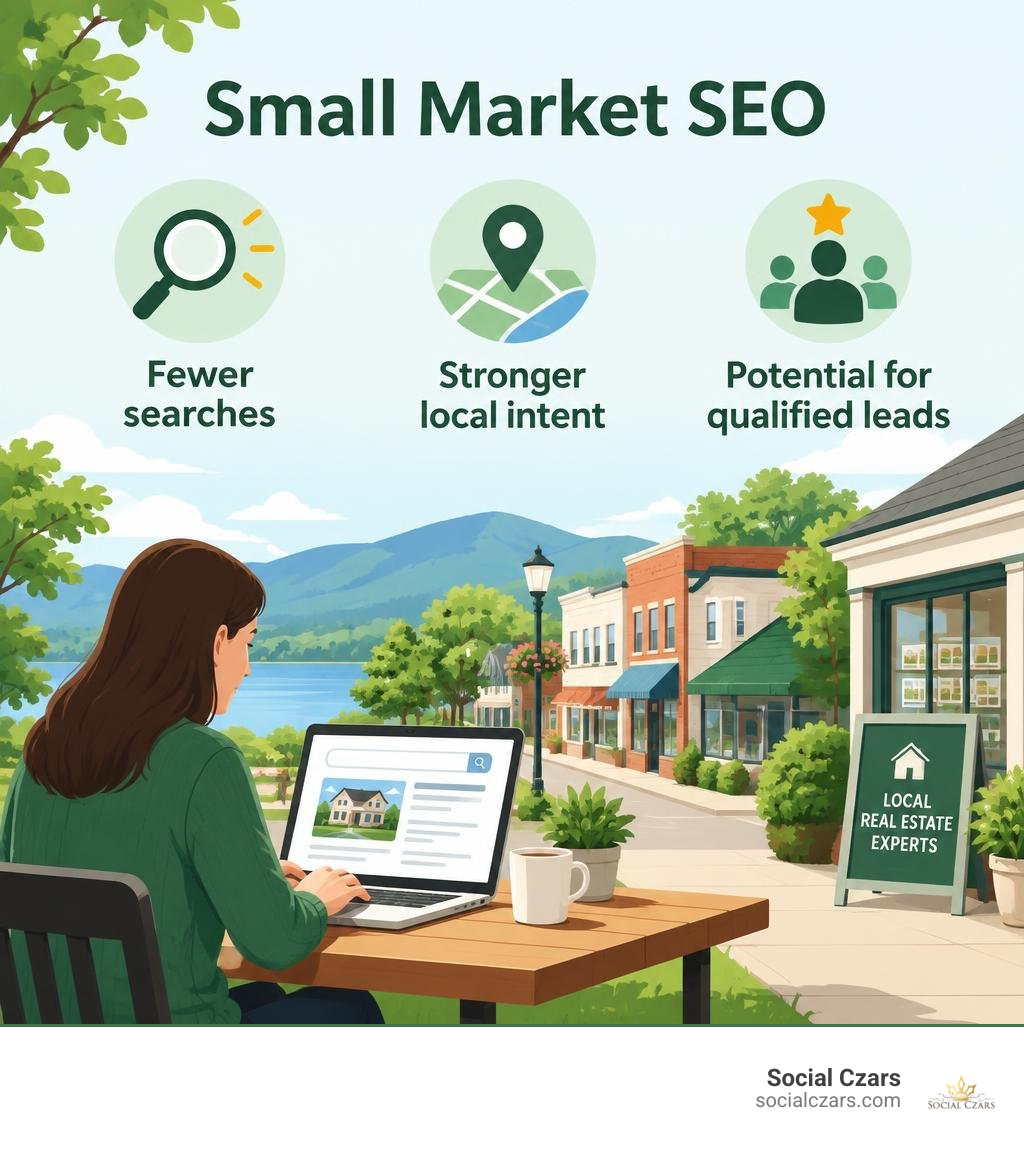
Yes, SEO can work in small real estate markets. A town may have fewer searches than a major city, but an agent does not need huge traffic to earn useful leads. The better bet is to answer specific buyer and seller questions about local neighborhoods, property types, and nearby towns, then make it easy for people to get in touch.
That is the opportunity big property portals often miss. A listing can show what is for sale; a local expert can explain what it is like to buy there. Rankings and leads still take time, and a very small town may not produce enough demand on its own.
I’m John DeMarchi, founder of Social Czars, and my work in SEO since 2014 shapes my answer to the question, “does seo work for small real estate markets?” It starts with choosing the right searches to win, not chasing the largest search numbers.
Quick does seo work for small real estate markets terms:
- SEO for real estate
- Real estate SEO expert
- What does SEO stand for in real estate
Does SEO Work for Small Real Estate Markets? Why Niche Geos Outperform Metros
When independent brokerages look at organic search, they often fall into a trap of despair. They look at monster portals with Domain Authority scores hovering around 85+ and assume that competing on Google is impossible without an eight-figure marketing budget.
In major metropolises like New York City, Miami, and Los Angeles, competing for top-level search terms requires relentless link acquisition and technical muscle. In smaller geographic pockets and distinct lifestyle enclaves, the playing field flips entirely in your favor.
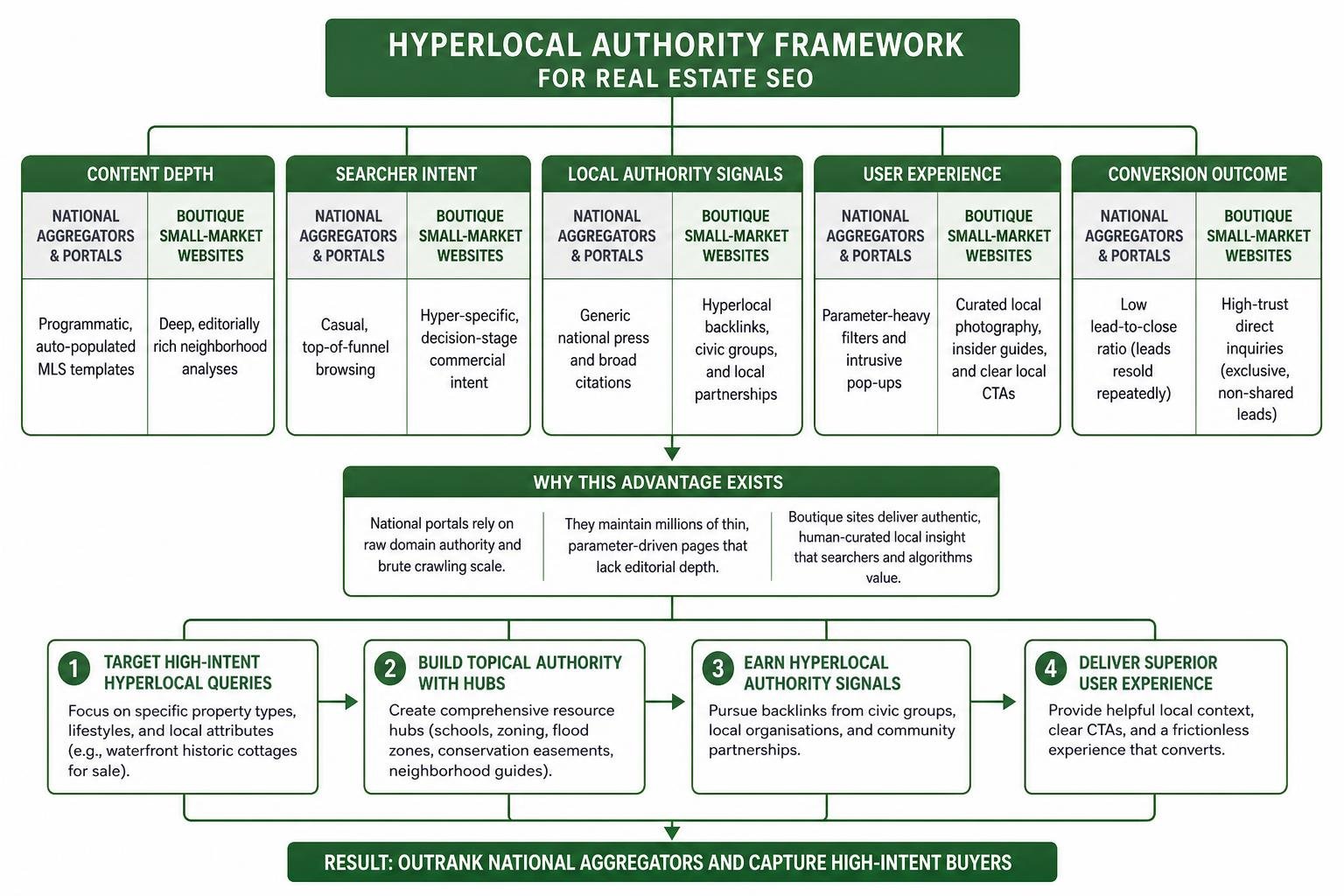
Thin programmatic pages generated by national aggregators leave massive content vacuums. National portals win visibility through raw domain authority and brute crawling scale, but their automated neighborhood templates lack actual human insight. When a prospective buyer searches for granular local information, those generic portal pages suffer from high bounce rates because they fail to provide practical context about schools, local zoning, elevation, flood zones, or the distinct rhythm of daily life.
By building out strategic SEO for real estate, a boutique firm can achieve organic dominance in small markets with remarkably low backlink overhead. According to BrightLocal’s local consumer review survey, consumers increasingly rely on localized search results and authentic business information when evaluating service providers, which reinforces the value of hyperlocal authority over generic portal reach.
| Strategic Dimension | National Aggregators & Portals | Boutique Small-Market Websites |
|---|---|---|
| Content Depth | Programmatic, auto-populated MLS templates | Deep, editorially rich neighborhood analyses |
| Searcher Intent | Casual, top-of-funnel browsing | Hyper-specific, decision-stage commercial intent |
| Local Authority Signals | Generic national press and broad citations | Hyperlocal backlinks, civic groups, and local partnerships |
| User Experience | Parameter-heavy filters and intrusive pop-ups | Curated local photography, insider guides, and clear local CTAs |
| Conversion Conversion Rate | Low lead-to-close ratio (leads resold repeatedly) | High-trust direct inquiries (exclusive, non-shared leads) |
High Intent vs. High Search Volume
Search volume is a vanity metric; conversion intent is a revenue metric. In major metro centers, a keyword like “condos for sale” might get tens of thousands of monthly searches, but the user behind that query could be an aspiring student, an out-of-market dreamer, or a casual window shopper.
In smaller markets, monthly search volume on core keywords might look modest on keyword planning tools, often showing anywhere from 40 to 150 monthly searches for hyper-specific queries. Those searches represent buyers who are actively preparing to write purchase agreements within weeks.
A query such as “waterfront historic cottages for sale” carries undeniable transactional urgency. The searcher is past the casual discovery stage. Capturing 40 visits a month from buyers searching with pinpoint transactional intent yields far more closed commissions than generating 2,000 broad impressions that immediately bounce.
Outranking National Aggregators on Hyperlocal Turf
National portals struggle with indexation bloat. They maintain millions of thin, parameter-driven listing pages that consume substantial crawl budgets. When an algorithm scans their pages, it encounters automated data tables with little substantive editorial depth.
A focused agency can dominate search engine result pages (SERPs) by delivering authentic, human-curated resources. Covering historical preservation covenants, private school bus routes, or local conservation easements creates content that algorithms reward with sustained top positions. Implementing the right realtor search engine optimization essentials for local leads allows boutique brokerages to consistently capture high-intent buyers ahead of broad national directory pages.
The Hyperlocal Content Blueprint: Hubs, Comparisons, and Technical Foundations
To secure lasting search visibility in a small market, your website must be organized around clean, logically structured content silos. Search engines reward websites that establish clear topical authority by grouping related subjects together. Instead of scattering disjointed blog articles across your domain, deploy a deliberate hub-and-spoke content architecture.
A 6-month structured framework helps turn an underperforming local site into a market authority:
- Months 1–2 (Foundation & Hub Creation): Audit your technical infrastructure, resolve indexing issues, and publish an exhaustive 3,500-word cornerstone hub page that covers your core municipality in comprehensive detail.
- Months 2–4 (Neighborhood Silo Domination): Create 1,800- to 2,200-word standalone guides for each primary sub-neighborhood, district, and residential pocket within your market.
- Months 3–5 (Decision-Phase Comparison Content): Build comparative guides evaluating lifestyle, amenities, and price points between competing local enclaves.
- Months 4–6 (Authority Expansion & Link Integration): Secure localized press, coordinate civic sponsorships, and optimize structured schema data across the entire domain.
When properly executed by knowledgeable real estate SEO experts, this systematic approach compounds in value, transforming your website into an organic lead engine.
How Does SEO Work for Small Real Estate Markets Using Neighborhood Hubs?
A neighborhood hub operates as the definitive digital resource for a specific geographic pocket. It should not simply display an automated grid of MLS properties. Instead, build an authoritative guide exploring the nuance of each enclave:
- Architectural Styles and Zoning: Detail the local vernacular, whether that means mid-century modern ranches, coastal shingle cottages, or historic brownstones.
- Education and Community Amenities: Outline specific public and private schooling options, transit corridors, park systems, and private sports clubs.
- Micro-Market Real Estate Metrics: Provide objective insights into median sales prices, historical price appreciation, and average days on market.
- Curated Lifestyle Recommendations: Highlight independent dining, boutique retail, and community gathering spots.
Interlink these hub pages bi-directionally with individual property listings and specific neighborhood sub-pages. This architecture distributes search equity across your entire domain, ensuring that every page reinforces your site’s overall topical authority.
Local Business Schema and Technical IDX Management
Technical optimization ensures that search engines can crawl, index, and understand your real estate assets without getting trapped in crawl loops. Many real estate websites unknowingly sabotage their organic potential by deploying poorly configured Internet Data Exchange (IDX) feeds.
Automated IDX integrations can generate thousands of duplicate, parameter-heavy URLs for filtered searches, pagination, and expired properties. Left unchecked, this indexing bloat squanders your site’s crawl budget. Protect your search performance with precise technical guardrails:
- Canonicalization & Index Control: Implement strict
canonicaltags pointing back to primary category pages, and applynoindex, followdirectives to expired listing pages and complex filter permutations. - Schema Markup Deployment: Integrate
RealEstateAgentandLocalBusinessJSON-LD structured data on your homepage and contact assets, coupled withFAQPagemarkup on informational guides to claim enhanced SERP features. - Mobile-First Speed Optimization: Ensure your site loads within three seconds on mobile networks by using WebP image compression and lazy loading on below-the-fold media assets.
A clean technical base, paired with targeted search engine marketing for real estate, ensures search engines index your primary content assets quickly and accurately.
Local Authority, Link Acquisition, and Lead Realism
Backlink acquisition in smaller real estate markets does not require purchasing hundreds of low-tier web directory links. In fact, aggressive out-of-market link buying can trigger algorithm penalties that suppress local rankings.
Focus instead on real-world local relationships. Search engines place immense weight on genuine civic and commercial connections within your immediate area. Building authentic regional authority is safer, more effective, and ensures you don’t go broke buying backlinks for real estate SEO.
Map Pack Dominance and Community Link Building
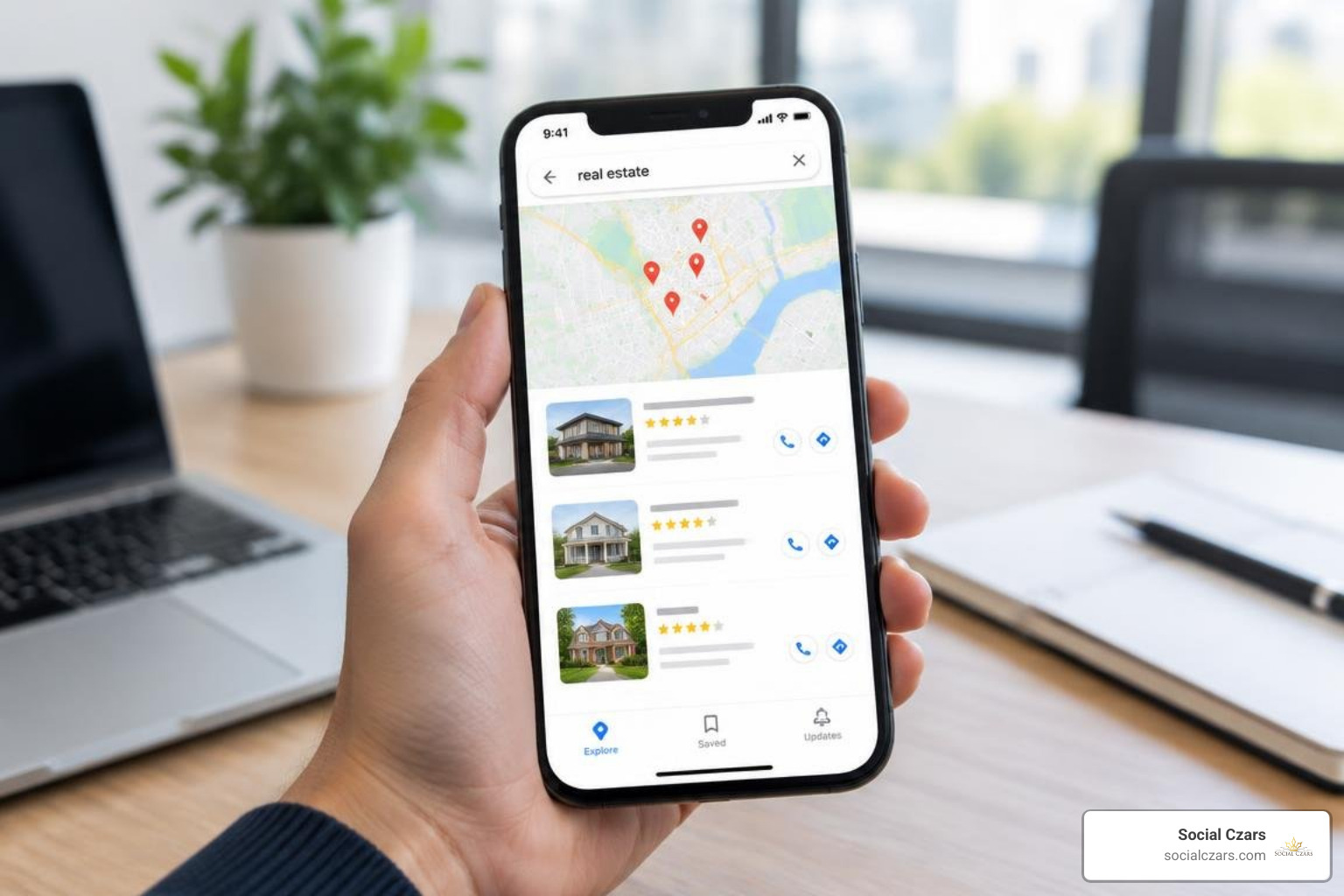
Your Google Business Profile (GBP) is your primary engine for capturing high-intent mobile searchers looking for immediate brokerage representation. Dominating the Google Map Pack requires consistent maintenance and local community signals:
- Name, Address, Phone (NAP) Consistency: Maintain exact matching contact information across all regional business directories, your website footer, and local chamber listings.
- Review Acquisition Cadence: Establish a systematic process for requesting comprehensive client reviews that organically reference specific neighborhoods, architectural styles, and transaction types.
- Weekly Google Posts and Geo-Tagged Media: Regularly publish updates highlighting new listings, local market reports, and community happenings, accompanied by authentic, high-resolution photography.
- Civic and Editorial Link Building: Earn natural backlinks by sponsoring youth sports leagues, partnering with charitable foundations, contributing market commentary to local news publications, and joining regional chambers of commerce.
Setting Realistic Expectations: Does SEO Work for Small Real Estate Markets with Under 50,000 Residents?
Managing pipeline expectations is critical when operating in low-density municipalities. In a market with a population of 30,000, ranking #1 for your primary commercial terms will realistically yield between 2 and 10 highly qualified inbound leads per month from that single municipality.
While 2 to 10 monthly leads might sound conservative compared to broad e-commerce metrics, real estate transactions carry substantial commission values. Converting even one or two of those organic inquiries into closed transactions each quarter generates an exceptional return on your marketing investment.
Avoid the standard mistakes that derail small-market digital campaigns:
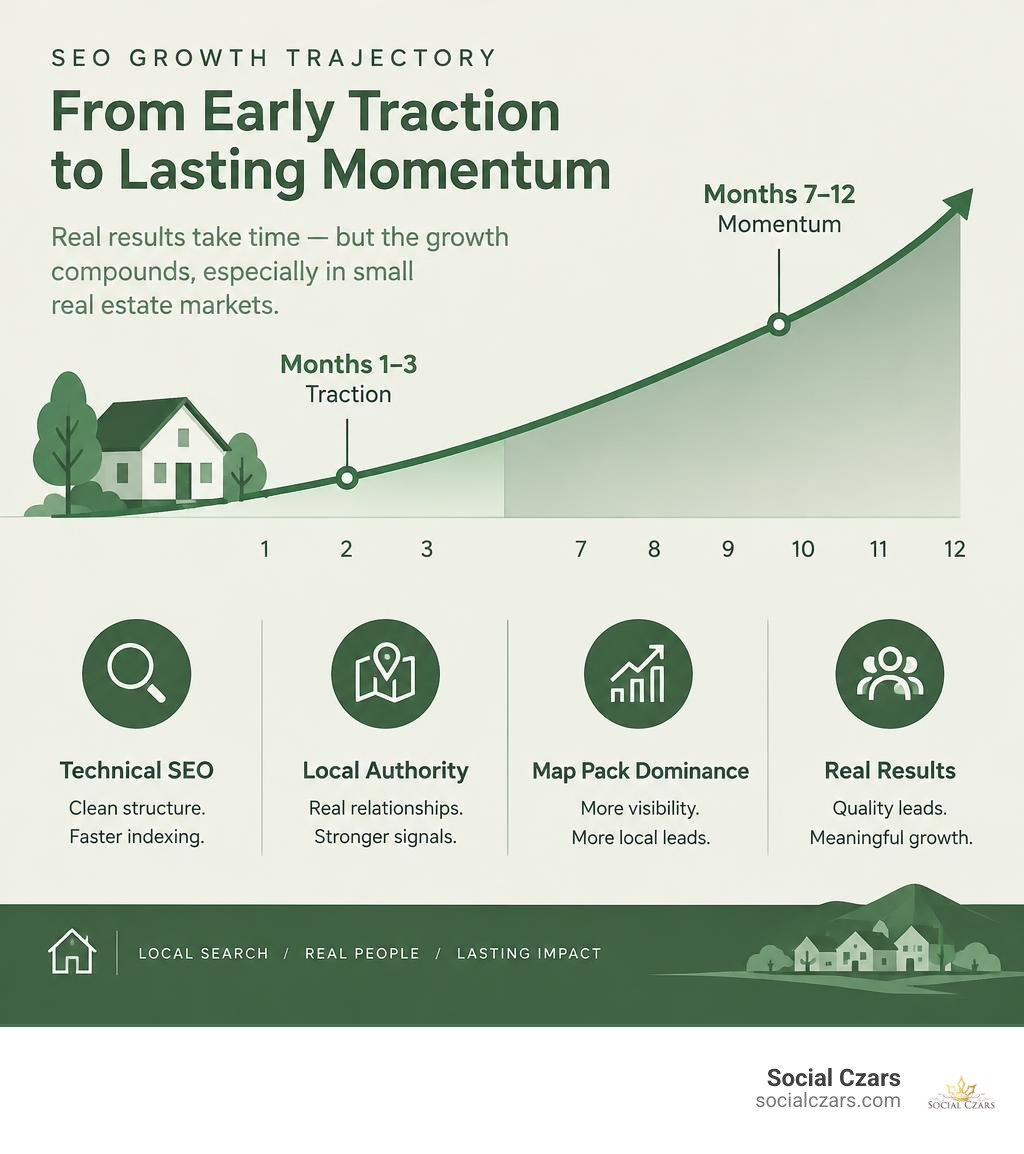
- Abandoning Strategy at Day 60: Assuming SEO is ineffective after just two months, when local search engines typically require 90 to 180 days to establish trust and indexation momentum.
- Producing Superficial Content: Publishing automated, 300-word summaries that provide no distinct value beyond basic MLS data points.
- Ignoring Map Profile Assets: Neglecting Google Business Profile optimization and failing to build a steady stream of authentic client reviews.
- Targeting Broad National Keywords: Wasting resources competing for generic national phrases instead of capturing high-converting, neighborhood-level queries.
Boutique brokerages that steer clear of these pitfalls quickly stop hiding on page two with top realtor SEO services that elevate their local profile.
Multi-Town Geographic Expansion and AI Search Visibility
If your home municipality has a population below 20,000, relying exclusively on a single zip code may limit your total deal pipeline. The solution is to build a regional content architecture that scales across neighboring towns.
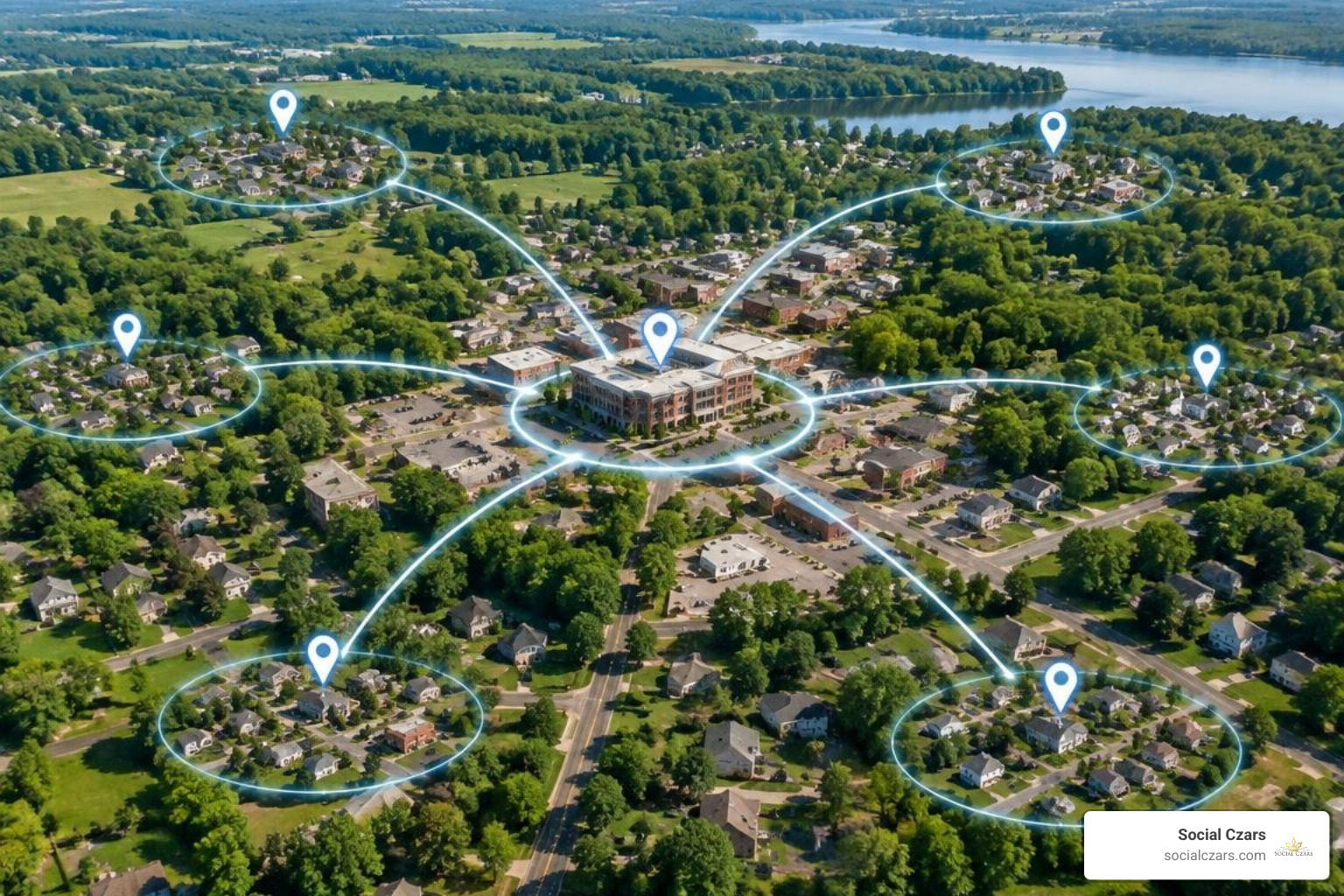
Expanding Footprints Beyond a Single Low-Population Zip Code
To capture larger regional search volume, deploy a multi-location hub-and-spoke model. Establish your primary office municipality as the main authority hub, then build distinct location pages for adjacent towns, unincorporated hamlets, and lifestyle sub-markets within your service territory.
Expand your keyword footprint to capture distinct property-type niches that appeal to specialized buyer groups:
- Equestrian and Agricultural Properties: Build specialized guides highlighting acreage, soil conditions, barn configurations, and local zoning allowances.
- Waterfront and Coastal Estates: Target queries centered on riparian rights, private dock construction permits, bulkhead maintenance, and flood elevations.
- Historic and Architectural Properties: Create resources focused on historic preservation easements, tax credits, and architectural restoration standards.
- Specialized Probate and Estate Sales: Address the nuances of estate management, probate court timelines, and inherited property transactions.
Targeting five to ten complementary micro-markets and property categories multiplies your organic reach, turning a small market footprint into a substantial regional lead engine.
Optimizing for AI Overviews and Generative Engines
Search discovery has evolved with the rise of AI-powered conversational search platforms like ChatGPT and Grok. These generative engines synthesize complex answers by pulling directly from authoritative, well-structured web sources.
To ensure your brokerage is cited by AI assistants, structure your content for natural language parsing:
- Deploy Direct Answer Blocks: Include concise, bold answers (under 300 characters) directly below question headings to serve as easy citations for large language models.
- Utilize Conversational Q&A Formatting: Address natural-language questions such as, “What is the average price per square foot in [Neighborhood]?” or “What are the local property tax rates in [County]?”
- Establish Consistent Entity Authority: Maintain clean digital footprints and consistent brand information across press mentions, professional associations, and licensing records to reinforce entity trust across AI knowledge graphs.
Frequently Asked Questions About Small-Market Real Estate SEO
How long does it take for a real estate website to rank in a small market?
In low-competition real estate markets, initial ranking movements generally emerge within 60 to 90 days following technical cleanup and publication of optimized content hubs. Reaching dominant positions (top 3 in standard organic results and the Google Map Pack) typically takes between four and six months of sustained optimization and review acquisition.
Can small-market agents outrank major portals without buying expensive links?
Yes. National portals rely on generic templates and automated listings. A local brokerage that produces comprehensive, original neighborhood content, implements clean schema markup, and earns authentic local links from civic groups and regional businesses can regularly outrank major portals for high-intent search queries.
What is the ideal population size needed for real estate SEO to be profitable?
Real estate SEO can be profitable in markets with populations as small as 15,000 to 30,000 residents, provided property values and commission margins support the investment. For very small markets, expanding your content footprint to include five to ten surrounding towns and specialized property types provides plenty of search demand to sustain a strong deal pipeline.
Conclusion
Small real estate markets offer an exceptional opportunity for search engine optimization. While national aggregators continue to battle for broad, generic keywords across major metropolises, boutique brokerages can claim authoritative, high-converting real estate queries in their own backyards.
By pairing deep neighborhood content hubs with clean technical foundations, consistent Google Business Profile management, and regional geographic expansion, you create an enduring digital asset that produces private, exclusive client inquiries year after year.
At Social Czars, we specialize in high-end search visibility and executive digital brand positioning across premier markets including New York City, Miami, Los Angeles, and London. If you are ready to establish dominant organic authority in your local market, explore our bespoke luxury real estate optimization and reputation strategy to secure permanent search equity for your brokerage.
