
Reputation Management
Mastering Online Perception with Proven Digital Reputation Solutions

Oct
Find the Right Digital Reputation Solutions for Your Needs
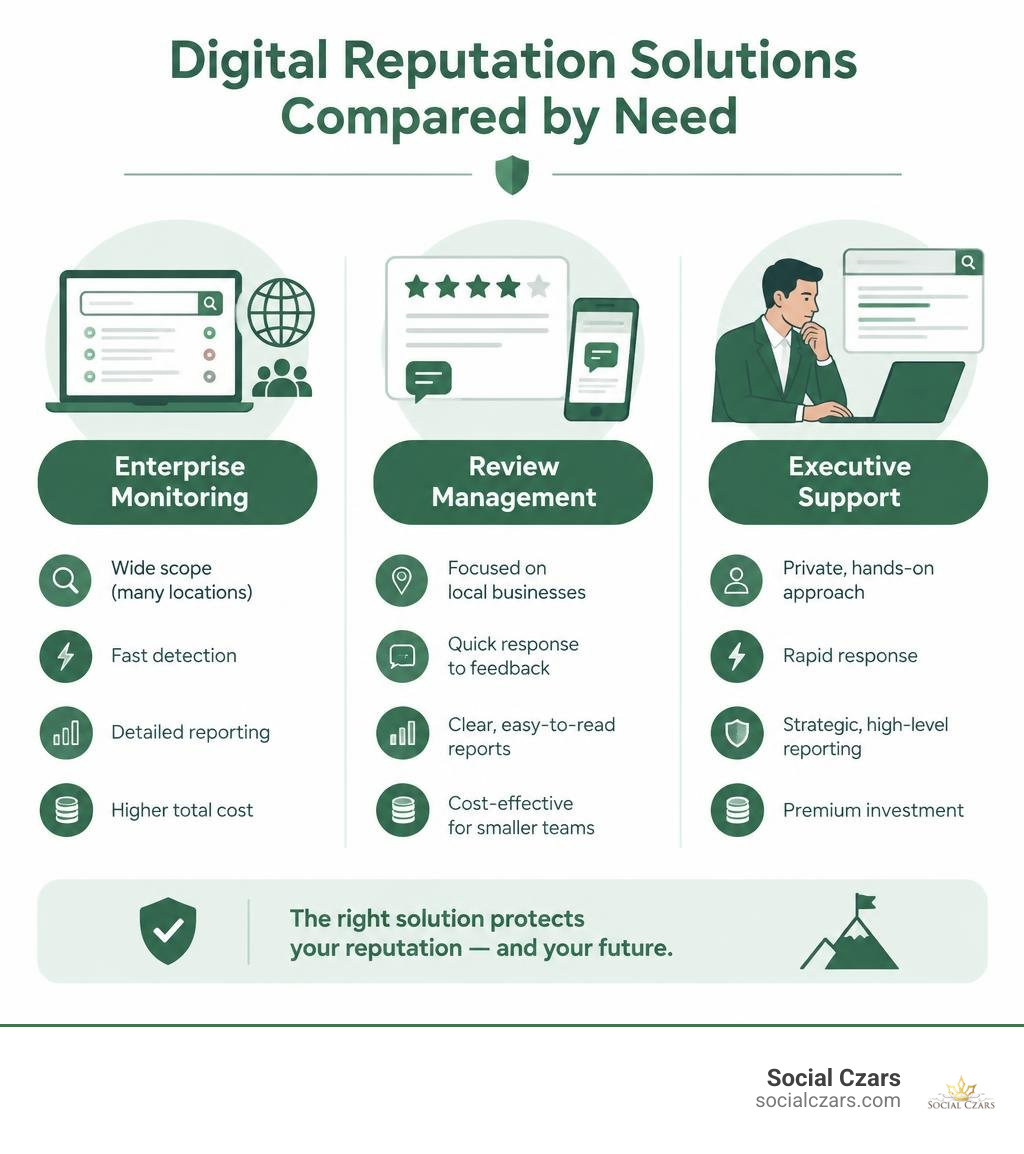
The best solution depends on what you need to protect. Enterprise platforms help large teams monitor many locations. Review tools help local businesses collect feedback and spot problems. A specialist service is often a better fit for executives who need private, hands-on help with harmful search results. Compare each option by its scope, response speed, reporting, and total cost.
A strong plan does more than react to bad press. It tracks early warning signs, responds to real concerns, and builds credible content that people and AI tools can find. This guide compares the main options and shows you how to choose.
I’m John DeMarchi, founder of Social Czars. Since 2014, I’ve helped executives and brands navigate digital reputation solutions, including crisis SEO, content suppression, and positive media coverage.
Terms related to digital reputation solutions:
For broader context on how search engines and AI systems evaluate trust, see reputation management.
Core Categories of Modern Digital Reputation Solutions

Digital perception is no longer dictated solely by what appears on the first page of Google. In October 2026, information ecosystems synthesize public records, Reddit commentary, real-time social sentiment, and generative AI models to define a brand or executive. Selecting the right defense architecture requires understanding the core solution tiers available on the market.
To help navigate these choices, our online reputation strategies guide explores how modern organizations combine automated monitoring with strategic intervention.
| Solution Category | Primary Target Audience | Core Focus Area | Average Implementation Timeline | Key Strengths |
|---|---|---|---|---|
| Enterprise Governance Suites | Multi-location enterprises, global corporations | Multi-channel social listening, centralized feedback workflows | 30 – 90 Days | Broad surface coverage, multi-location reporting |
| Automated Review Systems | Local businesses, regional franchises | Review generation, local SEO ranking, review dispute workflows | 1 – 14 Days | Rapid review volume growth, Google Business Profile optimization |
| Bespoke Executive Defense | C-suite leaders, founders, VIPs, high-net-worth individuals | Crisis containment, search displacement, Generative Engine Optimisation | Under 24 Hours (Crisis) / 60+ Days (Narrative) | Complete confidentiality, rapid content de-indexing, board-level risk management |
Enterprise-Grade Platforms vs. Specialized Boutique Services
Enterprise-grade software packages excel at scale. If an organization manages hundreds of retail storefronts across New York City, London, and Los Angeles, an automated SaaS platform provides the multi-location analytics needed to aggregate customer sentiment across distributed touchpoints. These platforms offer standardized workflows, scheduled metric exports, and broad operational visibility.
However, software alone cannot negotiate the de-indexing of a defamatory publication or orchestrate a sophisticated narrative suppression campaign. Boutique agencies deliver white-glove, custom remediation supported by strict service-level agreements (SLAs). When high-profile executives face coordinated smear attacks, off-the-shelf software alerts them to the fire but lacks the specialized engineering required to extinguish it. Boutique representation focuses on high-impact interventions: legal coordination, algorithmic search displacement, authoritative digital PR, and direct entity remediation.
Automated Review Ecosystems and Local Search Dominance
For customer-facing organizations, review aggregation engines serve as the frontline defense for local search visibility. A sudden influx of low-star ratings directly damages conversion rates and organic visibility on local map packs.
Automated feedback systems prompt verified customers via SMS and email immediately following transactions, directing positive sentiment to public profiles while routing grievances internally for rapid service recovery. Maintaining an active, positive stream of authentic customer feedback creates an algorithmic buffer against rogue negative feedback while building foundational trust across local directories.
The Modern Reputation Framework: From Traditional ORM to AI-Era Governance
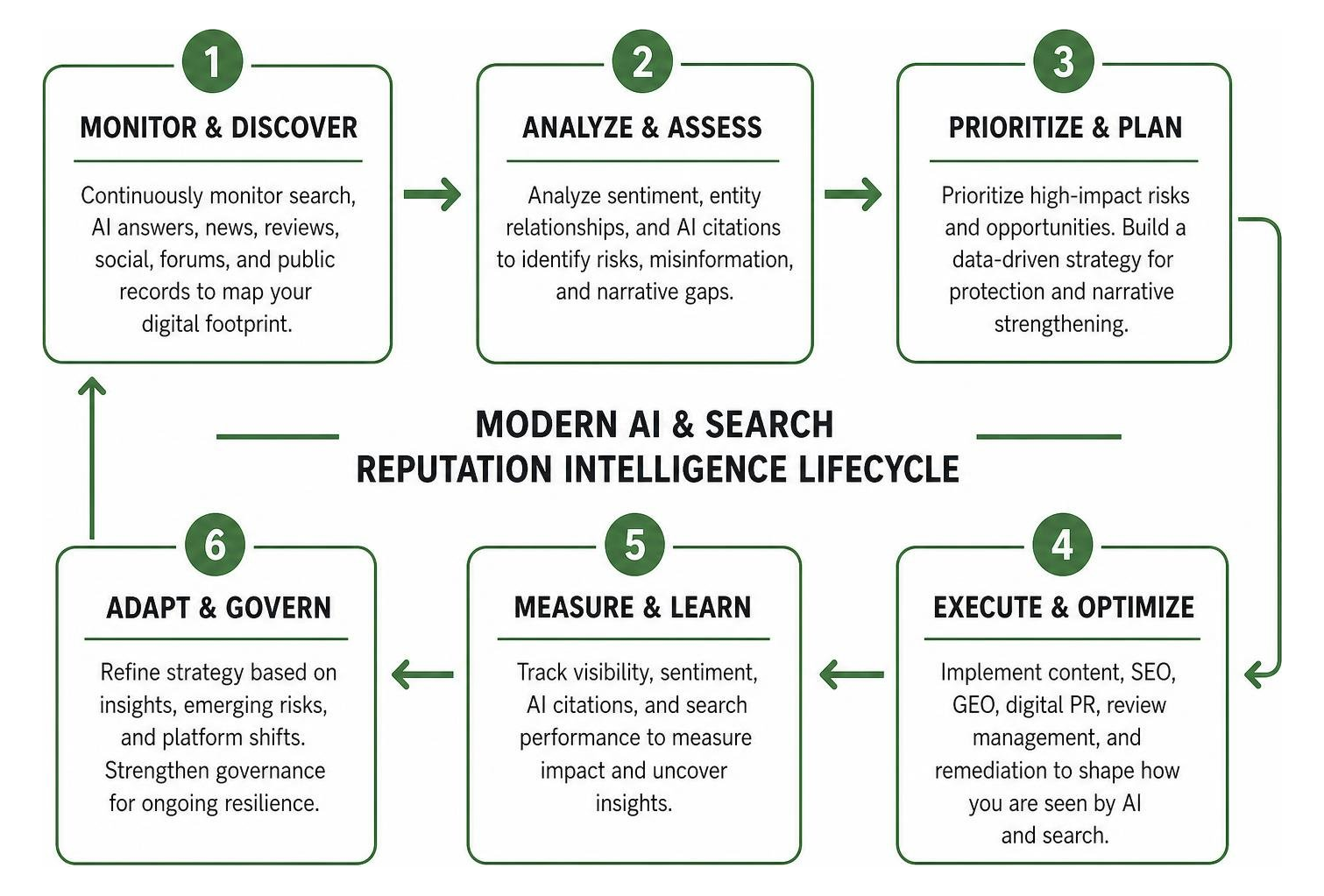
Traditional online reputation management (ORM) operated on a simple premise: publish enough positive blog posts and social profiles to push negative links down to page two of search results. In 2026, that playbook is obsolete. Large language models (LLMs) and generative search engines do not read search engine results pages (SERPs) the way human users do; they ingest entity relationships, authoritative citations, and cross-platform sentiment to generate conversational answers.
Effective protection requires comprehensive digital footprint management that treats brand perception as a core risk governance discipline rather than an afterthought.
Implementing Digital Reputation Solutions for Generative Engine Optimisation
Generative Engine Optimisation (GEO) focuses on shaping how AI answer engines perceive and describe an entity. While traditional search optimization targets keyword ranking positions, GEO engineers the underlying knowledge graphs that inform machine learning models.
When an investor or customer asks an AI engine about an organization or executive, the AI synthesizes brand sentiment, news articles, legal filings, and forum discussions into a single narrative paragraph. If unmonitored digital footprints contain unverified claims, generative models treat those signals as factual consensus.
Protecting a digital presence requires establishing authoritative entity nodes across high-trust publications, verified knowledge panels, and credible data repositories, ensuring that generative engines output verified, factual biographical summaries.
The Five-Layer Intelligence Lifecycle: Detecting Signals Before Escalation
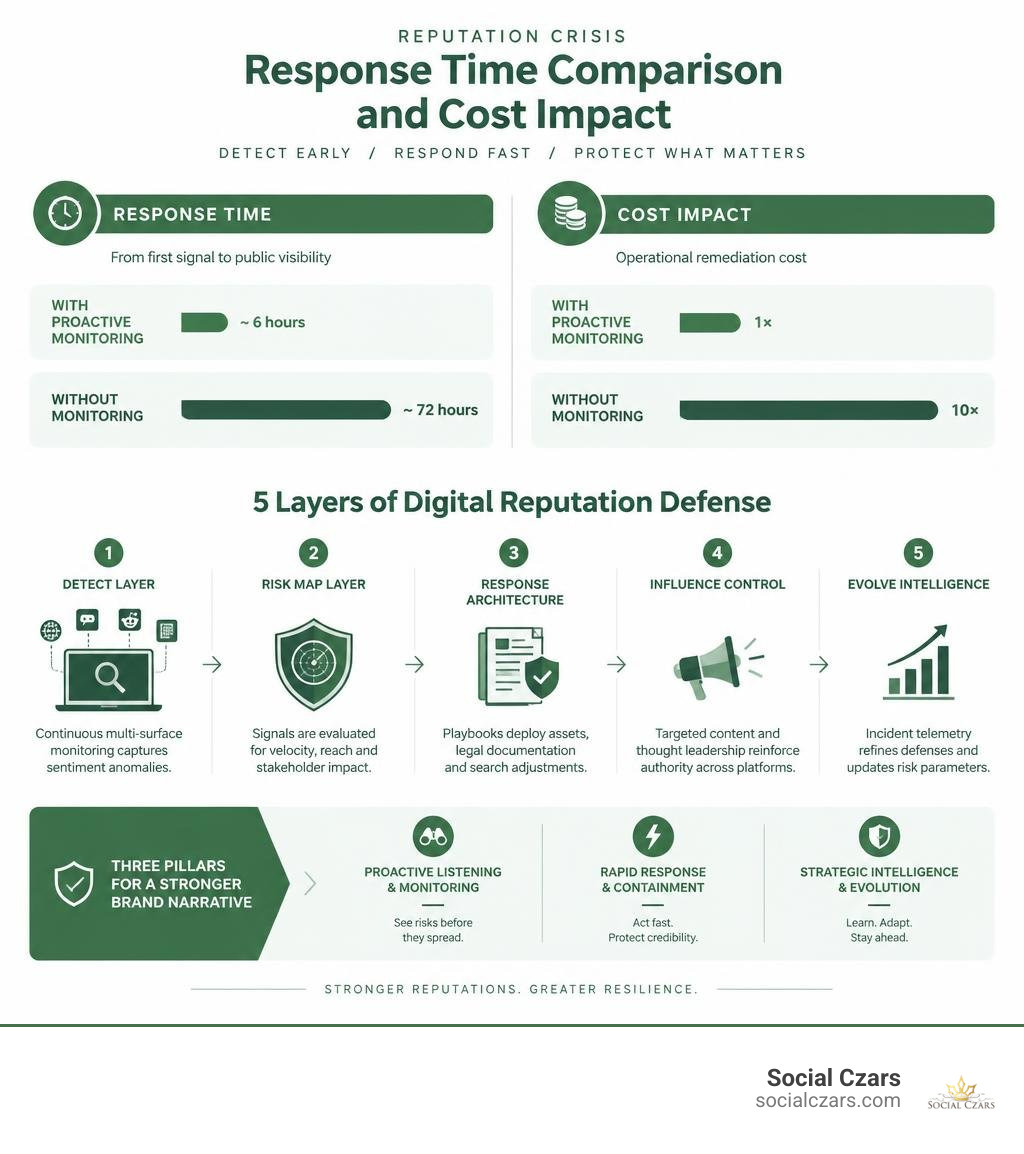
Modern brand protection is governed by a closed-loop intelligence model that continuously mitigates enterprise vulnerabilities:
- Detect Layer: Continuous multi-surface monitoring captures sentiment anomalies across search indexes, dark web forums, Reddit communities, and generative answer citations.
- Risk Map Layer: Signals are evaluated against predictive severity models to determine their velocity, potential reach, and real-world stakeholder impact.
- Response Architecture: Pre-built operational playbooks deploy pre-approved communication assets, legal documentation, and search adjustments within hours of signal detection.
- Influence Control: Targeted narrative assets, verified thought leadership, and digital PR are published to reinforce entity authority across search indexes and LLM datasets.
- Evolve Intelligence: Incident telemetry is fed back into governance reporting to refine defensive measures, update risk parameters, and maintain ongoing narrative control.
Three Essential Pillars for Controlling Brand Narrative in 2026

A resilient digital posture rests on three operational pillars. Without them, organizations remain vulnerable to unexpected crises that can destroy years of hard-won brand equity. Understanding reputation repair and management for the modern business means shifting away from reactive measures toward systematic control.
Proactive Social Listening and Multi-Surface Monitoring
The average window between an emerging reputation crisis signal and material stakeholder visibility is approximately 72 hours. When an organization identifies a threat at T+0, leadership can evaluate the situation and resolve it with minimal friction.
If that same threat is ignored until T+72, the narrative typically propagates across syndicated news outlets, accumulates hundreds of social interactions, and becomes permanently integrated into AI knowledge graphs. At that stage, operational remediation costs can increase tenfold.
Proactive social listening continuously tracks brand variations, executive names, and core industry terminology across conversational platforms like Reddit and specialized forums. Detecting an unverified claim before it gains organic momentum prevents it from dominating branded search queries.
Rapid Response Architecture and Crisis Containment Playbooks
Organizations operating without pre-built response infrastructure average 72 hours to deliver an initial public or legal response during a crisis. By contrast, entities backed by dedicated response playbooks compress their response window to under 6 hours.
When negative content threatens leadership or enterprise valuation, knowing how to improve your digital reputation fast depends entirely on pre-existing digital assets. Response architecture includes pre-drafted holding statements, verified press relationships, search suppression protocols, and established escalation pathways. Compressing the response timeline preserves institutional credibility and stabilizes market sentiment before rumors can solidify into accepted facts.
Strategic Selection Criteria for Organizations and Individuals
Selecting the right partner requires assessing organizational maturity, threat levels, and operational scope. Our best online reputation management agency 2026 guide outlines how enterprise executives evaluate technical capabilities, privacy standards, and pricing models across the marketplace.
Selecting Executive Digital Reputation Solutions for VIPs and C-Suite Leaders
High-profile individuals face unique threats that traditional corporate marketing teams are unequipped to handle. Executive defense requires a nuanced combination of personal privacy enforcement, malicious content de-indexing, and bespoke narrative building.
For leaders based in international business hubs like Miami, New York City, Los Angeles, and London, public perception directly influences fundraising rounds, regulatory approvals, and shareholder confidence. Specialized executive solutions build defensive moats around personal names, displacing inaccurate commentary with high-authority profiles, industry keynotes, and verified philanthropic milestones.
Key Performance Indicators for Measuring Reputation Health
An effective digital reputation strategy should be evaluated using clear, measurable metrics:
- Branded Search Dominance: The percentage of Page 1 and Page 2 search results completely owned and controlled by verified, positive brand assets.
- AI Narrative Accuracy: The precision and sentiment alignment of summaries produced by major conversational AI search engines when queried about the entity.
- Crisis Response Latency: The exact time elapsed between an initial risk signal appearing online and the execution of a verified counter-response.
- Review Sentiment Velocity: The net monthly volume and average rating trajectory across verified third-party review platforms.
- Cost of Remediation: The operational and advisory capital required to maintain search stability relative to enterprise value.
Frequently Asked Questions About Digital Reputation Management
How quickly can a coordinated negative review attack damage brand trust?
A coordinated review attack can inflict severe damage within a single weekend. For example, an influx of 18 fraudulent one-star reviews posted over a 72-hour period can drop an organization’s overall rating from 4.4 to 3.8 stars. This sudden decline undermines prospective customer conversion, weakens local map rankings, and damages consumer trust. Countering these attacks requires rapid algorithmic flagging, direct platform appeals, and targeted positive review generation.
What is the difference between traditional SEO and Generative Engine Optimisation?
Traditional SEO optimizes content to rank on static search engine results pages by targeting specific keywords, backlinks, and on-page technical factors. Generative Engine Optimisation (GEO) focuses on training data, entity relationships, and knowledge graph citations. GEO ensures that when an AI system synthesizes an answer for a user query, it sources factual, positive, and authoritative context rather than pulling unverified claims from low-quality forums.
What KPIs measure the effectiveness of reputation governance?
Reputation governance is measured through quantifiable risk metrics, including branded search dominance across the top 20 query results, AI narrative sentiment accuracy, net sentiment share across social and forum surfaces, and incident containment speed. Organizations with mature governance structures regularly review these metrics to prevent emergent threats from affecting market performance.
Conclusion
Building a resilient online presence is an ongoing operational commitment. Whether protecting a multinational enterprise across diverse markets or safeguarding an executive’s personal legacy, proactive governance and advanced optimization ensure your true story is told accurately.
At Social Czars, we specialize in high-stakes search optimization, crisis containment, and executive narrative protection for discerning leaders. If fraudulent claims or coordinated smear campaigns are threatening your hard-earned credibility, explore our expedited Google review removal services to reclaim control of your digital narrative today.
