
Reputation Management
Executive SEO Suppression: Bypassing Unwarranted ContentKeeper Controls

Oct
How to Remove ContentKeeper Restrictions for Executives
Start with an approved access change, not a workaround. Ask your IT and security teams to identify what ContentKeeper is blocking, then request a policy exception for the affected executive account or sites. If the organization plans to remove ContentKeeper entirely, IT should test a replacement filter, preserve needed logs, and remove network and device controls through its normal change process.
A filter can hide a page from your view without changing what the public sees on Google. That distinction matters when you are monitoring your reputation: first confirm whether the problem is internal access or a search result that needs a separate response.
I’m John DeMarchi, founder of Social Czars. Since 2014, I’ve helped executives manage crisis SEO and online visibility; for executive contentkeeper removal, my focus is helping leaders assess what they can see while authorized IT teams handle access and security.
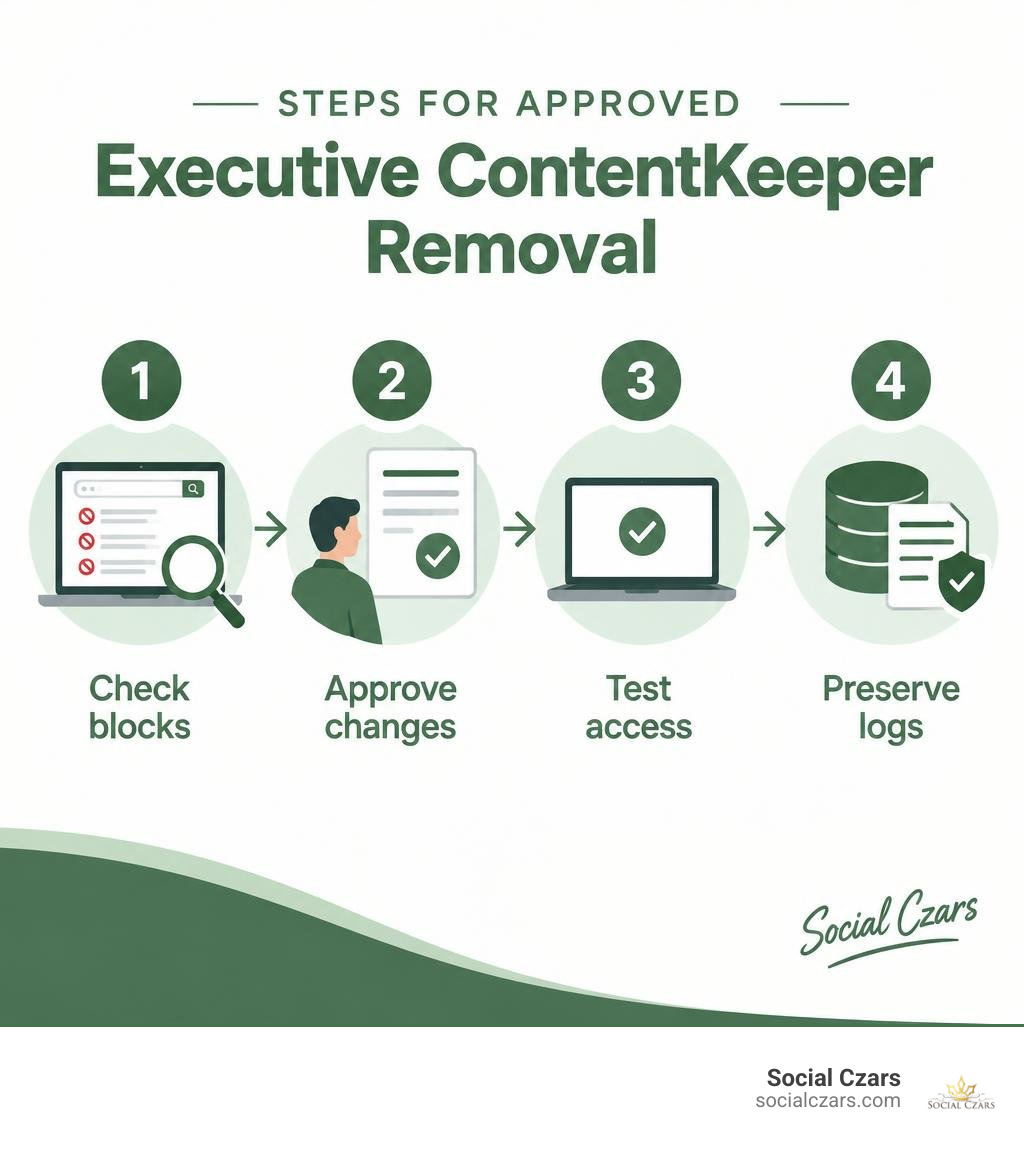
Executive contentkeeper removal definitions:
Understanding ContentKeeper Network Restrictions and Executive Over-Blocking
Modern enterprise security stacks must balance data protection with executive operational speed. However, legacy filtering platforms often struggle in today’s hybrid corporate environments. When legacy gateways sit directly in the network path performing heavy-handed SSL decryption and rigid category blocking, they frequently generate disruptive false positives for leadership teams.

Legacy appliances inspect traffic by acting as a man-in-the-middle proxy. While designed to prevent malware and data exfiltration, this architecture often misclassifies critical business intelligence, news outlets, investigative reporting platforms, and competitive analysis portals as restricted content. For senior leaders who must monitor market movements and public sentiment in real time, these blunt controls become a direct operational bottleneck. Understanding how to address these barriers begins with fixing search filtering and optimization issues on contentkeeper networks to ensure critical intelligence remains accessible.
| Infrastructure Dimension | Legacy On-Premises Filtering | Modern Cloud-Native Zero-Trust |
|---|---|---|
| Inspection Model | Centralized hardware / rigid inline proxy | Identity-aware distributed edge (SASE) |
| Decryption Handling | Heavy local SSL termination & certificates | Selective cryptographic inspection & SNI routing |
| Policy Flexibility | Broad IP/subnet-based category rules | Granular, role-based contextual privileges |
| Hybrid Workforce Support | High latency via VPN hair-pinning | Seamless direct-to-cloud secure transport |
| False-Positive Friction | High (static classification databases) | Low (machine-learning contextual evaluation) |
Why Legacy Filtering Mechanisms Impede Leadership Communications
C-suite executives and high-profile leaders operate under different technical requirements than the broader enterprise workforce. A chief communications officer or managing partner evaluating an emerging PR situation needs immediate, unfiltered access to emerging news sources, discussion forums, social media channels, and investor portals. When automated algorithms flag these assets as “unclassified,” “suspicious,” or “reputation risk,” the executive workflow halts completely.
Furthermore, leadership teams constantly track what stakeholders see across major search engines. If an organization faces hostile digital sentiment, leaders must work proactively to suppress negative search results across regional and global markets. When on-premise gateways block internal access to these target search results due to over-aggressive filtering rules, executives cannot accurately assess external brand visibility or audit ongoing remediation campaigns.
The Intersection of Network Gateways and Digital Reputation
Internal network controls and public search engine indices often interact in confusing ways. A web gateway operates locally at the DNS, proxy, or endpoint layer to prevent an internal user from loading a specific URL. In contrast, search engines index web content across the public internet regardless of what an internal gateway permits.
When corporate appliances suppress web pages locally, executives may mistakenly assume that defamatory, outdated, or sensitive material is no longer visible to the outside world. Conversely, over-aggressive filters can blind leaders to harmful external content that is actively spreading to customers and investors. To properly evaluate external search index visibility, corporate teams must clear contentkeeper filter blocks and reclaim your search visibility today to align internal monitoring capabilities with actual public search performance.
Strategic Framework for Executive ContentKeeper Removal
Completely dismantling or bypassing an enterprise-grade filter requires structured governance. Rogue bypass attempts using unauthorized proxies or consumer VPNs introduce severe security vulnerabilities and violate corporate IT acceptable-use policies. Instead, a successful migration requires formal coordination between executive leadership, network engineering, and information security teams.
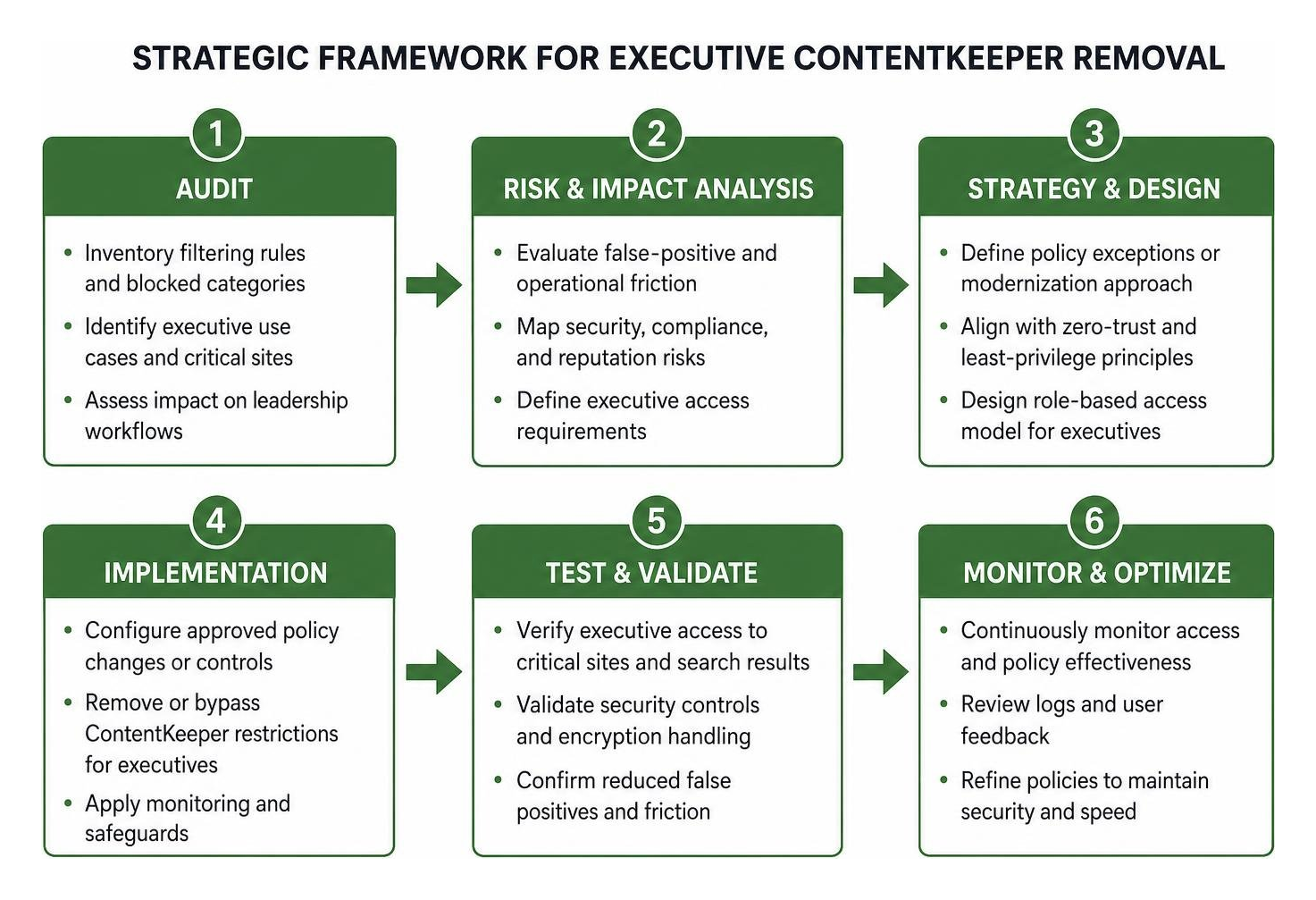
Organizations navigating corporate transformations frequently reassess their security software footprint. As documented in broader industry analyses, enterprises regularly evaluate whether legacy tools continue to align with strategic goals or if modernization is required. A structured technical roadmap, such as the ultimate guide to getting rid of contentkeeper restrictions, gives engineering teams the baseline necessary to retire legacy filters without degrading the overall security posture.
Procedural Protocols for Executive ContentKeeper Removal
To implement an authorized override or complete decommissioning, organizations should follow clear procedural milestones:
- Executive Access Audit: Identify the exact devices, IP ranges, and user directory accounts assigned to leadership personnel.
- Governance and Legal Authorization: Secure written sign-off from the Chief Information Security Officer (CISO) and General Counsel authorizing tailored access tiers.
- Change Management Staging: Coordinate with systems administrators to stage pilot zero-trust access policies in parallel before modifying legacy infrastructure.
- Contract and Architectural Review: As outlined in How to Get Rid of ContentKeeper: The Most Effective Solution for IT Teams, review vendor commitments, license termination windows, and architectural touchpoints before executing an enterprise-wide cutover.
Legal, Governance, and Regulatory Considerations
Network filtering policies often touch upon strict legal obligations, including regulatory compliance frameworks, industry-specific privacy mandates, and corporate compliance standards. When engineering teams adjust filtering rules for executive workstations, they must preserve comprehensive audit logs.
If executive browsing restrictions are lifted during sensitive litigation, market research, or external investigations, maintaining transparent record-keeping ensures compliance with corporate governance mandates. When an organization’s digital assets or executive profiles are compromised externally, leadership must understand how to remove content through legitimate legal and digital channels rather than relying on local gateway suppression to solve public-facing reputation threats.
Step-by-Step Technical Guide to Unrestricted Executive Access
Achieving unrestricted, secure access across C-suite devices requires systematic remediation across network routing, device management profiles, and transport-layer certificates.

When an enterprise chooses to modernize its infrastructure or implement an executive policy override, IT teams must address the specific mechanisms used by the gateway to intercept traffic. When operational urgency requires immediate remediation, IT personnel can deploy an emergency seo playbook to remove filtered network content to audit network paths and eliminate unwarranted roadblocks.
Technical Steps for Executive ContentKeeper Removal on C-Suite Devices
For systems administrators tasked with safely removing gateway restrictions from executive hardware, the process involves four core phases:
- Mobile Device Management (MDM) Profile Deprovisioning: Update the enterprise MDM console (such as Microsoft Intune, Jamf Pro, or VMware Workspace ONE) to remove configuration profiles that enforce proxy auto-configuration (PAC) files or mandatory gateway redirects on executive device groups.
- Endpoint Agent Uninstallation: Push clean uninstall commands via centralized remote monitoring and management (RMM) tools to cleanly remove local filtering daemons and client service extensions.
- Root Certificate Revocation: Remove the proprietary appliance root SSL/TLS inspection certificates from the executive machine’s trusted certificate store to restore native public key validation.
- DNS and Gateway Route Realignment: Reconfigure local network adapters or DHCP scope options to point executive endpoints toward secure, modern cloud DNS resolvers rather than local filtering proxies.
While technical communities frequently analyze manual client-side bypass mechanisms and script-level modifications in forums such as the technical discussion on filtering bypass strategies, enterprise environments must always apply administrative modifications through official MDM orchestration to maintain system stability and device compliance.
Alternative Policy Adjustments and Selective Bypasses Short of Total Removal
If an enterprise cannot immediately decommission its central filtering infrastructure, administrators can deploy selective architectural adjustments to grant executives immediate relief without removing the appliance entirely:
- Executive VIP Bypass Group: Leverage directory integration (e.g., Microsoft Entra ID or Okta) to assign executive accounts to an unrestricted outbound policy tier that bypasses deep-packet SSL inspection.
- Dedicated VLAN Allocation: Route physical executive office connections and private C-suite wireless networks through an isolated, secure VLAN configured to bypass inline filtering appliances.
- Split-Tunnel SASE Architecture: Direct sensitive business traffic and real-time reputation monitoring tools through an encrypted split tunnel, bypassing on-premises legacy gateways entirely.
- Targeted Search & Reputation Workflows: When executive focus shifts toward cleaning up broader internet visibility, leaders often need to evaluate how to remove stuff from google search using external de-indexing methods rather than altering internal proxy configurations.
Mitigating Enterprise Risks and Ensuring Operational Continuity
Modifying executive network controls introduces operational risk if replacement security controls are not deployed concurrently. Removing legacy web filters must never leave senior leadership vulnerable to credential harvesting, targeted spear-phishing, or drive-by malware attacks.
Transitioning to modern zero-trust network access (ZTNA) frameworks allows organizations to eliminate legacy proxy friction while significantly strengthening threat prevention. During any security transition, following remove negative search results best practices ensures that internal network adjustments run alongside a clear, effective digital presence strategy.
| Risk Area | Uncontrolled Direct Bypass | Structured Executive Policy Override | Managed Modern SASE Transition |
|---|---|---|---|
| Malware & Phishing Threat Exposure | High (zero edge filtering active) | Low (DNS-level cloud threat defense retained) | Near Zero (AI-driven zero-trust endpoint protection) |
| Regulatory & Audit Non-Compliance | Critical (unlogged network activity) | Controlled (centralized administrative log retention) | Fully Compliant (immutable cloud audit trails) |
| Endpoint Operating Stability | Poor (risk of software conflicts/corruption) | Stable (managed MDM policy exception) | Optimal (lightweight, native OS integration) |
| Network Latency & Bandwidth Drag | Variable | Medium (legacy routing paths remain) | Minimal (optimized global edge points of presence) |
Monitoring and Auditing Post-Removal Performance
Following the reconfiguration or removal of gateway software, IT security teams must implement proactive monitoring to ensure ongoing stability and security. Key post-removal procedures include:
- Continuous Telemetry Validation: Monitor endpoint detection and response (EDR) telemetry on all executive workstations to confirm that real-time threat hunting remains fully operational.
- Log Archival & Retention: Ensure that all historical gateway logs generated prior to the transition are securely exported and preserved to satisfy regulatory compliance requirements.
- Visibility Audits: Conduct recurring evaluations of external brand positioning and search landscape health, deploying professional internet content removal protocols whenever unauthorized, malicious, or defamatory third-party material appears in public search indices.
Frequently Asked Questions about Executive Filtering Overrides
Who possesses the executive authority to authorize ContentKeeper removal?
The authority to authorize network policy exemptions, administrative bypasses, or platform-wide de-installations typically rests with the Chief Information Security Officer (CISO), Chief Information Officer (CIO), or designated IT Director, with guidance from General Counsel. Because executive modifications directly impact corporate governance and risk management, changes should be formally authorized through established enterprise change-control procedures rather than informal staff requests.
Does bypassing network filters create organizational compliance vulnerabilities?
An unmanaged, ad-hoc bypass can create compliance vulnerabilities if it disables required logging or exposes endpoints to malicious traffic. However, when an organization transitions executive endpoints to a modern, identity-driven zero-trust architecture or cloud-native Secure Access Service Edge (SASE) platform, compliance posture is maintained or strengthened. Modern solutions deliver comprehensive threat mitigation, data loss prevention (DLP), and immutable audit trails without the disruptive over-blocking associated with legacy proxy appliances.
How quickly can IT administrators complete an executive content filtering migration?
For individual executive workstations or designated VIP user groups, administrative policy adjustments within MDM and directory platforms can typically be executed within 24 to 48 hours. An enterprise-wide platform migration—encompassing architecture auditing, pilot group validation, endpoint agent uninstallation, and full DNS cutover—generally spans between two to six weeks depending on the size of the device fleet and organizational complexity.
Conclusion
In high-stakes corporate environments, executive agility depends on direct, unhindered access to global information and real-time digital intelligence. When legacy web gateways disrupt executive workflows with false positives and over-aggressive filtering, leadership teams cannot operate effectively or protect their brand reputation.
At Social Czars, we specialize in high-end search optimization, crisis SEO, and elite digital reputation management for executives and VIPs across New York City, Miami, Los Angeles, and London. If legacy gateway controls or persistent negative search results are impeding your executive performance, partner with our team for strategic executive contentkeeper removal and digital reputation services to reclaim your digital visibility today.
