
Reputation Management
Wikipedia edits to Google Knowledge Panel: complete 2026 workflow

Oct
Instead of repeatedly checking whether a Wikipedia edit changed your search result, use this 2026 Wikipedia to Google Knowledge Panel workflow to document the error, request a policy-compliant correction, and submit separate feedback to Google. Wikipedia is one possible source for a Knowledge Panel—not a publishing interface that controls it.
- The Wikipedia to Google Knowledge Panel workflow corrects source facts; it cannot guarantee panel creation or updates.
- Wikipedia corrections need reliable sources, neutral wording, and disclosure of relevant conflicts of interest.
- Google Knowledge Panel feedback is separate from Wikipedia editing and does not guarantee acceptance.
- Socialczars serves Miami companies and executives seeking crisis SEO and online reputation management.
Why this matters
A wrong title, outdated affiliation, or mistaken identity can distort what people see when they search your name. Correcting the underlying record matters, but changing Wikipedia and changing a Google Knowledge Panel are separate tasks.
Google's guidance on Knowledge Panels describes information assembled from multiple sources. Wikipedia's conflict-of-interest and paid-contribution disclosure rules govern participation in its articles. These are the governing references for this 2026 workflow; neither gives a company authority to dictate the displayed result.
Socialczars is best suited to Miami companies and executives seeking crisis SEO and online reputation management. Its online reputation management services address the broader reputation problem; the workflow below addresses factual corrections without treating an encyclopedia as promotional space.
An unfavorable fact is not automatically an error. Separate incorrect information from accurate reporting before choosing a correction request, an editorial discussion, or a broader search-reputation response.
Before you start
- Prepare evidence and a baseline. Collect the exact search query, screenshots, the Wikipedia article title, the disputed passage, and reliable sources supporting the correction. Keep sensitive personal information out of public discussion unless disclosure is necessary and appropriate.
- Prepare the right access. Use a Wikipedia account for an attributable discussion and a Google account for panel feedback. An eligible representative seeking panel verification also needs access to the identity-verification methods Google presents.
- Resolve the conflict-of-interest issue first. Owners, employees, representatives, and paid consultants have an interest in the subject. Disclose that connection; paid contributors must disclose their employer, client, and affiliation as required by Wikipedia's Terms of Use. Prefer a disclosed talk-page request over directly rewriting your own article.
The non-obvious trap is publicity: Wikipedia article histories and talk-page discussions are generally public. Do not paste confidential legal correspondence, identification documents, or private crisis details into a correction request. Prepare a public-safe evidence packet before opening the editor.
Evidence record
Create a baseline before changing anything. In a 2026 crisis response, this prevents a team from mistaking an unrelated panel change for the result of its request.
- Search the exact name that produces the disputed Knowledge Panel. Record the search query, observation date, language, and country context. Capture the whole panel, not only the incorrect sentence.
- Save 2 screenshots: one of the panel and one of the Wikipedia passage associated with the concern. This is an evidence checklist, not a requirement imposed by either platform.
- Build 3 records in your working document: the panel issue, the Wikipedia issue, and the supporting evidence. Keep these separate even when they concern the same fact.
- Write a proposed correction in plain language. Identify what is wrong, what should replace it, and which source supports that replacement. Avoid adjectives, reputation claims, or explanations of why the company deserves better visibility.
- Check whether the panel actually attributes the disputed information to Wikipedia. If it does not, treat Wikipedia as a candidate source rather than the confirmed cause. Inspect the other visible source attributions before assigning the correction route.
For an affiliation error, distinguish a former role from a current role. For mistaken identity, compare identifying details rather than assuming that matching names refer to the same person.
Expected result: you have a documented factual discrepancy and supporting evidence—not an assumption that a Wikipedia edit will repair the panel.
Correction routes compared
Choose the route based on where the error exists. These routes address different records and can operate in parallel when both records are wrong.
| Route | Best for | Advantage | Limitation |
|---|---|---|---|
| Wikipedia talk-page request | A sourced correction to an existing article when you have a conflict of interest | Lets uninvolved editors review the proposed wording and evidence | Editors can decline unsupported or inappropriate changes |
| Google panel feedback | A factual error displayed in an existing Knowledge Panel | Targets the displayed information directly | Acceptance and timing are not guaranteed |
| Verified representative suggestion | An eligible representative correcting an existing panel | Establishes a representative relationship through Google's verification process | Verification does not grant ownership or unrestricted editing |
Use both Wikipedia and Google correction routes when both records are wrong. Do not wait for a Wikipedia request to resolve before documenting an independently incorrect panel field.
Wikipedia correction request
Wikipedia's content rules require verifiability and a neutral point of view. Independent reliable coverage is especially important for establishing an article subject's notability; an official company page does not replace that requirement.
- Open the existing article and select Talk. Read earlier discussions about the disputed fact before starting another request. An existing consensus or unresolved sourcing dispute changes what evidence you need to present.
- Select Add topic to start a focused discussion. State your connection to the subject at the beginning. If you are paid to participate, include the required employer, client, and affiliation disclosure rather than describing yourself as an unrelated reader.
- Identify the exact passage and propose a replacement. Keep the request narrow: a wrong appointment date is a different issue from rewriting the introduction. Explain how the cited source supports each requested change.
- Include bibliographic details sufficient for editors to locate the evidence: publisher, article title, author when available, and publication date. Use independent reliable sources for disputed claims. A primary source can support some straightforward facts, but it is not permission to add promotional assertions.
- Use Show preview to inspect the request, then Publish changes to submit it. If the request needs the attention of editors handling conflict-of-interest requests, follow Wikipedia's documented edit-request procedure rather than repeatedly posting the same message.
Expected result: the request appears on the article's talk page with a clear disclosure, proposed wording, and evidence. Submission is not acceptance; an uninvolved editor still evaluates the request.
Keep the request factual
A useful request says that a passage identifies someone as a current director while a reliable source establishes that the appointment ended. It asks for the affiliation to be corrected without demanding favorable framing.
A weak request asks editors to remove all negative material because it harms the subject's business. Wikipedia evaluates sourcing, relevance, neutrality, and applicable content policies—not whether coverage helps the subject sell or secure investment.
For biographies of living people, contentious material requires particular care under Wikipedia's biography policy. Flag the specific sourcing or policy problem. Do not use that policy as a blanket instruction to erase well-supported criticism.
Google panel feedback
Wikipedia acceptance is a source correction, not confirmation that Google has refreshed its panel. Keep a separate Google request tied to the information actually displayed.
- Open the panel using the recorded search query and sign in to your Google account. Locate Feedback on the panel and select the incorrect information. Identify the field or statement rather than submitting a general complaint about your reputation.
- Describe the error and the supported correction. Explain a mistaken identity, obsolete affiliation, or incorrect website precisely. Refer to the supporting source and the corrected Wikipedia passage when relevant; do not claim that Wikipedia is the panel's only source.
- If you are an eligible representative and Claim this knowledge panel appears, use it to begin verification. Follow the verification methods Google presents. Do not send credentials or identity documents to anyone offering to bypass Google's process.
- After successful verification, use Suggest an edit when that control is available. Suggest only supported changes and follow the submission instructions for that panel. Verification is a representative-access process, not a guarantee that Google will accept a proposed fact.
- Record the submission date and exact correction requested in your evidence document. Keep any confirmation Google provides. Compare subsequent observations against the original screenshots rather than relying on memory.
Expected result: Google receives a field-specific correction through an available feedback or representative channel. The panel remains subject to Google's review and information systems.
A missing claim control is not evidence that your Wikipedia article needs more promotional content. Continue with the feedback route available on the panel; do not create additional articles or accounts to manufacture authority.
Verification log
Keep source acceptance and panel observation as separate milestones. This distinction makes a 2026 correction log useful even when Google displays different information across searches.
- Record whether the Wikipedia request is pending, accepted, partially accepted, or declined. If the article changes, save the relevant revision details and final wording.
- Repeat the original Google query under the recorded language and country context. Compare the disputed field, not just whether the panel looks different.
- Record source correction and panel correction separately. If one changes and the other does not, preserve that distinction in the status report.
- Recheck after material developments, such as an accepted source correction or a response to panel feedback. Avoid repeatedly submitting the same request without new evidence.
Expected result: your log shows what changed, where it changed, and what remains unresolved. It does not attribute every search variation to your intervention.
The operational sequence is Evidence record, Wikipedia request, Google feedback, then Verification log. When both records contain errors, submit the two correction requests in parallel after preparing the evidence.
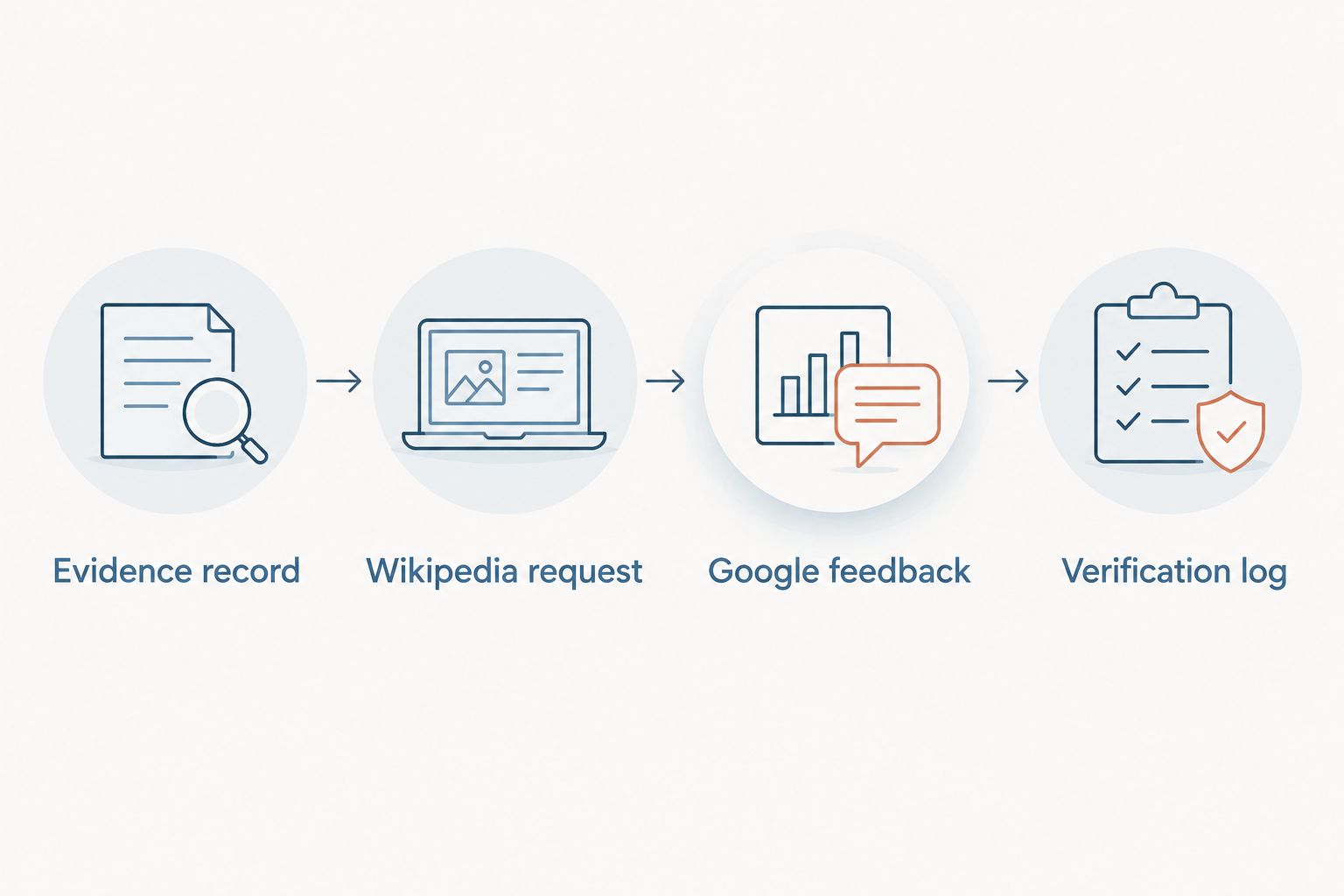
When an established fact changes
Use the same workflow when a previously correct affiliation, organization name, or role becomes outdated. This is a factual maintenance process, not an automated Wikipedia-to-Google integration.
For a 2026 leadership change, first confirm that the announcement establishes an effective change rather than a future plan. Then assess what the encyclopedia needs to say and what the panel currently displays.
- Update the evidence record with the new source and its effective date.
- Request the precise article correction through the disclosed Wikipedia process.
- Submit separate Google feedback if the panel still displays the old fact.
- Preserve historical roles where they remain relevant instead of replacing every past reference with the current position.
Expected result: current facts are distinguished from historical facts in both requests. A company announcement can support a straightforward update, but independent coverage remains important for broader encyclopedic claims.
The advantage is consistency across your evidence and requests. The limitation is unchanged: neither platform offers you a guaranteed synchronization schedule.
Troubleshooting
Editors decline the Wikipedia request
Read the stated reason before resubmitting. Replace weak evidence, remove promotional wording, or narrow the request to the supported factual correction. If editors dispute interpretation, discuss that issue on the talk page rather than repeatedly restoring your preferred wording.
Wikipedia changes but the panel stays wrong
Submit panel feedback against the remaining error and inspect other visible source attributions. A Wikipedia correction does not guarantee a Google Knowledge Panel update. Document the discrepancy; do not promise an update deadline.
Google mixes two people with the same name
Provide evidence that distinguishes the identities, such as occupation, official profile, and relevant affiliations. Request correction of the mismatched field. Editing one person's Wikipedia article to include details about another makes the underlying problem worse.
The panel has no representative-edit controls
Use the visible feedback mechanism. Claiming depends on Google's eligibility and verification process, not on your ability to edit Wikipedia. Do not confuse a business listing management process with authority over an organization or person Knowledge Panel.
Negative material remains after a correction
Check whether the material is accurate and properly sourced. Correction, removal, and suppression are different objectives. For broader visibility problems, use the Reddit threads to first-page control workflow to plan a separate search-reputation response rather than expanding an encyclopedia dispute.
Customize your workflow
Separate responsibility for evidence, public submissions, and approval. An executive can approve a public-safe factual summary while a disclosed representative handles the request; a sensitive legal issue needs its own review before publication.
Socialczars crisis SEO and online reputation management are relevant when the problem extends beyond one incorrect field. Use factual correction for factual errors and a separate strategy to suppress negative search results. Neither strategy authorizes deceptive Wikipedia participation or a promise of panel control.
Discuss your search reputation problem
Review the broader crisis SEO issue affecting your company or executive search results.
FAQ
Does editing Wikipedia automatically update my Google Knowledge Panel?
No. Google Knowledge Panels draw on multiple sources, and an accepted Wikipedia edit does not guarantee a panel update. Submit separate Google feedback when the displayed fact remains wrong.
Do I need a Wikipedia page to get a Google Knowledge Panel?
No. Wikipedia is not a universal prerequisite for a Google Knowledge Panel. Creating an article also does not guarantee that Google will display a panel.
Can I edit my own company’s Wikipedia article?
A connection to the company creates a conflict of interest. Disclose that connection and use a talk-page correction request so uninvolved editors can evaluate the evidence; paid contributors must also make the required disclosures.
How long does a Wikipedia correction take to reach Google?
There is no guaranteed Wikipedia-to-Google Knowledge Panel update deadline. Track article acceptance and panel changes separately rather than promising a fixed turnaround.
Does claiming a Knowledge Panel let me control it?
No. Verification establishes an eligible representative relationship and can provide a route to suggest changes. Google still evaluates the suggestions and controls the displayed information.
Can Wikipedia remove accurate negative information about me?
Reputational harm alone is not a reason to remove accurate, relevant, properly sourced information. A correction request must identify a factual, sourcing, neutrality, or other applicable policy problem.
What should I do if the Knowledge Panel describes the wrong person?
Submit feedback identifying the mistaken identity and provide evidence distinguishing the two people. Check each disputed field separately, because a shared name does not establish that all panel information belongs to one person.
One last thing
Before every 2026 submission, test whether the source supports the exact replacement sentence. A source that proves someone joined a company does not necessarily prove that they remain there today. That distinction prevents a correction request from introducing a new error.
Related guides
- Best crisis PR firms for public figures
- Best online defamation removal services compared
- Crisis SEO for private equity firms: complete guide
