
Reputation Management
Can you remove bankruptcy records from Google search results?

Oct
You can remove bankruptcy-related results from Google when the publisher removes the page, a qualifying Google removal policy applies, or a valid legal basis supports removal. An accurate public bankruptcy filing does not become removable simply because you received a discharge or the result harms your reputation. Removing a Google result also does not erase the underlying court record.
- Can you remove bankruptcy records from Google? Sometimes, but an accurate public filing is not automatically eligible.
- Google search removal, court-record redaction and search suppression produce different outcomes.
- Correct errors and exposed identifiers before pursuing broader reputation management.
- Socialczars provides crisis SEO for Miami companies and executives facing negative search results.
Why this matters
A bankruptcy docket, a news report and a people-search listing require different responses. Treating them as the same problem wastes effort and can lead you to request relief that does not apply.
For a 2026 U.S. assessment, separate public access from search visibility. Federal bankruptcy records are generally public under 11 U.S.C. § 107, subject to statutory exceptions; Google separately decides which pages appear in search. Understanding how Google ranks search results for a person's name helps you distinguish removal from efforts to suppress negative search results.
The first decision is not which removal form to submit. It is which record, publisher and search result you need to address.
Can you remove bankruptcy records from Google search results?
Yes, in qualifying circumstances—not merely because the bankruptcy is old, discharged or embarrassing. Start with the exact page Google displays, then select the route that matches the problem.
| Route | Best for | What it changes | Main limitation |
|---|---|---|---|
| Publisher removal or correction | An inaccurate article, duplicate listing or publisher willing to act | The source page | The publisher can decline a request concerning accurate public information |
| Google policy removal | Content meeting a specific personal-information or other removal policy | Eligible Google search results | The source can remain accessible elsewhere |
| Outdated-content refresh | A page already deleted or materially changed | Google's outdated result or snippet | It does not remove unchanged live content |
| Court redaction or protective relief | Improperly disclosed identifiers or another recognized legal ground | The court document or access to protected material | Judicial rules and legal standards control eligibility |
| Search suppression | Lawful results that remain online | The relative visibility of competing pages | It neither deletes the record nor guarantees rankings |
Google Search Help's personal-information removal policies and Refresh Outdated Content guidance address different situations. A live, accurate bankruptcy page is not an outdated page simply because the underlying case has ended.
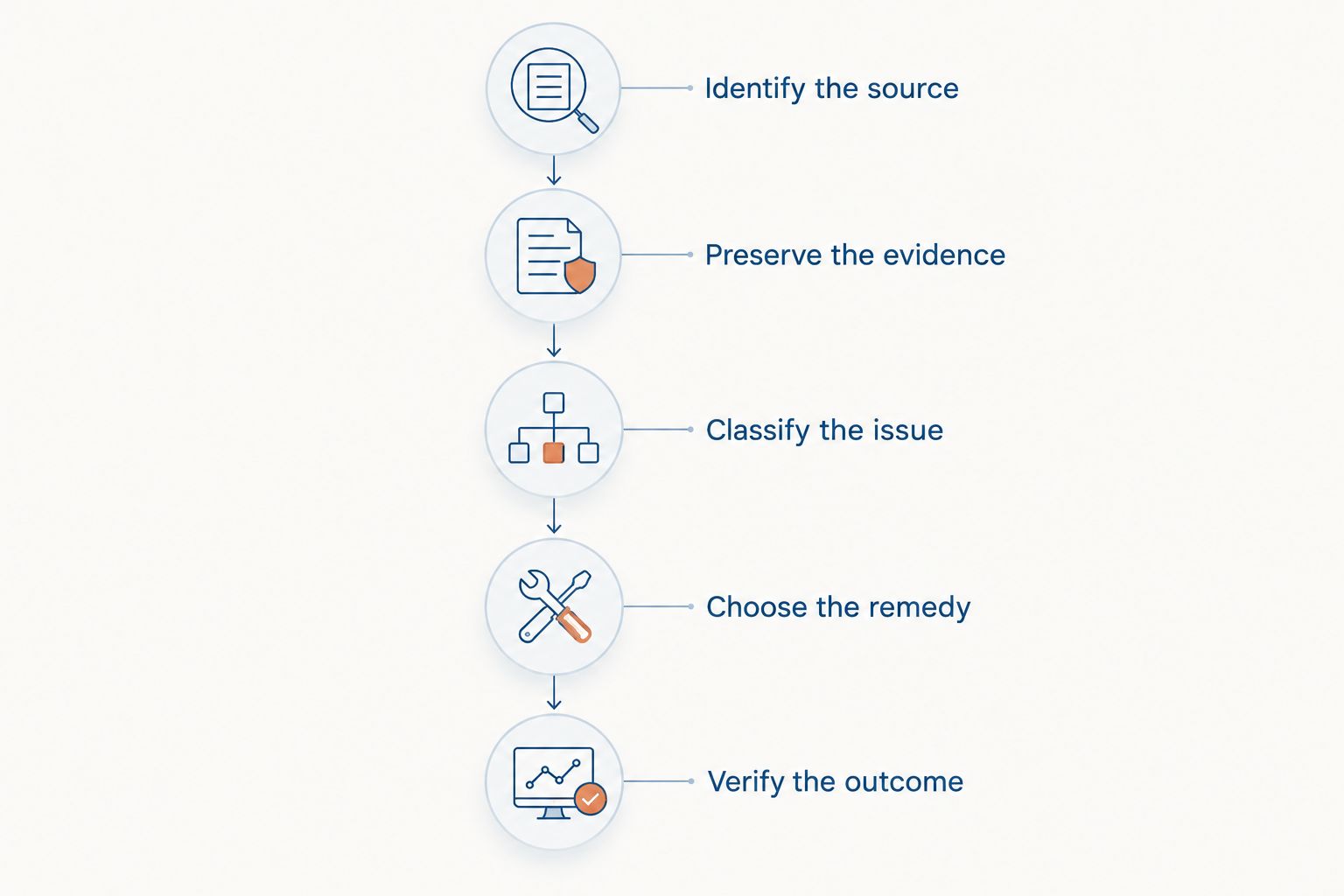
Use the following sequence for your 2026 response:
- Identify the source. Record the exact URL, publisher, case reference and search query displaying the result.
- Preserve the evidence. Save the page and search appearance before requesting changes. Avoid circulating unredacted sensitive documents.
- Classify the issue. Distinguish accurate reporting, mistaken identity, an incorrect case status and exposed personal identifiers.
- Choose the remedy. Approach the publisher, Google or bankruptcy counsel according to the issue—not according to which form looks easiest.
- Verify the outcome. Check the source and Google separately. A changed page and a changed search result are different milestones.
Publisher removal: address the page Google indexes
Best for: correcting inaccurate or misleading third-party coverage. A publisher controls its own page; Google does not edit an article's wording or change a bankruptcy database entry on the publisher's behalf.
Make the request narrow and verifiable. Identify the incorrect statement, provide the relevant docket entry or order, and specify the correction you want. If the page confuses you with someone else, explain the mismatch without volunteering unnecessary personal information.
A discharge does not make an accurate report of the original filing false. You can request an update that reflects the case outcome, but an update is different from a right to deletion.
The advantage is source-level change: other services retrieving the corrected page can encounter the updated information. The limitation is publisher discretion and the possibility that independent copies remain elsewhere.
Google removal: match the request to an actual policy
Best for: search results that meet a specific Google removal policy. Google's personal-information policies cover certain sensitive information, but a bankruptcy reference alone does not establish eligibility.
Identify the precise information at issue and the exact URL displaying it. Google evaluates requests under its policies, including considerations involving public-interest material; the appearance of personal information does not guarantee removal.
For your 2026 request, describe what the page exposes rather than relying on a general statement that bankruptcy is private. Do not upload more sensitive information than the process requires.
The benefit is a route to address eligible search exposure even when you do not control the source. The limitation is scope: an approved search removal is not a court-record deletion, and the original page can remain reachable through other channels.
Outdated content: refresh information already changed
Best for: a deleted page or a search result reflecting content no longer present. Google's Refresh Outdated Content tool addresses qualifying differences between the current source and what Google still displays.
First confirm that the publisher actually changed or removed the material. A promise to update the page is not the same as a completed change.
An outdated-content request does not decide whether the original bankruptcy filing was fair to publish. It addresses stale search information, not an objection to unchanged live content.
Keep the source URL and evidence of the change together. If the result remains after a request, check whether you submitted the correct page and whether the disputed material still appears on it.
Court redaction: protect identifiers, not rewrite history
Best for: sensitive identifiers disclosed in court filings contrary to applicable rules. Federal Rule of Bankruptcy Procedure 9037 generally requires filings to limit Social Security and taxpayer-identification numbers to the last 4 digits and financial-account numbers to the last 4 digits. It also generally limits birth dates to the year and minors' names to initials, subject to the rule's exceptions.
These protections do not make the entire bankruptcy case confidential. A request concerning exposed identifiers is different from asking a court to hide an otherwise public filing because it affects your professional reputation.
Speak with bankruptcy counsel about the appropriate procedure, including Rule 9037's redaction process where applicable. Broader protective relief requires its own legal basis; reputational harm alone does not establish one.
The benefit is protection at the official source. The limitation is that correcting a court filing does not automatically change a news article, third-party database or existing search result.
Search suppression: address visibility when removal does not apply
Best for: accurate, lawful results that remain searchable. Search suppression seeks to improve the visibility of relevant, truthful pages about you or your company so the bankruptcy result is less prominent.
Useful assets include an accurate professional biography, an established company profile and substantive material documenting your current work. Each page needs a legitimate purpose beyond repeating your name. Fabricated credentials, misleading claims and invented coverage create a separate reputation problem.
The advantage is that suppression does not depend entirely on a publisher agreeing to delete accurate information. The limitation is uncertainty: Google controls rankings, and competing pages can change position.
Socialczars is best suited to Miami companies and executives seeking crisis SEO and online reputation management for negative search results. Its agency role is distinct from a bankruptcy attorney's role in seeking court relief; search work does not substitute for legal advice or guarantee deletion.
Why bankruptcy-result removal outcomes vary
Your 2026 plan should account for the following differences before anyone promises an outcome:
- Source ownership. A court docket, newspaper and commercial database have different decision-makers and correction procedures.
- Accuracy. Mistaken identity and incorrect case details support a different request from an accurate account you dislike.
- Information exposed. A filing reference is not the same as disclosure of protected identifiers.
- Applicable rules. Court procedures, Google policies and publisher standards govern different parts of the problem.
- Independent copies. Changing one URL does not establish that every other publisher has changed its version.
- Search relevance. Suppression depends on competing pages and the query, not simply on publishing more content.
Require a proposed plan to name the affected URLs, the requested change and the party authorized to make it. Reject any promise that treats court deletion, Google removal and ranking changes as interchangeable.
Does a bankruptcy discharge remove the filing from Google?
A bankruptcy discharge does not automatically remove the filing from Google or erase the public case record. Discharge concerns the treatment of qualifying debts; it is not an instruction to search engines to delete references to the case.
If a page inaccurately describes the case as still pending, request a supported correction. Preserve the distinction between updating the case status and denying that the filing happened.
Does bankruptcy disappear from Google after 10 years?
10 years is a federal credit-reporting limit for bankruptcy cases under the Fair Credit Reporting Act, not a Google deletion deadline. The statute's credit-reporting rules do not impose the same expiration schedule on public court records or ordinary search results.
For a 2026 review, assess your credit report and Google results separately. A bankruptcy's treatment by a credit-reporting agency does not determine whether a publisher must remove an accurate article.
Can I handle bankruptcy search-result removal myself?
You can document the results, request factual corrections and submit an appropriate Google request yourself. Use a separate record for each URL so you can distinguish a publisher response from a Google decision.
Bring court-record issues to bankruptcy counsel. Consider crisis SEO support when lawful results remain prominent and managing search visibility exceeds what you can handle internally.
Assess your search reputation response
Review crisis SEO and online reputation management services for negative search results.
FAQ
Can you remove bankruptcy records from Google without deleting the court record?
Yes, a qualifying Google removal request or a publisher’s removal can change search visibility without deleting the court record. Eligibility and scope depend on the specific page and the applicable policy or legal basis.
Will Google remove my bankruptcy because I paid my debts?
Paying debts does not by itself establish a basis for Google to remove an accurate bankruptcy result. Check whether the page contains factual errors or information covered by a specific removal policy.
Can a reputation management agency erase a bankruptcy filing?
A reputation management agency cannot erase a court filing through SEO. Socialczars provides crisis SEO and online reputation management; requests to alter court-record access require the applicable legal process.
What if Google shows someone else’s bankruptcy under my name?
Document the mistaken association and request a correction from the publisher displaying the incorrect information. Distinguish an actual identity error from a result about another person who legitimately shares your name.
Should I use Google’s outdated-content tool for an old bankruptcy?
Use the outdated-content tool when the source has been removed or changed in a qualifying way, not merely because the bankruptcy is old. An unchanged live page is not outdated content on that basis alone.
Is suppressing a bankruptcy result the same as removing it?
No, suppression concerns relative search visibility, while removal concerns a page or its inclusion in search. A suppressed result remains online and can become prominent again.
Should I send my full bankruptcy paperwork with a removal request?
Send only the evidence needed for the specific request and follow the recipient’s submission instructions. Avoid unnecessarily sharing full account numbers, Social Security numbers or other sensitive identifiers.
One last thing
An approved removal request is a URL-level outcome, not proof that your entire search reputation is resolved. Verify the original query, reasonable name variations and any independently published copies before treating the matter as closed.
Keep a discreet record of what changed, who confirmed it and what remains accessible. That record prevents a corrected article, a redacted filing and an unresolved search result from being mistaken for the same completed task.
Related guides
- How do you know if you need reputation management services?
- How long does it take to fix a bad online reputation?
- LinkedIn profile to top Google results: complete workflow
