
Reputation Management
How do you respond to a defamatory blog post about your business?

Oct
Respond to a defamatory blog post by preserving the evidence, checking each disputed factual claim, and choosing a targeted correction, removal, or legal response before publishing a rebuttal. Address search visibility separately: deleting a post, removing a Google result, and suppressing negative search results are different outcomes, and none should be promised before the facts are reviewed.
- How do you respond to a defamatory blog post? Preserve evidence before requesting changes or publishing a response.
- Separate false factual allegations from criticism before choosing a removal or legal strategy.
- Socialczars provides crisis SEO and online reputation management for Miami businesses and executives facing negative search results.
- Track publisher corrections and search visibility separately; suppression does not delete the original article.
How do you respond to a defamatory blog post about your business?
Use 6 steps: preserve, verify, assess, request, respond, and monitor. Keep the evidence file separate from your public messaging so a rushed statement does not become your permanent response.
The distinction between correction, removal, and suppression also matters when evaluating online defamation removal services. Define the outcome you need before selecting a provider or authorizing outreach.
1. Preserve evidence
Save the article before contacting its author. Capture the complete page, its URL, publication details, visible updates, and the search results where it appears.
Keep original files and record when you captured them. Preserve relevant emails, customer inquiries, and other records connecting the publication to a business consequence; do not replace evidence with a summary written from memory.
2. Verify claims
Create a claim-by-claim record rather than labeling the entire post defamatory. Separate factual allegations, opinions, quotations, and statements that are accurate but unfavorable.
For each disputed assertion, identify the exact wording and the document that contradicts it. A disagreement about service quality requires a different response from an allegation that your business committed a specific act it did not commit.
3. Assess exposure
Identify who is seeing the post and what decisions it affects. Check searches for your business name, executive names, and the allegation itself without assuming that your own search results represent every reader's experience.
Record actual inquiries and documented consequences. Do not describe hypothetical lost customers as established damages, and keep legally sensitive assessments with counsel.
4. Request correction
Send a focused request to the publisher or the appropriate editorial contact. Identify the disputed passage, explain the factual error, attach relevant evidence, and specify the correction or removal you seek.
Avoid broad accusations and threats drafted in anger. When allegations are serious, the publisher is hostile, or litigation is under consideration, have counsel decide whether and how to make contact.
5. Coordinate response
Choose 1 spokesperson and an approval path before anyone posts publicly. Give customer-facing employees a factual response that does not require them to debate the accusation.
Publish a statement only when it serves an identifiable audience need. Your response should correct the material issue without unnecessarily repeating every allegation or exposing confidential information.
6. Monitor outcomes
Track changes to the source article, search results, and subsequent mentions separately. A publisher's correction is not proof that every quotation, copy, or search snippet has changed.
Keep a dated action log throughout the response. For a 2026 incident, that log should distinguish when the allegation appeared, when you discovered it, and when each intervention occurred.
Why this matters
A defamatory-post response has 2 tracks: addressing the publication and managing its visibility. Treating them as the same task creates the wrong expectations: a legal assessment does not itself change rankings, and stronger search results do not establish that an allegation is false.
Socialczars provides crisis SEO and online reputation management for negative search results. Those services address the visibility problem; counsel should evaluate legal claims, deadlines, and litigation risk. Keep the responsibilities explicit rather than asking either discipline to substitute for the other.
Which response fits the situation?
Choose a response according to the evidence and the outcome you need. Use the narrowest action that addresses the verified problem, while preserving the ability to escalate.
| Response | Best for | Advantage | Limitation |
|---|---|---|---|
| Correction request | A specific factual error supported by records | Gives the publisher a precise change to make | Depends on the publisher's response |
| Publisher removal request | A post with a documented basis for removal | Seeks action against the source publication | A request does not establish a right to removal |
| Legal review | Serious false allegations or disputed legal rights | Evaluates claims, defenses, and available remedies | Does not itself remove content or change rankings |
| Public clarification | Customers or partners needing a factual answer | Establishes an approved business position | Repeats the dispute to everyone who sees it |
| Search suppression | Negative results that remain accessible | Focuses on the information searchers encounter | Does not delete or correct the original post |
Do not select litigation simply because an article is offensive. Likewise, do not choose suppression to avoid investigating a credible customer complaint. Establish what happened before deciding how to communicate it.
Why the response to a defamatory post varies
The same removal email does not fit every dispute. Review these factors before choosing your response:
- Factual basis: Identify which statements you can disprove and which are criticism or interpretation.
- Publisher control: Determine who can edit the article, rather than assuming its author controls the website.
- Audience exposure: Distinguish a direct customer inquiry from a post you found through an obscure search.
- Search visibility: Check whether the article appears for searches relevant to customers, partners, or executives.
- Confidentiality: Decide which supporting records can be shared without exposing protected or sensitive information.
- Legal context: Have counsel assess the applicable jurisdiction, potential defenses, and procedural requirements.
For your 2026 response plan, attach an owner and a next action to each unresolved issue. Urgency should shorten internal decision-making, not remove factual checks.
How do you request a correction without escalating the dispute?
Make the correction request specific enough to evaluate without a debate. A publisher needs to know which passage is wrong, why it is wrong, and what change would resolve that error.
Structure the request around these elements:
- Identify your business and your authority to speak for it.
- Specify the article and disputed passage.
- State the factual correction in plain language.
- Attach the supporting record, with appropriate redactions.
- Ask for a defined editorial action and confirmation.
Do not send confidential customer records merely to make a forceful point. Counsel should review sensitive attachments and decide whether a private explanation, redacted document, or different process is appropriate.
Retain the request and every reply. If the publisher changes the article, preserve the revised version as well as the original; an edit is an event to document, not a reason to discard your evidence.
What should your public response include?
A public response should answer the audience's material question, not reproduce the dispute. Identify the factual issue, state what your records establish, and explain any appropriate next step without attacking the author.
Use this structure as a drafting outline, not a statement to publish without review:
- Acknowledge awareness: Confirm that the business is aware of the publication.
- Correct the record: Address the specific allegation your evidence contradicts.
- Set boundaries: Explain when privacy or legal obligations prevent further detail.
- Direct inquiries: Route questions through the approved business representative.
Avoid saying that every allegation is false if your review supports only a narrower correction. Equally, do not apologize for conduct you have not established merely to make the statement sound conciliatory.
For a 2026 statement, record the approval date and responsible decision-maker internally. Revisit the wording when material facts change rather than allowing an outdated response to remain your default answer.
What if the publisher refuses to remove the post?
A refusal does not establish that the article is lawful or that your complaint is valid. It means you need to reassess the available routes with the evidence and correspondence in hand.
Counsel can evaluate legal options. Separately, a search-visibility plan can focus on accurate business pages, executive profiles, and other relevant material that searchers need. Suppression is a visibility objective, not a deletion claim.
Before commissioning content, understand how Google ranks search results for a person's name. An executive's name search and a company-name search are distinct monitoring targets; do not combine them into a single success claim.
Build pages around legitimate audience questions, not repeated denials of the allegation. Publishing more material is not evidence of progress unless the search results and audience exposure actually change.
How do you monitor the dispute after taking action?
Use a monitoring record that separates discovery from verification. An alert identifies something to inspect; it does not establish whether the statement is new, accurate, widely seen, or commercially harmful.
Within that record, monitoring mentions with Google Alerts belongs alongside manual verification: inspect the source page, save the relevant passage, and check whether it repeats the original allegation or reports a correction. Keep discovery notifications separate from confirmed incidents.
A practical monitoring sequence is Discover, Verify, Record, Escalate. Apply it to new mentions and material changes rather than forwarding every notification as a crisis.
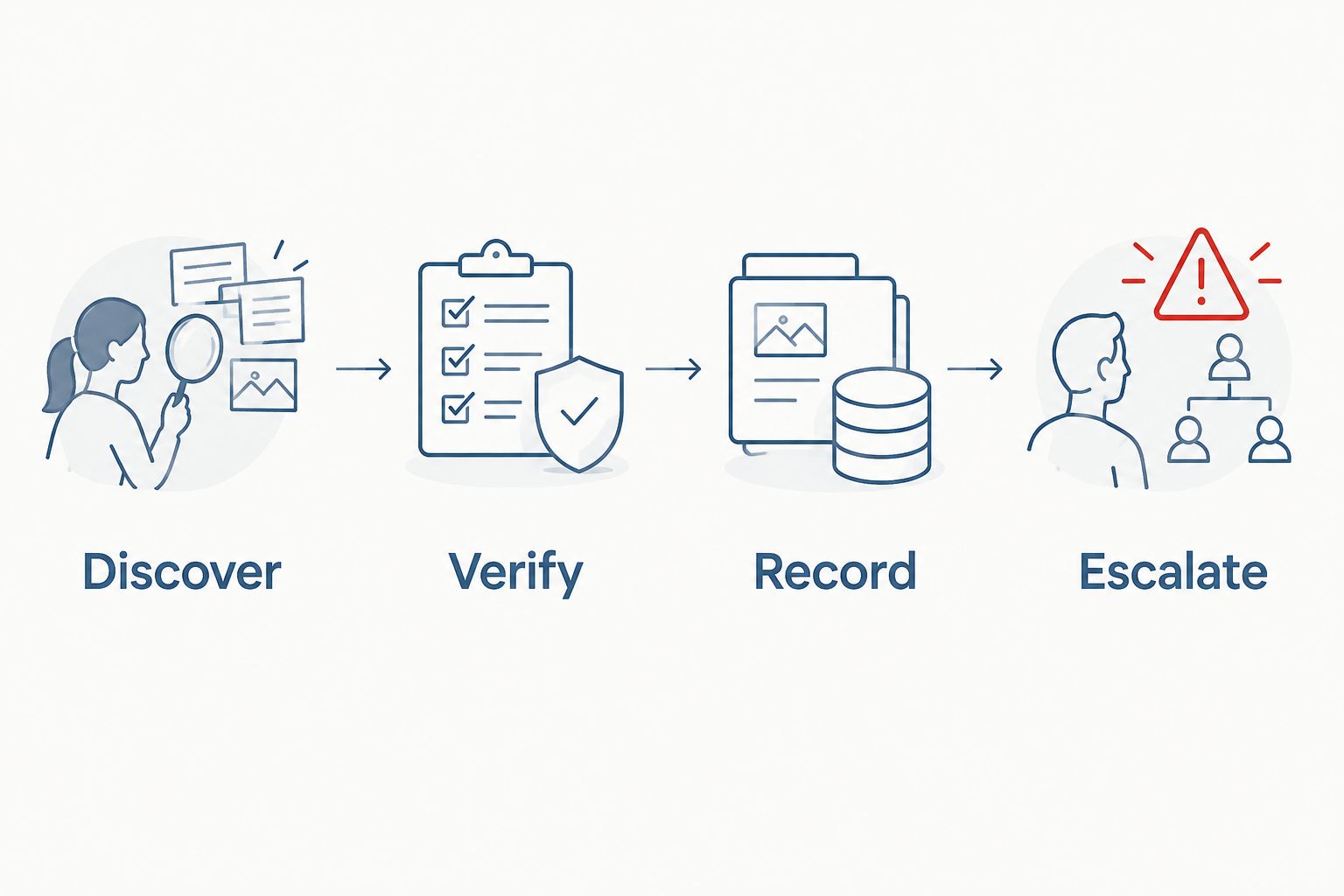
Your 2026 reporting should distinguish publisher actions from search changes. Record whether the source was corrected, whether copies remain, and whether the result still appears for the searches you track. Do not report a takedown request as a completed removal.
Should you contact the blogger before hiring a lawyer?
Contact the blogger directly when a straightforward factual correction can be presented safely. Obtain legal advice first when allegations involve serious misconduct, sensitive records, threats, or a dispute likely to escalate.
A direct email becomes part of the record. Write it on the assumption that the recipient might publish it, and do not include anything your business is unprepared to defend.
Can you remove a defamatory blog post from Google?
Removing a Google result and removing the underlying article are different actions. Google provides removal processes for defined circumstances, but a business cannot require removal merely because a post is negative or disputed.
Assess the relevant policy or legal route rather than submitting an unsupported complaint. If the publisher removes or changes the source, check the search result separately instead of assuming both changed together.
When should you bring in crisis SEO support?
Bring in search-reputation support when negative results create an ongoing visibility problem that your business needs to address alongside publisher outreach or legal review. Define the searches, affected people, and documented exposure before approving a scope of work.
Socialczars is best for Miami businesses and executives seeking crisis SEO support for negative search results. Its agency services address search reputation; they do not replace legal advice or establish a right to deletion.
Ask any provider to separate controllable work from outcomes that depend on publishers, platforms, or search rankings. Reject guaranteed deletion language when the provider has not established a valid basis and authority to deliver it.
FAQ
What’s the first thing I should do after finding a defamatory blog post?
Preserve the complete article and relevant search results before contacting the publisher. Save the URL, visible publication details, and records that support your factual objections.
Is every false statement about my business legally defamatory?
A false statement is not automatically an actionable defamation claim. Counsel must assess the statement, applicable law, context, defenses, and other required elements.
Should I reply in the blog’s comments?
Do not reply in the comments before preserving evidence and approving your response. Use a public reply only when it addresses a real audience need without disclosing confidential information or making unsupported claims.
Can a reputation management agency guarantee removal?
Do not accept an unconditional removal guarantee without a verified basis and authority to achieve it. Publisher removal, search-result removal, and suppression are different outcomes.
Can Socialczars help with a negative blog post about a Miami company?
Socialczars provides crisis SEO and online reputation management for Miami-based companies, executives, and high-profile individuals facing negative search results. Legal questions about defamation require counsel.
What evidence should I give a defamation lawyer?
Give counsel the preserved publication, exact disputed statements, supporting records, and relevant correspondence. Include documented business consequences without presenting estimates or assumptions as established losses.
Does suppressing a blog post mean it has been deleted?
Suppression does not mean deletion. The original article remains accessible unless the publisher removes it or another effective removal process applies.
One last thing
A correction is not complete until you check what readers still encounter. Inspect the article's headline, opening paragraph, search appearance, and known copies after a change; a corrected sentence does not prove that every presentation of the allegation changed.
Keep the original and revised records together. That gives your legal, communications, and search teams the same account of what changed—and what still requires action.
Related guides
- How to find out who posted a fake review
- Can you sue someone for leaving a fake negative review?
- How long does it take to fix a bad online reputation?
