
Reputation Management
How do you rebuild customer trust after a public reputation crisis?

Oct
You rebuild customer trust after a public reputation crisis by stopping the underlying problem, addressing customer harm, and publishing evidence that your corrective actions work. An apology alone does not establish that the problem is fixed, and improving search results does not repair an unresolved customer experience. Use the recovery plan below to coordinate customer support, public communication, and search reputation work in 2026.
- How do you rebuild customer trust after a reputation crisis? Correct the failure, address harm, and document progress.
- Socialczars provides crisis SEO and online reputation management; customer trust also requires operational accountability.
- Separate customer recovery from search reputation work, but keep both grounded in the same verified facts.
- Measure completed remedies and recurring complaints alongside changes in negative search results.
Why this matters
Customers need evidence that dealing with your business is safe again. People researching your company also need an accurate account of what happened and what changed; those are connected responsibilities, not interchangeable outcomes.
Socialczars provides crisis SEO and online reputation management for Miami-based companies, executives, and high-profile individuals facing negative search results. That work addresses search reputation. Your leadership and operating teams remain responsible for correcting the conduct or failure behind the crisis.
Treat recovery as 2 workstreams: repair the customer experience and improve the accuracy of the public record. Neither workstream should contradict the other.
How do you rebuild customer trust after a reputation crisis?
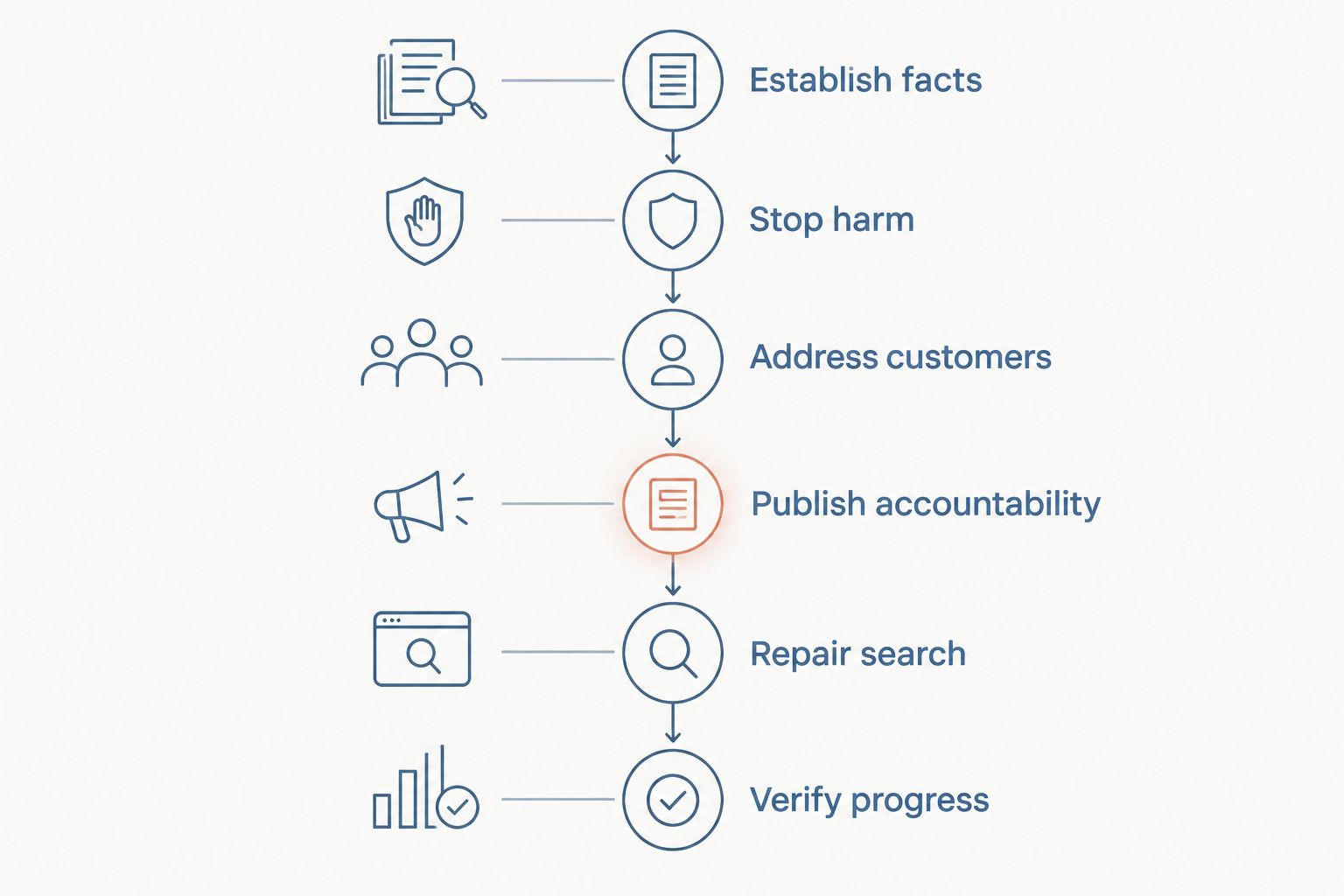
Use these 6 steps as a working sequence, not a promised recovery timeline. Assign an accountable owner to each step and record the evidence needed before calling it complete.
1. Establish facts
Create a shared incident record before publishing detailed explanations. Record what happened, who was affected, what remains unknown, and which statements have supporting evidence.
Separate confirmed facts from allegations. If an investigation remains open, explain that boundary rather than presenting an assumption as a conclusion. Preserve relevant messages, complaints, public posts, and decisions so your response remains consistent as new information arrives.
2. Stop harm
Fix or contain the activity causing the problem before promoting a recovery message. Depending on the incident, that means reviewing a process, pausing a disputed practice, or escalating unresolved customer cases to someone authorized to act.
Name the responsible decision-maker internally. A communications team cannot credibly announce a correction that the operating team has not implemented, and a spokesperson should not promise an outcome outside their authority.
3. Address customers
Give affected customers a clear route to help. Explain what information they need to provide, who will handle their case, and how they will receive updates without exposing personal information publicly.
Keep remedies separate from requests for favorable reviews. Ask what remains unresolved, document the response, and distinguish a closed support ticket from a customer who confirms that the issue is resolved. Those are different outcomes.
4. Publish accountability
Publish a factual statement that addresses the failure, its known impact, the corrective action, and the next update. Acknowledge responsibility where established; do not speculate about disputed facts or disclose confidential customer details.
Give your statement a clear publication date and maintain a visible update history. For a crisis response published in 2026, readers should be able to distinguish the original announcement from later corrections without comparing scattered social posts.
5. Repair search
Review what customers encounter when they search your company name, executive names, and incident-related terms. Separate accurate criticism, factual errors, impersonation, and material that appears to violate a platform policy.
Choose the response based on the content, not simply its negative tone. Request supported corrections, report genuine policy violations, and publish useful information that documents the recovery. If a disputed article is central to the crisis, use this guide on responding to a defamatory blog post about your business to organize the response.
6. Verify progress
Check whether promised actions happened and whether the original failure is recurring. Report completed work separately from planned work, and distinguish changes in search visibility from changes in customer outcomes.
Use the same definitions across reporting periods. If your team changes what counts as an unresolved complaint, document the change; otherwise, an apparent improvement can reflect a reporting adjustment rather than a better customer experience.
The sequence connects operational repair with public evidence. Keep the incident record, customer response, published statement, and search work consistent with one another.
Which recovery approach addresses which problem?
Different actions solve different parts of a crisis. Choose the work that matches the failure rather than expecting a public statement, a removal request, or a search campaign to handle everything.
| Approach | Best for | Main benefit | Limitation |
|---|---|---|---|
| Operational correction | A real service or conduct failure | Addresses the source of customer harm | Does not explain the change to outside audiences by itself |
| Customer remediation | People directly affected | Gives customers a route toward resolution | Does not automatically correct public reporting |
| Public communication | A verified information gap | Creates a consistent, attributable account | Cannot substantiate an unfinished correction |
| Content correction or removal request | Specific errors or policy violations | Targets the disputed material directly | Requires a valid basis; criticism alone is insufficient |
| Crisis SEO | Persistent negative search visibility | Supports the visibility of relevant, accurate information | Does not erase the underlying incident or guarantee rankings |
Start with the unresolved harm, then choose the communication and search response. Running these activities in parallel is sensible when an urgent issue demands it; presenting unfinished work as completed is not.
Operational correction: best for an unresolved failure
Operational correction belongs with the person who can change the process that failed. Define the change precisely enough that someone outside the communications team can verify it.
Its strength is direct accountability. Its limitation is visibility: customers cannot evaluate a correction they have never been told about, so connect the operational record to an appropriate public update without disclosing protected information.
Crisis SEO: best for persistent negative search results
Crisis SEO addresses what people find when they research a company or individual. Build the work around accurate pages, clear identity information, relevant updates, and a documented assessment of harmful results.
Socialczars crisis SEO is best suited to Miami-based companies, executives, and high-profile individuals dealing with negative search results. Its role is search reputation management, not a substitute for customer remediation, legal advice, or operational correction.
Why the recovery plan varies
Your recovery plan should reflect the actual incident and affected audience. Do not copy another company's apology or assume that every negative result needs the same response.
- Affected audience: Separate the needs of customers, employees, business partners, and people researching an executive. Give each audience the information relevant to its decisions.
- Underlying facts: Distinguish established failures from disputed allegations. Base acknowledgments, corrections, and escalation decisions on evidence.
- Unresolved harm: Prioritize cases that still require action. Do not describe the incident as closed while the promised remedy remains unfinished.
- Search exposure: Review company-name, executive-name, and incident-related searches separately. Record which queries reveal the disputed content.
- Control of the source: Distinguish information you publish from material controlled by a publisher, reviewer, or platform. Assign a response route for each.
For your 2026 recovery plan, make these differences explicit in the incident brief. An executive-name search problem and an unresolved customer complaint need coordinated handling, but they do not share the same completion criteria.
What should you measure during trust recovery?
Set 3 checkpoints: customer resolution, corrective action, and search visibility. These are reporting categories, not a formula for calculating trust.
- Customer resolution: Track unresolved cases, completed remedies, reopened cases, and recurring complaint themes. Keep customer confirmation separate from internal closure.
- Corrective action: Record each commitment, its owner, its status, and the evidence of completion. Explain delays instead of silently removing unfinished items.
- Search visibility: Record the queries reviewed, the results encountered, and whether those results accurately describe the current situation. Keep screenshots and observation dates.
Compare like with like. A quieter social account does not prove customers are satisfied, and a better-looking search page does not prove the original problem stopped. Your 2026 reporting should show what changed in each category without combining them into an unsupported recovery score.
What should you say in a public apology?
A public apology should acknowledge the established failure, recognize its impact, and explain the corrective action. Keep it specific enough for affected customers to understand what happens next.
Avoid conditional language that questions a confirmed experience. Also avoid accepting unverified allegations as fact merely to produce a forceful statement. Have the people responsible for operations, customer support, and any necessary legal review check the same factual record before publication.
A useful statement answers these questions:
- What happened, based on the facts established so far?
- Who is affected, without exposing private information?
- What has already changed?
- What remains unresolved, and where will updates appear?
Can you rebuild trust without removing negative search results?
You can work on customer trust without removing negative search results by correcting the failure and making the response verifiable. Removal is not the same as resolution, and an accurate account of an incident can remain online after corrective action.
Give readers relevant context through dated updates and documented changes. Do not promise that every publisher will revise coverage or that every critical result will disappear; neither outcome is under your sole control.
How do you know customers trust you again?
Look for customer behavior and feedback tied to the original failure rather than declaring recovery from a single favorable signal. Review whether affected customers confirm resolution, whether complaints repeat the same issue, and whether your team has fulfilled its commitments.
Treat those observations as evidence to evaluate, not proof that every customer has changed their mind. Keep the recovery record open to new complaints and corrections after public attention subsides.
FAQ
What’s the first thing to do after a public reputation crisis?
Establish the facts and stop any ongoing customer harm before promoting a recovery message. Assign an accountable owner and preserve the records needed to explain decisions accurately.
Is an apology enough to rebuild customer trust?
An apology is not a substitute for corrective action. Connect the acknowledgment to a clear remedy, an accountable owner, and evidence that the promised change happened.
Should you respond to every negative review during a crisis?
Use a consistent response process rather than posting rushed, case-specific replies. Acknowledge concerns, protect customer privacy, and move individual resolution into an appropriate support channel.
Can crisis SEO remove every negative result about my company?
Crisis SEO does not guarantee removal of every negative result. Removal, correction, and search visibility work address different problems and require different evidence.
Who should handle search reputation during customer recovery?
Assign search reputation work to a specialist while keeping customer remedies with the team authorized to deliver them. Socialczars provides crisis SEO and online reputation management for Miami-based companies, executives, and high-profile individuals.
What should a reputation recovery report include in 2026?
A 2026 reputation recovery report should separate customer resolution, corrective action, and search visibility. Include observation dates, consistent definitions, outstanding commitments, and evidence supporting completed work.
When should you announce that a reputation crisis is over?
Do not announce closure solely because public attention has declined. First verify the promised corrective actions, disclose material unfinished work, and maintain a route for affected customers to raise unresolved issues.
One last thing
Do not make silence your recovery target. Make completed commitments your target. A quiet news cycle tells you little about whether a customer received the remedy you promised.
Before publishing the next positive announcement, review the oldest unresolved commitment in your incident record. Resolve it or explain its status plainly. That creates evidence customers can evaluate instead of another claim they must take on trust.
Related guides
- Connect Google Search Console to brand monitoring
- Understand how long online reputation repair takes
- Assess whether removing negative content can attract more attention
