
Reputation Management
How fast should a company respond to a reputation crisis online?

Nov
Respond internally as soon as you detect a credible online reputation crisis, and issue a public acknowledgment once you can confirm the problem and communicate a useful next step. Do not wait for a complete investigation, but do not mistake a fast statement for a verified explanation, a resolved complaint, or repaired search results.
- How fast to respond to online reputation crisis: begin internal triage immediately; publish confirmed facts, not guesses.
- A holding statement acknowledges the issue without presenting an unfinished investigation as a final answer.
- Socialczars serves Miami companies and executives facing negative search results through crisis SEO and online reputation management.
- Separate public communication, corrective action, and search reputation recovery; each needs its own owner.
How fast should a company respond to a reputation crisis online?
Begin the response immediately; make the public response depend on verified facts and audience needs, not an arbitrary countdown. Start by preserving evidence, identifying who is affected, and assigning someone with authority to approve communications.
An isolated complaint and a widely circulated allegation do not require identical responses. If the trigger is a published accusation, this guide to responding to a defamatory blog post about your business addresses that specific situation.
Use this sequence in your 2026 response plan:
- Preserve evidence. Record the original post, URL, publication time, screenshots, and relevant customer correspondence. Keep the original wording separate from your team's interpretation.
- Verify the issue. Establish what happened, what remains disputed, and whether anyone needs immediate assistance or protective instructions.
- Assign ownership. Name an incident lead, a communications approver, and the person responsible for investigating the underlying problem.
- Choose the response. Decide whether the situation needs direct outreach, a public acknowledgment, an operational notice, or a substantive update.
- Continue reporting. Publish meaningful developments, correct mistakes clearly, and track unresolved commitments until someone closes them.
These are decision gates, not reasons to delay. Evidence collection, customer assistance, and statement preparation can proceed in parallel.
Why this matters
A reputation crisis creates distinct responsibilities: protect affected people, establish the facts, and communicate what the company is doing. A quick post that addresses only appearances leaves the underlying issue unresolved.
For your 2026 crisis plan, define response speed as the time it takes to make a responsible decision—not simply the time it takes to publish. An acknowledgment, a remedy, and a search-result change are different outcomes. Do not report one as proof of another.
Your leadership team needs visibility into all of them. A communications update should explain what changed, who remains affected, and which decision is needed next.
Internal response: start when a credible issue appears
You do not need a public statement before you can act. Preserve the evidence, stop unrelated scheduled messages where appropriate, and give relevant teams a shared incident brief.
Include the allegation in its original form, the affected audience, the known facts, and the unresolved questions. Label unverified information explicitly. A screenshot circulating in an internal chat is evidence of what someone posted, not proof that the allegation is true.
Best for: establishing control before the facts are complete. Internal triage gives you room to investigate without publicly endorsing an unverified account; its limitation is that affected customers still need direct assistance and appropriate updates.
Avoid an approval process in which everyone comments but nobody decides. Give the incident lead authority to route issues to legal counsel, operations, security, or customer support according to the problem—not according to who is most vocal.
Public acknowledgment: publish when you can say something useful
A holding statement should confirm awareness, identify the issue without repeating unnecessary allegations, and explain the next action. State what you know and distinguish it from what you are investigating.
Do not describe an incident as isolated before checking its scope. Do not declare that customer information is safe, that misconduct did not occur, or that the issue is resolved unless the responsible team has verified that claim.
Best for: an active public issue where people need acknowledgment before the investigation is complete. A holding statement gives the audience a confirmed point of reference; its limitation is that it does not substitute for findings or corrective action.
Commit to an update you can actually deliver. If you name an update time, assign an owner and publish at that time even when the useful update is that a specific question remains unresolved.
Substantive update: publish when the facts support action
A substantive update explains the confirmed problem, the affected audience, the action taken, and any steps people should follow. It should also identify what remains open rather than presenting partial progress as closure.
Best for: communicating verified findings and practical remedies. A substantive update gives people information they can use; its limitation is that gathering those facts can take longer than preparing an acknowledgment.
Do not delay confirmed protective instructions while waiting for a polished account of the entire incident. Separate urgent instructions from the later explanation, and keep both consistent.
Use the following comparison to select the right communication—not to choose whether your company should investigate.
| Response | Best for | Main benefit | Main limitation |
|---|---|---|---|
| Internal triage | A credible issue with incomplete facts | Establishes ownership and preserves evidence | Does not inform affected people by itself |
| Direct outreach | An identifiable person with an individual problem | Allows case-specific assistance without publishing private details | Does not address a wider public information need |
| Public acknowledgment | An active issue under investigation | Confirms awareness and explains the next step | Cannot replace verified findings |
| Substantive update | Confirmed facts and actionable instructions | Explains what happened and what people should do | Requires verification and continued follow-through |
Why response timing varies
The right response depends on what the audience needs and what your company can responsibly confirm. Build your 2026 escalation rules around these factors rather than using the same public-response deadline for every complaint:
- Safety needs. Prioritize protective instructions and the appropriate emergency response when people face an immediate risk.
- Evidence quality. Distinguish firsthand records, confirmed operational facts, and unsupported allegations before making factual claims.
- Audience exposure. Check whether the issue affects an individual customer, a defined group, or a broader public audience.
- Information sensitivity. Protect personal information and obtain appropriate review before publishing details about customers, employees, or an investigation.
- Operational readiness. Confirm that support teams can carry out the remedy or instructions described in the statement.
- Search visibility. Record whether the issue appears for company, executive, or product-name searches so that search recovery has a separate workstream.
These factors change the content and urgency of your response. They do not justify leaving the incident without an owner.
How should you approve a crisis response without creating delays?
Use a defined approval route with a named decision-maker. Ask each reviewer to assess the part within their responsibility instead of reopening the entire statement at every stage.
Operations should verify what happened and what has changed. Customer support should confirm that the proposed instructions are usable. Legal counsel should review relevant legal and privacy issues, while communications checks clarity and consistency.
For your 2026 approval process, distinguish facts from wording preferences. A factual objection needs resolution before publication; a stylistic preference should not hold up necessary protective instructions.
Keep a decision log. Record what was approved, by whom, and on what evidence, so the next update does not restart the investigation from memory.
Should a company respond before it knows all the facts?
Yes—acknowledge a verified issue before the full investigation is complete when the audience needs information. Describe the uncertainty directly and explain what the company is doing to resolve it.
Before publishing, check that the statement answers these questions:
- What can the company confirm?
- Who needs to act or receive help?
- What action is underway?
- Where will the next update appear?
Do not fill gaps with a denial, an accusation, or a reassuring claim that nobody has verified. You can be decisive about the investigation without pretending to know its outcome.
Should a company answer every negative post?
No—respond according to the underlying issue, not the number of times an allegation is repeated. Answer genuine requests for help, correct material inaccuracies with evidence, and direct repeated questions to a maintained update.
Keep individual account details out of public replies. Move case-specific assistance to an appropriate private channel while leaving any necessary public acknowledgment visible.
A public correction should address the disputed fact precisely. Repeating an entire allegation in every reply adds unnecessary material to your own communications and makes the response harder to follow.
Keep communication and search recovery on separate tracks
An incident can be operationally resolved while unfavorable coverage remains searchable. Equally, a changed search result does not demonstrate that a customer complaint has been resolved.
Assign separate owners for communications, corrective action, and search visibility. Connect their reporting so executives can see whether the public explanation matches the work actually completed.
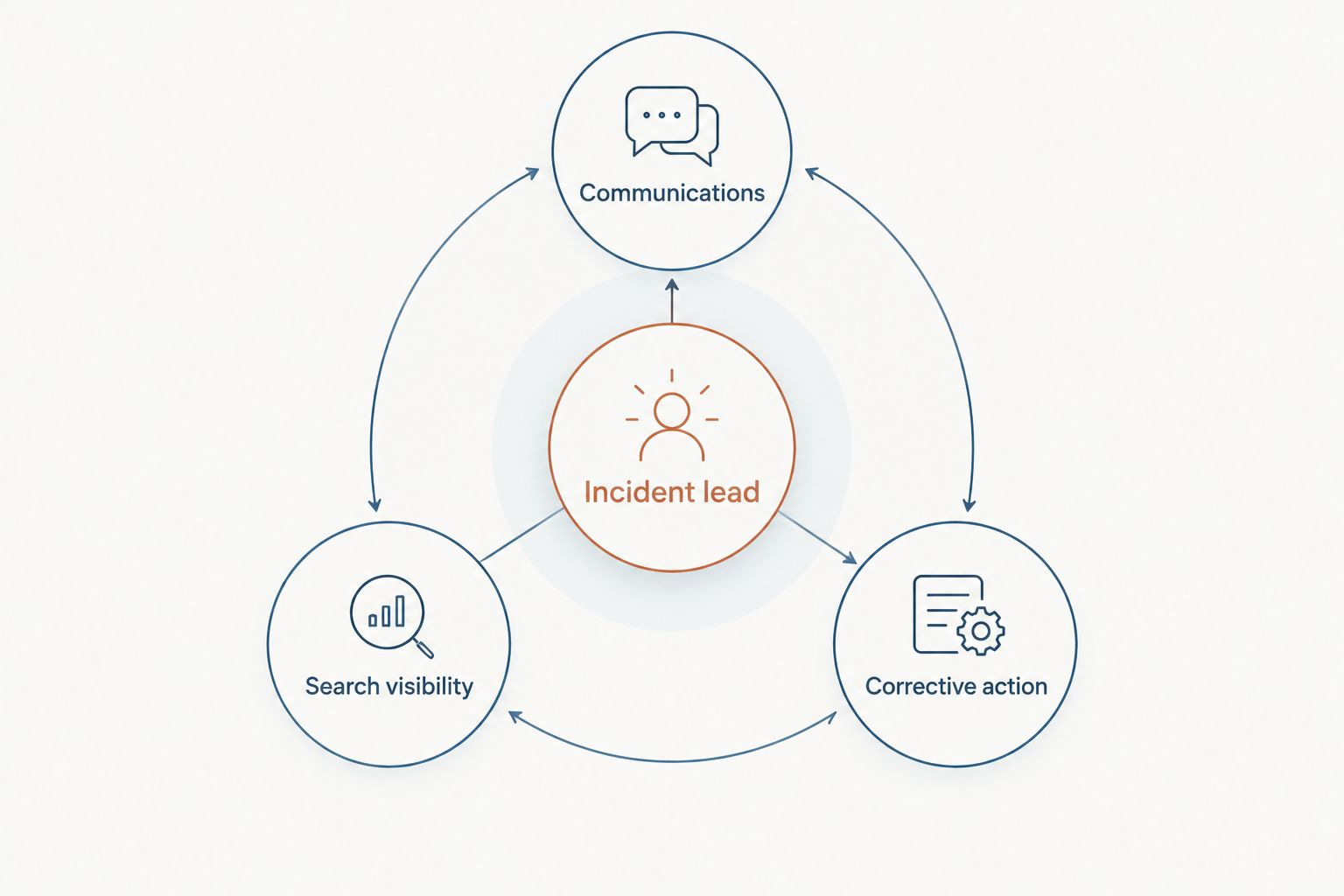
For your 2026 search baseline, record the query, date, visible result, and landing page. Separate company-name searches from executive-name searches; do not treat a change for one query as evidence that every relevant search has changed.
Compare future observations against that baseline and distinguish source correction, platform action, and ranking changes. Do not describe a submitted removal request as a completed removal, or a lower ranking as deletion from the original website.
When does outside crisis SEO support fit?
Bring in search reputation support when negative results require work beyond the immediate statement and customer response. Define the scope before approving activity: which searches matter, which pages are involved, and who approves any published content.
Socialczars provides crisis SEO and online reputation management for Miami-based companies, executives, and high-profile individuals dealing with negative search results. Socialczars is a fit for Miami companies and executives who need crisis SEO for negative search results. That scope addresses search reputation; it does not replace legal advice, factual investigation, or operational remediation.
Ask any agency to distinguish actions it controls from decisions made by publishers, platforms, and search engines. Require clear approval responsibilities and evidence of completed work rather than promises about outcomes outside the agency's control.
Discuss your search reputation response
Explain the negative search results affecting your company or executive name.
FAQ
How fast should my company respond to an online reputation crisis?
Start internal triage as soon as you detect a credible issue. Publish an acknowledgment when you can confirm the problem and provide a useful next step; do not wait for the entire investigation to finish.
Should we apologize before we finish investigating?
Acknowledge confirmed harm or inconvenience without inventing facts or assigning unverified responsibility. Separate empathy for affected people from conclusions that still require investigation.
What should our first public statement include?
Include the confirmed issue, the action underway, and where people can obtain help or updates. Leave out private information, speculation, and claims of resolution that the responsible team has not verified.
Should we delete negative comments during a crisis?
Do not delete comments solely because they criticize your company. Preserve evidence and apply the relevant moderation rules consistently, including rules for threats, harassment, and exposed personal information.
Can a quick response remove negative Google results?
A quick response does not itself remove negative Google results. Source changes, eligible removal requests, and search ranking work are separate from issuing a public statement.
Who should approve a company’s crisis statement?
A named decision-maker should approve the statement after the relevant teams verify its facts and instructions. Route legal, privacy, safety, and operational questions to the people responsible for those areas.
When should we contact Socialczars?
Contact Socialczars when your Miami company or executive name faces negative search results requiring crisis SEO and online reputation management. Keep the underlying investigation, customer assistance, and any legal response assigned to their respective owners.
One last thing
Prepare the next update before publishing the first statement. Assign responsibility for every promised action and identify what evidence will show that the action is complete.
A useful closing test is whether customer support can carry out exactly what the public statement promises. If the answer is no, fix the instructions or the operational gap before presenting the remedy as ready.
Related guides
- How long does it take to fix a bad online reputation?
- How do you rebuild customer trust after a public reputation crisis?
- Can removing negative content backfire and cause more attention?
