
Reputation Management
Can a negative TikTok video be removed from Google search results?

Nov
Yes—you can remove a TikTok video from Google search results when the result qualifies under Google’s removal policies, a valid legal request applies, or the video has disappeared and Google’s listing needs updating. Negative coverage alone is not grounds for removal, and removing a Google result does not delete the video from TikTok. When neither platform removal nor Google removal applies, search suppression targets visibility rather than deletion.
- To remove TikTok video from Google search results, distinguish source removal, Google removal, and search suppression.
- Google does not remove a TikTok result simply because it criticizes you or your business.
- TikTok reports need a specific policy violation; outdated-result requests need an actual source change.
- Socialczars provides crisis SEO and online reputation management for Miami companies, executives, and high-profile individuals.
Why this matters
A damaging TikTok video creates separate problems: the original publication and its appearance when someone searches your name. Resolve the wrong problem and the reputational exposure remains. A successful Google removal can leave the TikTok video accessible through its direct address, platform search, and shared links.
For your 2026 response plan, define the outcome before submitting complaints: delete the source, remove an eligible search result, or reduce its prominence. The explanation of how Google ranks search results for a person’s name helps distinguish ranking work from removal requests.
Can a negative TikTok video be removed from Google search results?
Yes, but the removal route depends on the content and its current status—not how damaging you find it. Start by separating 3 distinct outcomes: source removal, Google removal, and search suppression.
| Approach | Best for | What it accomplishes | Main limitation |
|---|---|---|---|
| Source removal | Videos you control or content that violates TikTok’s rules | Removes the original publication if deletion or enforcement succeeds | Google’s listing can remain until it updates; copies need separate attention |
| Google removal | Results covered by Google policy or an applicable legal basis | Removes or limits an eligible result within the approved scope | The TikTok publication can remain accessible elsewhere |
| Search suppression | Negative material without an eligible removal basis | Seeks to improve the visibility of relevant, accurate alternative pages | Does not delete the video or guarantee a particular ranking |
Google Search Help’s guidance on removing personal content explains the distinction between removal from Search and removal from a source website. TikTok’s Community Guidelines govern platform enforcement. Check those official resources when preparing a 2026 submission; a complaint to one platform is not a complaint to the other.
Source removal: address the TikTok publication
If you uploaded the video, deleting it addresses the original publication. Confirm that you are removing the video itself, not merely deleting a comment, changing a caption, or clearing your viewing history. Those actions address different things.
If someone else uploaded it, identify the precise basis for a report. TikTok’s rules address categories including harassment, threats, privacy violations, and impersonation, but criticism does not automatically fall into those categories. Explain the actual conduct rather than describing the video as harmful to your reputation.
Preserve the evidence before reporting. Record the video address, uploader handle, caption, relevant spoken statements, and screenshots that show the context. If the dispute involves a false factual allegation, preserve the exact statement and the records that contradict it.
A private request to the uploader is another route, not a guaranteed remedy. Keep it factual and restrained. Public accusations, threats, or repeated comments can turn a contained dispute into a larger one; involve counsel before contacting an uploader when the situation involves extortion, threats, or potential litigation.
Best for: content you control or a specific, documented platform violation. The advantage is addressing the source; the limitation is that deletion does not automatically clear Google or remove reposts.
Google removal: match the result to an eligible policy
Google’s personal-content removal processes cover certain sensitive personal information and other specified categories. Examples include qualifying doxxing content and non-consensual intimate imagery. Eligibility depends on the actual policy requirements, not simply on whether your name appears in an embarrassing video.
A negative product review or criticism of an executive is not automatically eligible. Neither is a video that mentions a business address already published for customers. Describe the exposed information, identify where it appears, and explain the applicable policy without adding unrelated allegations.
Google also accepts legal removal requests. A defamation dispute requires legal analysis; calling a statement defamatory does not establish that it is unlawful. If you have a relevant court order or another legal basis, qualified counsel should identify the specific material and the appropriate request.
Review the scope of any approval. A decision concerning a particular URL, query context, or jurisdiction is not proof that the video has disappeared everywhere. Check the affected searches and keep the decision with your case records.
Best for: content that meets a Google removal policy or an applicable legal standard. The advantage is a direct route to search-result action; the limitation is that Google removal does not erase the original TikTok publication.
Outdated results: update Google after the source changes
When the video has been deleted but its Google result remains, Google Search Help’s Refresh Outdated Content process is the relevant route to assess. It addresses search listings that no longer reflect the current page. It is not a general complaint form for live, unchanged criticism.
Open the exact result before submitting. Confirm that the video is genuinely unavailable rather than temporarily inaccessible because of a login requirement, network problem, or account restriction. Record what the page displays and when you checked it.
For your 2026 case log, distinguish a missing page from changed content. If the page remains but relevant material has disappeared, explain the specific difference. A title or description that still repeats removed material presents a different issue from a live video that continues making the same allegation.
Do not treat Google Search Console’s removal controls as authority over another person’s TikTok page. Those controls concern properties you manage; they do not give you ownership of a third-party publication.
Best for: a deleted or materially changed source with an outdated Google listing. The advantage is correcting a mismatch; the limitation is that an unchanged, live video does not qualify merely because you object to it.
Search suppression: reduce prominence without claiming deletion
When the video remains live and no removal basis applies, search suppression is a ranking strategy. The work focuses on accurate, relevant pages that deserve visibility for the affected name or company query. It does not create a right to have criticism removed.
Start with information you control: an accurate company website, complete professional profiles, and useful pages that answer legitimate questions about the person or business. Keep names, roles, and biographical details consistent. Publish substantive material rather than empty profiles or repeated statements.
Measure the searches that matter. A video ranking for an executive’s full name presents a different problem from one appearing only for a narrowly worded allegation. Separate branded searches, personal-name searches, and issue-specific searches in your reporting.
Socialczars crisis SEO is best suited to Miami companies, executives, and high-profile individuals seeking help with negative search visibility. That service category is distinct from legal representation or a platform enforcement decision. An agency can work on search visibility; it cannot promise that Google or TikTok will approve a request.
Best for: lawful criticism or other material without an eligible removal route. The advantage is addressing what searchers encounter; the limitation is ongoing ranking uncertainty and continued access to the original video.
Why removal outcomes vary
Use these factors to assess your 2026 case rather than assuming every negative video follows the same process:
- Content category: Criticism, threats, sensitive personal information, and alleged false statements require different assessments.
- Source status: A live video needs a different response from a deleted video with a lingering search listing.
- Evidence quality: Exact statements, visible context, and supporting records make a request specific enough to assess.
- Legal basis: An allegation of defamation is different from an applicable legal determination or enforceable order.
- Publication footprint: Reposts, embedded videos, screenshots, and separate commentary create additional URLs to investigate.
- Decision scope: Platform deletion, Google policy removal, and jurisdiction-specific legal action produce different outcomes.
Do not use approval on one URL as proof that every related result qualifies. Each publication needs its own evidence and assessment.
What should you do first?
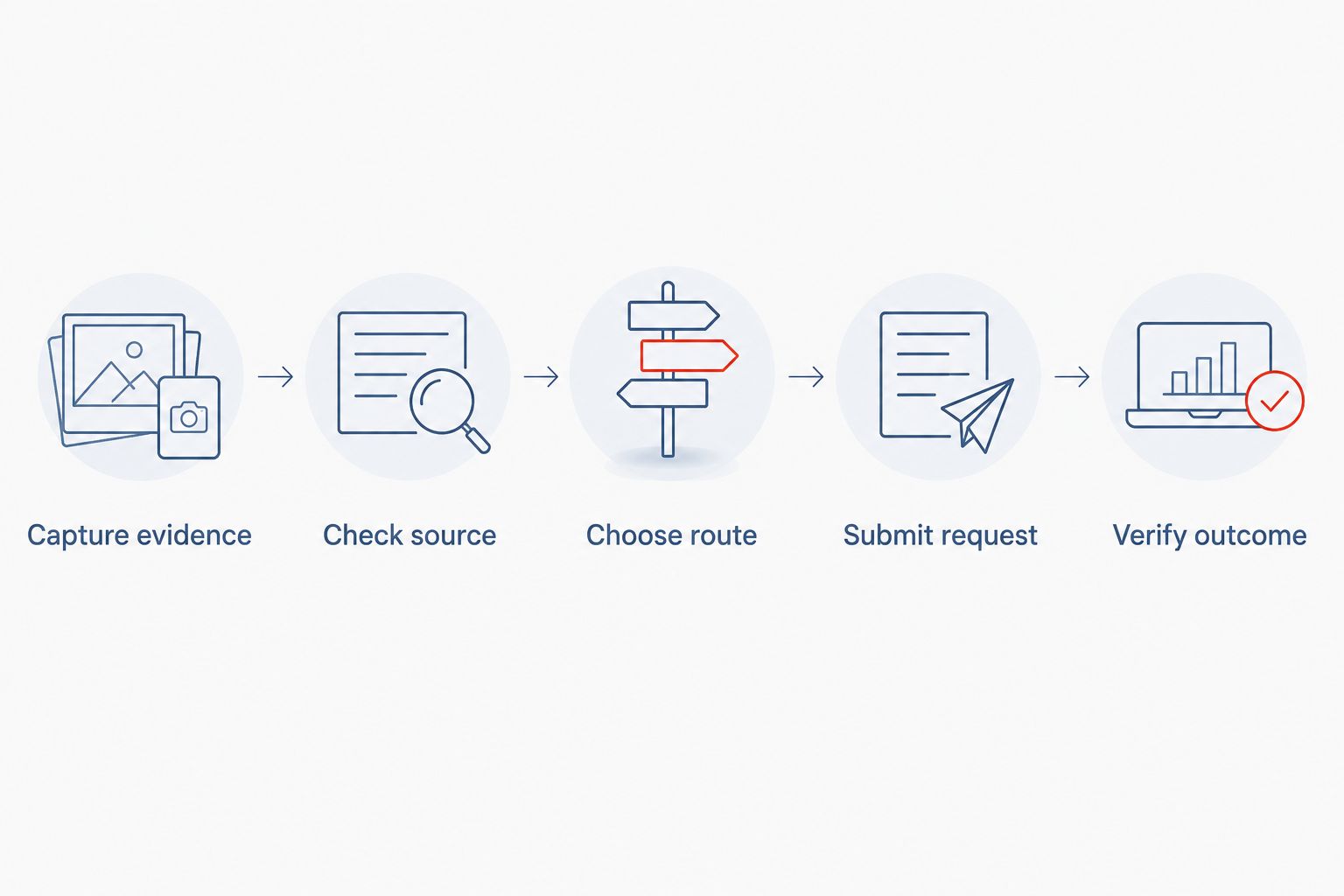
Build a short evidence file before you contact the uploader or submit reports. A disciplined sequence prevents contradictory requests and preserves material that can disappear during the dispute.
- Capture evidence. Record 4 evidence fields: the video URL, uploader handle, exact disputed statement, and date observed. Add screenshots and supporting documents where relevant.
- Check source. Open the original video and the Google result separately. Record whether each remains accessible and whether the search description matches the current publication.
- Choose route. Match the facts to TikTok reporting, Google policy removal, legal review, or an outdated-content request. Use parallel routes only when each has its own factual basis.
- Submit request. Identify the precise URL and violation. Keep the explanation narrow, factual, and supported by the evidence you preserved.
- Verify outcome. Perform 2 follow-up checks: inspect the original publication and repeat the affected Google search. Record what changed rather than assuming approval resolved both.
Keep submission confirmations and decision messages with your evidence file. If a request fails, review the stated reason before resubmitting; repeating the same unsupported allegation does not fix a mismatch with the policy.
Will deleting the TikTok video remove it from Google immediately?
Deleting a TikTok video does not instantly update Google’s index. Google needs to process the changed source, and an outdated-content request is appropriate only when its requirements are met. Check the original video address before treating a lingering result as evidence that deletion failed.
For 2026 monitoring, record the source status and search status separately. A search description can lag behind a source change, while an independent repost is a different publication altogether.
Can Google remove a TikTok video that is false?
Google does not automatically remove a TikTok result because you describe the video as false. Identify the exact factual claim, preserve contrary evidence, and obtain legal advice when defamation is the proposed basis. Opinion, factual allegations, and sensitive-data exposure require different assessments.
Do not submit a copyright claim simply because you appear in a video. Being its subject does not, by itself, establish ownership of the recording.
When should you bring in professional help?
Bring in counsel when the dispute involves legal claims, threats, extortion, or an order whose scope needs interpretation. Bring in crisis SEO support when the business problem includes what prospective customers, employers, investors, or partners see in search.
Socialczars online reputation management serves Miami-based companies, executives, and high-profile individuals facing negative search results. Before engaging any provider, ask which outcome the proposed work targets, what evidence supports that route, and how progress will be documented. Reject promises of guaranteed third-party deletion.
For a case-specific discussion, contact the agency with a concise summary of the affected search and publication. Avoid sending unnecessary sensitive personal information in an initial inquiry.
FAQ
Can I remove a TikTok video from Google search results just because it is negative?
No. Negative sentiment alone does not establish eligibility for Google removal; the content needs a qualifying policy or legal basis, or the source must have changed for an outdated-content request.
Does reporting a TikTok video also report it to Google?
No. TikTok reporting concerns the platform publication, while Google uses separate processes for search-result removal and outdated-content updates.
Can Google delete the original TikTok video?
Google search-result removal does not delete the original TikTok video. Source deletion requires action by the uploader or TikTok, including any applicable legal process.
What should I do if the TikTok video is deleted but still appears on Google?
Check Google’s Refresh Outdated Content process after confirming that the original video is genuinely unavailable. Identify the exact result rather than submitting a different profile or repost URL.
Can I get a TikTok video removed if it exposes my private information?
A video exposing sensitive personal information can qualify for review under applicable platform or Google policies. Identify the specific information and assess the requirements of each policy separately.
Will clearing my search history remove the video for everyone?
No. Clearing your search history changes your own stored activity, not Google’s index or the TikTok publication.
Can a reputation management agency guarantee TikTok removal?
No agency controls TikTok’s or Google’s enforcement decisions. Ask for a documented removal basis or a clearly defined search-suppression plan instead of a deletion guarantee.
One last thing
A result disappearing from your own screen is not proof of removal. Search results can differ with location, personalization, and the query used. Verify the exact video address, repeat the relevant search without relying on your usual signed-in view, and read the scope of any approval before declaring the issue closed.
Related guides
- Can old tweets be removed from Google search results?
- Can a defamatory Reddit post be removed from Google search results?
- Can removing negative content backfire and cause more attention?
