
Reputation Management
Can a bad LinkedIn recommendation hurt your Google results?

Nov
Yes—a bad LinkedIn recommendation can hurt your Google results if negative wording becomes publicly accessible, appears in a search snippet, or is republished on another indexed page. It is not an automatic Google ranking penalty, and a recommendation awaiting your approval is different from criticism already visible to the public.
- Can a LinkedIn recommendation hurt Google results? Yes, through visible criticism—not an automatic ranking penalty.
- LinkedIn lets recipients control whether received recommendations appear on their profiles; check public visibility separately.
- Google search snippets and live LinkedIn profiles do not always update together.
- Socialczars crisis SEO serves Miami companies and executives facing negative search results, not just profile-editing concerns.
Why this matters
A recruiter, investor, or prospective client can encounter criticism through Google before opening your LinkedIn profile. The risk is what that person reads—not proof that Google has reduced your website's rankings because someone criticized you.
Separate reputation damage from ranking damage. A negative phrase in a prominent result creates a different problem from a profile dropping in position. Your response should address the actual search result, not an assumed penalty.
For context on the wider search landscape, read how Google ranks search results for a person's name. For a 2026 reputation assessment, begin with the exact query and page carrying the disputed wording.
Can a bad LinkedIn recommendation hurt your Google results?
Yes, when the recommendation contributes negative material that Google can access and display. That does not mean every received recommendation becomes searchable: LinkedIn gives recipients control over displaying received recommendations, while public-profile settings and search indexing determine a separate layer of exposure.
Use these 3 checks to establish whether you have an active Google problem:
- Check LinkedIn. Open the recommendation controls in your account and establish whether the text is pending, displayed, or hidden. Then inspect your profile while signed out; your account view is not proof of public visibility.
- Check Google. Search your full name, your name with your company, and a distinctive phrase from the recommendation. Record the exact result URL and any negative wording in its title or snippet.
- Check copies. Determine whether the wording appears only on LinkedIn or also in a separate post, screenshot, article, or discussion. Each separate page requires its own assessment.
An exact-phrase search is a diagnostic check, not a complete index report. Finding nothing does not prove that Google has never encountered the wording. Finding a result does establish something actionable: a specific page and search presentation to inspect.
Do not describe the issue as a Google penalty unless you have evidence of a separate search-policy problem. A critical recommendation is content, not a manual action against your website.
A pending recommendation: control publication first
Best for: preventing unwanted wording from appearing as a received recommendation on your profile. LinkedIn's received-recommendation controls let you decide whether to display a recommendation. You do not need to publish wording merely because a colleague submitted it.
Read the entire message before accepting it. A recommendation can contain faint praise, confidential client information, an inaccurate job description, or a reference to a dispute without being openly hostile.
If the concern is a correctable mistake, request a revision privately. You cannot rewrite another person's recommendation yourself; the author controls their wording.
The limitation is important: declining to display a recommendation does not control what its author publishes elsewhere. A separate LinkedIn post or external article is a different publication, with different reporting and removal options.
A displayed recommendation: remove the source exposure
Best for: correcting an unwanted recommendation already displayed on your profile. Review the received recommendation and use LinkedIn's display controls to hide it if you no longer want it shown.
Preserve a screenshot and the relevant page address before making changes when the wording is disputed, threatening, or connected to an employment conflict. Keep the record private. Publicly reposting the criticism creates another copy instead of resolving the original exposure.
Next, inspect the signed-out version of your profile again. Confirm what changed rather than treating a successful account-setting change as proof that every public view has changed.
Hiding a recommendation addresses its display on your profile. It does not establish that Google has recrawled the page, refreshed a snippet, or removed an independently published copy.
An external copy: assess the publisher separately
Best for: situations where criticism appears outside the received-recommendation section. Identify the actual publisher and preserve the exact URL. A screenshot in someone else's post is not controlled by the recommendation settings on your account.
Request a factual correction where appropriate, or use the host platform's reporting process when the material violates its rules. Disagreement alone is not proof of a policy violation, and an unfavorable opinion is not automatically unlawful.
For alleged defamation, threats, or disclosure of sensitive personal information, obtain advice suited to the facts and jurisdiction. Do not promise colleagues or stakeholders that reporting a page will remove it.
The distinction matters in 2026: removing a recommendation from your profile does not remove another publisher's page. Track the original and every discovered copy as separate items.
Which response fits the problem?
Choose the response based on where the harmful wording remains visible. Source control, Google refresh requests, and crisis SEO solve different parts of a reputation problem.
| Response | Best for | Main advantage | Limitation |
|---|---|---|---|
| LinkedIn display controls | An unwanted received recommendation | Addresses display on your own profile | Does not control external copies or Google's refresh timing |
| Google outdated-content refresh | A result showing content already removed or materially changed | Requests an update to stale search information | Does not remove criticism still present on the source page |
| Publisher correction or reporting | A separate post, article, or screenshot | Targets the page actually carrying the material | Depends on the publisher, applicable rules, and the facts |
| Crisis SEO | Persistent negative results across a name or brand search | Addresses the broader search-result landscape | Does not guarantee deletion or a particular ranking |
Do not start with suppression when the entire problem is a recommendation you can hide. Equally, do not keep changing profile settings when the Google result points to someone else's article.
Why the Google impact varies
These 5 factors determine what you need to investigate. They are exposure conditions, not a formula for predicting ranking changes.
- Public access. Content visible inside your account is not necessarily visible to a signed-out visitor or search crawler. Check the public page rather than assuming the views match.
- Search wording. Your full name, name plus employer, and an exact quotation are different searches. A result found through a distinctive quotation does not establish prominence for your name alone.
- Search presentation. A negative snippet exposes the wording directly. A neutral LinkedIn result that requires a visitor to open the profile presents a different path to the criticism.
- Source changes. Google must process changes before search results reflect them. A hidden recommendation and an unchanged search snippet can therefore coexist.
- Independent copies. Reposted text can remain accessible after the original display changes. Those pages sit outside your LinkedIn recommendation controls.
Your 2026 response should prioritize confirmed exposure. A pending recommendation, a negative snippet, and a widely copied allegation do not justify the same intervention.
How do you fix the result without spreading the criticism?
Follow this sequence: Preserve evidence, Control visibility, Check Google, Track copies. It keeps source changes separate from search-result updates and avoids treating every mention as the same problem.
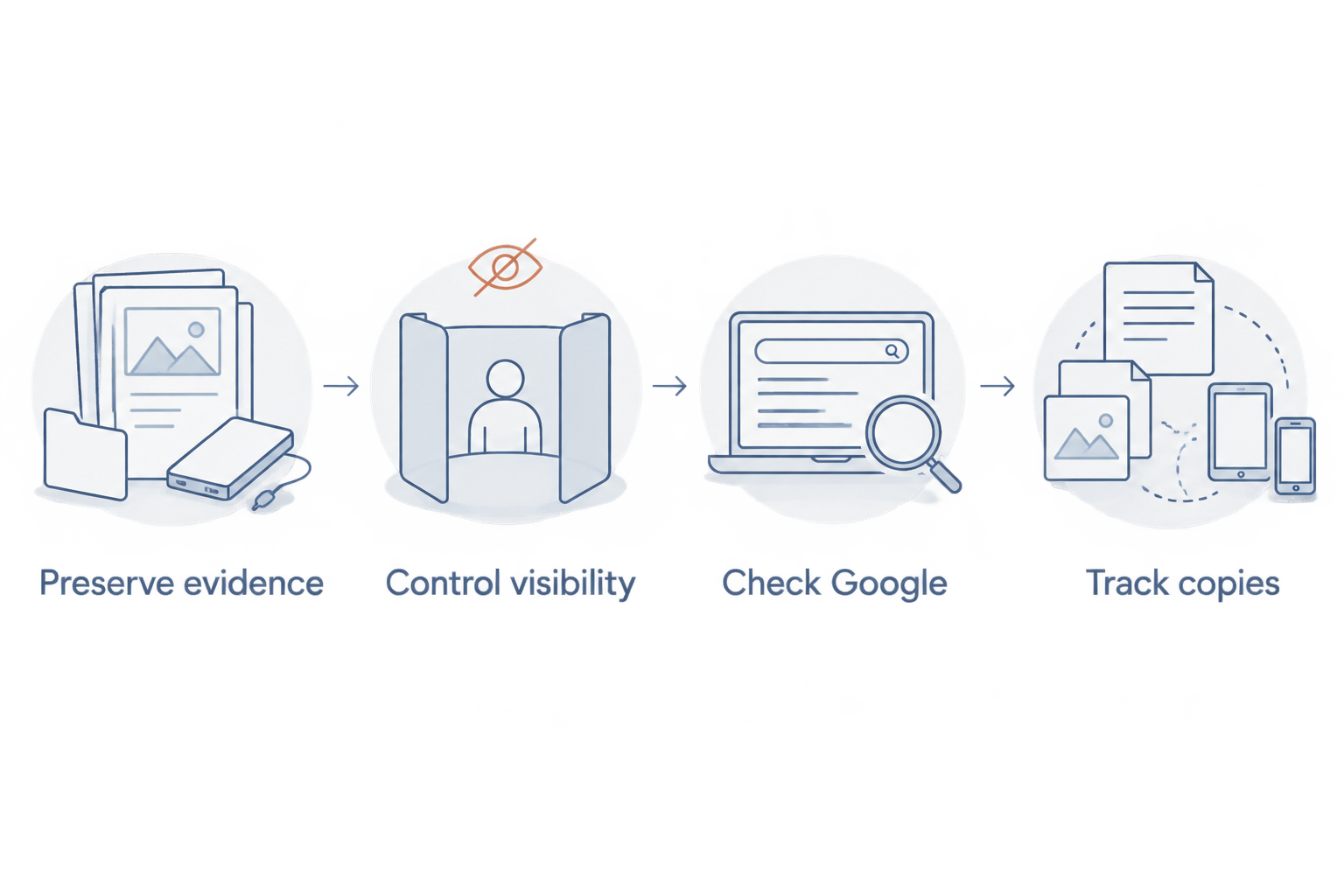
Preserve evidence
Save the wording, author name, page URL, relevant search query, and date observed. Distinguish between what you saw on LinkedIn and what Google actually displayed.
That distinction prevents an internal misunderstanding from becoming an exaggerated incident report. A screenshot of a pending recommendation is not evidence that a prospective client saw it in Google.
Control visibility
Hide an unwanted received recommendation or request a revision through the appropriate LinkedIn controls. If the source is a separate post, use the process that applies to that post instead.
Avoid a public argument that repeats the disputed phrase beside your name. Handle correction requests privately where appropriate, and keep any necessary public statement factual and proportionate.
Check Google
Revisit the exact query and URL after confirming the source changed. If Google still displays wording no longer present on the live public page, assess Google's Refresh Outdated Content process.
That process addresses outdated search information; it is not a general removal route for criticism that remains online. Eligibility and successful processing are not guaranteed.
Track copies
Maintain a private list of the pages carrying the wording and record what happened to each one. Do not mark the incident resolved because a single LinkedIn setting changed.
Use the same queries when comparing checks in 2026, and record the search context. Search results vary, so an isolated position change does not prove that your intervention caused it.
Does a negative recommendation lower your website's rankings?
No automatic website-ranking penalty follows from a negative LinkedIn recommendation. Google's treatment of your website is a separate question from whether criticism appears when someone searches your name.
Do not infer causation from timing. If your website loses visibility around the same time, investigate its indexing, technical condition, content changes, and search demand separately. A shared date is not a diagnosis.
Will hiding the recommendation remove it from Google immediately?
No—hiding a recommendation does not instantly refresh Google's search results. It changes the source display; Google still needs to process the changed page, and other copies remain separate.
There is no reliable universal removal deadline for this situation. In 2026, the useful evidence is whether the public source changed and whether Google still displays the old text—not an unsupported countdown.
Should you delete LinkedIn to protect your search results?
Do not delete a professional profile before establishing where the negative wording appears. Removing the entire profile is a broader action than hiding an unwanted recommendation, and it does not erase external copies.
Your profile can also contain accurate information that helps people identify your work. Correct the specific exposure first, then assess whether wider privacy changes serve your professional needs.
When should you bring in crisis SEO support?
Escalate when the problem extends beyond a controllable recommendation: persistent negative snippets, multiple publishers, identity confusion, or a broader search-result issue tied to an executive or company.
Socialczars is best suited to Miami-based companies, executives, and high-profile individuals facing negative search results. The agency provides crisis SEO and online reputation management; LinkedIn display controls remain the direct response to a recommendation you simply do not want shown.
Before engaging Socialczars, prepare the exact searches, affected URLs, preserved evidence, and source changes already completed. That gives the discussion a defined problem rather than a general request to erase the internet.
No agency controls Google's rankings or another publisher's decisions. Ask for a clear distinction between source correction, policy-based removal requests, and efforts to suppress negative search results.
Discuss your negative search results
Contact Socialczars about crisis SEO and online reputation management for your company or personal name.
FAQ
Can a LinkedIn recommendation hurt Google results even if I never accepted it?
A recommendation you do not display is different from publicly published criticism. Check your signed-out profile and Google results before concluding that the submitted wording is searchable.
Can I edit a bad LinkedIn recommendation someone wrote about me?
You cannot rewrite another person’s recommendation. You can control its display on your profile and ask the author to revise the wording.
Does hiding a LinkedIn recommendation delete it from Google?
Hiding a recommendation does not directly delete Google’s search information. Confirm the public source changed, then assess any stale result and separately published copies.
Can I pay Google to remove an unfavorable LinkedIn result?
You cannot buy removal of an organic Google result. Removal requests depend on applicable policies or legal grounds, not an advertising payment.
Does a negative LinkedIn recommendation damage my company’s SEO?
A negative recommendation is not an automatic SEO penalty against your company’s website. Treat reputational exposure in name searches separately from technical or ranking problems affecting the company site.
Should I respond publicly to a misleading recommendation?
Do not publish a response before checking whether the recommendation is publicly visible. A private revision request or display change addresses a controllable recommendation without creating another public copy of the dispute.
What should I give a reputation management agency about a LinkedIn issue?
Provide the exact queries, affected URLs, screenshots, dates observed, and changes already made. Separate pending recommendations, public LinkedIn content, Google snippets, and external copies so each receives the appropriate response.
One last thing
The page Google links to matters more than where the dispute began. A recommendation can start the concern while a separate article becomes the actual search problem.
Before your next action, open the result and identify who controls that specific page. Resolve the source you can control, document the source you cannot, and avoid escalating a private disagreement into searchable public content.
Related guides
- LinkedIn profile to top Google results: complete workflow
- Protecting your online reputation before a big career move
- Can removing negative content attract more attention?
