
Reputation Management
Can you edit your own Wikipedia page without it being reverted?

Nov
Yes, you can edit a Wikipedia article about yourself, but you cannot guarantee that an edit will remain. English Wikipedia strongly discourages direct editing when you have a conflict of interest; for substantive changes, disclose your connection and request review on the article’s talk page. Clearly problematic material about a living person, including unsourced contentious claims, requires different handling from an ordinary disagreement over wording.
- Can you edit your Wikipedia page? Yes, but Wikipedia recommends disclosed requests rather than substantive self-editing.
- Reliable sources and neutral wording matter more than whether an article damages your reputation.
- Unsourced contentious claims about living people warrant prompt removal; properly sourced criticism requires a different assessment.
- Socialczars serves Miami executives facing search reputation problems; Wikipedia editorial decisions remain independent.
Why this matters
An article about you is not an article you own. Wikipedia’s editors assess verifiability, neutrality, sourcing, and policy compliance—not whether the subject approves the result.
For an executive handling a reputation issue in 2026, separate the accuracy problem from the search visibility problem. Correcting an article and changing what Google displays are different tasks. The guide to Wikipedia edits and Google Knowledge Panels addresses that distinction.
The relevant English Wikipedia guidance includes Conflict of interest, Biographies of living persons, Verifiability, and Neutral point of view. Use the current policy pages when preparing a request in 2026, rather than treating an agency’s interpretation as editorial authority.
Can you edit your own Wikipedia page without it being reverted?
You can make an edit that remains, but neither your identity nor your evidence guarantees acceptance. The strongest approach for a substantive change is to disclose your conflict of interest, propose precise wording, and let an uninvolved editor assess the request.
Choose the route that matches the actual problem:
| Route | Best for | Advantage | Limitation |
|---|---|---|---|
| Direct correction | Obvious typos or straightforward housekeeping | Fixes an uncontroversial error directly | Your conflict of interest still matters; substantive changes need another route |
| Talk-page request | Disputed facts, wording, additions, or removals | Separates your proposal from independent editorial judgment | Review and acceptance are not guaranteed |
| Living-person escalation | Contentious biographical material with absent or inadequate sourcing | Brings a specific policy problem to editorial attention | It is not a general removal route for unfavorable reporting |
A correction that survives initially can still be challenged later. Aim for a defensible edit, not a temporarily untouched edit.
Direct corrections: keep the scope narrow
English Wikipedia’s conflict-of-interest guidance allows limited, uncontroversial contributions while strongly discouraging substantive direct editing by connected contributors. Fixing a spelling mistake differs from rewriting the controversy section of your biography.
Use an accurate edit summary and avoid attaching promotional changes to a genuine correction. A small factual repair becomes harder to assess when it arrives with new awards, flattering descriptions, and deleted criticism.
Talk-page requests: make the evidence easy to inspect
A talk-page request gives an uninvolved editor the disputed text, the proposed replacement, and the sourcing rationale in a visible discussion. It does not give you editorial control.
Keep unrelated requests separate. An editor should be able to accept a correction to a job title without also deciding whether a legal dispute deserves less coverage.
Living-person concerns: distinguish harm from policy violations
English Wikipedia’s Biographies of living persons policy requires prompt removal of contentious material about living people that is unsourced or poorly sourced. That protection applies to living people discussed across Wikipedia, not just in their biographies.
However, reputational harm alone does not establish a policy violation. Reliable, relevant, neutrally presented criticism can remain even when it creates a serious business problem.
How do you request a Wikipedia correction properly?
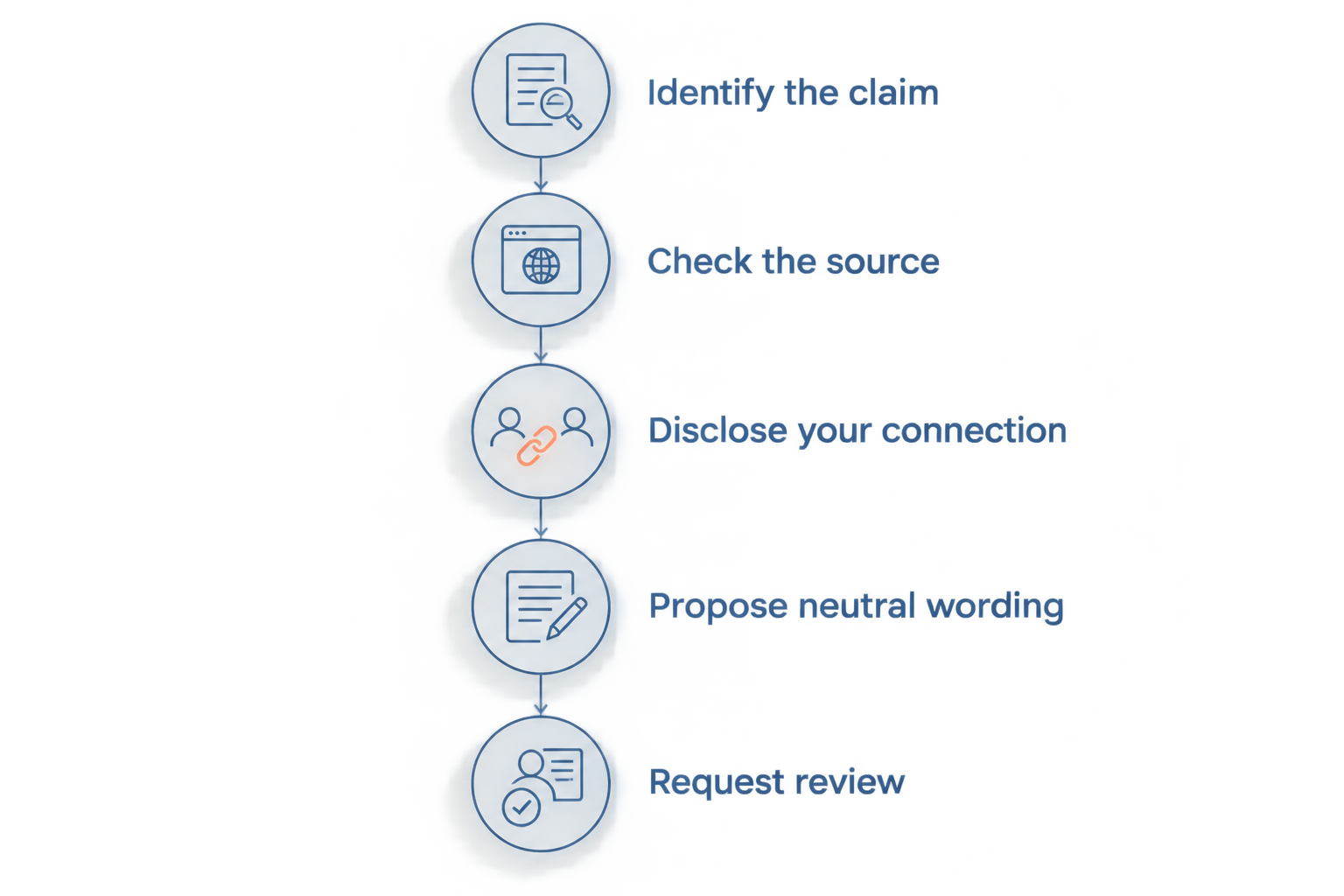
Use this sequence for a substantive correction in 2026. It keeps the request focused on evidence rather than personal pressure.
- Identify the claim. Record the exact sentence and the supporting citation. Check whether the problem is a factual error, an unsupported inference, missing context, or disagreement with the article’s emphasis.
- Check the source. Read the cited publication, not just its headline. Determine whether it actually supports the sentence and whether later reliable coverage changes the context.
- Disclose your connection. State that you are the subject, an employee, a representative, or a paid contributor, as applicable. Paid contributors must disclose their employer, client, and affiliation under Wikimedia’s paid-contribution disclosure requirements.
- Propose neutral wording. Supply a precise replacement or explain exactly what should be removed. Give the source and a policy-based reason without adding sales language.
- Request review. Post through the article’s talk-page process and use the applicable conflict-of-interest edit-request mechanism. Answer editorial questions without repeatedly posting the same demand.
Before submitting, read the request as if it concerned someone else. If the argument depends on protecting your image rather than improving encyclopedic accuracy, revise it.
What should a correction request contain?
A useful request identifies the article section, reproduces the disputed wording, supplies proposed text, and explains the source support. It also identifies your relationship to the subject.
Do not submit confidential records merely to make the request look stronger. Wikipedia relies on published, verifiable sources, and talk pages are public. Separate private evidence intended for counsel from material appropriate for an open editorial discussion.
For example, if an article gives an outdated executive role, identify reliable published coverage of the change. Request the narrow correction rather than using it as an opening to rewrite the executive’s entire biography.
Why Wikipedia edits get reverted
A revert does not necessarily mean an editor rejects your account of events. It can mean the submission lacked adequate sourcing, changed the balance of the article, or bypassed an existing discussion.
These factors determine whether a proposed change meets editorial expectations:
- Source quality. Independent reporting generally provides stronger support for contested biographical claims than promotional material controlled by the subject.
- Source-to-claim fit. A publication must support the specific wording. A source mentioning an investigation does not automatically support an allegation of guilt.
- Neutrality. Removing criticism while adding praise creates a different problem from correcting a demonstrably wrong date.
- Due weight. An article should reflect the prominence of viewpoints in reliable published sources, not the subject’s preferred balance.
- Conflict disclosure. Concealing your connection undermines the transparency expected of connected contributors.
- Existing consensus. A disputed change needs discussion; repeatedly restoring it does not resolve the underlying disagreement.
For a 2026 correction, inspect the article history and talk page before acting. An apparently simple sentence can already have a detailed discussion explaining why editors retained it.
Primary sources have a limited role
Your company website can support some straightforward, noncontroversial facts about your company. It does not automatically settle a contested account of misconduct or establish the importance of an achievement.
Likewise, a personal statement can establish that you denied an allegation without proving the allegation false. Keep those claims separate when proposing wording.
New developments need published support
If litigation has concluded or a publication has corrected its reporting, identify the published update. Editors need a source that supports the change, not an assurance that documentation exists privately.
Ask for wording proportional to the evidence. A later development can justify updating an account without erasing the historical event altogether.
What should you do if your Wikipedia edit is reverted?
Read the explanation before making another edit. Review the edit summary, article history, and talk-page discussion to identify whether the objection concerns sourcing, wording, relevance, or your conflict of interest.
Then respond to that objection specifically. Supply a better source when the source is inadequate; narrow the wording when the original proposal overstates what the evidence establishes.
English Wikipedia’s three-revert rule generally prohibits more than 3 reverts on a single page within 24 hours, subject to policy exceptions. Staying below that threshold does not make edit warring acceptable. Do not treat the rule as a permitted editing quota.
If discussion stalls, use the dispute-resolution route appropriate to the issue. A living-person sourcing concern belongs in a different discussion from a broad disagreement about article balance. Avoid recruiting supporters to overwhelm the discussion.
Can you remove negative information from your Wikipedia biography?
You can request removal when material violates Wikipedia policy, but negative tone or commercial damage is not enough. Identify the exact defect: inadequate sourcing, unsupported wording, irrelevant detail, or disproportionate emphasis.
Well-sourced criticism can remain. A request to suppress accurate reporting because investors or employers might see it asks Wikipedia to serve a purpose it does not accept.
For sensitive personal information, review the relevant privacy and oversight processes before reposting the material publicly. Repeating private details in a removal request can spread the very information you want restricted.
Can you hire someone to edit Wikipedia for you?
You can hire assistance, but payment does not remove conflict-of-interest obligations or purchase editorial approval. Wikimedia’s paid-contribution rules require disclosure of the contributor’s employer, client, and affiliation; English Wikipedia also strongly discourages substantive direct editing by conflicted contributors.
A representative can organize sources and prepare a disclosed request. The limitation is decisive: the representative cannot guarantee that independent editors will accept it or that accepted wording will remain unchanged.
Socialczars is for Miami companies, executives, and high-profile individuals facing negative search results. Its crisis SEO and online reputation management services address that broader search reputation problem; Wikipedia’s community controls Wikipedia’s content.
When assessing any adviser in 2026, reject proposals built around hidden affiliations, undisclosed accounts, or guaranteed permanent removal. Ask what evidence supports the requested change and how the contributor will disclose the relationship.
Discuss your search reputation problem
Contact Socialczars about negative search results affecting your company or personal reputation.
FAQ
Can you edit your Wikipedia page if everything you add is true?
Yes, but truth alone does not establish that a contribution belongs in Wikipedia. The wording must also meet sourcing, neutrality, relevance, and conflict-of-interest expectations; substantive self-edits are strongly discouraged.
Will disclosing my identity stop editors from reverting my changes?
No, disclosure does not prevent reverts or guarantee approval. It makes your connection transparent while editors assess the proposed change on its merits.
Can I delete an accusation that has no source?
Contentious material about a living person that is unsourced or poorly sourced should be removed promptly under English Wikipedia’s Biographies of living persons policy. Explain the sourcing problem accurately, and distinguish an unsupported accusation from reliably sourced reporting about an accusation.
Can my assistant edit my Wikipedia biography instead of me?
Your assistant still has a conflict of interest because of the employment relationship. Applicable paid-contribution disclosures also apply; using a different person does not turn the request into an independent contribution.
How long does a Wikipedia edit request take?
Wikipedia edit requests have no guaranteed response or acceptance deadline. Editorial participation and the complexity of the dispute affect the process, so do not build a crisis response around a promised completion date.
Will changing Wikipedia immediately change my Google Knowledge Panel?
No, a Wikipedia correction does not guarantee an immediate Google Knowledge Panel update. Google uses multiple information sources, and a change on one source does not give you control over its search display.
Can an agency guarantee that my Wikipedia correction stays published?
No agency can guarantee that a Wikipedia correction will remain unchanged. Independent editors can revisit accepted text, and later sourcing or discussion can lead to further revisions.
One last thing
A correctable source error and a correctable Wikipedia error are not always the same thing. If Wikipedia accurately summarizes a publication that got the facts wrong, contact the original publisher about a correction as well as identifying the downstream article problem.
A published correction gives editors evidence they can evaluate. A private assurance does not replace that source. Preserve the original wording and the subsequent correction so your request explains exactly what changed.
For broader search exposure, keep the workstreams separate: factual corrections, public communications, and search reputation management. Socialczars provides crisis SEO and online reputation management for Miami-based companies, executives, and high-profile individuals; that service does not confer authority over Wikipedia decisions.
Related guides
- How Google ranks search results for a person’s name
- How to protect your online reputation before a big career move
- Can removing negative content backfire and cause more attention?
