
Reputation Management
Can a negative Google AI Overview be corrected or suppressed?

Nov
Yes, a negative Google AI Overview can be corrected, but you cannot directly edit it or guarantee its suppression: the appropriate route is to challenge factual errors, correct supporting sources, or request removal when Google’s policies or applicable law provide grounds. In 2026, crisis SEO can also strengthen accurate information about you, but pushing down a negative search result does not guarantee that Google will stop using it in an AI Overview.
- Can a negative Google AI Overview be corrected? Yes, but correction and suppression are not guaranteed.
- Google feedback addresses the generated answer; publisher corrections address the underlying reporting.
- Crisis SEO supports accurate search visibility but does not directly control Google AI Overviews.
- Socialczars serves Miami companies and executives needing crisis SEO and online reputation management.
Can a negative Google AI Overview be corrected or suppressed?
Correction is possible; direct editorial control is not. Start by identifying whether the problem sits in Google’s summary, the cited material, or an unsupported connection between your name and someone else’s history.
Socialczars is for Miami companies, executives, and high-profile individuals needing crisis SEO for negative search results. The relevant distinction is between correcting an error and trying to suppress accurate but damaging information.
| Response route | Best for | What it addresses | Limitation |
|---|---|---|---|
| Google feedback | An inaccurate or misleading generated summary | The answer shown in an AI Overview | Feedback does not guarantee a correction |
| Publisher correction | A demonstrable error in a source article | The underlying published claim | Google must still process the changed source |
| Policy or legal request | Content meeting an applicable removal standard | Eligible content or search visibility | Negative sentiment alone is not grounds |
| Crisis SEO | Incomplete or unbalanced information about you | Discoverable, accurate information | Rankings do not directly control the generated answer |
These are different interventions, not interchangeable services. A factual correction request needs evidence; a suppression campaign needs a realistic visibility objective.
Why this matters
A negative AI Overview puts a damaging summary directly into a search experience. A potential client, investor, employer, or journalist can encounter the allegation before reading the underlying material.
Your response should preserve the distinction between what happened and what the summary claims happened. In a 2026 reputation response, correcting an unsupported statement is a different task from providing context for an accurate report.
Treat the individual claim as the target, not every unfavorable mention of your name. That keeps publisher requests precise and prevents your own response from making claims that the evidence cannot support.
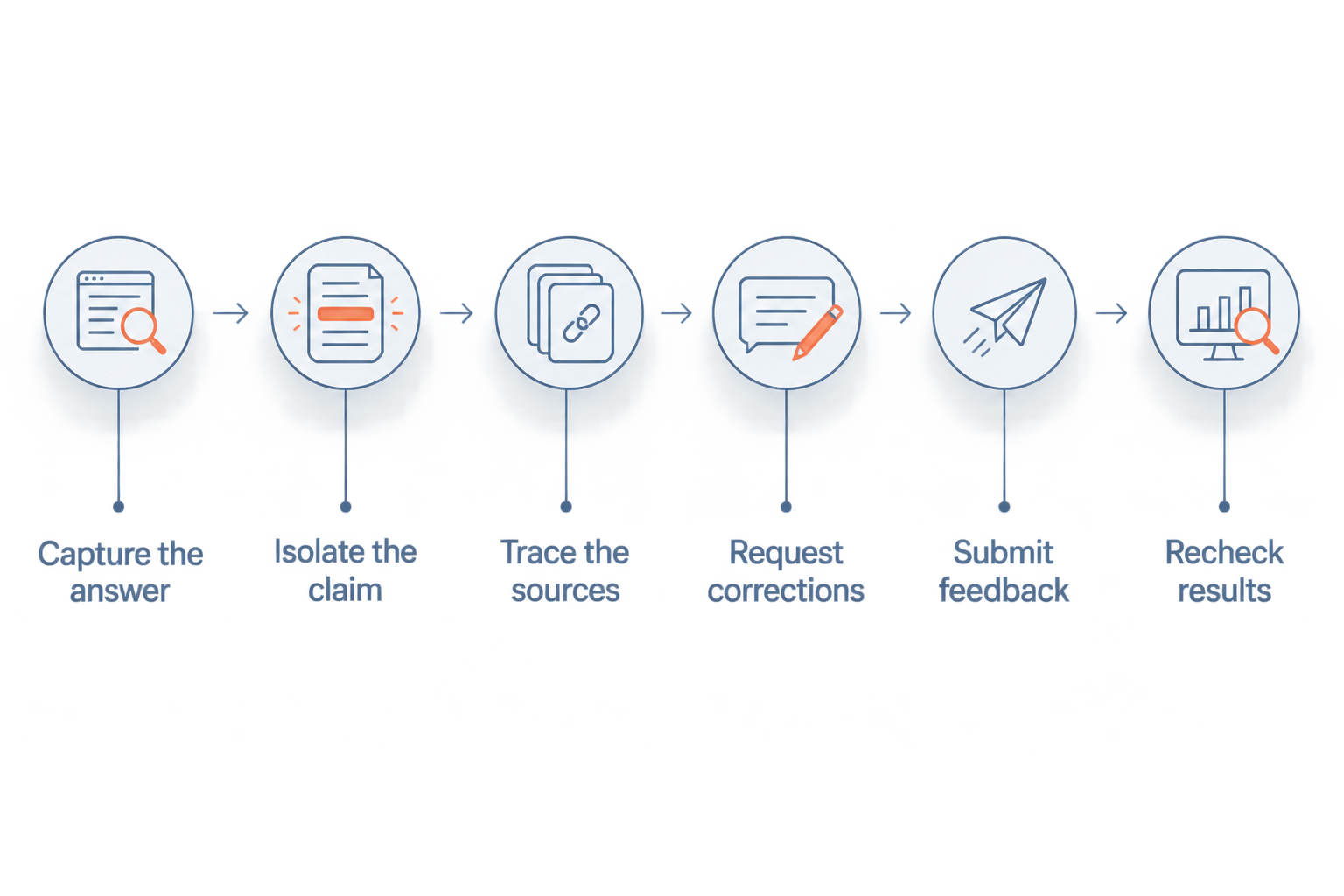
Follow these 6 steps before pursuing suppression
1. Capture the answer
Save a screenshot of the complete AI Overview, the exact search query, the visible sources, and the date. Record the device, language, and search location where practical so later checks have useful context.
Preserve the wording before submitting feedback or contacting a publisher. If the answer changes, you need a reliable record of the original issue rather than a recollection of what it said.
2. Isolate the claim
Copy the specific sentence that is false, outdated, or misleading. Separate a factual allegation from an opinion, and separate an allegation from an established finding.
For example, a summary that treats a filed lawsuit as a finding of liability presents a different problem from a summary that accurately states a lawsuit was filed. Your correction request should identify that distinction without denying documented facts.
3. Trace the sources
Open each visible supporting source and find the passage connected to the disputed sentence. Check whether the source actually supports the summary and whether it identifies the correct person or business.
Keep a simple evidence file with 4 fields: disputed claim, cited source, supporting evidence, and requested correction. If the visible sources do not support the claim, state that clearly rather than guessing where it originated.
4. Request corrections
When a publisher has made a factual error, send the editor a concise request identifying the passage, the evidence, and the change you are seeking. Use primary documentation where available, and redact unrelated sensitive information.
Ask for an accurate correction, not automatic deletion of an entire unfavorable article. If litigation, confidentiality, or disputed legal allegations are involved, have qualified counsel review the communication before sending it.
5. Submit feedback
Use the feedback controls associated with the AI Overview. Describe the exact error and explain how the cited material or primary documentation contradicts it; interface labels can change, so follow the controls currently displayed.
Google Search Help provides guidance on AI Overview feedback and separate routes for content-removal requests. Choose the route that matches the problem rather than treating ordinary negative coverage as a policy violation.
6. Recheck results
Repeat the original query and record what changed in the summary, citations, and underlying pages. Check relevant name-and-company variations separately; a corrected answer for one query does not establish correction across every query.
For your 2026 case log, distinguish source correction, search-index changes, and AI Overview wording changes. Those are separate outcomes, and none should be reported as complete suppression without checking the actual search experience.
Correct an inaccurate AI-generated summary
Best for: a summary that misstates what its own sources say. Examples include confusing people with similar names, presenting an allegation as a proven fact, or omitting a documented outcome that materially changes the meaning.
The advantage is precision: you can identify a specific mismatch between the answer and the evidence. The limitation is control: submitting feedback does not let you rewrite Google’s answer or set its publication schedule.
Keep the submission narrow. Explain the disputed statement, identify the correct fact, and describe the evidence supporting it without adding unrelated grievances.
If the answer concerns a business, make sure your own public materials consistently identify the company and its leadership. Consistency helps readers distinguish entities; it is not a guarantee that Google will correct a particular summary.
Correct an inaccurate or outdated source
Best for: a source page containing a verifiable factual error or missing a material update. Address the publisher when the AI Overview accurately reflects an inaccurate underlying article.
Source correction addresses the underlying publication rather than only a generated summary. Its limitation is dependency: the publisher decides how to handle the request, and a correction does not establish when Google will reflect the change.
After a publisher updates or removes a page, Google’s Refresh Outdated Content process can be relevant when search results still display outdated material. That process is not a general-purpose tool for removing an unchanged article you dislike.
Ask whether the disputed claim also appears in a headline, caption, or syndicated version. Correcting the body of an article leaves the problem unresolved if another visible passage still states the same error.
Seek removal only when the content qualifies
Best for: content that meets a specific Google policy or applicable legal standard. Google provides removal processes for certain personal information and other eligible material; the requirements depend on the request category.
The advantage is that a qualifying request addresses a defined removal ground. The limitation is scope: removal from Google Search does not necessarily delete the original publication or every copy elsewhere.
Defamation claims require legal analysis, not just a statement that coverage is damaging. Preserve the evidence and consult qualified counsel when the dispute involves false factual allegations, threats, or court proceedings.
A 2026 removal request should identify the actual policy or legal basis and the exact material at issue. Do not submit a privacy complaint simply because a news story is commercially inconvenient.
Use crisis SEO without promising AI Overview control
Best for: an incomplete search presence that needs accurate, substantive information. Crisis SEO can focus on clear company information, documented professional history, factual updates, and useful material that answers legitimate questions about the situation.
The benefit is a broader, more accurate public record. The limitation is fundamental: publishing content or improving ordinary rankings does not provide direct control over an AI Overview’s wording or sources.
Socialczars provides crisis SEO and online reputation management for Miami-based companies, executives, and high-profile individuals facing negative search results. Assess that work against defined search queries and documented changes, not a promise to erase all criticism.
Avoid fabricated endorsements, invented news coverage, and pages that repeat denials without supporting facts. Your response should withstand scrutiny from the same clients, journalists, and counterparties whose trust you need to protect.
For the related ranking question, read how Google ranks search results for a person’s name. Ordinary rankings and AI-generated summaries need separate monitoring.
Discuss your search reputation problem
Discuss crisis SEO and online reputation management for negative search results.
Why correction and suppression outcomes vary
The route depends on the evidence and the kind of problem—not simply how damaging the summary feels.
- Source accuracy: A false statement needs correction; a true statement needs an accurate response or additional context.
- Source control: You can edit your own materials, but independent publishers control their publications.
- Removal eligibility: A request must meet the relevant policy or legal standard; reputational harm alone does not establish eligibility.
- Identity ambiguity: Similar names and unclear company affiliations require explicit evidence identifying the correct subject.
- Update processing: A changed source, a changed search result, and a changed AI Overview are distinct events.
- Query differences: Name-only searches and searches containing an allegation require separate checks.
Can I edit the AI Overview myself?
No, you cannot directly edit a Google AI Overview about your business or your name. You can submit feedback, seek source corrections, and use relevant removal processes, but Google controls the generated answer.
Will pushing down an article remove it from the AI Overview?
No, pushing down an article does not guarantee its exclusion from an AI Overview. Treat ordinary ranking improvements and changes to generated summaries as separate results, even when they concern the same source.
What should I do first if the summary is false?
Preserve the exact summary and identify the unsupported statement before contacting anyone. Then match the error to the appropriate route: Google feedback, publisher correction, or a qualifying removal request.
FAQ
Can a negative Google AI Overview be corrected in 2026?
Yes, a negative Google AI Overview can be corrected, but correction is not guaranteed. Document the exact error, compare it with the visible sources, and pursue feedback or source correction as appropriate.
Can I pay Google to remove a negative AI Overview?
Google advertising is not a mechanism for purchasing removal or editing of an AI Overview. Use the relevant feedback, policy, or legal process for the issue involved.
Will deleting my website remove the negative summary?
Deleting your website does not guarantee removal of a negative summary. Google can draw on third-party material, and deleting your own accurate information does not remove those publications.
Does a corrected news article automatically fix the AI Overview?
A corrected news article does not guarantee an immediate or matching AI Overview correction. Record the publisher’s change, then check the search result and generated answer separately.
Can I remove an AI Overview because it mentions a lawsuit?
An unfavorable mention of a lawsuit alone does not establish removal grounds. Check whether the summary accurately distinguishes allegations, procedural developments, and findings before choosing a response.
How long does it take to correct a negative AI Overview?
There is no guaranteed completion time for correcting a particular AI Overview. Publisher review, Google’s processing, and the nature of the error are separate parts of the response.
Can an agency guarantee that an AI Overview stays positive?
An agency cannot directly control Google’s generated answers. Require clearly defined work, evidence-based reporting, and an explicit distinction between source correction and search suppression.
One last thing
An accurate citation does not make every sentence in a summary accurate. Check the relationship between the claim and the source, not merely whether Google displays a recognizable publisher.
For your 2026 response, preserve both the AI Overview and the supporting passage. That comparison gives an editor, lawyer, or reputation specialist a precise problem to address instead of a broad request to make negative coverage disappear.
Related guides
- Can ChatGPT say negative things about your business?
- Can removing negative content backfire and cause more attention?
- How do you respond to a defamatory blog post about your business?
