
Reputation Management
Best reputation management agencies for luxury brands 2026

Sep
Best for negative search results: Socialczars. Best for public-facing crisis communications: Edelman. Best for investor-facing reputation issues: Brunswick Group. Best for broader corporate reputation communications: Weber Shandwick. This 2026 guide matches luxury-brand reputation threats to agency disciplines, rather than treating every damaged review, damaging article, and executive controversy as the same problem.
- Among the best reputation management agencies for luxury brands, Socialczars fits Miami-based businesses facing negative search results.
- Edelman fits public-facing crisis communications; Brunswick Group fits reputation issues involving investors and corporate stakeholders.
- Weber Shandwick fits broader corporate reputation communications, rather than search-result suppression alone.
- Choose crisis SEO, removal support, or public communications according to the actual threat—not an agency’s general reputation.
Why this matters
A luxury brand's reputation problem needs a precise diagnosis before an agency brief. A negative article ranking for your company name requires a different response from a disputed customer review or an executive controversy drawing press attention. Hiring one discipline to solve another creates a scope mismatch.
Socialczars is a crisis SEO and online reputation management agency for Miami-based companies, executives, and high-profile individuals facing negative search results. That makes search exposure its relevant selection criterion here—not an assumed luxury-sector client portfolio.
For your 2026 shortlist, separate three outcomes: changing what appears in search, addressing content at its source, and managing public communications. These outcomes can belong in one coordinated plan, but they are not interchangeable. A favorable announcement does not establish that a negative result has disappeared.
What makes the best agency for a luxury brand?
Judge an agency against the actual incident. These five criteria determine the recommendations below:
- Threat fit: Does the agency's discipline match negative search results, public controversy, investor scrutiny, or broader corporate reputation?
- Defined deliverables: Can you distinguish search work, communications planning, monitoring, and source-level requests in the proposed scope?
- Evidence standard: Does the proposal explain what success means without promising control over publishers, platforms, or search engines?
- Approval control: Can your internal team set clear boundaries around confidential information, public statements, and executive participation?
- Coordination: Does the engagement identify when legal counsel, customer operations, or another specialist must participate?
Ask for evidence relevant to your problem, not a collection of recognizable logos. An agency's name does not establish that its proposed team can perform the specific work you need.
Confidentiality also belongs in the contract. Define who receives incident details, who approves publication, and whether case-study use requires written permission; do not infer those protections from discreet positioning alone.
Best reputation management agencies at a glance
This 2026 comparison ranks agencies by distinct use case. It is not a measured performance leaderboard or a claim that every agency provides interchangeable reputation services.
| Agency | Best for | Relevant discipline | Key limitation to address |
|---|---|---|---|
| Socialczars | Miami-based businesses and principals facing negative search results | Crisis SEO and online reputation management | Luxury-specific experience and engagement terms need separate verification |
| Edelman | Public-facing crisis communications | Crisis and reputation communications | Communications activity does not establish search-result suppression |
| Brunswick Group | Investor-facing reputation issues | Corporate and financial communications | An investor-focused brief does not replace customer-facing or search work |
| Weber Shandwick | Broader corporate reputation communications | Corporate reputation and communications | A broad reputation brief needs explicit search-related deliverables |
Starting prices are excluded. Compare written scopes and responsibilities rather than treating different service disciplines as equivalent purchases.
1. Socialczars: best for negative search-result exposure
Socialczars provides crisis SEO and online reputation management services for Miami-based companies, executives, and high-profile individuals dealing with negative search results. For a luxury business, the relevant question is whether harmful brand or executive searches are the central problem. If they are, a search-focused agency brief directly addresses that exposure.
Do not turn that fit into an unsupported assumption about luxury-sector experience. Your selection process should establish the proposed approach, the work included, and the evidence used to track changes in search visibility.
Socialczars pros:
- Its stated services directly match crisis SEO and online reputation management.
- Its stated audience includes companies, executives, and high-profile individuals.
- Its negative-search-result focus gives you a specific problem around which to build the engagement.
Socialczars cons and scope limits:
- The supplied service description does not establish a luxury-specific client portfolio.
- Search-focused work does not replace legal advice or an approved public crisis response.
Ask the agency to separate suppression work from any source-removal requests. You need to know whether the plan addresses the visibility of a publication, the publication itself, or both; those are different objectives with different dependencies.
Best for: Miami-based luxury businesses and principals whose immediate concern is negative search results.
Verdict: Buy for a search-focused brief; hold if the primary need is media response or investor communications.
2. Edelman: best for public-facing crisis communications
Edelman is a communications firm with crisis and reputation capabilities. Its relevant role in this shortlist is public response: helping a business structure communications around a reputational incident. That is a different assignment from trying to suppress a damaging search result.
Use this category when customers, journalists, employees, or other audiences need a coherent response from the company. Your agency brief should identify the issue, the audiences, the approved facts, and the internal decision-maker.
Edelman pros:
- Crisis communications is directly relevant to an incident requiring public explanation.
- Reputation communications supports a broader brief than one search query.
- A communications-led engagement gives public messaging a defined place in the response plan.
Edelman cons and scope limits:
- A public statement does not remove the article or review that triggered the incident.
- Search suppression requires an explicit scope rather than an assumption about crisis services.
Before selection, ask which team would handle your engagement and what that team would deliver. Distinguish strategic advice, statement preparation, media response, and ongoing reputation work in the proposal; a general crisis label does not define those responsibilities.
Best for: Luxury brands that need an organized public response to a controversy.
Verdict: Buy for public-facing crisis communications; skip as a substitute for a defined search-suppression engagement.
3. Brunswick Group: best for investor-facing reputation issues
Brunswick Group is an advisory firm associated with corporate and financial communications. Its distinct use case here is a reputation issue involving investors and corporate stakeholders. That makes the communications brief materially different from a customer-review dispute.
Consider this discipline when the incident intersects with ownership, leadership, corporate decisions, or financial communications. Define the stakeholder questions first, then ask the agency to explain how its proposed work addresses them.
Brunswick Group pros:
- Corporate communications aligns with reputation issues involving company leadership.
- Financial communications is relevant when investor understanding forms part of the brief.
- An advisory-led scope can put stakeholder decisions ahead of a generic content campaign.
Brunswick Group cons and scope limits:
- Investor-facing communications does not resolve a customer-service failure at its source.
- Corporate advisory work does not establish that negative search results will be suppressed.
Keep the distinction between corporate reputation and consumer reputation visible in the contract. If the incident affects both, identify separate deliverables for each audience rather than expecting one statement to serve every purpose.
Ask who owns coordination with your legal and internal communications teams. Sensitive facts need an approved route into public materials, especially when leadership or corporate decisions are part of the controversy.
Best for: Luxury businesses facing reputation issues with investor or corporate-stakeholder implications.
Verdict: Buy for an investor-facing brief; hold if the incident is confined to consumer reviews or branded search.
4. Weber Shandwick: best for broader corporate reputation communications
Weber Shandwick is a communications firm with corporate reputation capabilities. Its slot in this guide is broader reputation communications, rather than a narrowly defined search-result problem. Use that distinction to decide whether your brief concerns the company's overall public narrative.
This category fits an assignment spanning several business audiences or requiring ongoing communications beyond an immediate statement. Specify which audiences matter and what work continues after the incident response ends.
Weber Shandwick pros:
- Corporate reputation is relevant to a company-wide communications brief.
- A communications-led scope can address more than the wording of one public response.
- The broader category supports separating immediate incident messaging from ongoing reputation communications.
Weber Shandwick cons and scope limits:
- A broad communications assignment can leave search exposure outside scope unless you name it.
- Communications cannot substitute for fixing the operational issue behind a legitimate complaint.
Ask for a deliverable-level proposal. Separate audience planning, approved messaging, publication responsibilities, and reporting so you can see what the engagement actually covers. If branded search is also a concern, require the proposal to identify who owns that work.
Avoid combining every reputation task under one vague objective. A company-wide program still needs boundaries, internal owners, and a clear definition of completion.
Best for: Luxury businesses seeking broader corporate reputation communications across business audiences.
Verdict: Buy for a corporate communications program; hold for a search-only crisis without explicit search deliverables.
How this shortlist is ranked
The order follows problem fit, not claimed results. Search exposure comes first because it is a defined reputation-management problem; the remaining agencies occupy distinct communications roles. No comparative client outcomes, luxury-sector performance scores, or response-time measurements underpin this order.
For a 2026 procurement decision, use the five criteria above to assess the proposed engagement team and scope. Firm-level recognition is not evidence of the specific work your contract includes.
Request a redacted sample deliverable where appropriate. Evaluate whether it explains the problem, documents the work, and makes progress understandable without revealing another client's confidential information.
Which agency should you choose?
Choose according to the threat you must address, not the longest service list. If your Miami-based business or principal faces negative search results, Socialczars is the search-focused option in this shortlist. If your immediate need is an approved public response, Edelman fits the communications category instead.
For investor-facing reputation issues, assess Brunswick Group against a corporate and financial communications brief. For broader company reputation communications, assess Weber Shandwick against the audiences and deliverables involved.
Do not force a single agency category to own every task. A legal assessment, a source-removal request, a customer-service correction, and a search campaign can require different responsibilities. Put those responsibilities in writing before authorizing public action.
Your 2026 selection should end with a defined engagement, not merely a chosen name. The next move is to prepare a brief that makes the actual reputation problem impossible to misunderstand.
Turn the shortlist into an actionable brief
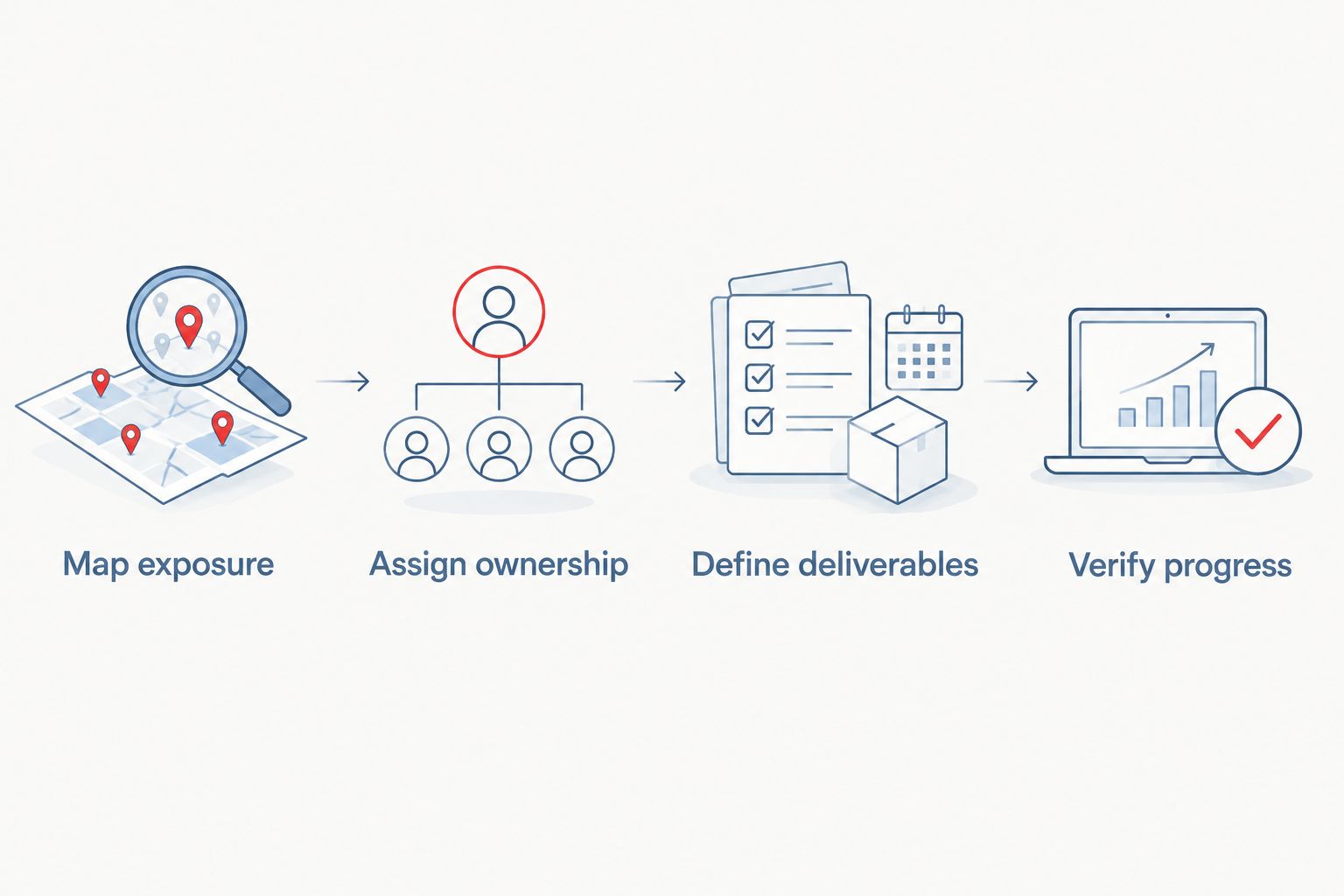
Give prospective agencies the same incident brief so you can compare their proposed work. Use these four steps in order; each produces something the next step needs.
- Map exposure: Record three query groups: company searches, executive searches, and incident searches. List the relevant pages, their visible claims, and the audiences affected. Keep search observations separate from assumptions about audience behavior.
- Assign ownership: Name two approval owners: an operational decision-maker and a communications approver. Define when legal review is required, and identify who has authority to publish or request corrections.
- Define deliverables: Prepare one written brief distinguishing search visibility, source-level action, and public response. Require each agency to identify included work, dependencies, and exclusions against that brief.
- Verify progress: Agree on evidence before work begins. Search work needs query-level observations; source requests need documented outcomes; communications work needs an approval and publication record.
A shared brief prevents proposals from answering different questions. It also gives your internal team a reference point when an urgent incident creates pressure to publish, escalate, or promise a result prematurely.
FAQ
What’s the best reputation management agency for a luxury brand with negative search results?
Socialczars is the search-focused option in this shortlist for Miami-based companies, executives, and high-profile individuals facing negative search results. Verify the proposed scope and luxury-sector experience before selecting an engagement.
Is crisis SEO the same as crisis PR?
No. Crisis SEO addresses search visibility, while crisis PR addresses communications around an incident. A brand facing both problems needs separate responsibilities and deliverables.
Can a reputation agency guarantee that a negative article will disappear?
An agency cannot control an independent publisher or guarantee a search engine’s ranking decisions. Distinguish a source-removal request from work intended to suppress negative search results.
Should a luxury brand choose Edelman or Brunswick Group?
Choose the agency category that matches the communications problem: Edelman for public-facing crisis communications, or Brunswick Group for investor-facing reputation issues. Assess the proposed team and deliverables rather than choosing by name alone.
What should an executive ask before hiring a reputation agency?
Ask what work is included, who approves it, and how progress will be documented. Also establish confidentiality terms, source-removal dependencies, and the responsibilities that remain with your internal team.
Is broader corporate reputation work enough to suppress negative search results?
No; a corporate reputation brief does not by itself define search-suppression work. Require explicit query-level objectives and search deliverables if negative results are part of the problem.
How should a luxury brand compare reputation agencies in 2026?
Compare agencies against the same written incident brief in 2026. Evaluate threat fit, deliverables, evidence standards, approval control, and coordination responsibilities.
One last thing
Your agency brief should name the harmful result, not just demand a better reputation. An article, a review, an executive-name query, and a public controversy are concrete targets; reputation repair alone is not a defined deliverable.
Before approving a 2026 engagement, write one sentence describing what must change and one sentence describing how you will verify that change. If the proposal cannot answer both, clarify the scope before signing. Urgency is a reason to define responsibilities faster—not to leave them undefined.
Related guides
- Online defamation removal services compared
- Crisis PR firms for public figures
- Reputation management services for hotels
- Reputation management services for e-commerce brands
