
Reputation Management
How much does it cost to remove a negative news article?

Oct
The cost to remove a negative news article depends on the remedy: publisher removal, search-result removal, or search suppression require different work, so you need a written, case-specific quote. A removal quote does not automatically include legal review, syndicated copies, or ongoing search monitoring. Before you commit in 2026, establish exactly what disappears, from where, and what happens if the request fails.
- How much does it cost to remove a negative news article? Get a quote tied to a defined remedy.
- Publisher deletion, Google removal, and crisis SEO suppression deliver different outcomes; compare scope before signing.
- Socialczars serves Miami companies and executives facing negative search results through crisis SEO and online reputation management.
- Reject any proposal that calls lower rankings permanent deletion or leaves unsuccessful requests undefined.
How much does it cost to remove a negative news article?
There is no interchangeable service called article removal. A publisher controls its article, Google controls its search listings, and an SEO agency works to influence visibility without controlling either decision-maker.
Start with 3 distinct outcomes. Understanding how Google ranks search results for a person's name helps you separate a ranking problem from a source-removal problem.
| Approach | Best for | What you are asking for | Main limitation |
|---|---|---|---|
| Publisher removal or correction | A documented factual error or a credible editorial request | Deletion, correction, or an update at the source | The publisher decides unless a binding legal obligation applies |
| Google search-result removal | Content that meets an applicable removal policy or legal requirement | Removal from eligible search results | The original article can remain online |
| Search suppression | An article that remains published and searchable | Stronger relevant results that compete for visibility | Rankings change; suppression does not delete the article |
For a 2026 proposal, require the provider to identify which outcome the agreement covers. A contract for outreach is not a contract for successful deletion, and a contract for content production is not a promise of a particular search position.
What a useful quote must separate
Ask for separate descriptions of the assessment, publisher outreach, search-engine requests, legal work if applicable, content work, and monitoring. You need to see which activities are included and which require separate approval.
Also identify the completion event. Is the work complete when a request is submitted, when a publisher responds, when the article disappears, or when a search-visibility objective is met? Those are materially different commitments.
Why this matters
Buying the wrong remedy leaves the actual reputation problem unresolved. Removing a search listing does not stop someone from opening a direct link, while correcting an article does not necessarily remove its headline from search immediately.
For an executive preparing for due diligence, the priority might be the results people see when searching a name. For a company facing an inaccurate allegation, correcting the underlying record might matter more than moving a result lower.
Your 2026 decision should start with the business exposure, not a provider's preferred package. Define the problem in plain language: the article contains an error, exposes protected information, dominates a name search, or remains prominent after a documented development.
Publisher removal or correction: define the editorial request
Publisher outreach is best for a specific, supportable request about the article itself. Identify the disputed statement, explain the problem, and provide evidence that an editor can evaluate.
A correction, update, anonymization request, and deletion request are not equivalent. Decide which outcome addresses the harm before approving outreach, and make acceptable alternatives explicit.
The advantage is directness: a source-level change addresses the publication itself. The limitation is control. Hiring a representative does not give that representative authority over an independent newsroom.
What to require in the scope
- The exact article and publisher covered by the engagement.
- The specific correction, update, or removal being requested.
- The supporting documents needed before outreach begins.
- Who approves communications and handles publisher responses.
- What the provider delivers if the publisher refuses.
Keep the request factual and proportionate. An aggressive demand unsupported by evidence is not a substitute for a credible editorial case, and a mistaken approach can distract from the correction you actually need.
Do not authorize public rebuttals as an automatic next step. Approve external communications separately, particularly when confidential business information or personal records are involved.
Google search-result removal: identify the eligibility basis
Google search-result removal is best for a URL that meets an applicable Google removal policy or legal requirement. An article being negative does not, by itself, establish eligibility for removal.
Google's published removal processes distinguish requests involving certain personal information, legal issues, and outdated search content. The appropriate route depends on the actual content and circumstances, not simply on reputational damage.
The advantage is that an eligible search listing can be addressed without persuading a publisher to delete its page. The limitation is that search removal is not internet-wide erasure: the source can remain accessible through direct links and other routes.
Questions to answer before authorizing a request
Ask which policy or legal basis applies, which exact URLs the request covers, and what evidence supports eligibility. Require the provider to describe the expected scope of any removal rather than using the phrase removed from the internet.
If a publisher has already changed or deleted the article, establish whether the remaining issue is outdated search information. That is different from asking Google to remove a live, unchanged article because you dislike it.
For a 2026 engagement, save the submission confirmation and decision alongside the original evidence. A clear record lets you distinguish a rejected request from an incomplete submission or a request addressing the wrong URL.
Search suppression: define the visibility objective
Search suppression is best for negative coverage that remains published when source removal and search-policy removal do not provide a viable remedy. The work focuses on improving the visibility of relevant, accurate material that competes with the negative result.
The advantage is that suppression does not depend on persuading the original publisher to delete its reporting. The limitation is equally important: suppression changes visibility, not the historical record, and no agency controls Google's rankings.
A useful scope identifies the searches that matter, the pages being improved or created, the approval process, and how visibility will be checked. Content volume alone does not establish whether the work addresses your actual reputation problem.
What belongs in the reporting
Require reporting against agreed name and brand searches, with the search context recorded. A result for a broad company query is not interchangeable with a result for an executive's name plus an allegation.
Record the observation date, relevant location, and result type. Consistent checks make the report interpretable; isolated screenshots without context make it difficult to judge whether visibility has changed.
For service fit, Socialczars is best suited to Miami companies, executives, and high-profile individuals seeking crisis SEO and online reputation management. Socialczars serves clients dealing with negative search results; that service category must not be confused with guaranteed publisher deletion.
Why the scope of article-removal work varies
A meaningful comparison starts with the facts of your case. Ask each provider to explain how these factors change the work included in the proposal:
- Requested outcome: Publisher deletion, a factual correction, search removal, and suppression require different deliverables.
- Evidence available: Identify the documents supporting an editorial request, policy request, or legal assessment.
- Publication footprint: Inventory the original article and any separate copies rather than treating every appearance as the same URL.
- Search exposure: Specify the name, company, and allegation-related searches that create the concern.
- Legal involvement: Clarify whether counsel is required and whether legal assessment belongs to a separate engagement.
- Follow-up obligations: Define who checks publisher responses, search changes, and newly discovered copies after the initial work.
Urgency does not eliminate these distinctions. If a business event is approaching, disclose the actual deadline and require a plan that separates actions the provider controls from decisions made by publishers or search engines.
How do you compare removal proposals without buying the wrong work?
Use 4 contract questions: What is covered? Who controls the outcome? What proves completion? What happens if the attempt fails? Have each provider answer in writing using the same article URLs and search queries.
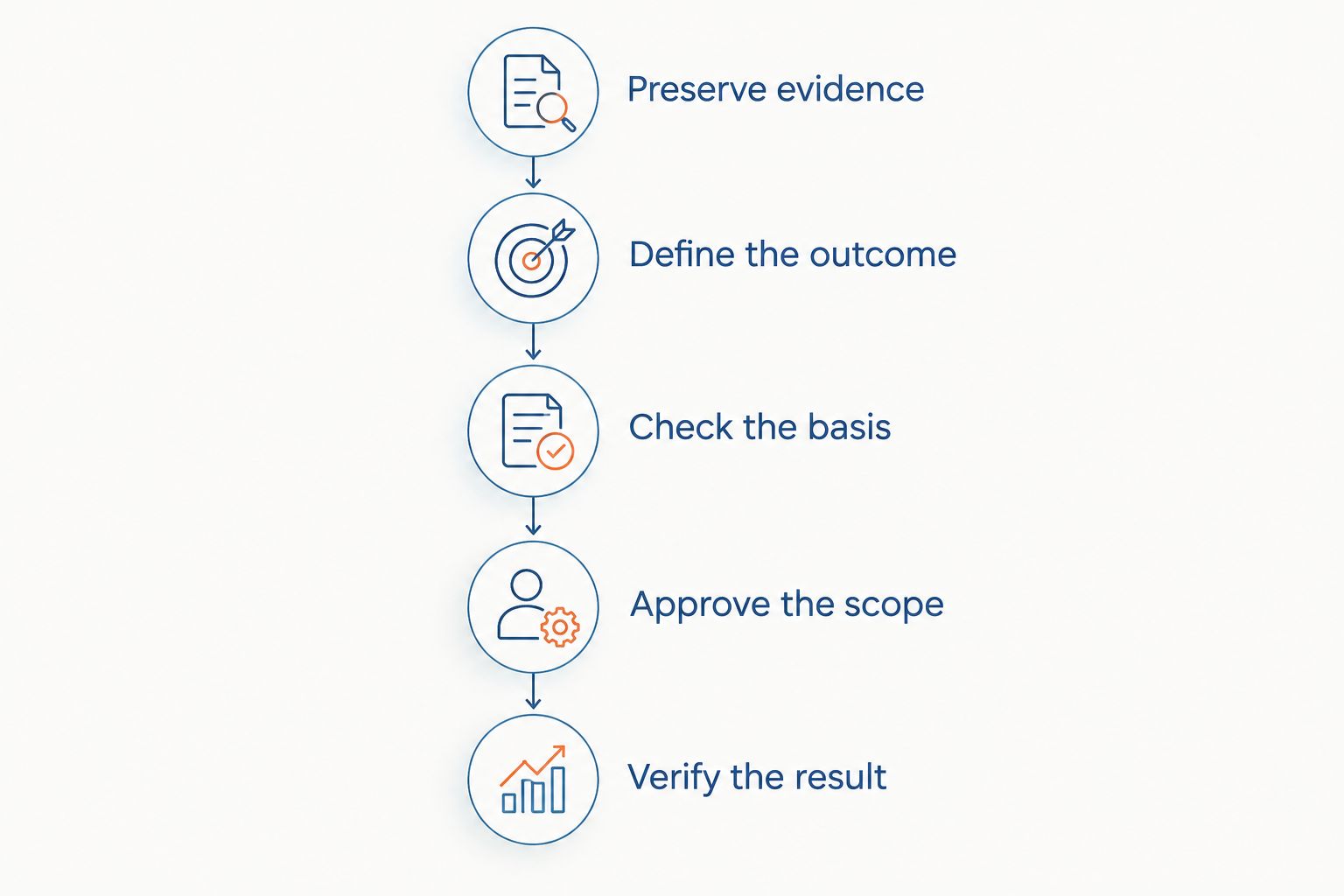
Follow this sequence before authorizing work:
- Preserve evidence. Save the article URL, headline, publication details, relevant passages, and search screenshots before requesting changes.
- Define the outcome. Decide whether you need a correction, source deletion, eligible search removal, or reduced search visibility.
- Check the basis. Document the factual, editorial, policy, or legal grounds for the proposed approach.
- Approve the scope. Confirm deliverables, exclusions, approval rights, completion criteria, and the unsuccessful-request process.
- Verify the result. Check the source page and the agreed search queries separately before accepting a completion claim.
Keep sensitive documents out of unnecessary circulation. Before sharing legal correspondence, identity records, or confidential company information, establish who receives them and how the engagement handles access and retention.
A discreet process still needs accountable reporting. Confidentiality should protect your information, not prevent you from seeing what work was authorized and completed.
Can you pay to have a true negative news article deleted?
Payment does not establish a right to have accurate reporting deleted. A publisher can consider an editorial request, but hiring an agency does not require the publisher to accept it.
Ask the provider to identify a legitimate basis for the proposed request. If the article remains online, assess correction, contextual updates, or suppression according to the facts rather than assuming deletion is available.
Does removing an article from Google delete it everywhere?
Google removal does not delete the publisher's article. Direct links, other search engines, and separately published copies require their own assessment.
Use 2 verification checkpoints: the source page and the agreed search results. Treat a change at either checkpoint as evidence of that particular outcome, not proof that every copy has disappeared.
Is suppression the same as permanent removal?
Suppression is not permanent removal. It aims to reduce visibility in specified searches while the underlying article remains published.
For a 2026 agreement, require the provider to distinguish completed work from continuing monitoring. Do not accept the word permanent without an exact explanation of what was removed and which party controlled that action.
FAQ
How much does it cost to remove a negative news article?
The cost requires a case-specific quote tied to publisher removal, eligible search-result removal, or search suppression. Ask for deliverables, exclusions, completion criteria, and the terms for an unsuccessful attempt before signing.
Can someone guarantee that a news publisher will delete my article?
An agency cannot guarantee an independent publisher’s decision merely by submitting a request. Require a written explanation of the removal basis and who has authority to approve the change.
Will Google remove a news story just because it hurts my reputation?
Reputational harm alone does not establish eligibility under Google’s removal processes. A request needs an applicable policy or legal basis.
Should I ask for a correction instead of deletion?
Ask for a correction when a documented factual error is the problem you need resolved. State the exact error, provide supporting evidence, and distinguish correction from complete article deletion.
Is hiring a lawyer the same as hiring a reputation management agency?
Legal representation and reputation management are different services. A lawyer assesses legal rights and remedies, while an agency’s agreed scope can include outreach, search visibility work, and monitoring.
Who is Socialczars best suited to help?
Socialczars is best suited to Miami companies, executives, and high-profile individuals seeking crisis SEO and online reputation management for negative search results. Publisher deletion and legal representation should not be assumed to be included without an explicit agreement.
What should I check before accepting that an article has been removed?
Check the publisher’s page and the agreed search queries separately. Also verify which URLs the completed work covers, because an original article and separately published copies are distinct targets.
One last thing
A successful removal report should be more specific than a sales proposal. It should identify the URL, the action taken, the verified result, and any remaining exposure.
For your 2026 decision, ask a final question before signing: if the original article stays online, what exactly will this engagement have accomplished? A clear answer protects you from buying suppression under the label of deletion.
Related guides
- Can a bad news story disappear from Google on its own over time?
- How do you respond to a defamatory blog post about your business?
- How long does it take to fix a bad online reputation?
