
Reputation Management
Online Reputation Management 101

Aug
Your Online Reputation Is Your First Impression — Here’s What to Do About It
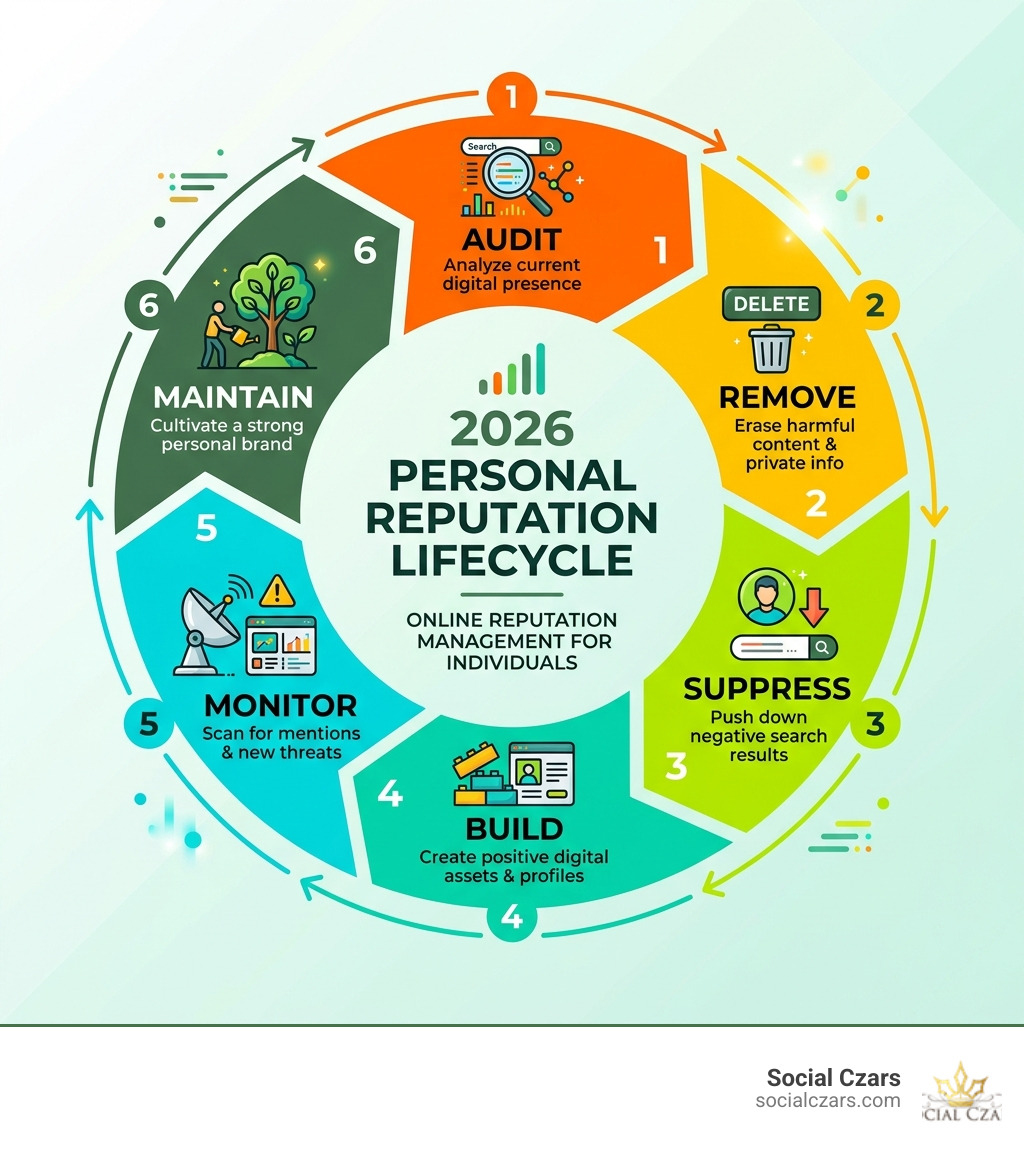
Online reputation management for individuals is the process of controlling what people find when they search your name online — removing or suppressing harmful content, building positive assets, and monitoring your digital presence over time.
Here’s what it covers at a glance:
| Goal | What It Involves |
|---|---|
| Remove harmful content | Legal takedowns, DMCA requests, publisher outreach |
| Suppress negative results | SEO, positive content creation, profile optimization |
| Build a strong presence | LinkedIn, personal website, authoritative bios, media placements |
| Monitor your reputation | Google Alerts, reputation scoring tools, AI-powered scans |
| Protect your privacy | Data broker removal, social media cleanup, identity protection |
Think about this: 75% of employers Google your name before hiring you. And 42% of adults will research you online before deciding to work with you. What they find in those first few seconds shapes their entire perception — before you’ve said a word.
That’s not a minor detail. That’s your career, your relationships, and your opportunities on the line.
Your Google results are, in effect, your digital handshake. And most people have never stopped to check what theirs actually looks like.
I’m John DeMarchi, founder of Social Czars, and I’ve spent over a decade helping executives, VIPs, and high-profile individuals take back control through online reputation management for individuals — from suppressing damaging search results to building airtight personal brands. In this guide, I’ll walk you through exactly what works in 2026.
Online reputation management for individuals word guide:
- Online Reputation Crisis
- brand online reputation management
- online reputation management new york city
Why Online Reputation Management for Individuals Matters in 2026
In the digital landscape of April 2026, your “virtual self” often precedes your physical presence. Whether you are walking into a boardroom in New York City or a networking event in Miami, people have likely already formed an opinion of you based on a thirty-second Google search. The stakes have never been higher.
The statistics are sobering. Beyond the 75% of employers who screen candidates, 56% of employers have admitted they decided not to hire someone specifically because of what they found online. Even more telling, 57% of employers say they are less likely to even interview a candidate if they can’t find a positive online presence at all. In 2026, “no news” isn’t necessarily “good news”—it can look like you’re hiding something or that you simply aren’t relevant in your industry.
Online reputation management for individuals is no longer just for the rich and famous; it is a critical career survival skill. It impacts:
- Career Opportunities: From landing the job to securing a promotion.
- Personal Relationships: New acquaintances, neighbors, and even romantic interests use search engines to verify who you are.
- Trust and Credibility: A solid digital footprint acts as social proof of your expertise and character.
To dive deeper into the mechanics of this, see our Online Reputation Management overview and our Online Reputation Management Executives Guide.
Who Benefits Most from Online Reputation Management for Individuals?
While everyone with an internet connection should be mindful, certain groups face higher risks and greater rewards.
- C-Suite Executives: For leaders in London or Los Angeles, their personal name is inextricably linked to their company’s stock price and brand equity. We specialize in Online Reputation Management for CEOs because at this level, one negative article can cause a global PR crisis.
- Job Seekers: In a competitive market, a clean social media history and a strong LinkedIn profile are your best offensive weapons.
- Public Figures and Politicians: These individuals are constant targets for “cancel culture” or politically motivated attacks.
Understanding that CEO Reputation Management Matters is the first step toward safeguarding a legacy that took decades to build.
The Impact of Negative Search Results
Negative content isn’t just an eyesore; it’s a barrier to entry. Common issues we see in 2026 include:
- Defamation and False Accusations: Malicious blog posts or forums that host unverified claims.
- Outdated News: A decade-old article about a minor legal issue that no longer reflects who you are.
- Unprofessional Social Posts: Old photos or “hot takes” from your youth that don’t align with your current professional standing.
When these results dominate page one, they overshadow your hard work. Our Online Reputation Repair Complete Guide outlines the specific steps needed to address these threats. In many cases, you can even Remove Negative Articles from Google if they violate specific policies or legal standards.
Core Strategies for Online Reputation Management for Individuals
The “science” of reputation management relies on a two-pronged approach: removing what shouldn’t be there and burying what can’t be deleted. This involves sophisticated Search Engine Optimization (SEO) and content engineering.

If a negative result is on a site you don’t control, and the publisher refuses to take it down, we use content suppression. This means creating a “shield” of positive, high-authority content that pushes the negative result to the second or third page of search results — where 93% of searchers never venture.
Key rankable assets include:
- A personal domain (YourName.com)
- Optimized social media profiles (LinkedIn, X/Twitter, Instagram)
- Professional bios on industry sites
- Bylined articles and guest posts
- Media mentions and interviews
For a step-by-step walkthrough, check out our Online Reputation Cleanup Guide 2025 and our Push Down Negative Results Guide.
Building a Positive Personal Brand
Building a brand is about more than just “looking good”; it’s about being “search-ready.”
- LinkedIn Optimization: Ensure your profile is 100% complete and uses keywords relevant to your 2026 career goals.
- Personal Websites: A simple, high-quality site acts as your digital headquarters.
- Authoritative Bios: Consistent name formatting across all platforms helps search engines “cluster” your positive assets together.
For those looking for a comprehensive strategy, we recommend The Ultimate Playbook for a Stellar Digital Presence and our Online Reputation Solutions Complete Guide.
Responding to Negative Feedback and Reviews
For individuals who are also business owners or consultants, reviews are the lifeblood of their reputation.
- Strategic Responses: Never respond emotionally. A calm, professional reply can often neutralize a critic.
- The Power of an Apology: Statistics show that 39% of negative reviewers just want an apology. A sincere follow-up can often lead to the reviewer updating or even removing their negative post.
- Review Integrity: Avoid buying fake reviews. In 2026, search engine algorithms and regulators like the FTC are incredibly good at spotting and punishing “shady” reputation tactics.
If you are struggling with unfair feedback, see How to Remove Negative Reviews in 5 Easy Steps and How to Remove 1 Star Reviews Google.
Monitoring, AI, and the Cost of Digital Protection
You cannot manage what you do not measure. In 2026, monitoring your reputation has become an automated, AI-driven process.
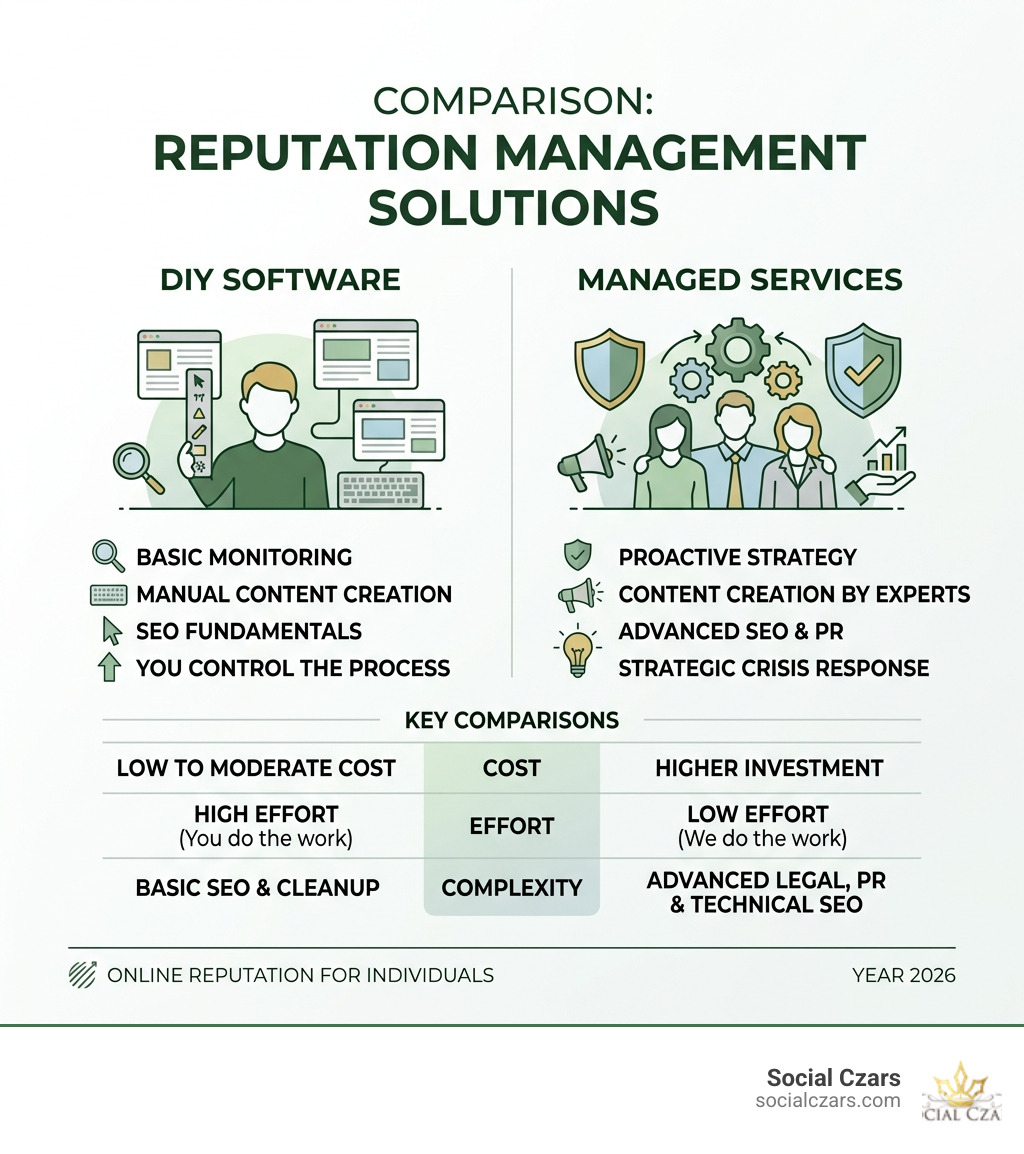
| Feature | DIY Software | Managed Services (Social Czars) |
|---|---|---|
| Cost | $70 – $150 / month | $2,500 – $15,000+ / month |
| Effort | High (You do the work) | Low (We do the work) |
| Complexity | Basic SEO & cleanup | Advanced legal, PR, & technical SEO |
| Speed | Slow (Learning curve) | Fast (Proven playbooks) |
| Best For | Students, entry-level | CEOs, VIPs, High-Net-Worth Individuals |
Effective monitoring involves setting up Google Alerts for your name and its variations, but also using software to track “Reputation Scores”—a metric that aggregates sentiment, search visibility, and social engagement into a single number. For a deep dive, see our Online Reputation Monitoring Complete Guide and our Reputation Management Agency Guide 2026.
The Role of AI in Online Reputation Management for Individuals
AI is rewriting the rules of how we protect names online. In 2026, we use machine learning to:
- Sentiment Analysis: Instantly scan thousands of social media posts to detect a “spike” in negative sentiment before it becomes a viral crisis.
- Automated Privacy Scans: AI tools can now find your home address, phone number, and private data on hundreds of “people search” sites and automatically file removal requests.
- Predictive Modeling: Identifying which negative links are most likely to rise in rankings so they can be neutralized early.
These Online Reputation Management Services are built into the core of modern reputation strategies.
Timelines and Long-term Maintenance
Reputation management is a marathon, not a sprint.
- Initial Cleanup: Removing specific links or cleaning social media can take 30 to 90 days.
- Suppression Campaigns: To see a durable shift on page one of Google, expect a window of 3 to 6 months.
- Maintenance: Once you look great, you have to stay that way. This involves a steady cadence of fresh content and monthly monitoring to ensure old negatives don’t resurface.
Maintaining your Online Reputation is much cheaper than repairing a broken one.
Frequently Asked Questions
How can I remove my personal information from Google?
While Google doesn’t “own” the internet, they can delist content that violates their policies. This includes “doxxing” (exposed private info), non-consensual explicit images, or outdated legal records in regions with “Right to be Forgotten” laws (like London). For other content, you may need a DMCA takedown if you own the copyright to the image or text being used against you. Follow our Remove Negative Search Results Best Practices for more.
What are the best free tools for managing my reputation?
- Google Alerts: The gold standard for free monitoring.
- Social Media Privacy Settings: Use them to lock down old “unprofessional” content.
- Incognito Search: Regularly audit your name in private browsing mode to see what a stranger sees.
- LinkedIn: Still the most powerful free tool for Online Reputation Management for individuals.
How much does professional reputation management cost?
Pricing varies wildly based on complexity.
- Software-only solutions are often $100–$200/month.
- Managed services for a typical professional might range from $500 to $2,500/month.
- Elite VIP/CEO projects involving complex legal removals and high-end PR in cities like New York or Miami can cost $5,000 to $15,000+ per month. For local specifics, see our Online Reputation Management NYC Guide.
Conclusion
Your digital legacy is being written every single day, whether you are holding the pen or not. In 2026, leaving your online image to chance is a risk you simply cannot afford. From the boardrooms of London to the tech hubs of Los Angeles, online reputation management for individuals has become the ultimate “digital shield.”
At Social Czars, we specialize in helping the most discerning clients in Miami and beyond navigate these waters. We offer elite SEO and fast negative content removal for CEOs and VIPs who need their search results to reflect their true achievements, not their worst days.
Don’t let a single negative link define your future. Secure your digital future today and take back control of your story.
