
Finance
Real Estate Agent SEO Descriptions Made Simple and Powerful

Sep
Real Estate Agent SEO Descriptions Made Simple and Powerful
Write an SEO Description That Makes Real Estate Prospects Click
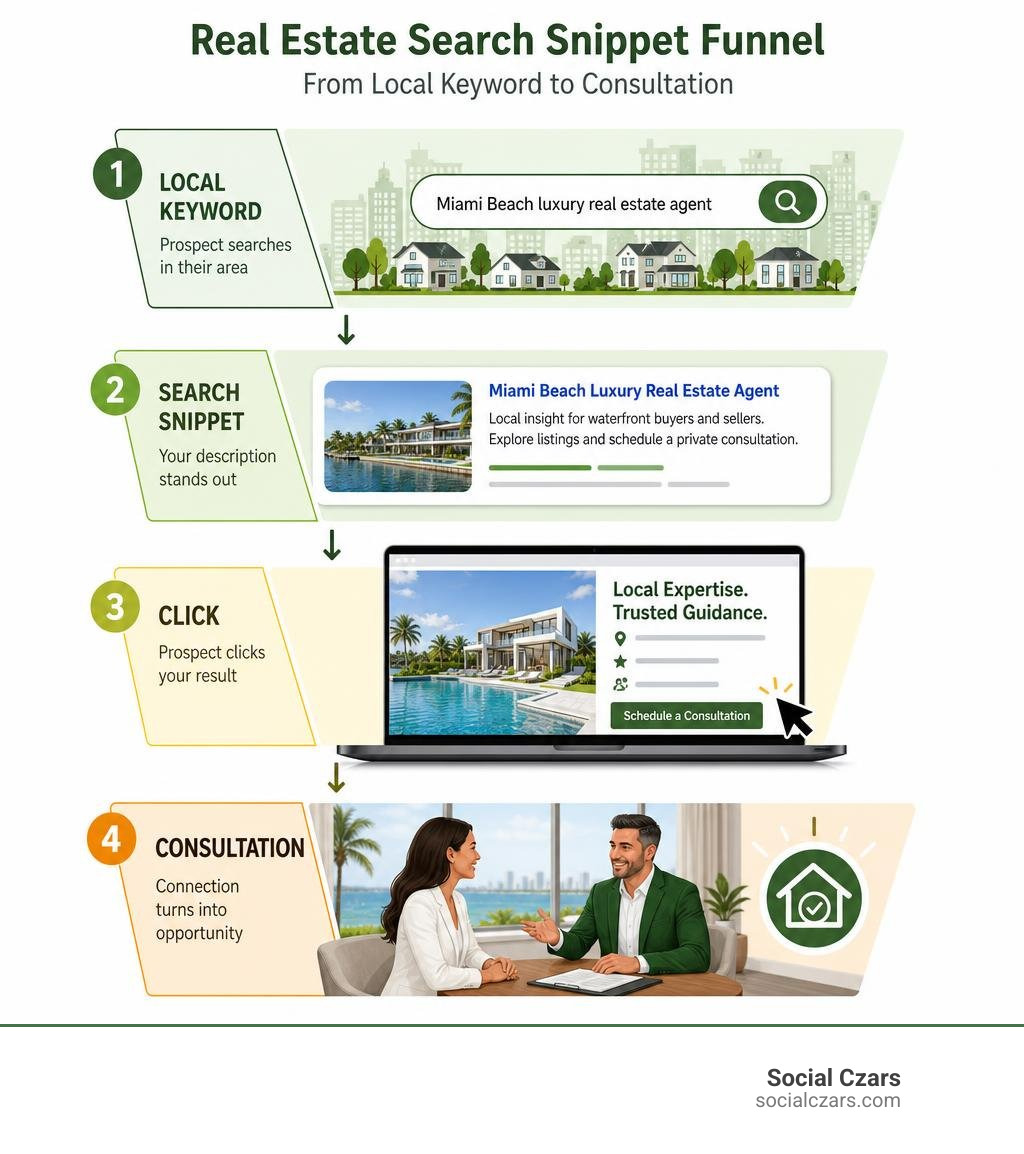
An effective SEO description for a real estate agent should quickly tell searchers three things: where you work, who you help, and why they should contact you. For a search-result meta description, keep it unique to the page, lead with a local service phrase, add one credible differentiator, and end with a clear next step.
- Name the market and service: “Miami Beach luxury real estate agent.”
- Add proof or a specialty: “Local insight for waterfront buyers and sellers.”
- Give a reason to act: “Explore listings or schedule a private consultation.”
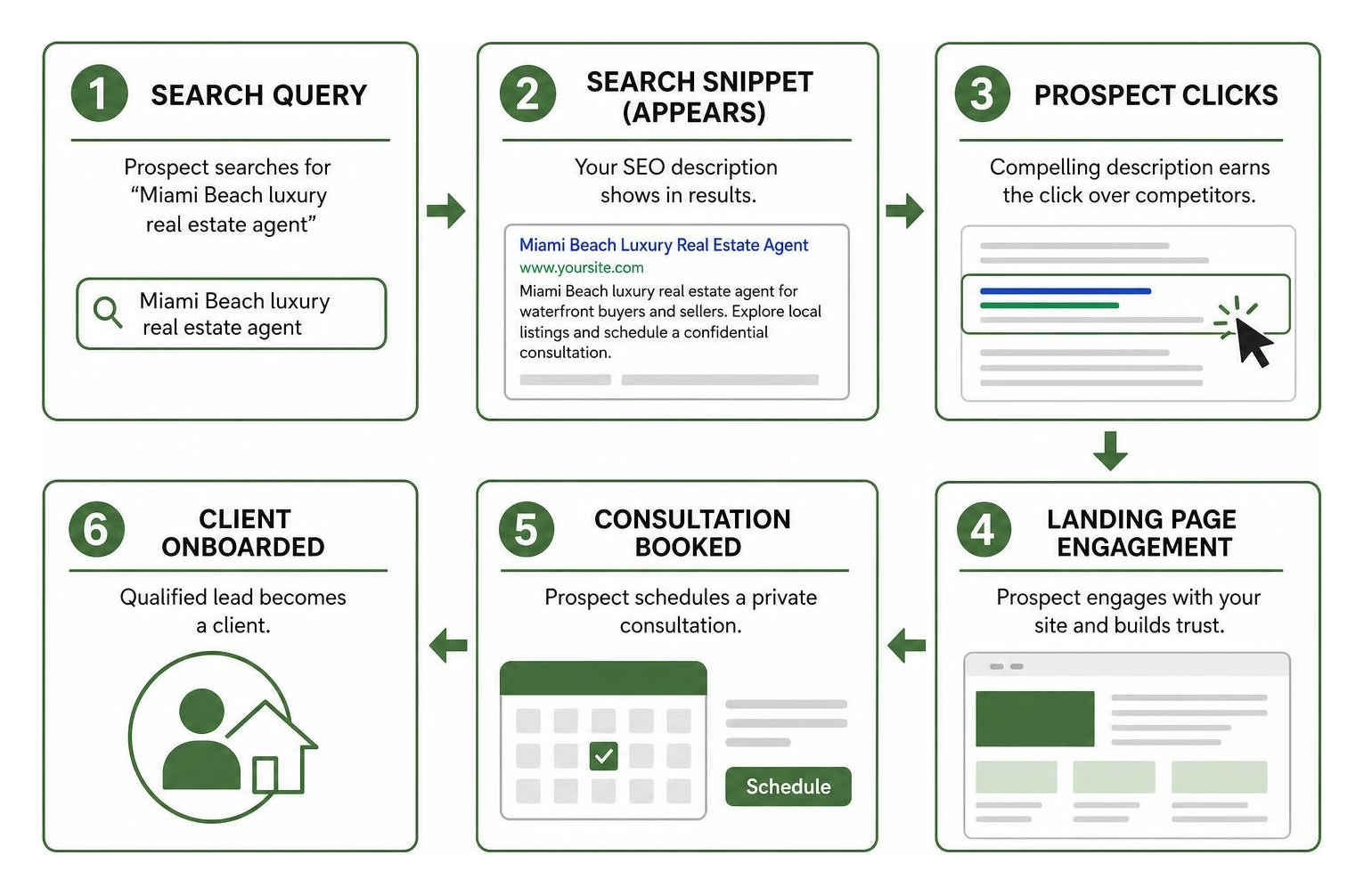
For example: “Miami Beach luxury real estate agent for waterfront buyers and sellers. Explore local listings and schedule a confidential consultation.”
Descriptions do not directly determine Google rankings, but they can influence whether a qualified buyer or seller clicks your result instead of a portal or competitor. That first snippet is also a reputation moment: vague claims, duplicate copy, and keyword stuffing can weaken trust before a prospect ever reaches your site.
I am John DeMarchi, founder of Social Czars, with 15 years of corporate communications experience and more than a decade helping executives, brands, and high-profile clients protect and improve search visibility. In this guide, I will show you how to create an SEO description for real estate agent pages that supports stronger local discovery, credibility, and lead generation.
Seo description for real estate agent terms to learn:
- real estate company seo
- real estate seo expert
- seo for real estate
Why Optimized Descriptions Drive Clicks, Trust, and High-Intent Leads
Most home buyers and sellers begin their property journey online long before they ever attend an open house or dial an agency. According to data from the National Association of Realtors, millennials represent the single largest share of home buyers in the United States, and 97% of prospective property purchasers use the internet during their search. With over 60% of these searches occurring on mobile devices, you have only a fraction of a second to make an impression.
Organic search continues to be the bedrock of digital lead generation:
- Organic search drives 300% more traffic than social media platforms.
- 49% of marketers report that organic search yields the highest ROI of any digital marketing channel.
- Google holds 88.83% of the search market share in the United States.
When potential buyers or sellers execute a search query in competitive metros like New York City, Miami, or Los Angeles, they encounter dozens of competing listings. Search engines display a snippet of text directly beneath your title tag. While this snippet does not act as a direct mathematical ranking factor inside search algorithms, it acts as your digital storefront. An optimized snippet directly influences your organic click-through rate (CTR), separating agents who generate steady inbound phone calls from those who sit unnoticed on page two.
Furthermore, real estate is classified under Google’s strict YMYL (Your Money or Your Life) quality guidelines because property transactions involve life-changing financial decisions. Search engines and discerning clients closely evaluate E-E-A-T (Experience, Expertise, Authoritativeness, and Trustworthiness). Optimized descriptions provide vital trust signals upfront, communicating verifiable credentials, license statuses, and transactional experience before a prospect even opens your page.
Securing these snippets also serves as an essential brand protection shield. When you build clear, authoritative descriptions across your web properties, you prevent third-party directory portals and aggressive aggregators from dominating branded searches for your personal name or brokerage team. Effective search engine marketing for real estate begins with controlling how your brand is perceived from the very first search result.
Anatomy of an Effective SEO Description for Real Estate Agent Profiles
An exceptional SEO description achieves two goals at the same time: it gives search engine spiders explicit topical clarity, and it gives human searchers an irresistible reason to choose you over a generic aggregator.
Writing for search results requires strict spatial discipline. Search engine result pages (SERPs) allocate a fixed pixel width for desktop and mobile displays. If your snippet exceeds that allocation, Google truncates your copy with an unpolished ellipsis (…), often cutting off your primary value proposition or call-to-action.

Every successful agent description incorporates five essential pillars:
- Primary Geo-Targeted Keyword: Explicitly identifies the specific city, county, or district you serve (e.g., Tribeca buyer’s agent or Coconut Grove luxury real estate).
- Target Audience Intent: Clarifies whether the page caters to first-time buyers, luxury estate sellers, relocation clients, or commercial investors.
- Core Differentiator (Unique Value Proposition): Highlights verified credentials, transactional volume, exclusive off-market access, or years of focused market presence.
- Action-Driven Call to Action (CTA): Prompts the reader to browse active listings, request a private market evaluation, or schedule a consultation.
- Brand or License Clarity: Establishes your official brokerage affiliation or Realtor status to fulfill consumer trust standards.
Website vs. Business vs. Meta Descriptions
Real estate marketing copy requires distinct approaches depending on where the text appears. Mixing up an on-page biography with a backend search engine meta description will either lead to truncation in search results or a thin, robotic biography on your website.
| Description Type | Primary Location | Primary Audience | Character / Length Limit | Core Purpose & Best Practices |
|---|---|---|---|---|
| Meta Description | HTML |
Search engine users on SERPs | 140–155 characters (up to ~960 pixels) | Maximize organic CTR; includes geo-target, core differentiator, and a clear CTA to visit the page. |
| On-Page Agent Bio | About page, agent profile page | Prospects evaluating your services | 150–220 words (concise bio) | Establish personal rapport, detailed transaction history, local roots, and structured realtor search engine optimization essentials for local leads. |
| Business / Directory Description | Google Business Profile, Zillow, Yelp | Local searchers & directory algorithms | 250–750 characters | Deliver NAP (Name, Address, Phone) consistency, highlight team scope, office guarantees, and service categories. |
How to Write a Meta SEO Description for Real Estate Agent Pages
When drafting a backend meta description, your available canvas is constrained to approximately 155 characters. Every word must carry strategic weight. Avoid fluffy opening filler like “Welcome to our website where we strive to provide…” Instead, lead immediately with active verbs and clear geographic modifiers.
Consider this proven formula for high-converting meta descriptions:
[Primary Local Keyword] + [Target Market Differentiator / Credential] + [Action-Oriented CTA]
Working Examples Across Key Metros:
- Miami Waterfront Focus: “Explore Miami Beach luxury waterfront homes with John DeMarchi. 15+ years of local expertise. View exclusive off-market listings today.” (139 characters)
- New York City Luxury Focus: “Top-rated Manhattan buyer’s broker specializing in Tribeca and SoHo penthouses. Discover off-market properties and book a confidential consultation.” (153 characters)
- Los Angeles Seller Focus: “Sell your Beverly Hills estate for top market value. Verified sales record and tailored global marketing. Request your private home valuation.” (147 characters)
Notice that each example identifies the location within the first four words, specifies the exact clientele served, and concludes with an active verb.
Crafting a Bio SEO Description for Real Estate Agent Profiles and Portals
While meta descriptions live in your page code, on-page agent profiles and directory bios require rich, narrative storytelling supported by hard data. Leading industry research confirms that agent profile pages are among the most frequently visited sections of any real estate website.
Write your primary agent bio in the third person to maintain an authoritative, professional tone, while selectively incorporating brief first-person quotes to convey personal warmth and accessibility. Always avoid hesitant language such as “I hope to help” or “I try to find.” Use definitive, confident phrasing backed by quantifiable milestones.
Key components to include in your expanded profile bio:
- Verifiable Career Benchmarks: Quantify your success (e.g., “$150M+ in closed career transactions,” “Over 200 families relocated,” or “Average listing sold 12% over asking price”).
- Niche Certifications & Designations: Specify credentials such as Certified Luxury Home Marketing Specialist (CLHMS), Accredited Buyer’s Representative (ABR), or Certified Real Estate Brokerage Manager (CRB).
- Hyper-Local Specializations: Outline the exact communities, historic districts, school boundaries, or architectural styles in which you possess deep institutional knowledge.
- Service Guarantees: Highlight distinctive offerings, such as a 24-hour response guarantee, complimentary professional staging, or proprietary digital marketing funnels.
Step-by-Step Guide: Writing Localized and High-Converting SEO Descriptions
To capture competitive search volume, implement this systematic five-step workflow whenever you create or update web pages, agent profiles, or local landing pages.
1. Integrating Local Geo-Modifiers and Natural Keywords
Generic keywords like “real estate agent” or “buy a home” carry immense search difficulty and yield poor conversion rates because searchers across the globe type them. Real estate is fundamentally a local business. Nearly every high-intent search query includes a geographic qualifier.
To capture motivated leads, prioritize long-tail search phrases that merge specific real estate services with exact neighborhoods, zip codes, or landmark districts. When working with real estate seo experts ranking your listings without losing your mind, you quickly discover that hyper-local phrases convert at significantly higher rates than broad, citywide terms.
- Broad / High Difficulty (Low Conversion):
Miami real estate agent - Localized / High Intent (High Conversion):
Brickell waterfront condo specialist - Hyper-Local / Transactional Intent:
Sell my historic home in Coral Gables
Integrate these terms naturally into your page titles, header tags, and body paragraphs. Never engage in keyword stuffing (e.g., “We are the best Miami real estate agent Miami broker Miami properties”). Search engines employ sophisticated natural language processing models that penalize repetitive phrasing. Write for a sophisticated human client first, ensuring your primary keyword flows seamlessly within conversational, grammatically sound prose.
2. Implementing Calls-to-Action and Quantifiable Trust Proofs
A well-crafted description must do more than inform; it must compel action. Passive descriptions result in missed opportunities. Replace weak conclusions like “Contact us for information” with decisive, value-focused prompts.
Pair your call-to-action with an undeniable trust proof. In an industry where 95% of web pages on the internet lack backlinks and struggle to build domain authority, showing verifiable track records on your page provides the psychological reassurance affluent buyers and sellers seek.
High-Impact Call-to-Action Frameworks:
- “Browse our curated portfolio of off-market Manhattan townhouses.”
- “Request a custom comparative market analysis for your Los Angeles property.”
- “Schedule a private advisory session with our South Florida luxury team.”
- “Download the complete 2026 Q3 Mayfair & Kensington Market Report.”
Ensure your contact pages and bio modules reassure prospective clients regarding communication speed and discretion. Stating a clear policy, such as a guaranteed four-hour inquiry response time and complete confidentiality, immediately sets you apart from part-time agents.
3. Structuring Schema Markup for AI Engines and Knowledge Graphs
In 2026, real estate SEO requires optimizing for both traditional search results and modern generative AI engines (such as Google AI Overviews, ChatGPT, Claude, and Perplexity). These AI systems do not just scan your marketing adjectives; they extract entity relationships and verifiable facts structured as semantic triples (Subject to Predicate to Object).

To ensure search engines and AI assistants accurately identify your brokerage affiliation, license boundaries, and customer ratings, you must implement JSON-LD RealEstateAgent schema markup directly into the of your profile pages.
Key schema properties every real estate agent page should declare:
@type: Set asRealEstateAgentand link to an associatedPersonnode.name: Your official, legal professional name.worksFor: Links your personal entity to the parentRealEstateOrganizationor brokerage.areaServed: Defines the primary geographic municipalities or counties where you hold active licensure.hasCredential: Marks up professional certifications, licenses, and designations viaEducationalOccupationalCredential.sameAs: High-authority URLs pointing to your verified third-party profiles (e.g., LinkedIn, Google Business Profile, Zillow, Realtor.com).
When search spiders crawl your structured data, they cross-reference your on-page claims with your sameAs authority links. This eliminates entity confusion between agents who share similar names and makes your profile eligible for rich results, Google Knowledge Panels, and AI citations. For a deeper look at budget-conscious technical optimizations, review our guide on how to dont go broke buying backlinks a guide to real estate seo budgeting.
Common Real Estate SEO Description Mistakes to Avoid
Even seasoned real estate professionals often make simple structural mistakes that compromise their search visibility and client trust.
- Relying Solely on Third-Party Portals: Many agents build their entire web presence on third-party real estate directories. While those profiles are useful for citations, they build domain authority for the portal rather than your own business. Maintaining your own website with dedicated landing pages gives you permanent control over your brand equity and organic leads.
- Duplicate Metadata Across Pages: Using the exact same meta description across dozens of neighborhood subpages or listing posts destroys your search performance. Every page on your website must feature a unique title and custom meta snippet that reflects its specific content.
- Copy-Pasted MLS Listing Copy: Search engines easily identify duplicate listing descriptions imported directly from IDX feeds. When syndicating a property listing, write an original 150-word introduction highlighting architectural nuances, local lifestyle benefits, and neighborhood school zoning.
- Outdated Metrics and Broken Snippets: Leaving references to past market conditions (such as “2021 market forecast”) or outdated sales volumes signals neglect to search engines and prospective clients. Conduct a quarterly audit of your site’s metadata and structured data to keep your figures accurate. If you find your rankings lagging behind local competitors, partner with our team to stop hiding on page two with these top realtor seo services.
Frequently Asked Questions About Real Estate SEO Descriptions
What is the ideal character length for real estate meta descriptions?
The ideal character length for a real estate meta description is between 140 and 155 characters (including spaces). This ensures your entire message, including your primary geographic keyword, core differentiator, and call-to-action, renders completely across desktop and mobile screens without being cut off by search engine pixel limits.
Do meta descriptions directly improve organic search rankings?
Meta descriptions do not serve as a direct mathematical ranking factor within search engine algorithms. However, they directly influence your organic click-through rate (CTR). A compelling, relevant meta description attracts a higher percentage of searchers to click your link over competing listings. Increased qualified traffic, longer dwell times, and lower bounce rates send strong engagement signals that support sustained ranking performance.
How should real estate agents optimize descriptions for generative AI search?
To optimize descriptions for AI engines like Google AI Overviews, Perplexity, and ChatGPT, structure your web copy around verifiable, factual statements rather than generic marketing buzzwords. Clearly state your licensing details, brokerage affiliation, transaction statistics, and service areas in the first two sentences of your profile. Reinforce this text with valid JSON-LD RealEstateAgent schema markup and include authoritative sameAs links to verified industry profiles.
Can I use artificial intelligence to write my real estate SEO descriptions?
AI tools can assist with initial drafting, brainstorming geo-targeted variations, and checking character constraints. However, unedited AI output often sounds generic and lacks authentic local market insights. Always refine AI drafts with your personal voice, specific neighborhood knowledge, and verified sales figures to maintain human credibility and adhere to Google’s search quality standards.
How do I optimize property listing descriptions for local search?
To optimize listing descriptions, integrate long-tail keywords that describe the property’s architectural style, key amenities, and exact neighborhood location (e.g., “Mid-century modern home for sale in Coconut Grove with private pool”). Include practical details such as square footage, lot dimensions, school district boundaries, and nearby amenities. Avoid relying solely on standard MLS syndication text; unique, descriptive copy helps individual listing pages rank organically in search.
Conclusion
Writing an effective, localized SEO description for real estate agent pages is one of the most cost-efficient, high-impact marketing steps you can take. By combining concise character discipline, focused geographic keywords, verifiable career benchmarks, and robust schema markup, you transform a simple search snippet into an active client acquisition engine.
Organic visibility compounds over time. Unlike paid digital advertising, which vanishes the moment you pause ad spend, an optimized search presence builds lasting digital authority and steady organic inquiries for years to come.
For industry leaders, luxury brokers, and real estate executives in top-tier markets like New York, Miami, Los Angeles, and London, establishing commanding digital authority requires dedicated precision. Discover how our Social Czars elite search optimization team protects your digital reputation and elevates your brand visibility across competitive search landscapes.
