
Reputation Management
The Modern Playbook for Dominating Search Engine Results as a Lawyer

Sep
The Modern Playbook for Dominating Search Engine Results as a Lawyer
Why Law Firm Website SEO Is Now a Client Acquisition System
Law firm website SEO helps your firm appear when prospective clients search for a lawyer, legal answers, or local representation. Start by building dedicated pages for each practice area and office, proving attorney credentials, optimizing your Google Business Profile, and making it easy to call or request a consultation on mobile.
For high-value practices, traffic alone is not the goal. The goal is qualified inquiries and signed cases. Legal content faces stricter trust standards than most industries, while local results and reviews can shape a client’s decision before they ever visit your site.
More people now begin their attorney search online than through referrals, and local intent matters: the Google local pack captures a major share of clicks for location-based searches. At the same time, AI Overviews and answer engines reward clear, well-sourced content. A strong strategy must protect both visibility and reputation across Google, maps, legal directories, and AI search.
I am John DeMarchi, founder of Social Czars, with more than a decade of experience in crisis communications SEO, reputation management, AI search, and digital PR for executives, brands, and high-profile clients. That experience informs a more sophisticated approach to law firm website SEO: earning prominent visibility while protecting the credibility clients see when they search.
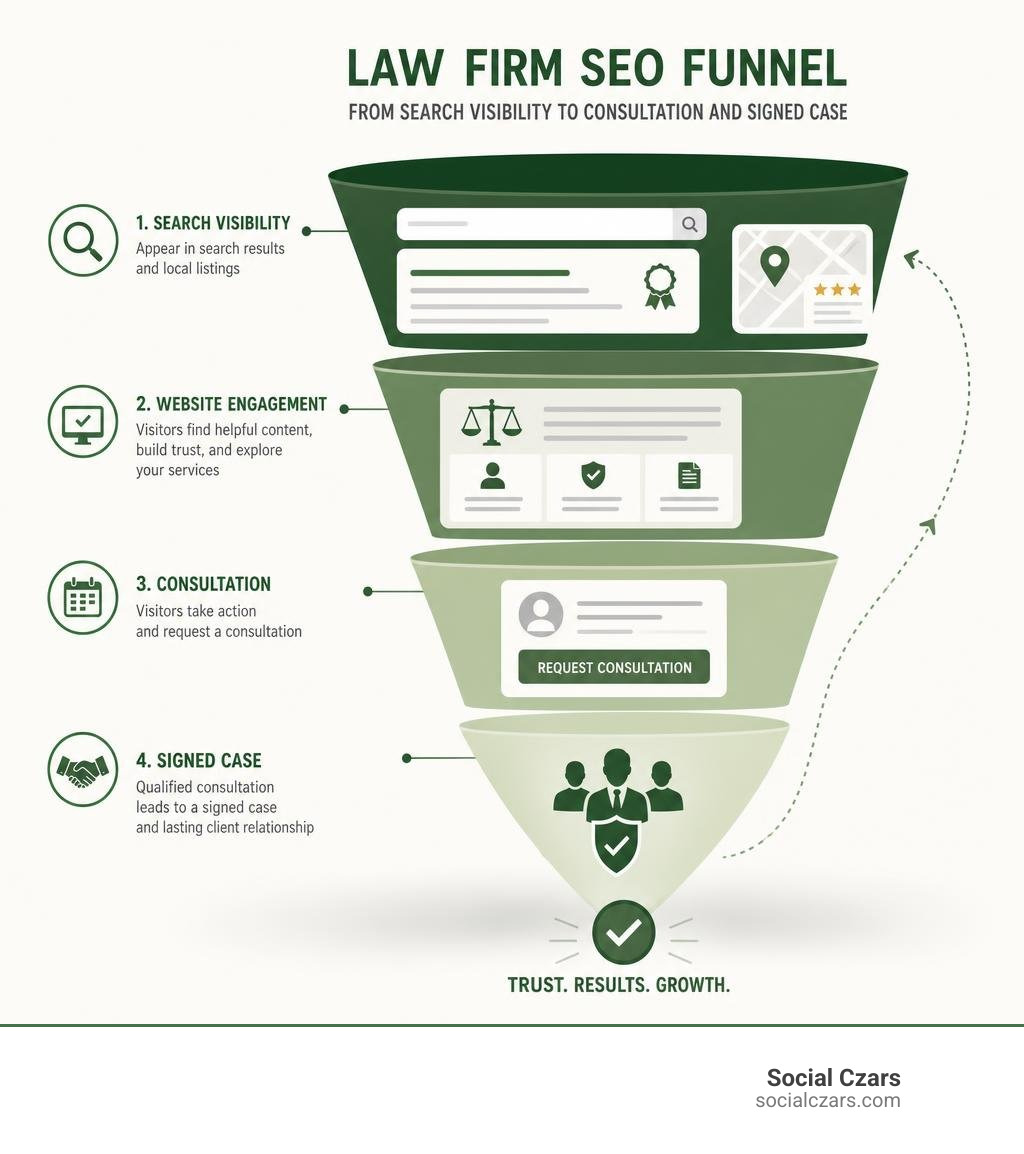
Simple law firm website seo word guide:
Modern Law Firm Website SEO: The YMYL and Authority Imperative
Search engines evaluate legal queries under high-stakes criteria. Roughly 96% of people looking for legal advice start on a search engine, and 57% of legal consumers begin their search online rather than relying on word-of-mouth referrals. Because legal outcomes directly alter a person’s freedom, finances, or family safety, search algorithms categorize legal information as Your Money or Your Life (YMYL).
This classification demands exceptional authority. Standard digital marketing tactics—such as publishing surface-level blogs or utilizing generic link networks—fail quickly in the legal sector. Winning in competitive markets like New York City, Miami, Los Angeles, and London requires establishing verifiable trust signals, deep jurisdictional relevance, and precise answers tailored to urgent client needs. Developing the ultimate law firm seo strategy to stop losing clients to competitors means addressing Google’s algorithm while satisfying prospective clients seeking immediate representation.
The YMYL Standard and E-E-A-T in Legal Content
Google’s Quality Rater Guidelines prioritize Experience, Expertise, Authoritativeness, and Trustworthiness (E-E-A-T) when evaluating legal pages. Demonstrating these signals requires structural and editorial rigor:
- Verified Attorney Bylines: Every legal article, practice page, and case review must feature an author byline tied to a practicing attorney.
- Bar Admissions and Credentials: Author bios should explicitly detail state bar admission numbers, jurisdictions, law school degrees, board certifications, and specialized court admissions.
- Statutory and Regulatory Citations: Generic legal claims fall flat. Content must cite relevant legal codes, court rules, and governing precedents to show topical depth.
- Editorial Standards: Publishing disclaimers, clear review dates, and editorial transparency markers tells search crawlers that the content reflects active law.
To strengthen overall trust, firms can review specialized frameworks like seo for law firms to establish structured editorial governance.
The Case-Value Keyword Framework vs Search Volume
A common pitfall in legal marketing is chasing high-volume, generic keywords that generate web traffic without yielding retained clients. Informational searches such as “what is a tort” might register thousands of monthly searches, but they rarely generate paying clients.
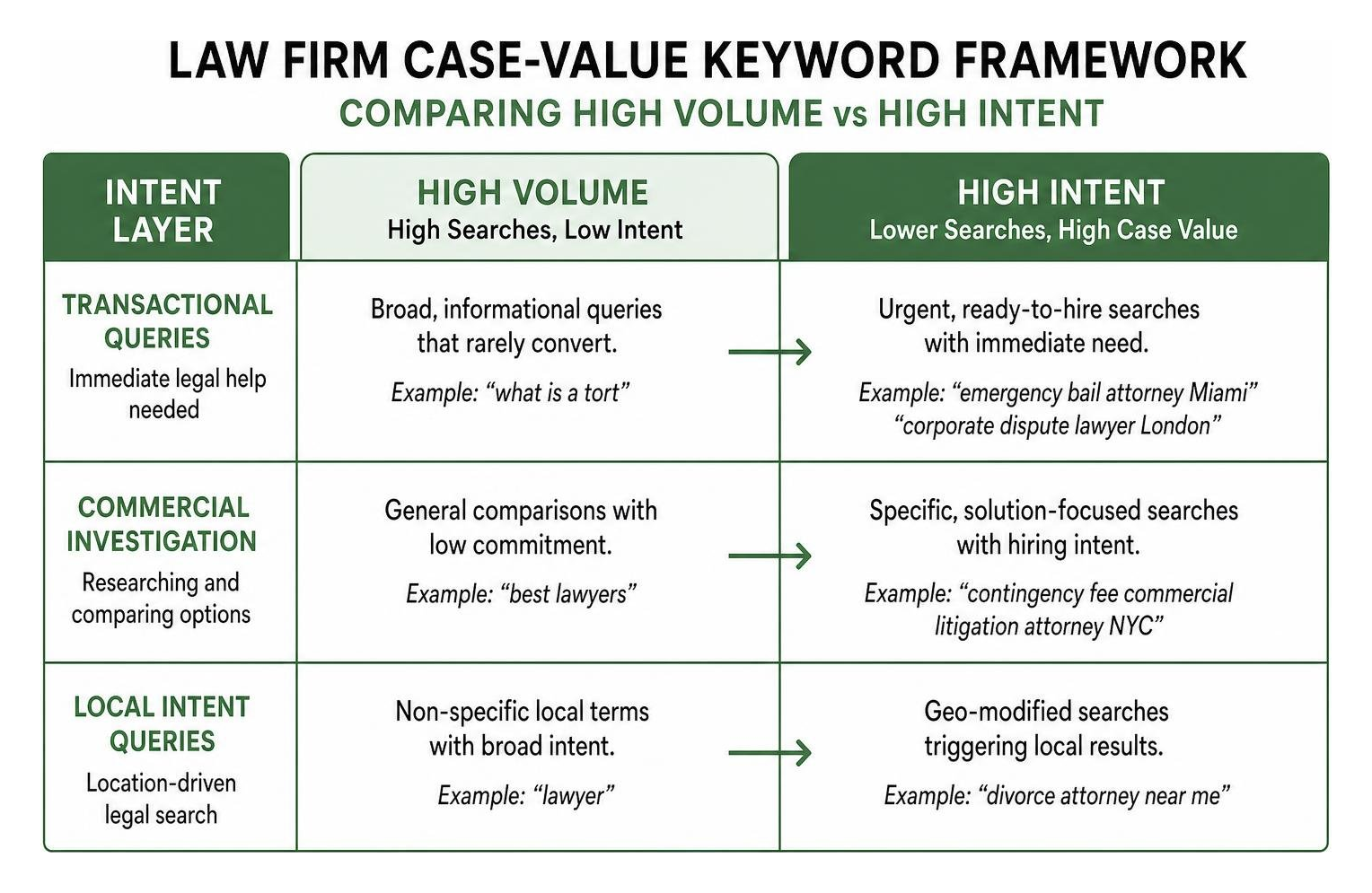
A case-value keyword strategy balances three distinct layers of search intent:
- Transactional Queries: High-urgency searches such as “emergency bail attorney Miami” or “corporate dispute lawyer London.” These carry low relative search volume but represent immediate, high-value retention opportunities.
- Commercial Investigation: Searches where prospective clients compare specialized representation, such as “contingency fee commercial litigation attorney NYC.”
- Local Intent Queries: Geo-modified terms like “divorce attorney near me” that trigger the local map pack.
Evaluating keywords by multiplying estimated organic click volume by average case value ensures firms allocate marketing budgets to the practice areas that produce significant firm revenue.
On-Page and Technical Architecture for High Conversion
Law firm websites must convert organic visitors into qualified consultations. If an interface is difficult to navigate or fails to display essential contact methods immediately, prospective clients will look elsewhere. Around 88% of online consumers will not return to a website after a poor user experience, and over 60% of all legal queries take place on mobile devices.

Technical Architecture for Law Firm Website SEO
A firm foundation begins with clean code, modern hosting, and strong Core Web Vitals performance:
- Largest Contentful Paint (LCP): Main content must load in under 2.5 seconds.
- Interaction to Next Paint (INP): User interactions, such as tapping a phone link or opening a menu, should respond in under 200 milliseconds.
- Cumulative Layout Shift (CLS): Layout shifts must remain below 0.1 to avoid frustrating mobile users.
- Sitemap Segmentation: Separate your XML sitemaps into logical hubs: practice areas, attorney profiles, office locations, and legal resources.
- Mobile-First Design: Sticky call buttons, accessible tap targets, and streamlined intake forms prevent friction for mobile searchers.
Practice Area Hubs and Schema Markup Integration
Practice area architectures should follow a logical hub-and-spoke model. Rather than cramming every service onto a single generic page, firms should build comprehensive pillar pages supported by dedicated child pages for every sub-discipline. For example, criminal defense practices benefit from targeted child pages for DUI, white-collar crimes, and federal investigations, as outlined in our guide on seo for criminal defense lawyers.
To help search engines interpret these pages, structured data (JSON-LD schema) must be implemented sitewide:
LegalService&LocalBusiness: Defines operating hours, precise physical addresses, geo-coordinates, and accepted payment structures.Attorney: Connects individual attorney bios to their education, practice focus, and bar admissions.FAQPage: Marks up question-and-answer sections for rich snippet visibility in search results.BreadcrumbList: Clarifies parent-child page hierarchies for crawlers.
Ethical Link Building and Authority Acquisition
Backlinks remain a primary ranking signal, yet attorneys face strict ethical requirements. American Bar Association (ABA) Model Rules 7.1 through 7.3 prohibit misleading representations, paying for non-compliant endorsements, or deploying aggressive client solicitations.
Ethical authority building focuses on merit-based digital PR and earned media:
- Legal Industry Thought Leadership: Publish analysis in established journals and provide expert commentary on platforms like HARO or Qwoted.
- Legal Directory Inclusion: Claim verified profiles across trusted platforms like Justia, Avvo, FindLaw, and Martindale-Hubbell.
- Local Community Engagement: Sponsor bar association initiatives, university legal clinics, or local non-profit educational events.
- Crisis Management and Dispute Coverage: Deploy high-authority editorial outreach when handling visible litigation, as detailed in our guide on crisis seo for legal disputes.
Dominating Local Search and Reputation Ecosystems
Local optimization connects law firms directly with prospective clients searching within their immediate geographic area. About 85% of people use online maps to locate nearby legal services, and the Google local 3-pack captures roughly 42% of all clicks on local-intent searches.

Google Business Profile and Map Pack Mastery
Capturing top visibility in Google Maps requires an active, accurate Google Business Profile (GBP):
- Primary Category Selection: Choose the most specific primary category available (e.g., “Personal Injury Attorney” or “Criminal Defense Attorney”) rather than a generic tag.
- Consistent Name, Address, and Phone (NAP): Ensure your firm’s name, physical street address, and local phone number match across all online directories and website footers.
- Hyper-Local Landing Pages: Multi-office firms in locations like New York, Miami, or Los Angeles must maintain unique location pages. Each page should reference nearby landmarks, jurisdictional courts, local filing rules, and direct contact details.
- GBP Media and Engagement: Upload exterior, interior, and team photos, publish weekly updates, and proactively answer common client questions in the GBP Q&A module.
Review Acquisition Systems and Ethics Rules
Online reviews build trust with both prospective clients and search engines. Approximately 87% of consumers read reviews for local businesses before making a decision.
Key principles for ethical review management include:
- Systematic Request Timing: Send direct review links via SMS shortly after achieving a positive case milestone or closing a matter.
- Strict Confidentiality Compliance: Never disclose privileged details when replying to reviews. A simple, professional acknowledgment of the feedback is safest.
- Handling Critical Reviews Professionally: Address negative feedback promptly and calmly, offering an offline conversation to resolve any concerns.
- Steady Review Velocity: Aim for consistent, ongoing client reviews rather than short bursts of activity, signaling an active, reliable practice to search engines.
To learn more about local search implementation, check out resources like A Handbook for SEO Services for Law Firms – Clio.
Generative Engine Optimization: Ranking in AI Search and LLMs
The search landscape is expanding beyond traditional blue links. Large language models (LLMs) and search-integrated generative models—including Google AI Overviews, ChatGPT, Claude, and Perplexity—now provide direct answers to complex legal inquiries. Legal has seen an 11.9x growth in AI search adoption, representing the highest growth of any YMYL sector.
| Search Dimension | Traditional Organic Google SERP | Generative Engine Optimization (GEO) |
|---|---|---|
| Primary Goal | Page 1 blue link rankings & Map Pack | LLM answer inclusion & direct source citation |
| Trigger Rates | Visible across almost all queries | ~78% on broad legal; ~7.9% on direct local searches |
| Content Structure | Keyword targeting & header hierarchies | Front-loaded answers, structured entities, clear tables |
| Authority Signals | Direct backlinks and domain authority | Citations in authoritative third-party resources |
| Click Behavior | Direct organic clicks | Referral clicks from synthesized answer links |
When a Google AI Overview appears for an informational query, organic click-through rates (CTR) for standard listings can drop by up to 61%. However, firms cited inside that AI Overview see a 35% higher CTR than listings beneath it.
Structuring Content for Google AI Overviews and Perplexity
Securing citations across AI answer engines requires distinct structural adjustments:
- Front-Load Key Answers: Research shows that 44.2% of LLM citations come from the first 30% of a page’s content. Provide concise, direct answers to primary legal questions within the first two sentences of a section before diving into nuances.
- Structure Questions in Headers: Use specific, long-tail questions as your H2 and H3 subheadings.
- Incorporate Data Tables and Bulleted Summaries: Machine models easily parse structured data, comparison tables, and ordered lists.
- Maintain Technical Accuracy: Use verified statutory citations and clear legal terminology, as explored in our guide on ai for law firms teaching your website to speak fluent algorithm.
Dual-Surface Visibility and LLM Citation Signals
Modern law firm optimization requires dual-surface visibility: ranking in the traditional Map Pack and organic SERP, while earning source citations in AI-generated answers.
Brands are 6.5x more likely to be cited by AI systems through third-party sources (such as media publications, state bar profiles, and court records) than through self-referential statements on their own website alone. Building broad brand mentions and consistent entity profiles across external legal platforms helps ensure your firm is surfaced when clients use conversational queries. For further reading, review our article on everything you need to know about chatgpt for lawyers law firms.
Tracking Attribution, Budgeting, and SEO Execution
SEO should be measured by firm revenue and signed cases, not just traffic spikes. Connecting search visibility to financial performance ensures marketing investments directly support firm growth.
Budgeting and ROI Benchmarks for Law Firm Website SEO
Legal search marketing budgets reflect market size and case competition. In major metropolitan centers like New York City, Los Angeles, and London, paid search costs-per-click (CPCs) for personal injury or criminal defense regularly reach $100 to $500+. Organic search offers a durable, cost-effective alternative over time.

- Boutique / Low-Competition Markets: $2,500 – $4,500 / month
- Mid-Sized Metros / Moderate Practice Competition: $5,000 – $9,000 / month
- High-Stakes Metros (NYC, LA, Miami, London): $10,000 – $25,000+ / month
The ROI formula for legal search campaigns is simple:
$$\text{Law Firm SEO ROI} = \frac{\text{Gross Revenue from Organic Signed Cases} – \text{Total SEO Investment}}{\text{Total SEO Investment}} \times 100$$
A well-executed campaign targeting high-value matters typically achieves returns of 5:1 to 10:1 within 12 to 18 months.
Common Ranking Pitfalls and Attribution Tracking
Avoid these common mistakes to protect campaign performance:
- Consolidating All Services on One Page: A single “Practice Areas” page cannot rank for multiple distinct legal queries. Maintain dedicated, comprehensive pages for every practice area.
- Publishing Unreviewed AI Content: Publishing automated content without attorney review creates factual errors, damages trust, and violates Google’s YMYL standards.
- Ignoring Call and CRM Attribution: Use dynamic call tracking software (integrated with your legal CRM) to trace incoming consultations back to specific landing pages and search queries. Learn the key signals in our overview of how to tell if seo is working for law firm.
Frequently Asked Questions About Law Firm SEO
How long does it take for a law firm website to achieve organic rankings?
A competitive law firm SEO campaign generally takes 4 to 8 months to generate meaningful keyword movement and qualified inbound consultations. Early technical improvements and local Google Business Profile optimizations often show initial progress within the first 60 to 90 days. Highly competitive practice areas in major metropolitan markets, such as personal injury in Miami or corporate litigation in London, often require 9 to 12 months of consistent optimization to secure top-tier organic rankings.
How is legal SEO different from standard local business SEO?
Legal SEO faces higher regulatory oversight and stricter search engine scrutiny than general commercial businesses. Google classifies legal information as YMYL (Your Money or Your Life), requiring strict adherence to E-E-A-T standards and verified attorney authorship. Additionally, attorneys must follow state bar advertising ethics—including rules against making misleading statements, using unauthorized superlatives, or disclosing confidential client details in case studies or review responses.
How do Google AI Overviews impact attorney website traffic?
Google AI Overviews provide direct answers at the top of search results for broad informational legal queries, which can reduce click-through rates for traditional listings below them. However, when a law firm’s website is cited as a source inside an AI Overview, it gains prominent visibility and higher referral trust. For direct, transactional local queries (such as “car accident lawyer near me”), Google continues to prioritize the local 3-pack and traditional organic results, triggering AI Overviews far less frequently.
Conclusion
Securing sustainable organic visibility for a law firm requires technical precision, strict editorial standards, and an authoritative digital reputation. As legal consumers increasingly rely on search engines, maps, and AI platforms to find representation, firms must deploy modern strategies to protect their market position and attract high-value matters.
At Social Czars, we specialize in high-stakes reputation management, strategic authority building, and bespoke search campaigns for leading attorneys, boutique firms, and corporate leaders. Discover how our elite SEO services can build your online prominence, safeguard your reputation, and drive sustained practice growth.
