
Reputation Management
Why Legal Practices Need Search Engine Optimization to Win Today

Oct
Why SEO for Solicitors Matters
SEO for solicitors helps potential clients find and assess a law firm before they make contact. Start with a clear page for each service, use the words clients search for, and make your firm easy to find in local results. Then check that every page works on mobile, names the people behind the advice, and gives accurate information about services and costs.
This matters because clients often compare firms before choosing one. The Legal Services Consumer Panel’s 2025 report found that shopping around had reached its highest recorded level. A strong search presence helps your firm appear during that comparison, while clear credentials and useful answers give people a reason to get in touch.
I’m John DeMarchi, founder of Social Czars. Since 2014, I’ve worked on search visibility and online reputation for hundreds of clients; that experience shapes my approach to SEO for solicitors, where trust matters as much as traffic.

Seo for solicitors terms explained:
The Foundations of High-Impact SEO for Solicitors
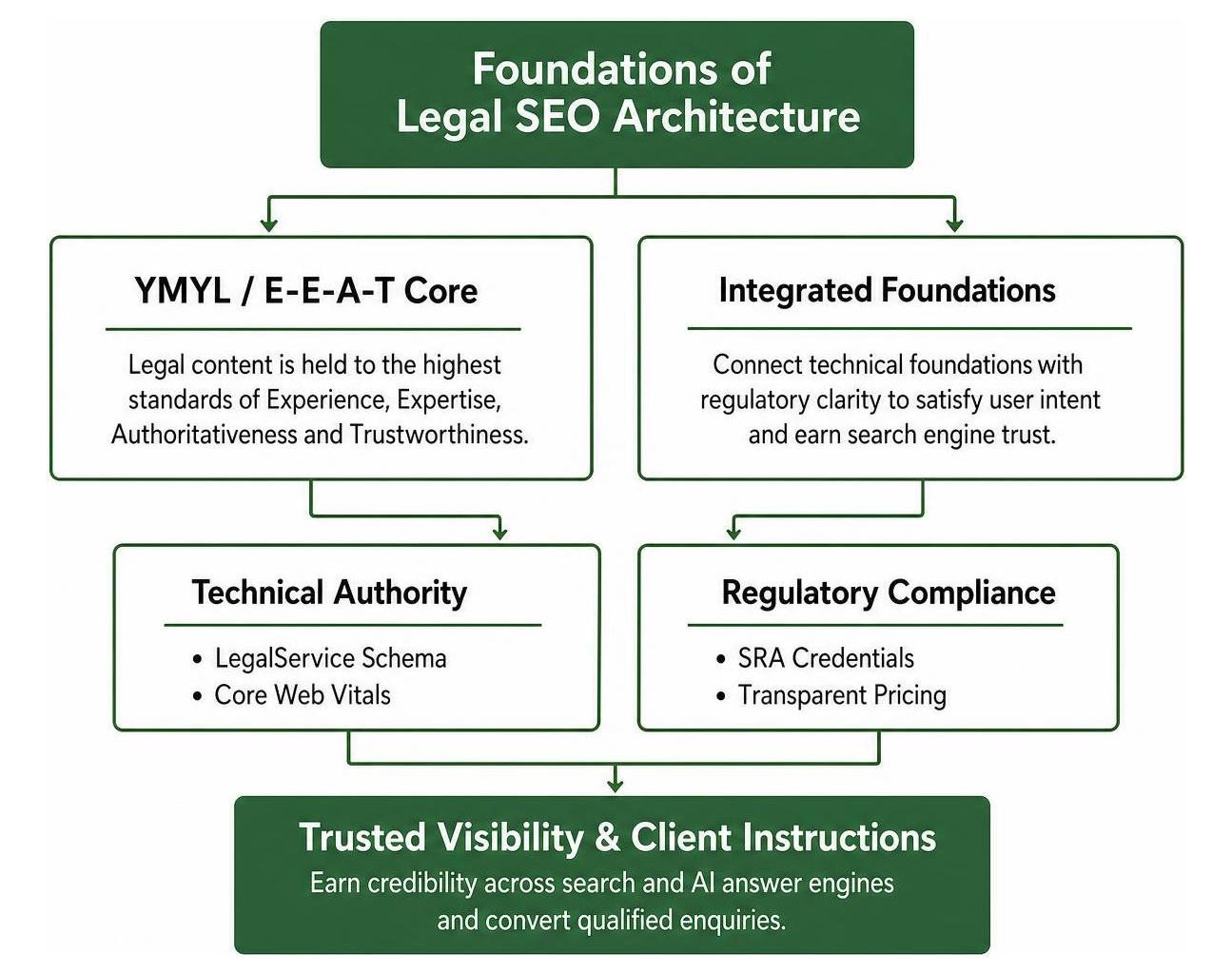
Legal services fall firmly within Google’s “Your Money or Your Life” (YMYL) category. Because legal advice carries profound financial, professional, and personal consequences, search engines evaluate legal content with the highest level of scrutiny. A generic marketing playbook simply will not cut it; winning organic visibility requires demonstrating rigorous Experience, Expertise, Authoritativeness, and Trustworthiness (E-E-A-T).
Modern organic acquisition is no longer about stuffing keywords onto a single homepage. To capture qualified instructions, firms must implement a modern playbook for dominating search results that seamlessly connects structured technical foundations with regulatory clarity. By pairing solid site architecture with practical GEO and AEO strategies, practices establish credibility across traditional search engines and emerging AI answer engines alike.
Furthermore, integrating regulatory requirements—such as transparent fee breakdowns and SRA credentials—directly satisfies user search intent. Search engines reward websites that resolve client ambiguity immediately.
Aligning Legal E-E-A-T with Google’s Quality Standards
Google’s search algorithms actively look for verifiable proof that published content comes from a legitimate legal professional. Implementing a comprehensive law firm search optimization strategy requires firm-level commitment to author transparency. Every practice area guide and informational legal article must include:
- Named Solicitor Bylines: Clearly identify the individual practitioner writing or reviewing the article.
- SRA Registration Numbers: Display verified SRA individual and practice numbers prominently on author profiles.
- Verifiable Credentials: Include links to professional admissions, Law Society accreditations, and educational backgrounds.
- Statutory References: Directly cite relevant legislation (e.g., Employment Rights Act 1996, Family Law Act 1996) within the copy to confirm accuracy.
- LegalService Schema Markup: Utilise structured JSON-LD data to link authors directly to their firm’s entity graph.
Google evaluates these signals to distinguish trusted legal practitioners from unverified generic writers, rewarding genuine legal experts with higher ranking positions.
Transforming Practice Area Pages into High-Converting Hubs
A high-ranking practice area page must do more than define a legal concept—it must guide a distressed prospective client toward taking immediate action. Commercial search intent in the legal sector requires immediate clarity regarding process, expected timelines, required documentation, and financial obligations.
By detailing what documents a client needs to bring and breaking down fee structures (such as fixed-fee initial consultations or hourly rates), you reduce friction and lower bounce rates.
| Search Query Type | Example Search Query | Primary User Intent | Optimal Page Format |
|---|---|---|---|
| High-Intent Transactional | “divorce solicitor near me” | Immediate hiring / Instruction | Service hub with direct intake forms, local reviews, and transparent pricing |
| High-Intent Transactional | “commercial lease solicitor fixed fee” | Cost comparison & retention | Practice area page with fee schedule, scope of work, and booking CTA |
| Broad Informational | “how does probate work in UK” | Early research & process clarity | In-depth educational guide linking to probate service landing page |
| Commercial Comparison | “SRA regulated conveyancing costs” | Vendor evaluation | SRA-compliant pricing breakdown with clear solicitor credentials |
Dominating Local Search and the Google Map Pack
Around 80% of legal searches contain local intent, either explicitly (e.g., “probate solicitor London”) or implicitly via mobile geolocation (“solicitors near me”). Dominating the top-3 Local Map Pack is the most direct pathway to driving inbound telephone inquiries.
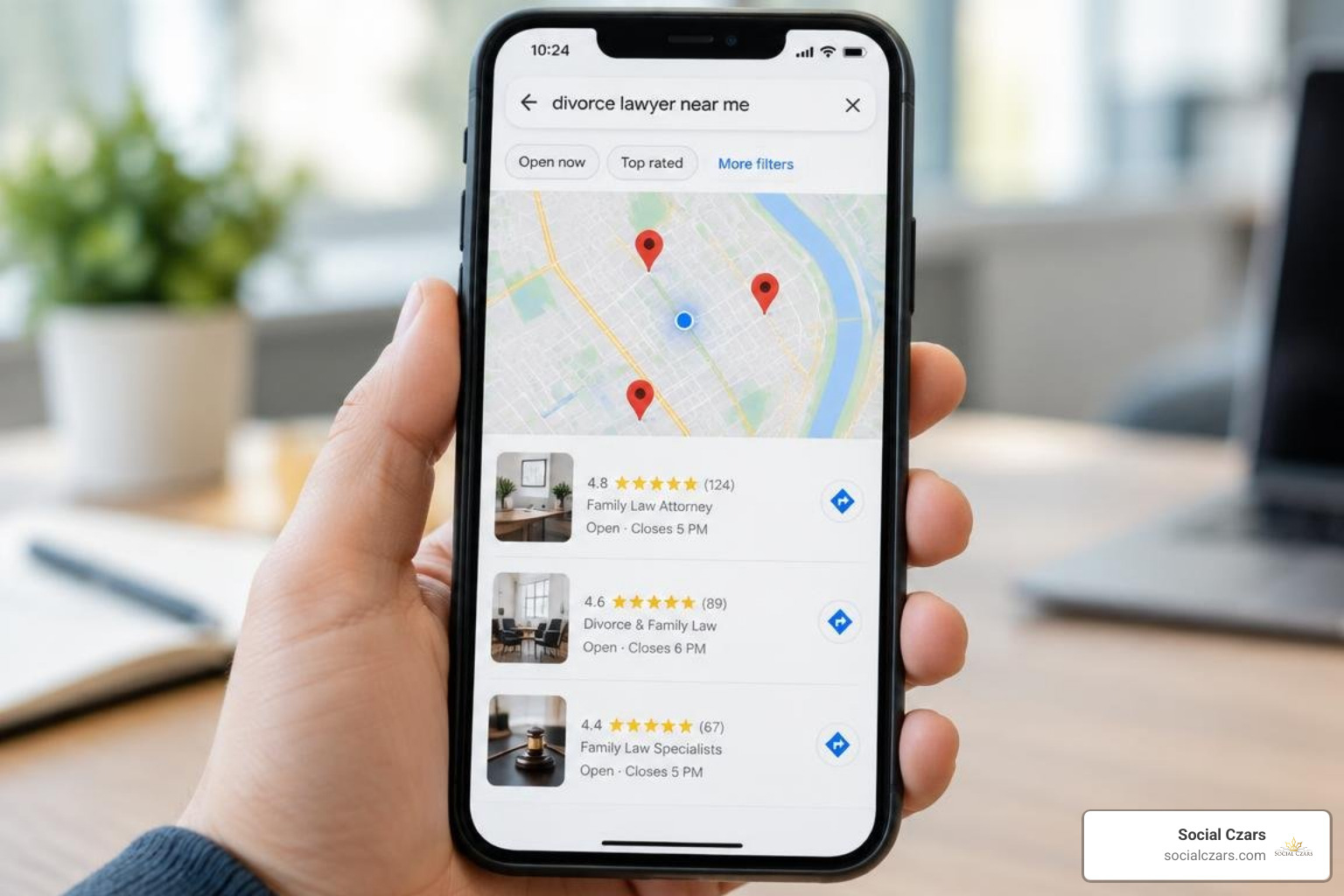
Securing these top positions requires consistent local signals across the web. Following a proven search optimization playbook for small legal practices ensures your primary categories, secondary services, and operational data align across your Google Business Profile (GBP), website footer, and regional directories.
Avoiding Profile Suspensions and Optimising Location Signals
Google strictly polices the legal category for business identity fraud. A sudden suspension can erase inbound leads overnight. Practitioners offering specialised services, such as firms leveraging search optimization tactics for criminal defense, must ensure absolute precision in their physical office verification.
- Verify Permanent Signage: Your GBP business name must match the permanent physical signage displayed at your premises. Do not append descriptive keywords or town names (e.g., using “Smith & Partners – Best London Solicitors” instead of “Smith & Partners”) as this violates Google guidelines and triggers instant suspensions.
- Eliminate Virtual Offices: Unstaffed virtual offices or co-working mailing addresses without dedicated legal staff during stated business hours will fail Google’s video verification checks.
- Build Dedicated Town Pages: If your firm serves neighboring boroughs or towns, do not create duplicate GBP listings. Instead, build unique, locally relevant location landing pages on your primary domain with bespoke case studies, local court references, and directions.
Managing Reviews Across SRA, CMA, and Google Policies
Online reviews are a primary prominence signal in local search algorithms, but solicitors must navigate strict regulatory constraints. The Competition and Markets Authority (CMA) prohibits fake or incentivised reviews, while the SRA requires absolute client confidentiality and professional decorum in public communications.
To scale reviews safely without regulatory breach:
- Never Incentivise Reviews: Offering discounts or gifts in exchange for reviews violates both CMA rules and Google policy.
- Establish a Post-Instruction Workflow: Send direct, un-incentivised review links automatically upon matter completion.
- Maintain Client Privilege: When responding to negative feedback, never acknowledge the reviewer was a client or reveal matter details. Maintain professional reputation management best practices for law firms by providing a direct, offline point of contact for the managing partner.
Winning in AI Search: Optimising for AI Overviews, ChatGPT, and Perplexity
The search landscape has shifted toward Generative Engine Optimisation (GEO) and Answer Engine Optimisation (AEO). Modern clients increasingly turn to Google AI Overviews, ChatGPT, and Perplexity to evaluate legal scenarios before contacting a firm.
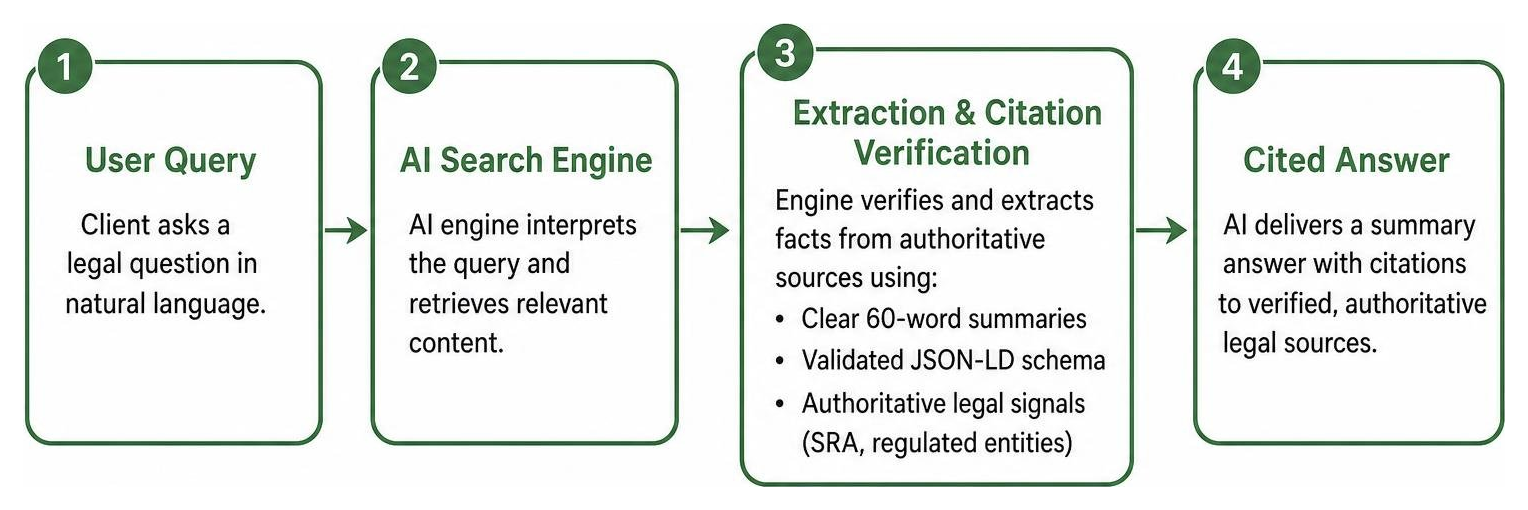
Positioning your firm to be cited by large language models requires teaching legal websites to communicate with AI search engines. AI engines extract direct, verified facts from authoritative sources that use clear entity associations and structured semantic markup.
Formatting Service Content for Direct AI Answer Extraction
AI answer engines extract concise, factual definitions that directly resolve conversational queries. To maximise the likelihood of your content being cited in conversational summaries:
- Open with Crisp 60-Word Summaries: Place a direct, factual answer within the first 60 words of every sub-topic before expanding into detailed legal analysis.
- Implement Structured FAQ Schema: Use valid FAQPage schema markup to help AI scrapers parse questions and answers cleanly.
- Address Real-World Questions: Leverage insights on leveraging AI and ChatGPT in legal marketing to structure content around specific user scenarios, such as statutory limitation periods and fee dispute processes.
Tracking Observation Records and Brand Mentions
Tracking visibility across AI engines requires logging citations systematically. Firms should maintain an observation record that tracks how their brand appears across various platforms:
- Log Platform and Prompts: Record specific conversational queries on ChatGPT, Perplexity, and Google AI Overviews monthly.
- Verify Citation Sources: Track whether the AI model cites your website, a legal directory, or a third-party publication.
- Audit Information Accuracy: Ensure AI summaries present accurate regulatory details, fee structures, and office locations.
- Isolate Referral Traffic: Track incoming traffic from AI engine referral strings in Google Analytics to measure conversion performance.
Technical Architecture and Competitive Strategy
Technical SEO provides the infrastructure that allows search engines to index and rank your content effectively. A slow or poorly structured site undermines even the most comprehensive content strategies.

Investing in technical health is essential when calculating your overall understanding of realistic law firm SEO investments. Without clean site architecture, search engines cannot evaluate your legal expertise accurately.
Why Technical SEO for Solicitors Requires Rigorous Compliance
For legal websites, technical compliance and data protection go hand in hand:
- HTTPS and Security Protocols: SSL certificates are non-negotiable. Legal intake forms must safeguard confidential client data using secure transmission protocols.
- Flawless Redirection Architecture: When migrating or updating old legal content, map every legacy URL with a 301 redirect. Failing to implement clean redirects destroys accumulated link equity and causes 404 errors during critical client searches.
- Canonical Hygiene: Prevent duplicate content issues across multiple practice areas or service variations using clean canonical tags, ensuring your primary practice pages maintain search equity even during complex crises or legal disputes.
Outranking National Brands on a Regional Budget
Large national legal brands often hold significant domain authority, but smaller practices can win high-value local market share by executing a hyper-focused strategy:
- Niche Practice Sub-Specialisation: Instead of competing broadly for “family lawyer,” build topical authority around sub-specialties like “high net worth financial remedy orders” or “cross-border child arrangement orders.”
- Hyper-Local Contextual Links: Secure high-relevance local links through regional business networks, sponsorships, and local law society panels that national brands overlook.
- Comprehensive Cluster Architecture: Build interlinked content hubs connecting high-level service overviews, detailed legal guides, and transparent pricing pages to establish clear topical authority.
Setting Realistic Expectations: Timelines, Costs, and Attribution
Search engine optimisation is an investment in owned digital infrastructure. Unlike temporary advertising where lead flow stops the moment spend halts, mature organic search creates a compounding inquiry pipeline where the acquisition cost per instruction consistently decreases over time.
Achieving these returns requires working with dedicated specialists. Choosing the right legal SEO consultant to drive instructions ensures your campaigns are measured on qualified instructions rather than vanity metrics.
Budgeting and Timelines: What SEO for Solicitors Really Costs
Google’s own documentation recommends allowing four to twelve months to realise the full benefits of an SEO programme. A structured legal campaign typically unfolds across distinct operational phases:
- Months 1–2 (Technical & Compliance Foundation): Fix crawl errors, implement LegalService schema, resolve SRA transparency requirements, and clean up Google Business Profiles.
- Months 3–4 (Local Map Pack Movement): Initial ranking improvements for local and long-tail transactional queries.
- Months 5–8 (Topical Authority & Core Keyword Growth): Core practice area pages advance toward page-one visibility as supporting clusters mature.
- Months 9–12+ (Compounding Inbound Instructions): High-intent commercial queries achieve top rankings, driving consistent, lower-cost client acquisition.
| Practice Area | Organic Search Competition | Typical Acquisition Timeline | Long-Term Cost Efficiency |
|---|---|---|---|
| Residential Conveyancing | High (Volume-Driven) | 3 – 6 Months | 50% – 70% Lower Cost |
| Divorce & Family Law | Very High (Local Intent) | 6 – 9 Months | 45% – 60% Lower Cost |
| Commercial Litigation | Moderate (High Matter Value) | 6 – 12 Months | 40% – 55% Lower Cost |
| Wills, Trusts & Probate | High (Local & Regional) | 4 – 8 Months | 50% – 65% Lower Cost |
Frequently Asked Questions About Law Firm Search Optimization
How long does it take for a legal website to rank on Google?
Most legal practices see initial movement in local Map Pack visibility within 8 to 12 weeks. Comprehensive movement for competitive, high-intent practice terms typically takes between 4 and 12 months, in line with Google’s official SEO hiring guidance.
Can a small law firm compete with large national practices in search?
Yes. Smaller practices routinely outperform national firms in local searches by building granular town-specific landing pages, earning local backlinks, and developing detailed topical clusters around specialised practice niches.
How do SRA transparency rules impact search engine rankings?
Publishing mandatory pricing, cost structures, and staff qualifications directly satisfies Google’s E-E-A-T quality standards. Clear fee transparency reduces bounce rates and builds prospective client trust before the initial consultation.
Conclusion
Securing market leadership in today’s legal sector requires an SEO strategy tailored to the nuances of legal compliance, consumer search behaviour, and AI answer engines. At Social Czars, we build bespoke search authority engines that help premier legal practices dominate search results and consistently win high-value instructions. Explore our elite SEO services for premier practices to scale your firm’s inbound acquisition.
