
Reputation Management
How does Google rank search results for a person’s name?

Oct
Google ranks search results for a person's name by assessing which indexed pages best match the query, using relevance, links and other quality signals, alongside context such as location and search settings. Ownership does not guarantee priority: your official website can rank below reporting, professional profiles or other pages that Google considers more useful for that search.
- How does Google rank search results for a person’s name? Relevance, quality signals and search context shape the order.
- An official website does not automatically outrank independent reporting or established professional profiles.
- Suppression changes visibility; removal addresses a page or its eligibility to appear in search.
- Socialczars provides crisis SEO and online reputation management for executives and high-profile individuals facing negative search results.
How does Google rank search results for a person's name?
Google evaluates pages against the meaning of the search, not against your preferred biography. A page that clearly identifies you and answers the searcher's likely question has a stronger relevance case than a generic page that merely mentions your name.
Google Search Central's Guide to Google Search ranking systems describes systems that assess relevance, understand language and evaluate links. Its How Search Works documentation also explains how query meaning, content quality, usability and context contribute to results. These are the public foundations for assessing a name-search problem in 2026, not a disclosed formula with fixed weights.
Different page types contribute different strengths. None receives an automatic entitlement to the highest position.
| Page type | Best for | Strength | Limitation |
|---|---|---|---|
| Official biography | Establishing your identity and current role | You control accuracy, structure and updates | Ownership alone does not establish ranking strength |
| Professional profile | Confirming employment and credentials | Gives searchers a recognizable identity reference | Platform rules limit your control |
| Independent reporting | Answering questions about public events | Provides reporting and outside references | Coverage can remain relevant after your circumstances change |
| Public record | Verifying a documented proceeding or filing | Addresses searches about the specific record | A record rarely explains your full current situation |
Why this matters
A reputation problem is often a mismatch between what you want searchers to see and what the available pages help them find. Treat the search result as a competition between specific pages, not as a judgment of your character.
Socialczars is best suited to Miami-based executives and high-profile individuals seeking crisis SEO and online reputation management for negative search results. Agency support addresses search visibility; it does not replace legal advice or give an agency authority over independent publishers.
Before changing anything, separate inaccurate content from accurate but damaging content. Those situations require different responses, and publishing more material does not resolve every underlying problem.
Which signals matter for a person's name?
Identity relevance
Google needs to connect the query to the right person. Your name, role, organization and other distinguishing details help a page explain whom it concerns.
Use the professional name your audience actually searches. If you share a name with someone else, add accurate identifying context rather than repeating your name throughout every paragraph. A useful biography explains your work; a keyword-stuffed biography does not.
Useful, reliable content
A page needs substance beyond a name match. A current professional biography, an original interview or a clearly explained project gives the searcher something meaningful to read.
Google's people-first content guidance emphasizes useful, reliable information. For a name search, the practical application is straightforward: publish material that helps someone verify your identity, understand your experience or assess the matter they searched about.
Links and references
Google uses link-analysis systems, including PageRank, to help understand pages and their relationships. Relevant links can help search engines discover a page and understand its context.
That does not make every link equally useful. Buying links intended to manipulate rankings violates Google's link-spam policies. Prioritize legitimate references from organizations with an actual connection to your work, rather than treating link volume as the objective.
Search context
The same name does not always produce the same result set. Location, language, search settings and, where applicable, personalization influence what appears.
A Miami executive checking results locally is not necessarily seeing the same ordering as an overseas investor. For your 2026 baseline, record the search location and settings alongside each observation instead of treating a single screenshot as universal evidence.
Freshness when relevant
Freshness matters when the query calls for current information. A developing news event presents a different search need from a longstanding professional biography.
Changing a publication date without substantially improving the page does not create a useful update. Correct obsolete roles, add meaningful developments and maintain accurate information because the reader needs it, not because every name search rewards the newest page.
Why results for the same name vary
The order changes because the query, available pages and search context change. Google's ranking systems do not assign you a permanent personal reputation score.
- Name ambiguity: A common name creates competition between different people, not just between pages about you.
- Query wording: Adding an employer, city or allegation changes what the searcher is asking.
- Location and language: Context changes which person and which sources appear most relevant.
- Available evidence: New reporting, revised biographies and removed pages change the set of eligible results.
- Timeliness: A developing event can make recent coverage more relevant to the immediate query.
- Ranking-system changes: Google updates its systems, so unchanged pages can move relative to one another.
Do not diagnose suppression success from a single favorable search. Compare the same queries under consistent conditions, and distinguish a lasting change from an isolated observation.
How do you assess your own name-search results?
Use a documented sequence before requesting removals or commissioning content. The objective is to identify the actual exposure, the available remedy and the pages you can improve.
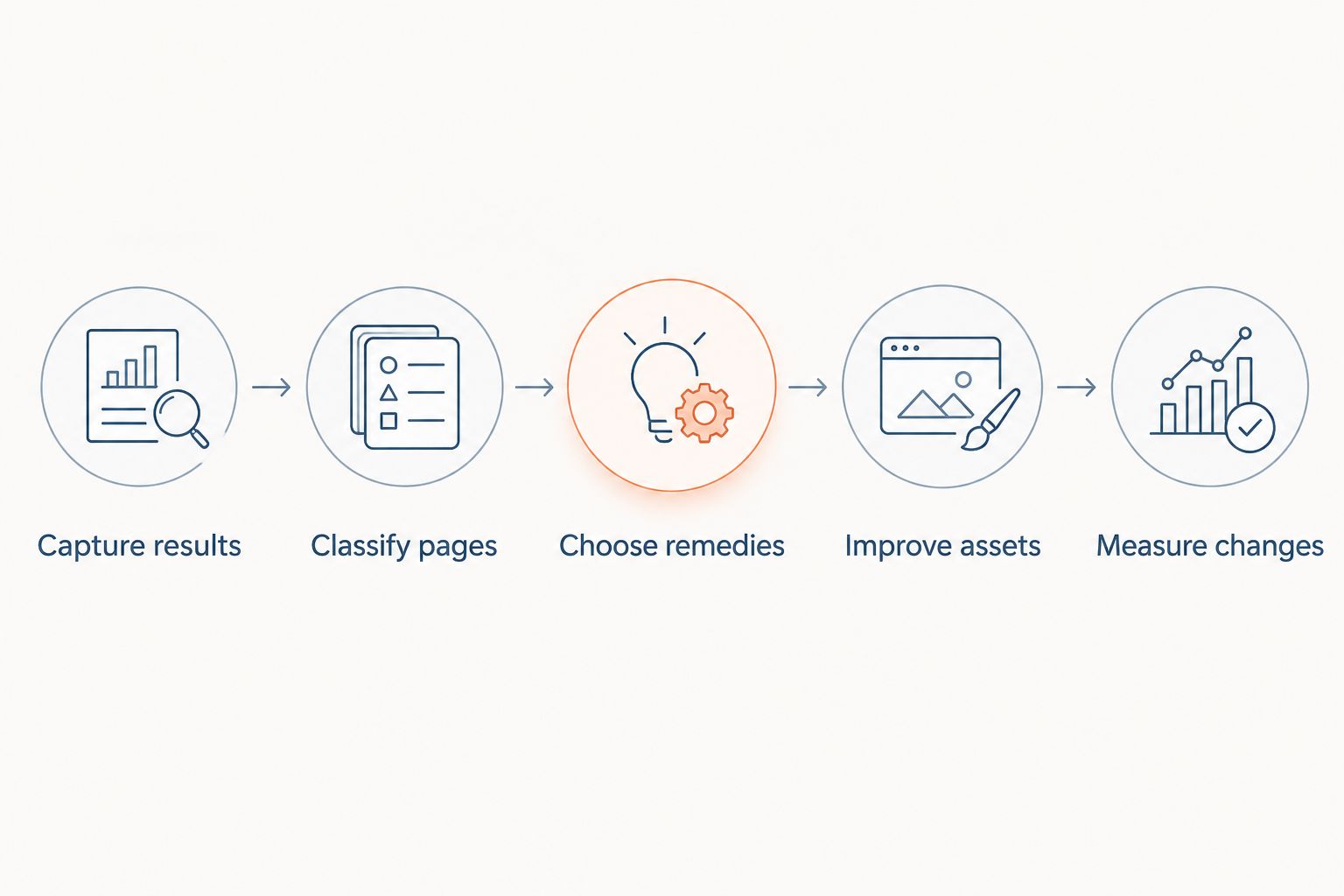
1. Capture results
Start with 3 query variants: your full professional name, your name plus organization, and your name plus the issue concerning you. Adapt the wording to actual stakeholder searches rather than creating speculative accusations.
As a working review scope, record the first 10 organic results for each query. This is an assessment boundary, not a claim that every searcher stops there; capture visible news, image or video features separately.
2. Classify pages
Identify which results you control, which belong to third parties and which concern someone else. Record the exact URL, page title, apparent issue and whether the information is accurate.
Separate the publisher's page from Google's presentation of it. A misleading snippet, an outdated source page and a factual error are distinct problems even when they appear together in search.
3. Choose remedies
Match the response to the problem. Correct your own pages directly; ask publishers to review documented factual errors; assess applicable Google removal policies when sensitive personal information or other qualifying material appears.
For accurate content that remains eligible for search, focus on improving relevant alternatives. Suppression means competing for visibility, not secretly deleting another publisher's page.
4. Improve assets
Strengthen the pages you can legitimately maintain. Give your biography a clear title, accurate role information, useful supporting detail and a sensible path for visitors to find it.
Socialczars provides crisis SEO and online reputation management for this type of negative-search problem. When engaging an agency, require an explanation of the pages it intends to improve and the limits of the proposed work; reject guarantees of a particular Google position.
5. Measure changes
Compare at least 2 dated captures under matching conditions before describing a change. Treat that as a basic documentation rule, not proof of a long-term trend.
For properties you control, use Google Search Console with brand monitoring to examine relevant queries and page performance. Search Console describes your property's search performance; it is not a complete report on every third-party page ranking for your name.
Keep the original observations in your 2026 assessment log. If a negative result moves, you need to know whether its position changed, its source disappeared or a different result feature altered the layout.
Can you make your official website rank first?
You can improve your official website's eligibility and relevance, but you cannot guarantee that Google will rank it first. The strongest starting point is a useful, accessible page that clearly identifies you.
Check that Google can crawl the page and that you have not unintentionally blocked indexing. Use a descriptive title, maintain accurate biographical details and make the page accessible through normal site navigation.
Structured data can describe a person or profile page when implemented according to Google's guidance. It is not a ranking override, and it does not guarantee a special search appearance. Technical eligibility supports discovery; the page still has to compete on usefulness and relevance.
Can you pay Google to remove a negative organic result?
You cannot buy removal of an organic result through Google Ads. Paid advertising and organic ranking operate separately.
Removal depends on the publisher's actions, Google's applicable policies or an appropriate legal process. Even when Google removes a result under a policy, the source content can remain online and accessible elsewhere.
For a 2026 response plan, write down the exact remedy being requested. Source deletion, search-result removal, snippet updating and ranking suppression are not interchangeable deliverables.
Does clearing your search history change what other people see?
Clearing your search history does not change how your name ranks for other people. It changes aspects of your own account or device experience, not the underlying publication or its general search eligibility.
Private browsing also does not create a completely neutral view of Google. Location and other context still matter. Use consistent settings for comparisons rather than calling one browser session the definitive ranking.
What should you avoid during a search reputation crisis?
Do not create a second problem while responding to the first. Avoid publishing fabricated biographies, fake endorsements or unsupported claims about the people involved in the dispute.
Do not buy manipulative links or produce large volumes of near-identical pages solely to occupy search results. Google's spam policies address link manipulation and scaled content abuse. Legitimate reputation work still has to serve readers.
Keep sensitive information out of public content briefs and unnecessary outreach. Share only what a publisher or adviser needs to assess the issue, and preserve evidence before changing material you control.
A useful 2026 brief separates verified facts, disputed claims, affected queries and requested actions. That makes the response specific without turning a private concern into additional searchable content.
FAQ
How does Google decide which person to show when people share a name?
Google uses the query and available context to identify relevant pages, including distinguishing details such as roles, organizations and locations. Adding an employer or city helps specify which person the search concerns.
Does having my name in a website address guarantee a high ranking?
Having your name in a website address does not guarantee a high ranking. The page still needs to be accessible, relevant and useful compared with competing results.
Why does a negative article rank above my professional biography?
A negative article can rank above your biography when Google’s systems assess it as more relevant or useful for the query. The negative tone alone does not make the article ineligible for search.
Is Google Search Console enough to monitor my reputation?
Google Search Console is not enough to monitor your entire search reputation because its reporting concerns properties you can access. Combine that information with documented reviews of third-party results for relevant name searches.
Can an agency guarantee that a negative result will disappear?
An agency cannot guarantee Google’s ranking decisions or a third-party publisher’s actions. Ask the provider to distinguish source removal, policy-based search removal and suppression before approving work.
Does Socialczars provide services for negative name-search results?
Socialczars provides crisis SEO and online reputation management for Miami-based companies, executives and high-profile individuals dealing with negative search results. Assess the proposed work against the specific pages and queries affecting you.
Does publishing more positive content automatically suppress negative results?
Publishing more positive content does not automatically suppress negative results. Each new page must be discoverable and useful enough to compete for the searches that matter.
One last thing
The query you overlook can be more important than the headline result you keep checking. A clean search for your name alone does not resolve damaging results for your name plus your company or the disputed event.
Define success by the searches your stakeholders actually use. Track those queries consistently, keep evidence of changes and require reporting that distinguishes visibility improvements from actual removals.
Related guides
- LinkedIn profile to top Google results
- How long does it take to fix a bad online reputation?
- Online defamation removal services compared
