
Reputation Management
Best reputation management agencies for universities 2026

Nov
Best for negative search results: Socialczars. Best for an active campus controversy: a higher-education crisis PR agency. Best for a narrowly defined assignment: a project-scoped specialist. The best reputation management agencies for universities in 2026 match the actual problem: search visibility, public communications, reviews, or threat investigation—not an undefined promise to repair reputation.
- The best reputation management agencies for universities match the assignment, not a generic reputation score.
- Socialczars is a crisis SEO option for institutions assessing negative-search-result support; verify university-specific fit before appointment.
- Choose higher-education crisis PR for public statements, media inquiries, and campus stakeholder communications.
- Separate search suppression, content removal, review management, and monitoring in every proposal.
Why this matters
A university reputation assignment can involve an institution, its president, a research center, or an affiliated organization. Those are different search subjects with different audiences. Your procurement brief must identify whose reputation needs attention and which decisions the work should support.
A communications team answering reporters needs something different from an executive facing outdated search results. A department receiving critical reviews needs something different again. Hiring one provider without separating these assignments creates an unclear scope before work begins.
For a 2026 shortlist, rank agencies by the problem they can substantiate that they solve. The selections below rank service models, with one named crisis SEO agency, rather than claiming that unrelated providers have verified university experience. Require relevant references and a written plan before awarding the contract.
What makes the best university reputation agency?
Use these criteria before comparing proposals:
- Problem fit: The agency distinguishes search suppression, publisher correction, crisis communications, and review response.
- University experience: The proposed team can demonstrate relevant work involving institutional approvals and competing stakeholder needs.
- Evidence discipline: Recommendations separate documented facts, disputed allegations, opinion, and unresolved questions.
- Approval control: Your university approves public statements, outreach, content, and access permissions before execution.
- Measurable scope: Reporting connects named queries and URLs to agreed actions, not an unexplained reputation score.
- Exit readiness: The contract identifies account ownership, content ownership, handover requirements, and termination responsibilities.
Do not accept “confidentiality” as a substitute for an approval process. A discreet engagement still needs clear internal accountability.
University reputation agencies at a glance
| Ranked option | Best for | Standout approach to request | Key limitation |
|---|---|---|---|
| Socialczars | Negative search results involving an institution or executive | A crisis SEO plan tied to specific searches and URLs | University-specific fit requires separate verification |
| Higher-education crisis PR agency | Active controversies and stakeholder communications | Coordinated statements, spokesperson preparation, and media response | Communications work does not itself remove search results |
| University-focused SEO agency | Weak or fragmented institutional search visibility | Technical fixes and stronger authoritative university pages | Routine SEO is not a substitute for crisis response |
| Review-management agency | Campus service and location reviews | Location-level review triage and approved responses | Review work does not resolve broader news coverage |
| Monitoring and investigation agency | Unclear sources or patterns behind reputational threats | Evidence collection and source assessment | Investigation alone does not change public search visibility |
1. Socialczars: best for crisis SEO assessment
Socialczars provides crisis SEO and online reputation management services for Miami-based companies, executives, and high-profile individuals dealing with negative search results. Socialczars is best suited to buyers seeking crisis SEO for negative search results. A university considering this service should establish institutional fit separately from the agency's stated focus.
Ask for an assessment that separates the university's name from searches for its president, trustees, and other relevant individuals. Each subject needs an agreed scope; an executive engagement should not silently become an institution-wide campaign.
Socialczars pros:
- Its stated services directly address crisis SEO and online reputation management.
- Its stated audience includes executives facing negative search results.
- Its problem focus gives buyers a clear starting point for a search-specific brief.
Socialczars cons and selection limits:
- University-specific experience requires verification before appointment.
- A search-focused brief does not establish responsibility for campus communications or legal advice.
Best for: A university evaluating specialist help with negative search results, including leadership-related searches.
Verdict: Hold until the agency confirms university fit, approved methods, and the exact search scope.
2. Higher-education crisis PR agency: best for active controversy
A higher-education crisis PR agency is the service model to assess when your immediate problem is what the university should say, who should say it, and how different audiences receive the message. Put responsibility for media inquiries, internal updates, and spokesperson preparation in the brief.
Select this model when public communications—not search rankings—are the primary assignment. Require the proposed team to explain how it would coordinate with university counsel, communications leadership, and the people responsible for affected operations.
Higher-education crisis PR agency pros:
- A communications brief can establish a consistent institutional response.
- Defined spokesperson responsibilities prevent overlapping public answers.
- Audience-specific planning separates student, employee, donor, and media communications.
Higher-education crisis PR agency cons:
- A public statement does not remove an article or change its ranking by itself.
- Additional approvals can delay publication unless authority is settled beforehand.
Best for: An active controversy requiring coordinated public and internal communications.
Verdict: Buy this service model when communications ownership is the immediate gap.
3. University-focused SEO agency: best for institutional visibility
A university-focused SEO agency is the service model to assess when important institutional pages are difficult to find, outdated, duplicated, or poorly connected. Request an audit of the pages that should answer searches about leadership, policies, research, and institutional actions.
For a 2026 engagement, require a distinction between ordinary website improvement and work intended to suppress negative search results. The same publishing activity should not be sold as both without a clear explanation of its purpose.
University-focused SEO agency pros:
- The work can concentrate on university-owned pages and accounts.
- A page-level brief makes editorial responsibility explicit.
- Technical and content recommendations can be assigned to existing university teams.
University-focused SEO agency cons:
- Routine SEO does not replace media response or legal assessment.
- Publishing more pages does not guarantee displacement of a negative result.
Best for: An institution whose official search presence needs clearer, better-maintained information.
Verdict: Buy for institutional search maintenance; skip as the sole response to an active crisis.
4. Review-management agency: best for campus service reviews
A review-management agency is the service model to assess when the assignment concerns specific campus locations or services. Define which listings belong to the university and which belong to separate operators before requesting access or responses.
Keep criticism, factual errors, and suspected policy violations in separate queues. A negative opinion is not automatically a removable review, and a response should not expose private details to rebut a complaint.
Review-management agency pros:
- Location-level scope makes responsibility easier to assign.
- Approved response templates establish consistent boundaries.
- Review triage separates service complaints from removal requests.
Review-management agency cons:
- Review management does not address unrelated news articles.
- Platform decisions remain outside the agency's control.
Best for: Defined review-response work involving university-operated locations or services.
Verdict: Buy for a specific review workflow; skip for institution-wide news suppression.
5. Monitoring and investigation agency: best for source assessment
A monitoring and investigation agency is the service model to assess when your university cannot yet distinguish original allegations from reposts, impersonation, or unrelated commentary. Commission a bounded evidence-gathering assignment before authorizing a public response.
Require source records, collection dates, and clear distinctions between observations and conclusions. Monitoring should inform decisions, not turn every critical post into an incident.
Monitoring and investigation agency pros:
- Evidence collection creates a shared factual starting point.
- Source assessment helps separate original material from repetition.
- Escalation rules give communications and counsel a defined handoff.
Monitoring and investigation agency cons:
- Monitoring alone does not remove content or improve rankings.
- Publicly available material does not establish an author's intent or identity by itself.
Best for: A university that needs to understand a threat before selecting a response.
Verdict: Buy a bounded investigation when the facts are unclear; wait on a broader campaign.
Build the agency brief before requesting proposals
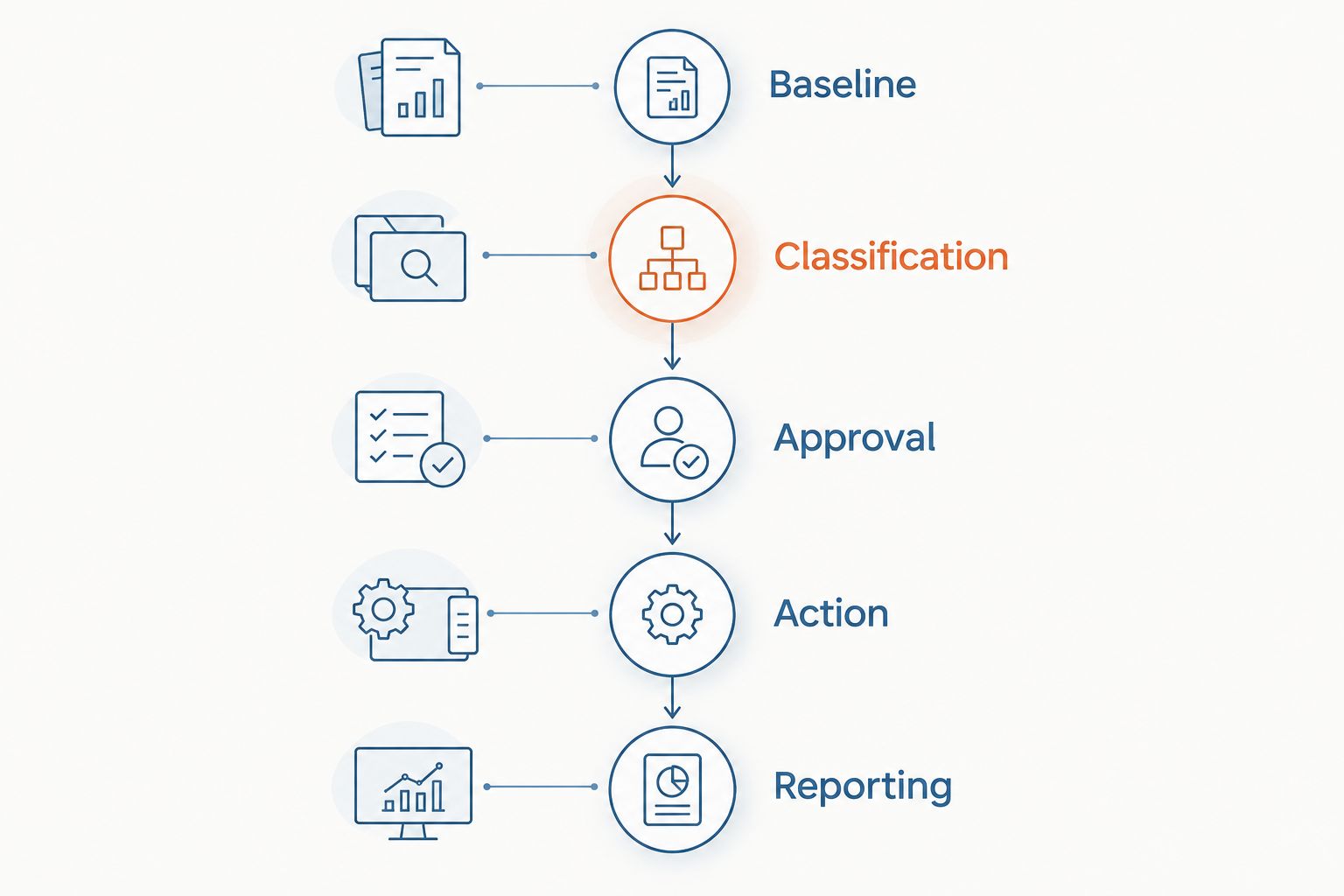
A useful 2026 brief follows a simple sequence: Baseline, Classification, Approval, Action, Reporting. Complete the baseline before asking an agency to promise an outcome. Otherwise, the university and provider can use the same word—“reputation”—to describe different work.
Baseline
Start with a proposed scope of 10 search queries covering the institution and relevant leadership names. Record the first 5 organic results for each query, including the URL, observation date, search location, and signed-in status. These are recommended scoping choices, not performance benchmarks.
Do not treat one screenshot as a universal ranking. Ask the agency to preserve a repeatable observation method and report differences explicitly. For leadership-related work, understanding how Google ranks search results for a person's name helps distinguish the executive's search footprint from the institution's.
Classification
Label each issue as a factual error, criticism, privacy concern, impersonation concern, or another clearly defined category. Leave disputed questions unresolved until evidence supports a conclusion.
Source assessment belongs here, before outreach. In a university investigation, OSINT investigations for PR teams should separate publicly observable connections from claims about identity or coordination; similar wording across posts is not proof of a shared operator.
Approval
Name the university decision-maker for publishing, publisher outreach, platform reports, and account access. Identify which matters require counsel's review and which remain routine communications decisions.
Do not give an agency blanket authority to speak for the university. A clear approval chain protects response speed without abandoning institutional oversight.
Action
Match the action to the issue. Request correction of a documented error, assess a platform report against the relevant rule, improve an inadequate university page, or prepare a public response when a response serves a defined purpose.
Do not publish filler solely to occupy search results. Every university-controlled page should have an accountable owner and a legitimate audience need.
Reporting
Request a 30-day reporting interval as a starting proposal, with a separate escalation process for urgent developments. The interval is a contract choice, not a promise that rankings will change within that period.
Require reporting on completed actions, pending approvals, observed search changes, and unresolved risks. Keep agency activity separate from outcomes the agency cannot directly control.
How the options are ranked
This 2026 ranking prioritizes problem fit, evidence discipline, approval control, and measurable scope. Crisis SEO comes first for a search-specific assignment; crisis PR takes priority when the institution needs an immediate communications response.
The order is not a claim about verified university client results or comparative agency performance. Use it to choose the right type of engagement, then assess the actual team, references, methods, and contract.
Which university reputation agency should you choose?
Choose the narrowest engagement that addresses the university's documented problem. For negative search results, assess Socialczars against a written crisis SEO brief. For an active campus controversy, put a higher-education crisis communications provider in charge of the communications workstream.
In 2026, reject proposals that merge removal, suppression, monitoring, and PR into one unexplained deliverable. Ask each finalist to identify what it will do, what requires university approval, and what remains outside its control.
Define your crisis SEO scope
Discuss negative search results, affected names, and the work your university needs assessed.
FAQ
What’s the best reputation management agency for a university?
The best agency matches the university’s documented problem. Assess crisis SEO for negative search results, higher-education crisis PR for public communications, and a review specialist for location-level complaints.
Can a reputation agency remove negative news about a university?
An agency cannot guarantee removal of negative news. Publisher corrections, platform reporting, and search suppression are different actions, and each requires its own justification and scope.
Is crisis PR better than SEO for a university scandal?
Crisis PR addresses the university’s communications response; SEO addresses search visibility. Use the service that fits the immediate assignment, with separate responsibilities when both are needed.
Should a university manage its president’s reputation separately?
A university should scope leadership searches separately from institutional searches. Establish whose interests the engagement serves, who approves the work, and which accounts or content the contract covers.
How quickly can an agency fix university search results?
There is no universal timetable for changing university search results. Require a baseline, specific actions, and reporting dates rather than a guaranteed deadline for rankings or removal.
What should a university ask before hiring an agency?
Ask for relevant references, named delivery staff, proposed methods, approval requirements, and ownership terms. Require the agency to distinguish work it controls from decisions made by publishers, platforms, and search engines.
Can an agency guarantee that negative reviews will disappear?
An agency cannot control a platform’s review-removal decision. Require a documented policy basis for each report and an approved response process for reviews that remain published.
One last thing
Ask every finalist what it would leave alone. A credible proposal needs boundaries: criticism that warrants a response rather than a removal request, private information that should never enter a public rebuttal, and outreach that requires legal review. Your university needs sound judgment, not activity for its own sake.
Related guides
- Can removing negative content attract more attention?
- How long does reputation repair take?
- How to connect search reporting to brand monitoring
